
The most popular advice about early maths is also the least complete: just let children play and the mathematics will take care of itself. Play is a powerful starting point, but young children need an attentive adult to notice the mathematics, introduce precise language, and offer the next useful challenge.
That's the difference between unplanned activity and inquiry based learning math. A child filling a container, arranging stones, building a tower, or sharing fruit is already exploring quantity, space, measurement, pattern, and fairness. A skilled educator turns that moment into deeper learning without taking control away from the child. For families, this means early numeracy can be playful and purposeful at the same time.
Rethinking Early Mathematics Beyond Rote Counting
Many parents understandably associate early mathematics with counting aloud, recognising numerals, flashcards, and worksheets. These skills have a place, but they're only one part of numeracy. A child may recite numbers fluently and still be developing an understanding of how many objects are in a group, whether two collections are equal, or how to explain a solution.
The broader meaning of numeracy includes using mathematical ideas to interpret situations, make decisions, communicate, and solve problems. The definition of numeracy for early learning helps families see why mathematics appears throughout play, routines, movement, construction, and conversation rather than only at a table with a pencil.
What children investigate naturally
Consider a toddler distributing cups at lunch. The child may notice that one person has no cup, compare full and empty containers, or change the arrangement so everyone receives one. Nobody needs to announce a formal lesson for mathematical thinking to begin.
A preschooler building with blocks encounters a different set of questions:
- Quantity: How many blocks are needed to make the bridge stable?
- Space: Which piece fits beside the opening?
- Measurement: Is this tower taller than the previous one?
- Pattern: What happens if the colours repeat in a different order?
- Reasoning: Why did the structure fall, and what could change?
The educator's work is to preserve the child's ownership while helping the child notice relationships. “You used three long blocks here. What might happen if we use two?” invites investigation. “That's wrong” closes it down.
Rigor can look like play
Inquiry doesn't remove explicit teaching. It changes the timing and purpose of teaching. Instead of presenting a procedure before children understand the problem, an educator listens for the child's strategy, introduces useful vocabulary, models a representation, and connects the child's discovery to conventional mathematical ideas.
Australian research supports this broader view. In a Queensland longitudinal programme, researchers observed more than 1,500 mathematics lessons over a decade and analysed several hundred through the Productive Pedagogies Framework. The resulting inquiry-lesson frameworks were adopted by Queensland's Department of Education for Curriculum into the Classroom and made available to teachers across three Australian states (University of Queensland research impact story).
Children don't need to choose between enjoyable learning and strong foundations. They need meaningful problems, thoughtful questions, time to test ideas, and adults who can connect play to mathematical knowledge.
The Philosophy Behind Inquiry Based Numeracy
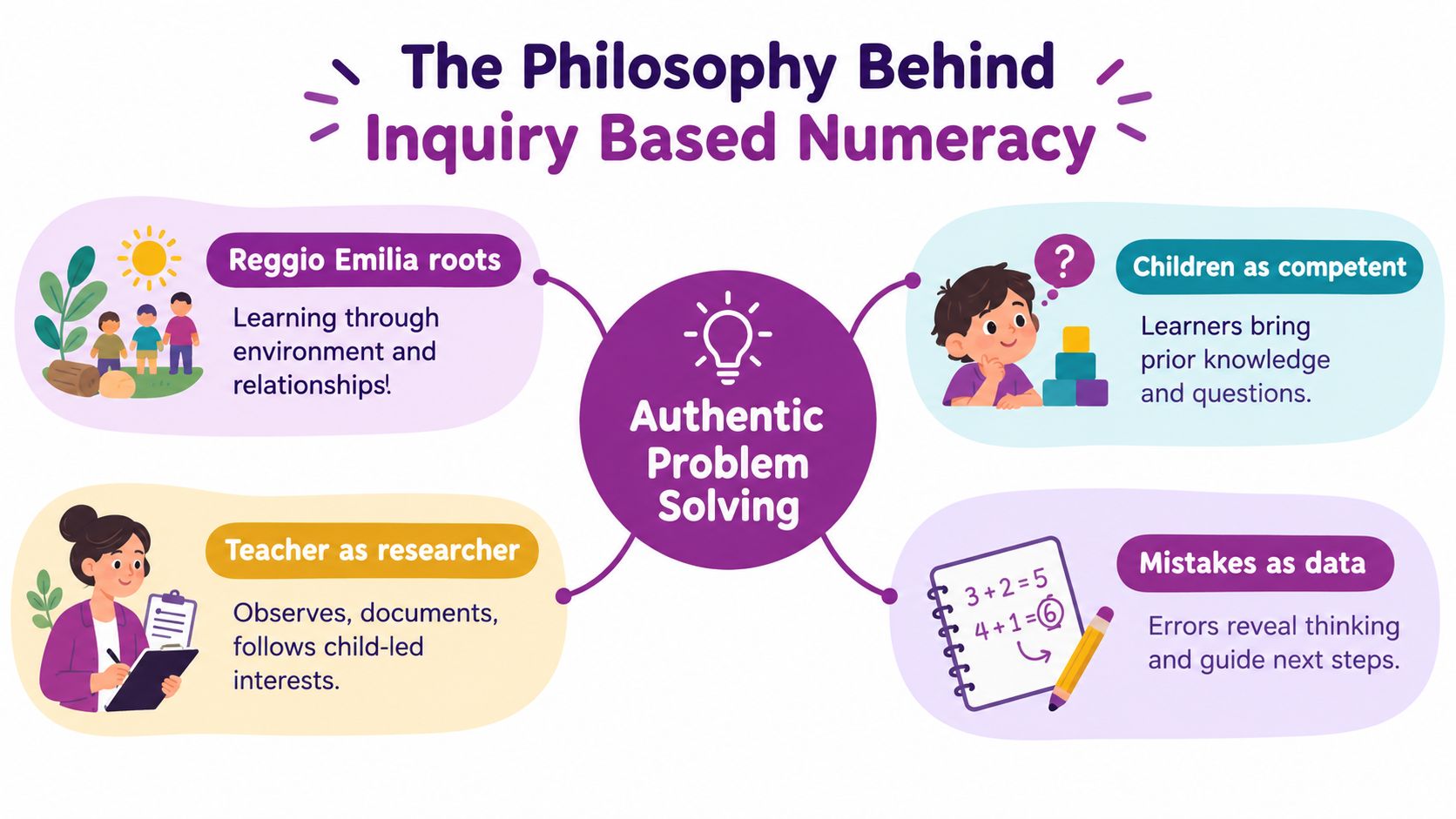
Real mathematical understanding in the early years rarely starts with a worksheet. It often starts with a child lining up shells, balancing blocks, filling cups, or arguing that one tower is “more fair” because both sides match. Inquiry based numeracy begins by treating those moments as serious thinking.
At the heart of this philosophy is a respectful image of the child. Children come with experiences, working theories, home language, cultural knowledge, and strong opinions about how the world works. A skilled educator pays attention to those ideas and then designs conditions where children can test them, talk about them, change them, and extend them. What looks spontaneous to a parent often includes careful professional decisions behind the scenes.
A Reggio Emilia-inspired environment supports this work through relationships, intentional materials, and close observation. Loose parts, natural objects, blocks, water, drawing tools, and everyday containers act as languages for mathematical thought. Before a child is ready to record with numerals or symbols, they may show an idea through movement, a building, a sketch, a spoken explanation, or a group of objects arranged with purpose.
From reproducing answers to making meaning
In a conventional maths task, the method is often already decided. In inquiry, the child has to work out what matters, choose tools, test a strategy, and explain the result. That process gives the educator something more useful than a right or wrong answer. It reveals how the child is reasoning.
Research from Queensland has shown that inquiry-based mathematics teaching can strengthen intellectual quality, including higher-order thinking, depth of knowledge, and substantive conversation, with particularly strong growth over time in higher-order thinking, as reflected in Australian evidence on inquiry-based mathematics teaching. For families of young children, the takeaway is simple. Rich mathematical habits begin well before formal written methods.
A child comparing two collections, insisting a bridge needs another support, or noticing that a pattern changes after one piece is moved is already doing real mathematical work.
Why conversation matters
Inquiry is social. Children hear another idea, notice a mismatch, defend a choice, or revise a plan after seeing a different strategy. An educator may document two ways of sharing objects, place the representations side by side, and ask, “How are these the same, and how are they different?” That kind of talk helps children move from private action to shared reasoning.
Precision still matters. If a child calls every round object a circle, the educator can affirm the observation and introduce more exact language. If a child counts the same object twice, the adult can reorganise the materials into a clearer one-to-one layout and invite the child to try again.
Handled well, inquiry makes mathematical knowledge meaningful, visible, and usable for young children.
The Educator Role in Guiding Child-Led Discovery
"Child-led" doesn't mean adults step away. It means educators begin with children's interests and strategies, then make deliberate decisions about how to extend learning. A VIT-registered teacher may spend much of the experience observing, but that quiet observation is active professional work.
The educator watches what the child notices, which materials attract attention, what strategy the child repeats, and where the child becomes uncertain. From there, the teacher chooses whether to wait, ask a question, add language, change the materials, model a representation, or provide a small-group experience.
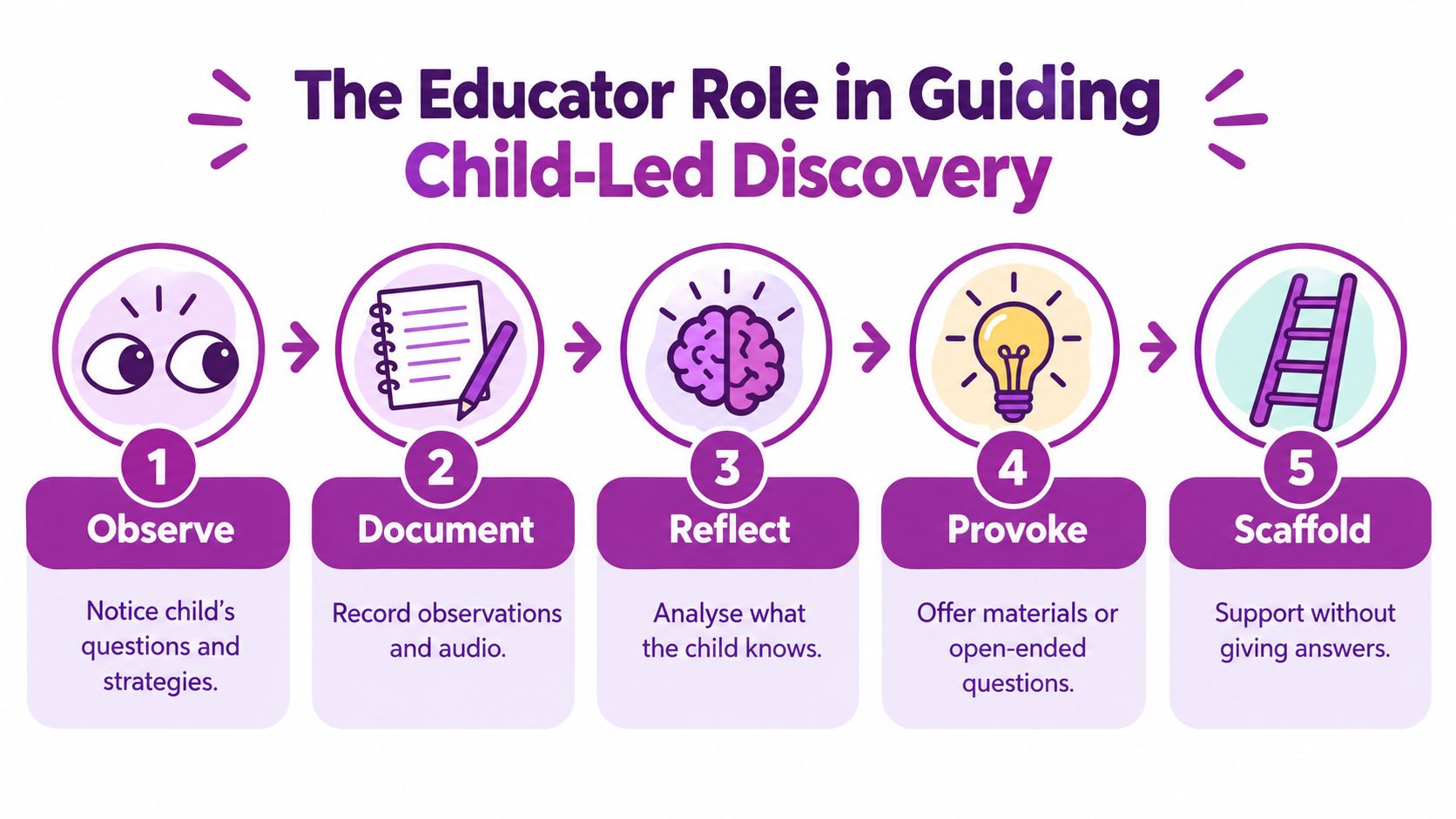
The four-part documentation cycle
A useful cycle is notice, interpret, respond, and revisit.
- Notice: A child repeatedly fills and empties containers during outdoor play.
- Interpret: The educator considers whether the child is exploring capacity, sequence, cause and effect, or just enjoying the sensory action.
- Respond: The teacher places containers of different sizes nearby and uses words such as "full", "empty", "more", "less", and "same".
- Revisit: Later, the educator returns to the experience and checks whether the child compares containers, predicts what will happen, or uses the new vocabulary.
Documentation may include a photograph, a learning story, a transcript of the child's words, or a note about the materials used. The important point is the reasoning behind the next decision. The educator isn't collecting decoration for a portfolio. They're building an evidence trail.
Practical rule: Ask a question that helps the child investigate, not one that tests whether the child can guess the adult's answer.
The language that opens mathematical thinking
Precise vocabulary gives children tools for noticing. “This is big” can become “This container holds more.” “It's over there” can become “The ball is behind the basket.” “It goes like this” can become “The colours repeat red, blue, red, blue.”
Useful prompts include:
- Compare: “Which group has more? How could we check?”
- Predict: “What do you think will happen if we add another block?”
- Represent: “Can you show your idea with the stones or draw it?”
- Justify: “What makes you think they're equal?”
- Generalise: “Would that work with different-sized cups?”
Children may need modelling, visual supports, repetition, or a smaller group to participate fully. This is particularly important for children learning English, children who are shy, neurodivergent children, and children who are less familiar with open-ended questions. Inclusive inquiry doesn't lower expectations. It gives each child a way into the mathematical conversation.
Australian early-years research describes effective mathematics learning as a combination of intentional relationships, environments, educator interaction, and meaningful assessment. For babies and toddlers, inquiry appears in spontaneous play, routines, transitions, planned experiences, and documentation, not only in formal group lessons (Australian early-childhood research on educator-facilitated mathematical learning).
Sample Provocations and Activities Across Age Groups
Children do not all meet mathematics in the same way. A baby may explore it with hands and movement. A three-year-old may need a real problem to solve with friends. An older preschooler may be ready to sort, record, and explain a result. Across every age, the educator keeps the mathematical intention in view while following the child's curiosity closely enough to know when to extend it.
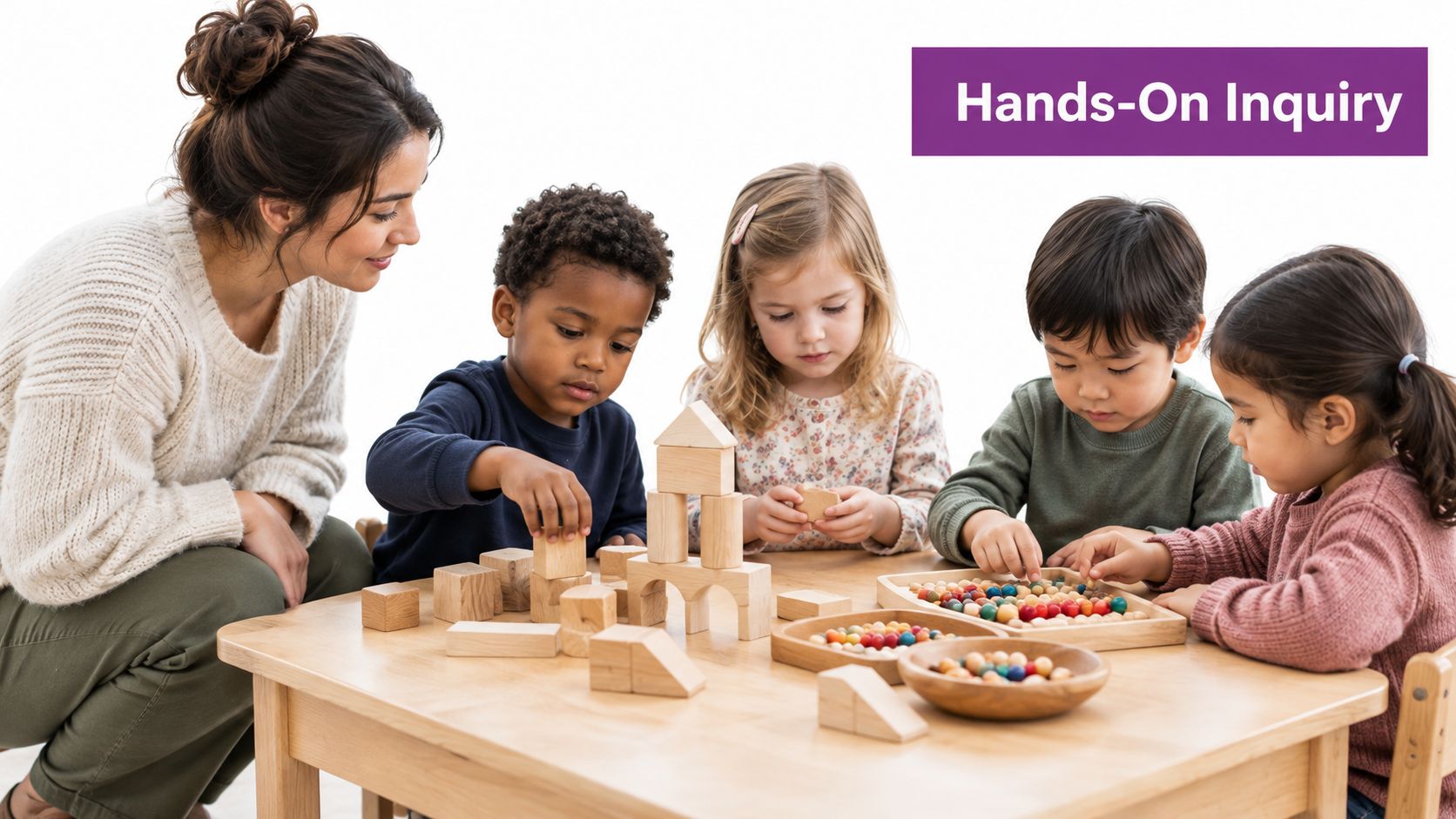
Babies and toddlers
A toddler pours sand from one container to another again and again. To an adult, that can look repetitive. To a trained educator, it is an opening. By placing a narrow cup, a wide bowl, and a scoop nearby, the teacher turns repetition into investigation. The child can test what fits, watch levels rise and fall, and begin to notice that one vessel may need several fills while another reaches the top quickly.
The teaching move here is subtle but purposeful. Instead of giving an answer, the educator gives language and time. “The cup is full. The bowl is empty. Which one holds more?” A verbal reply is not required. A pause, a look, a gesture, or a changed pouring strategy can all show that the child is comparing quantity and capacity.
That same kind of everyday mathematical noticing appears in Australian early-years work on babies and toddlers, which describes how educators use ordinary routines, materials, and interactions to support ideas such as quantity, position, size, pattern, comparison, and relationships (Australian research on mathematics for babies and toddlers).
Three-year-old kindergarten
At this age, mathematics often works best when it solves a social problem children actually care about. A group is getting ready for snack. Rather than handing out the right number of cups, the educator pauses. Now the children need to work out how many are needed, whether each person has one, and what to do when a friend arrives late. Counting matters because it does something useful.
The teacher can introduce words such as one for each, same number, more, and fewer while children act on the problem. If two children disagree, the educator does not rush to settle it. She might invite them to line cups up with people, make marks on paper, or check by moving one object to each child. That is how child-led maths becomes rigorous. Behind the scenes, the adult is choosing vocabulary, materials, pacing, and prompts that make the mathematical structure visible.
Blocks offer another strong provocation. Children build towers, compare heights, and alter one feature at a time. They might stand two towers side by side, use a strip of paper as a simple measuring tool, or predict which build will be taller before testing the idea. Families wanting more play-based examples can explore these numeracy activities for preschoolers.
After the investigation, a short shared reflection helps children return to their own thinking. Watching a brief video, looking at a photo, or revisiting the setup lets the educator ask, “What changed?” and “How do you know?” Reflection slows the moment down so children can notice the strategy, not just the outcome.
Four-year-old pre-PREP
Older preschoolers can begin exploring data through questions that matter to them. They might ask which fruit the group prefers, collect responses with objects or marks, compare sets, and decide how to show the results. The point is not to produce a polished graph. It is to help children see that data can answer a question, and that different ways of arranging information highlight different relationships.
This fits closely with the emphasis in the Australian Curriculum mathematics guidance, which supports mathematical understanding through reasoning, problem-solving, fluency, and meaningful representation.
In early childhood settings, the language stays simple while the thinking becomes more complex. “Which group is bigger?” can become “How do we know?” Then it can become, “Would we get the same result if we asked another group?” That progression is what intentional inquiry looks like in practice.
Connecting Mathematics to Music and Sports Enrichment
Children don't experience mathematics in separate boxes. Rhythm, movement, music, sport, construction, and outdoor play give them different ways to encounter the same underlying ideas. A child who finds quantity difficult with counters may understand repetition through a drum pattern or distance through a running game.
Music offers an especially rich setting for sequence and prediction. Children can copy a beat, alter it, continue a repeating pattern, and notice when a sound arrives too early or too late. Clapping, stepping, pausing, and changing tempo also create embodied experiences of order, duration, comparison, and memory.
The benefits of music for preschoolers include opportunities to listen, coordinate movement, communicate, and participate with others. From an inquiry perspective, the educator can ask, “What comes next?”, “Can you make the pattern longer?”, or “How could we show that rhythm with blocks?”
Sport turns space into a mathematical environment
Sports and physical education make geometry and measurement tangible. Children judge where a ball may travel, compare distances, adjust force, follow a pathway, and position their bodies in relation to others. A teacher might mark two landing points and ask which throw went farther, then invite children to find a fair way to compare them.
These experiences can develop:
- Spatial reasoning: Near, far, beside, behind, through, around, and between.
- Shape and direction: Curved paths, straight lines, turns, angles, and boundaries.
- Prediction: Where a rolling ball may stop or how a change in force affects movement.
- Data thinking: Recording which pathway worked best or comparing repeated attempts.
The specialist educator and classroom teacher can make the mathematics visible without interrupting the enjoyment. A simple conversation after movement, supported by photographs or marks on a map, helps children revisit what their bodies discovered.
The deeper connection is transfer. Children learn that mathematical ideas are not limited to one set of materials. They can use pattern in music, distance in sport, and comparison at snack time, then recognise relationships across contexts.
Authentic Assessment and True School Readiness
Parents often ask whether inquiry can prepare children for school if they aren't completing worksheets. The answer depends on what we mean by readiness. Reciting numbers and recognising numerals may provide useful information, but school also asks children to listen, explain, persist, adapt, communicate, and apply knowledge in unfamiliar situations.
An educator can see those capabilities during an investigation. A child may count inaccurately but notice that two groups should be equal. Another child may know a procedure but struggle to explain why it works. Observation captures these differences, while a single response can hide them.
What authentic evidence looks like
A learning record might include the child's initial strategy, the educator's prompt, the child's revised action, and the language used. For example, a child changes the angle of a ramp so a car travels farther, tests the idea again, and tells a friend what happened. That episode provides evidence of prediction, spatial reasoning, persistence, comparison, and communication.
Victorian guidance presents observation as authentic evidence of children's existing knowledge, learning approaches, dispositions, and capabilities (Victorian guidance on knowing children as learners). Educators can use the record to plan another experience, not to label the child permanently.
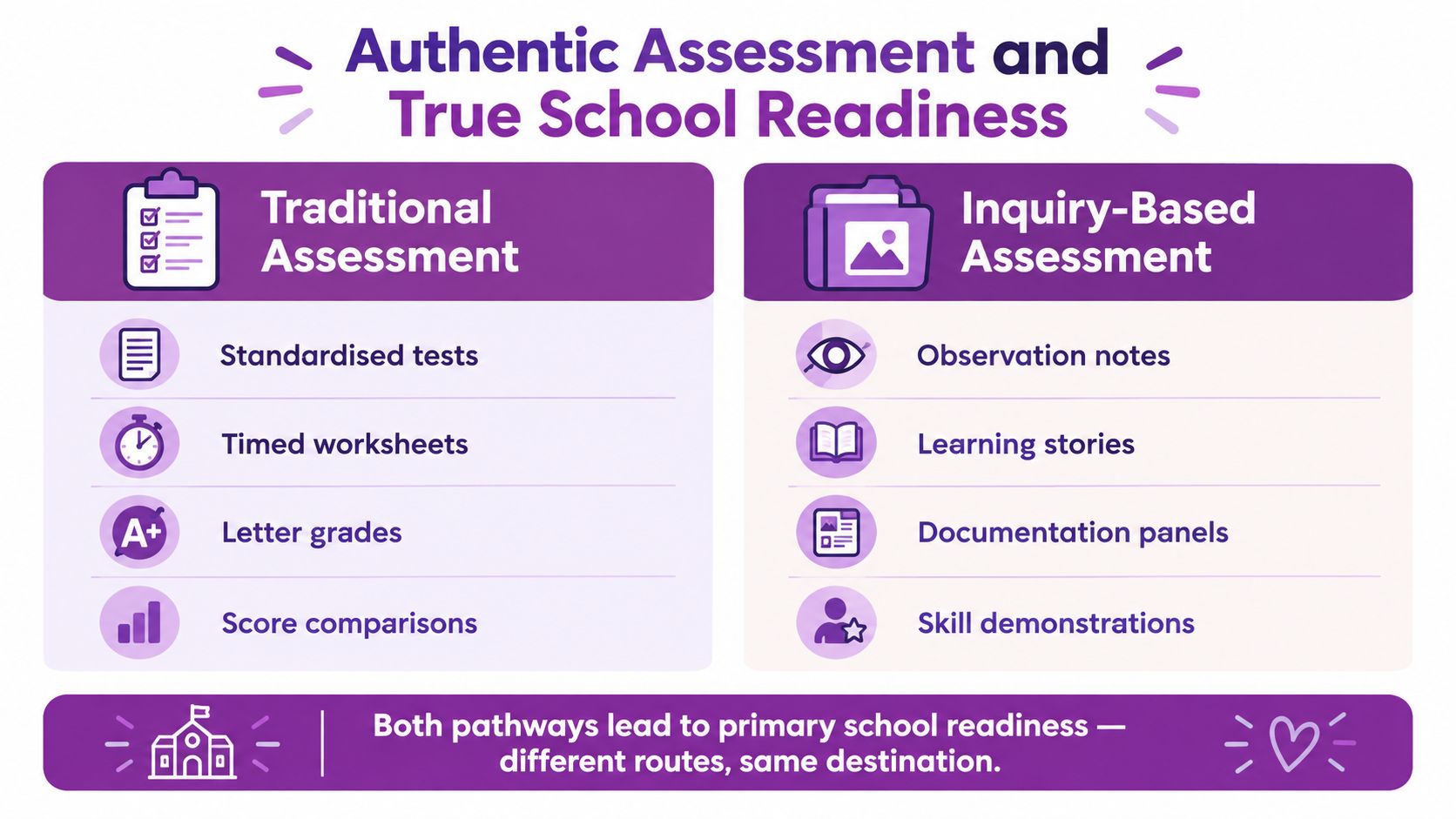
A more complete picture of readiness
The Australian Early Development Census assessed more than 288,000 children across 7,323 schools, including numeracy and cognitive indicators at school entry (Australian early-development information from the Australian Association of Mathematics Teachers). Community-level information cannot describe an individual child's full capability, which is why educators need detailed, contextual observations as well.
A useful documentation question is not only “Can the child count?” but also:
- Can the child match one object to one person or space?
- Can the child compare collections and explain how they checked?
- Can the child represent an idea through objects, drawings, movement, or words?
- Can the child try another strategy after the first one doesn't work?
- Can the child listen to another explanation and respond?
These are practical school-readiness behaviours. Inquiry makes them visible without reducing early childhood to timed testing.
Extending Mathematical Inquiry into the Home Environment
Families don't need special equipment to support mathematical thinking. The strongest home experiences often happen during routines because the mathematics has a genuine purpose. Cooking, shopping, setting the table, sorting washing, packing a bag, and organising toys all give children reasons to compare, order, count, measure, and predict.
Start by noticing rather than quizzing. If your child lines up cars, observe the arrangement and say, “I see you've put the red cars together.” Then add a gentle invitation: “How could we organise the trucks?” This keeps the child's idea at the centre while opening another mathematical possibility.
Turn routines into shared investigations
Try one small prompt at a time:
- Cooking: Ask which bowl is larger, whether the mixture needs more flour, or how to share pieces fairly.
- Shopping: Compare heavy and light items, group similar foods, and look for shapes on packaging.
- Tidying: Sort objects by use, colour, size, or material, then ask whether there's another way to organise them.
- Getting dressed: Order clothing steps, compare sleeve lengths, and notice matching pairs.
- Outdoor play: Collect leaves or stones, create a repeating pattern, and discuss which collection has more.
Use everyday words first, then introduce precise English vocabulary naturally. A family might discuss “more” and “less” in a home language while also offering the English terms. Children don't need to abandon their cultural routines or first language to learn school mathematics. Cooking methods, songs, family games, celebrations, shopping practices, and movement traditions can all provide meaningful mathematical starting points.
Support thinking without taking over
When your child gives an unexpected answer, ask how they worked it out. Their explanation may reveal a sensible strategy that differs from yours. If they become stuck, change the materials, demonstrate one small action, or offer two choices rather than supplying the complete solution.
Keep a short record when an idea interests your child. A photograph of a pattern, a note about a sorting rule, or the child's own words can help you return to it later. You might say, “Yesterday you sorted these by colour. Could we sort them by size today?”
Children need both agency and guidance. Warm, intentional conversations at home reinforce the same message as an inquiry-rich early-learning environment: mathematics belongs in their world, their questions matter, and mistakes provide useful information for the next attempt.
Kids Club Early Learning Centre offers Reggio Emilia-inspired learning, VIT-registered educators, numeracy experiences, and weekly music and sports programs for children from six weeks to six years. Visit Kids Club Early Learning Centre to explore how its infant, kindergarten, and pre-PREP environments can support confident mathematical thinking and school readiness.