
Your baby lies on their tummy for a moment, lifts their head, then protests as though you've asked for a full workout. You reach for a colourful toy, hoping it will make the experience easier. That instinct makes sense, but the most useful tummy time toy isn't the one that merely keeps a baby quiet. It's the one that encourages a safe, supervised movement, such as looking, turning, reaching or shifting weight.
Tummy time works best as a gentle part of everyday care. A few moments after a nappy change, play on your chest, or a toy placed just within view can all create opportunities for movement without turning the experience into a test. The right approach combines developmentally suitable toys, careful positioning and close attention to your baby's signals.
Understanding Tummy Time and Its Importance
Tummy time places your awake baby on their tummy for supervised play on a firm, clear surface. It is an early movement practice, similar to a gentle workout without weights. Your infant builds effort by lifting the head, pressing through the forearms, turning towards a sound and gradually learning how to shift the body across the floor.
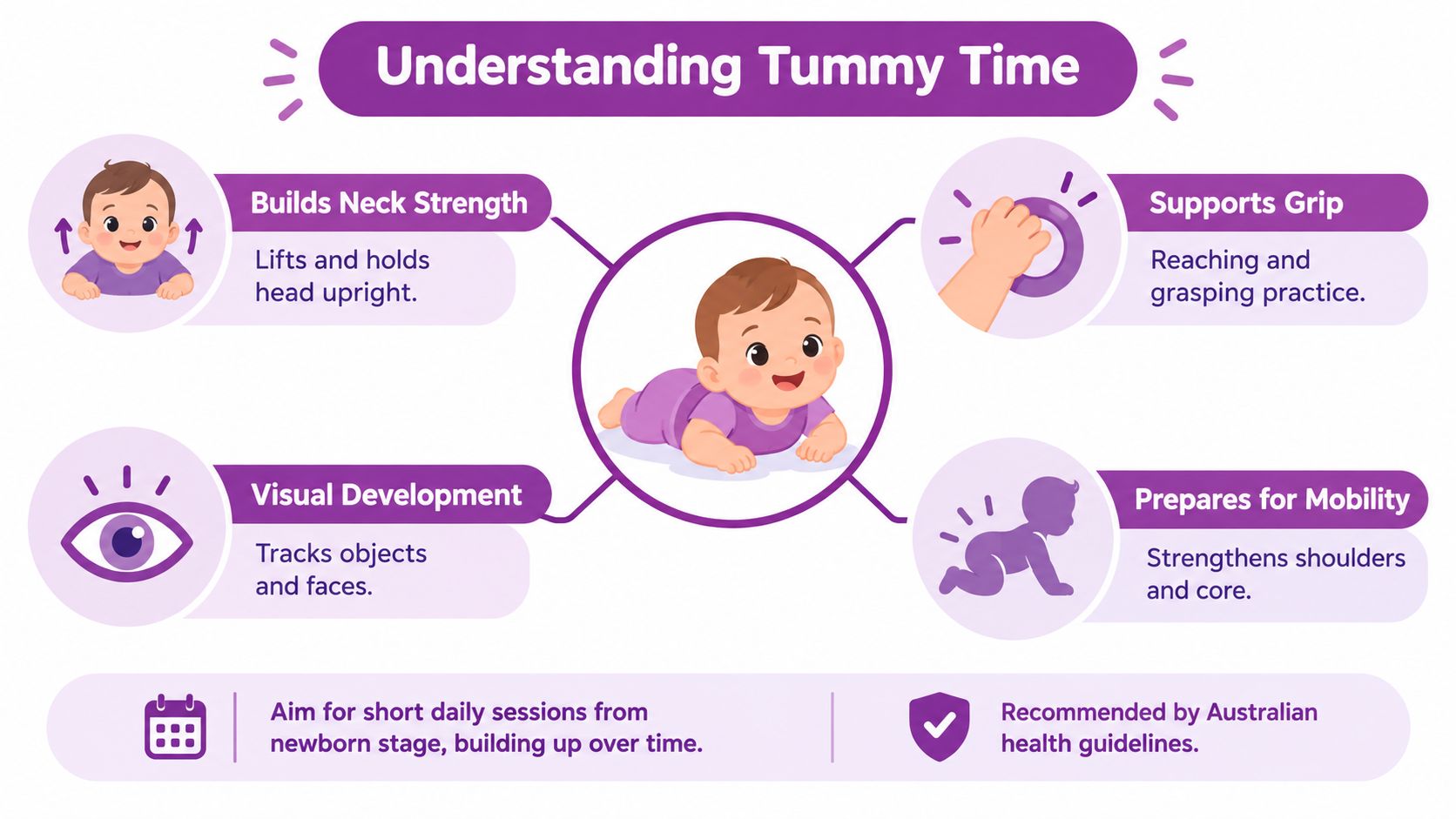
Australia's national movement guidance describes tummy time as a foundational daily activity for infants who aren't yet mobile. The Australian Government recommends at least 30 minutes spread across the day while the baby is awake, alongside supervised, interactive floor-based play (Australian Government 24-hour movement guidelines). This total can come from brief opportunities around feeding, sleep and nappy changes rather than one extended session.
What your baby is practising
A toy placed in front of your baby can encourage more than visual attention. Your baby may lift the head, steady the shoulders, press into the hands or forearms, and adjust the trunk to keep the object in view. Each response gives the body practice for later gross-motor skills such as rolling, sitting and crawling.
Tummy time also changes what babies see and feel compared with lying on their backs. A high-contrast card, soft mirror or familiar face may encourage focusing, tracking and head turning. A toy works best as a prompt for active engagement. It should invite a manageable movement, not replace movement or entertain your baby continuously.
Safe play is different from sleep
Under the same Australian movement guidance, infants should not be restrained for more than 1 hour at a time, except when travelling, in devices such as strollers, car seats or high chairs. Floor play leaves room for free movement, but an adult still needs to stay close and attentive.
Tummy time is for an awake, supervised baby. If your infant becomes drowsy, remove the toys and place them on their back in a safe sleep environment. Never leave a toy with a sleeping baby.
Developmental Benefits of Tummy Time for Infants
Tummy time supports the muscles that help a baby control the upper body. The head, neck, shoulders and trunk all have to work together when an infant lifts the face from the floor, looks towards a caregiver or reaches for an object. These actions are early examples of postural control, even when they last only briefly.
A systematic review summarised by the University of Wollongong examined 16 studies involving 4,237 infants from eight countries. It reported improvements in overall and gross-motor development, including prone or supine movement, rolling and crawling (University of Wollongong summary of the systematic review). The review didn't show a clear association with fine-motor development or communication, so tummy time shouldn't be presented as a solution for every area of development.
The movement sequence matters
A toy can help create a simple chain of actions:
- A bright object or familiar face attracts attention.
- The baby lifts or turns the head to keep looking.
- The infant presses through the forearms or hands.
- Reaching shifts some body weight.
- Repeated weight shifts support the control needed for future rolling and crawling.
The value lies in the repeated postural response, not in whether the baby successfully touches the toy. Keep the object close enough to invite effort, but not so far away that your baby becomes frustrated.
Visual tracking also has a practical role. Slowly moving a toy from the centre towards one side encourages the infant to follow it with the eyes and turn the head. Later, a reach towards that object can bring the shoulders and trunk into the movement.
Tummy time isn't the same as fine-motor practice
Grasping matters, but it's only one part of the experience. Parents sometimes expect a tummy time toy to teach precise hand skills immediately, when the larger priority is helping the baby organise the head, shoulders and trunk.
If you're also looking for ideas that support hand and finger control, explore these fine-motor activities for young children. For tummy time, choose a toy that encourages a whole-body response, such as turning towards a sound or shifting weight to reach.
Watch the quality of the movement rather than counting successful grabs. Notice whether your baby can look towards both sides, lift the head with growing control and pause when tired. Those observations are more useful than making the toy itself the target.
Choosing the Right Tummy Time Toys for Your Infant
The best tummy time toys for infants are simple, stable and easy to see or touch. A toy should give your baby a reason to look, reach or turn without creating excessive noise or movement. Start with your child's current ability rather than buying a large collection.
Match the toy to the movement
| Toy type | What it can encourage | How to use it |
|---|---|---|
| High-contrast object | Visual attention and tracking | Place it in front of your baby and move it slowly |
| Soft mirror | Head lifting and visual engagement | Position it securely at the front of the play space |
| Lightweight rattle | Reaching and grasping | Offer it within view and use a gentle sound |
| Textured cloth toy | Touch exploration and reaching | Keep it close enough for an easy first attempt |
High-contrast objects often suit a young baby who's still learning to focus. A soft mirror can provide an engaging visual surface, while a rattle adds a quiet auditory cue. Textured cloth toys offer variety without requiring a precise grip.
Raising Children Network recommends starting soon after birth with sessions of approximately 1–2 minutes, then gradually building towards 10–15 minutes several times each day as the baby adjusts (Raising Children Network tummy time guidance). A toy should support that gradual progression, not pressure you to extend a session before your baby is ready.
Check the construction before play
Choose items that are age-appropriate, securely made and free from detachable parts. Avoid toys with loose decorations, accessible batteries, long cords or pieces small enough to become choking hazards. A toy that remains stable when touched is often more useful than one that rolls away immediately.
Practical rule: Choose one clear invitation to move, then observe your baby's response before adding more stimulation.
Quiet toys are usually preferable to loud electronic products during floor play. Your baby should still be able to hear your voice, respond to your expression and notice their own movements. Rotate a small selection instead of placing every available toy in front of them.
A caregiver's face is also a valuable play resource. Before introducing a product, lie near your baby, smile and speak gently. If your infant responds to you more readily than to a toy, that's a useful sign that social interaction is currently the strongest motivation.
Practical Tips for Using Tummy Time Toys Effectively
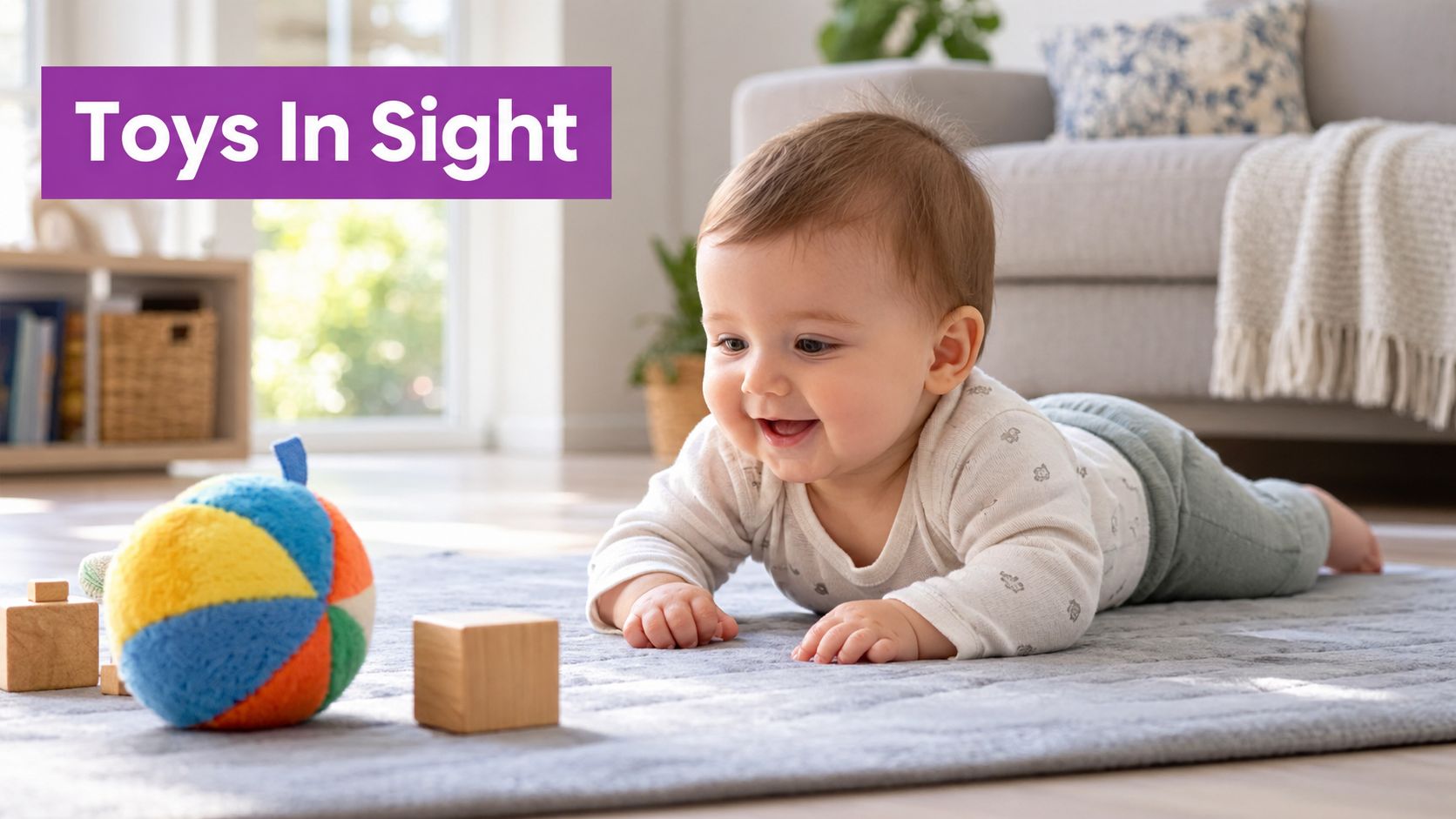
A clear, firm play surface gives your baby room to move while you stay close enough to respond. Place one toy within view rather than surrounding your infant with several objects. A single target gives them time to notice, focus and organise a response.
Adjust the placement gradually
Begin with the toy directly in front of your baby, close enough to encourage a controlled head lift. Once they can hold their attention, move it slowly to one side. Following the toy invites visual tracking, head rotation and a gentle shift of weight through the arms.
Use this simple progression at home:
- Begin centrally: Let your baby find the toy without turning.
- Move laterally: Encourage the eyes and head to follow it.
- Offer a reachable target: Place it near enough for a comfortable arm extension.
- Change sides: Give your baby chances to look and reach in both directions.
- Pause when tired: Finish before effort becomes distress.
Aim these short sessions towards the daily total recommended earlier. Let placement changes, rather than longer periods on the floor, create the next challenge. Moving the toy a little farther or changing sides can increase the work without making the activity overwhelming.
Keep the environment calm
Use a small selection of toys and rotate their positions. A high-contrast card can be followed by a mirror, then a soft textured toy. Make each session calmer rather than more exciting. Moving one familiar object to a new spot is often enough to invite a new movement.
For gentle sensory ideas, explore these DIY sensory bottle activities. Any item used around an infant must be securely constructed and used under direct supervision. Sensory materials should support active interaction with a caregiver, not replace it.
Watch what your baby does after each change. If they lift their head, shift their weight or reach, give them time to repeat the movement before introducing another toy. The toy acts like a small signpost, showing where to look or reach while your baby does the physical work.
The following video demonstrates tummy time play ideas and positioning. Use it as a general prompt, adapting each activity to your child's age, abilities and comfort.
Addressing Challenges When Babies Dislike Tummy Time
A baby may enjoy tummy time on your chest yet cry as soon as you place them on the floor. That response can reflect the position, timing or level of support, rather than a need for a more exciting toy. Ask what is making this position difficult today, before deciding whether a different toy would help.
Start with the short sessions described earlier and extend only as your baby's tolerance grows. Australian guidance for children's physical activity supports building activity gradually. A brief, calm attempt followed by a break can be more productive than continuing while your baby is distressed.
Change the position before changing the toy
Try chest-to-chest tummy time while you are awake and supervising closely. Your face and voice may feel safer than a toy. If floor play remains difficult, place a rolled towel under your baby's chest to reduce pressure and make lifting the head easier, following appropriate developmental guidance.
Timing affects comfort. Avoid tummy time immediately after a full feed or when your baby is already tired. Try after a nappy change, following a rest, or during a calm period when your infant is alert.
A side-supported position can offer another gentle variation when your baby is awake, supervised and positioned securely. Place a familiar face or simple toy nearby. One clear target gives your baby a reason to look or reach without adding too much sound, colour and movement at once.
If your baby becomes tired or distressed, stop, comfort them and try again later. Progress grows through repeated positive opportunities, not forced endurance.
Keep sleep safety separate
Tummy time is active play. Sleep always begins with your baby on their back, and toys should be removed if your infant falls asleep or becomes drowsy. Never use a tummy time toy in a cot to settle or occupy a sleeping baby.
If your baby continues to struggle despite shorter sessions, different timing and supported alternatives, discuss the pattern with a maternal and child health nurse or clinician. Persistent difficulty deserves attention and practical support, not blame.
When to Seek Professional Advice or Support
Contact a maternal and child health nurse, general practitioner or paediatrician if your baby persistently cannot tolerate tummy time, you're concerned about head control, or movements seem markedly uneven. You don't need to wait until a concern becomes severe before asking for guidance.
Bring specific observations to the appointment. Note when your baby is most comfortable, whether they look towards both sides, how long they remain settled and whether feeding, tiredness or discomfort appears to affect play. These details can help a clinician understand what support may be appropriate.
Professional advice can also help you adapt floor play for your child's individual needs. Tummy time may happen on your chest, across your lap or with support, as long as the baby is awake and supervised. Families exploring care options can learn more about day care for infants and ask prospective educators how they include safe floor play in the daily routine.
Your baby doesn't need to perform for a toy. Offer small opportunities, follow their cues and celebrate gradual improvements in comfort, head control and movement.
Kids Club Early Learning Centre provides supervised infant floor play with soft mats, high-contrast cards, cloth books, mirrors, textured materials and small age-appropriate toys to encourage looking, reaching and movement exploration. Visit Kids Club Early Learning Centre to learn how its infant program supports safe, responsive play for babies and toddlers.