
Your toddler is standing at the kitchen sink, sleeves soaked, pouring water from one cup to another for the twentieth time. You're wondering whether to stop the mess, wipe the floor, or let it continue because she's so focused. That moment is a useful place to start, because sensory play often looks simple from the outside. What's happening underneath is learning, provided the experience is safe, child-led, and matched to your child's needs.
What Is Sensory Play and Why It Matters
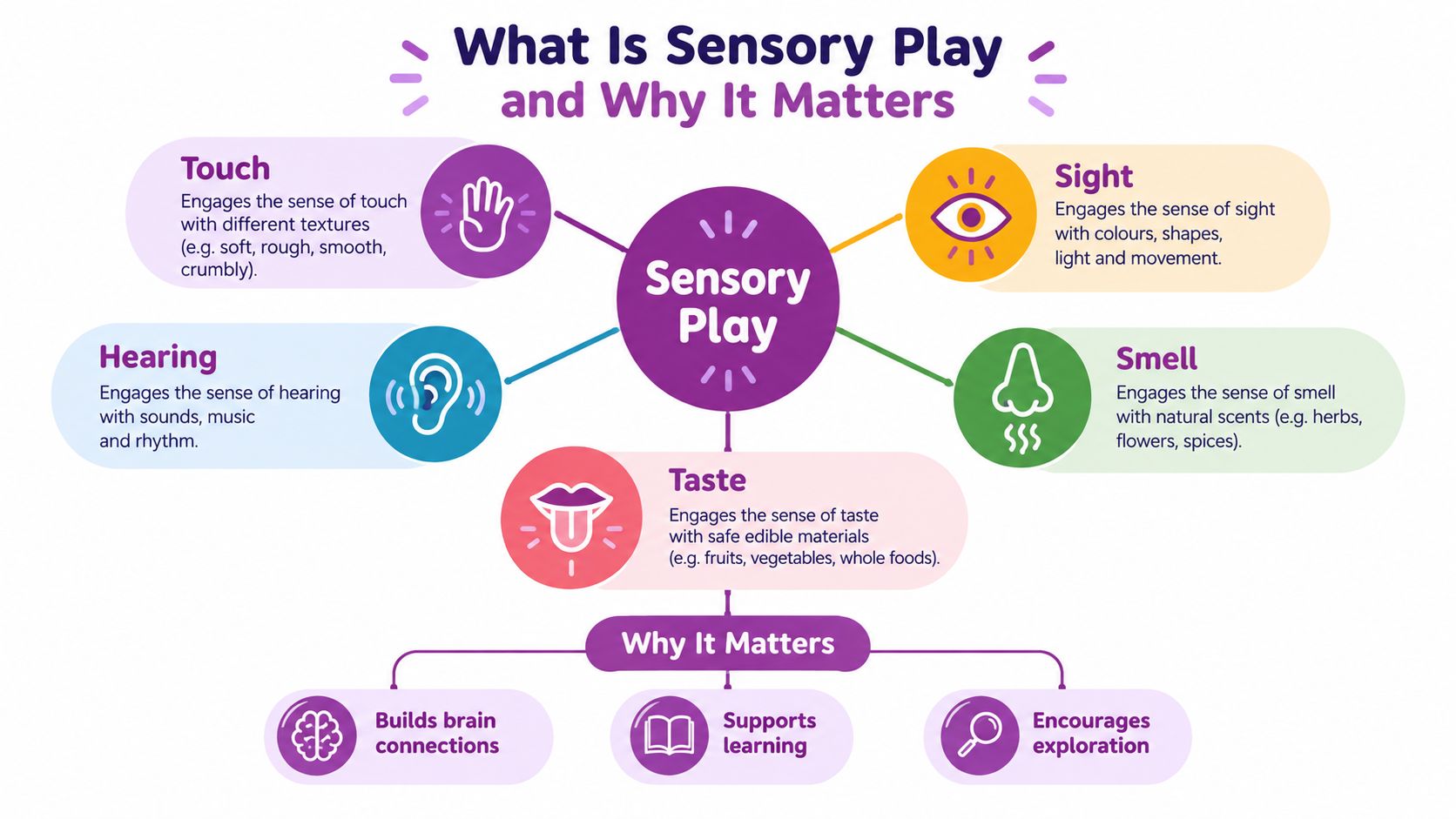
A toddler at a water table isn't just splashing. She's feeling temperature and movement, watching water swirl, hearing it pour, and testing what happens when a small cup tips into a bigger bowl. Sensory play means activities that invite children to explore through touch, sight, sound, smell, taste, movement and balance. It's how young children gather information before they can learn much from instructions or books.
Think of how you learn to make a new recipe. Reading the method helps, but you understand more once you've kneaded the dough, heard the pan sizzle, and noticed the smell change. Children learn in the same hands-on way, only more so, because their senses are their main tools for making sense of the world.
More Than Messy Fun
In Victoria, this isn't treated as optional amusement. Victoria's Early Years Learning and Development Framework identifies play as essential because it integrates children's intellectual, physical, social and creative abilities. The Victorian Government defines sensory play as exploration involving textures, smells, sounds, tastes and visual qualities, including mixing materials, investigating objects and pulling things apart.
That definition matters for families choosing care in Melbourne. When an educator offers sand, water, dough or leaves with a clear purpose, she isn't filling time. She's creating a chance for your child to compare, persist, imagine and communicate. The framework applies from birth to eight years, so the same principle grows with your child from infancy into kindergarten.
The senses connect rather than work in isolation, and this visual map shows how each one can be engaged during play.
What Counts as Sensory Play
You don't need expensive kits. Common examples include:
- Water and sand: Pouring, scooping, sieving, moulding and comparing wet and dry textures.
- Dough and clay: Squeezing, pinching, rolling and pressing objects into a surface.
- Natural materials: Sorting leaves, stones, seed pods, bark and shells.
- Sound and movement: Shakers, tapping, gentle music, swinging, rolling and balancing.
A good sensory experience has no single right answer. Your child can investigate, change the material, and discover something new on the next attempt.
That open-ended quality is central to the sensory play benefits families hear about. The learning comes from active exploration, not from an adult telling a child what a material should feel like.
The Evidence-Based Benefits Across Four Areas of Development
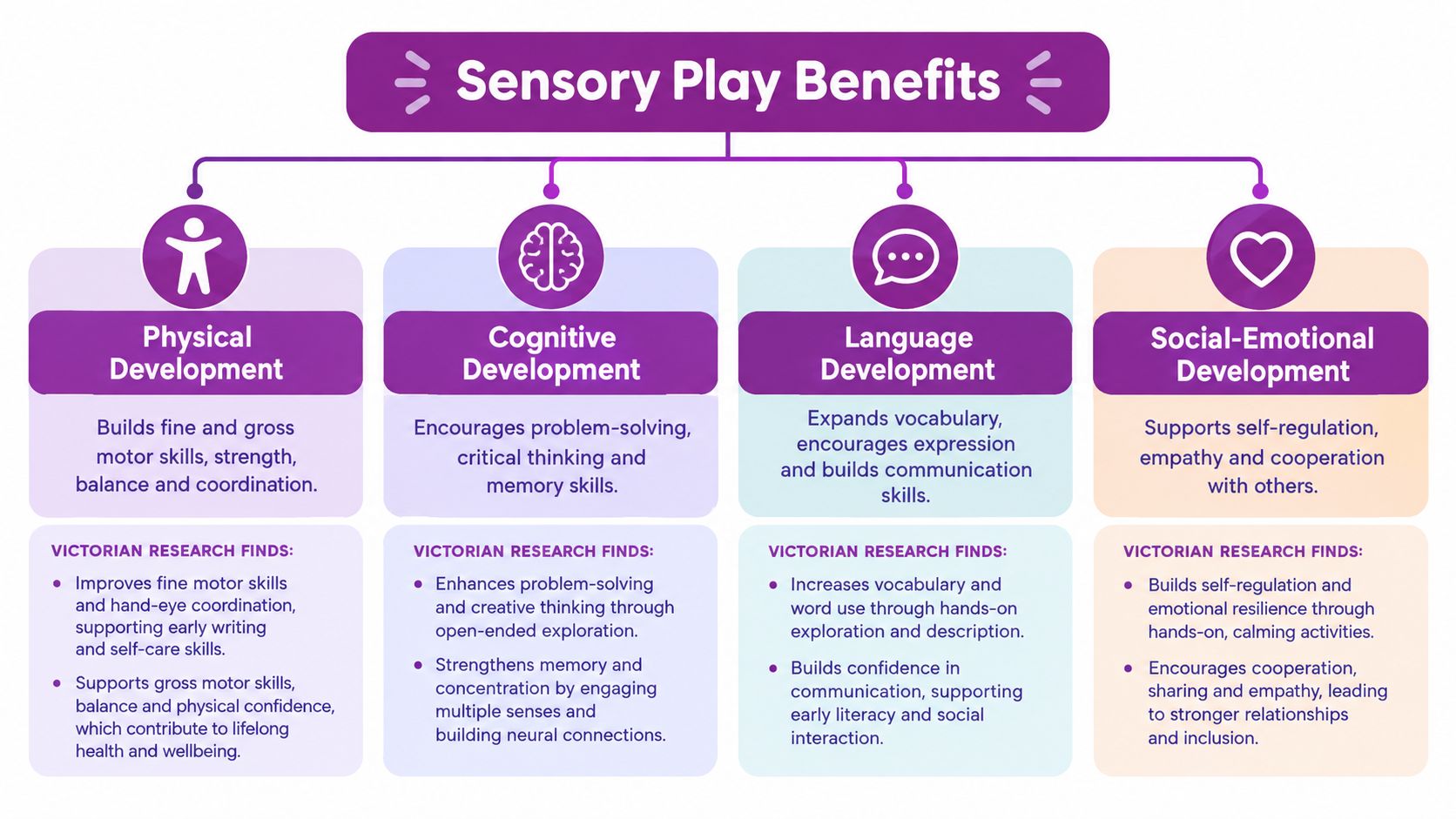
Parents often ask for a tidy list of outcomes. Development doesn't separate that neatly, but looking at four connected areas helps you see what to observe during play. This chart groups the main benefits before we unpack them one by one.
Physical and Cognitive Growth
Physical development shows up in small, repeated actions. Pouring without spilling, scooping sand into a narrow container, kneading firm dough and using tongs all practise hand strength, coordination and control. Larger actions, such as carrying buckets, digging or sweeping water, build body awareness and whole-body coordination. If you want to extend those hand skills at home, these ideas for improving fine motor skills pair well with sensory activities.
Cognitive development begins with cause and effect. A child notices dry sand slips through fingers, wet sand holds a shape, and a full cup feels heavier than an empty one. Those comparisons introduce early ideas about weight, volume, gravity and form, which later support mathematics and science. She's also forming a working idea, testing it, and adjusting, much like an adult testing whether a lid will fit a container.
Language and Social-Emotional Learning
Language development grows because sensory experiences give children something concrete to talk about. Words such as rough, smooth, sticky, dripping, heavy and empty make more sense when a child can feel or see what they describe. Adults help by narrating briefly and waiting, not by turning play into a quiz.
For social-emotional development, local evidence is encouraging but should be read carefully. In the Victorian study of sensory early-childhood environments, researchers conducted 10 semi-structured interviews with educators across two Victorian early childhood education and care sites in August 2022, and educators reported that water tables, sand pouring and bubble popping could help settle and calm children. Overstimulating or understimulating environments were associated with behaviour challenges.
That doesn't prove every child will calm at a water table. The study was qualitative and small, and wider evidence for physical and sensory-environment interventions has been described as mixed but promising. The practical message is stronger than a guarantee: educators need to observe each child and match the experience, timing and intensity to what helps that child participate.
Watching children use materials in different ways can make those four areas easier to recognise in real time.
The strongest sensory play benefits appear when an adult treats play as information. What your child repeats, avoids or seeks tells you what to offer next.
Sensory Play Activities for Infants, Toddlers and Preschoolers
The right activity depends less on a theme and more on what your child can safely do right now. Start simple, stay close, and let repetition do its work. A baby mouthing a clean fabric square and a preschooler comparing containers are both investigating, just at different levels of complexity.
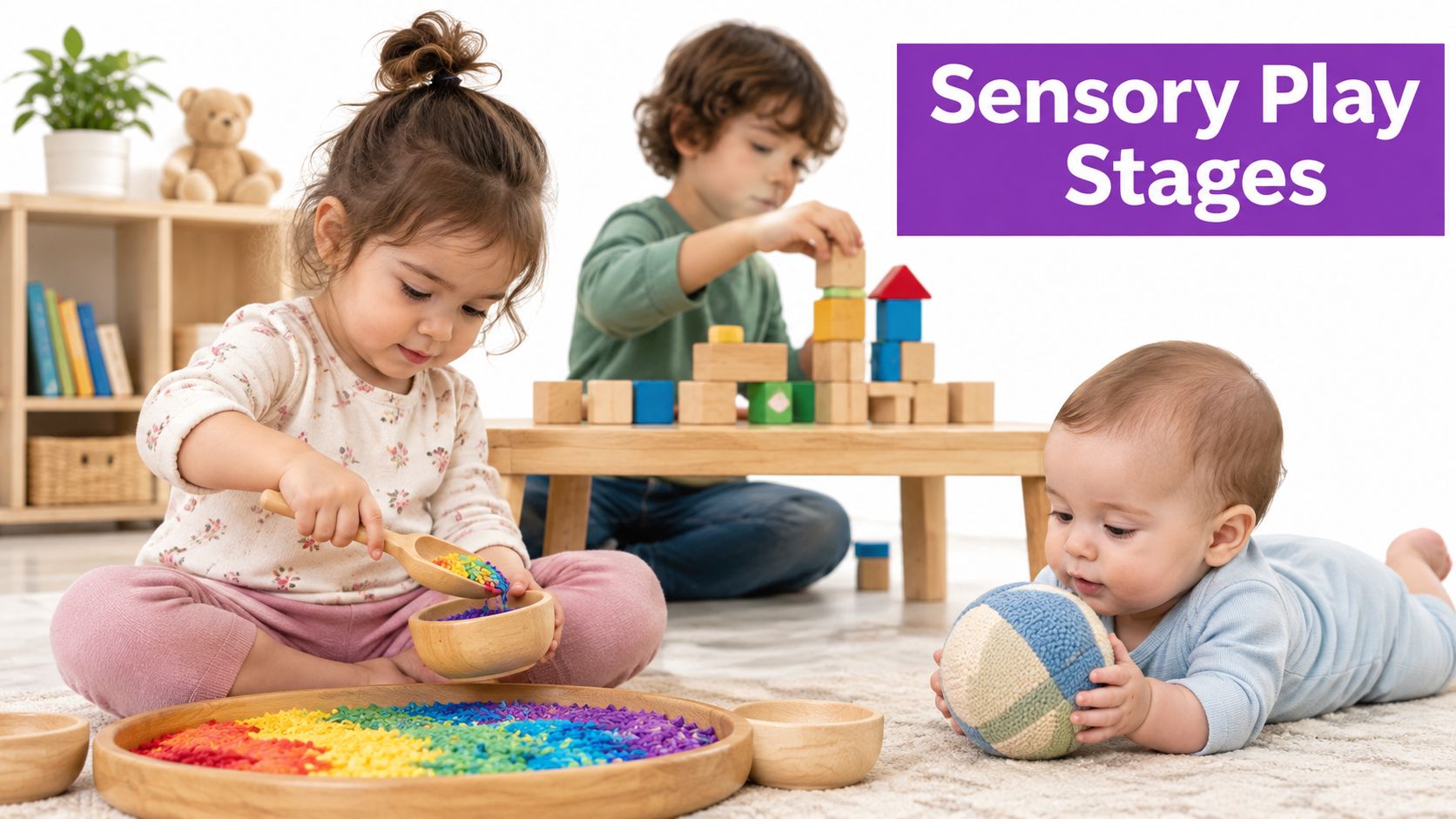
Children often learn most when they can return to familiar materials with a trusted adult nearby, as this image of shared indoor play suggests.
Infants From Six Weeks to Twelve Months
For infants, keep experiences gentle, clean and closely supervised. Offer fabric swatches with different weaves, safe mouthing toys, soft balls, and simple shakers that don't produce a harsh sound. During tummy time, place a high-contrast cloth or textured mat within reach so your baby can bat, grasp and kick against it.
Supervised water play can be as small as a shallow tray for splashing with hands, with an adult within arm's reach at all times. Watch for turning away, arching, grizzling or becoming suddenly still. Those cues mean your baby needs a pause, not more stimulation to get used to it.
Toddlers From One to Three Years
Toddlers usually want to move materials from place to place. Use that urge rather than fighting it:
- Pour and transfer: Water, cups, jugs, funnels and sponges build coordination and early volume awareness.
- Dig and scoop: Sand with spoons, scoops and containers supports persistence and hand control.
- Knead and press: Dough with rollers or safe cutters strengthens hands and invites early pretend play.
- Sort nature finds: Large leaves, smooth stones and seed pods can be grouped by size, colour or texture.
Expect tipping, tasting attempts and short bursts of attention. That's normal toddler research, which is why edible or non-toxic choices and constant supervision matter.
Preschoolers From Three to Six Years
Preschoolers can handle a question with their materials. Ask which container holds more, what happens when colours mix, or how to make wet sand strong enough for a tunnel. They can build themed sensory bins, compare floating and sinking objects, create patterns with natural materials, and record what changed through drawing or dictation.
Your role shifts from protecting the activity to stretching the thinking. Offer tools, ask one open question, then step back so children can negotiate, collaborate and solve problems together.
How to Set Up Sensory Play at Home or in Your Centre
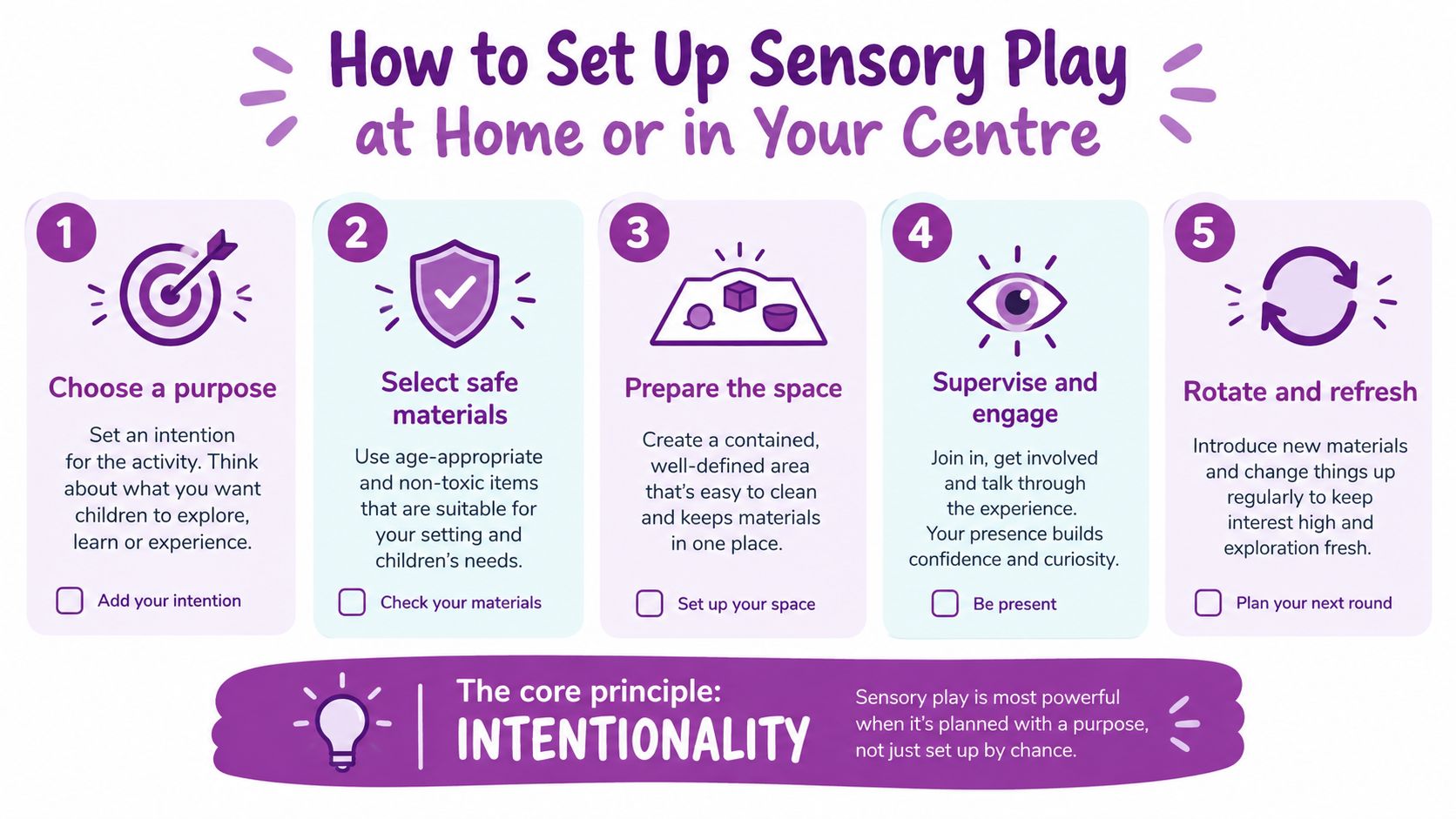
A thoughtful setup beats a bigger collection of materials. Children can become distracted when every texture, colour and sound arrives at once, and adults learn less about what helped. Intentional sensory play means you choose a purpose, prepare for safety, observe closely, and adjust based on your child's response.
This five-step guide keeps the process manageable whether you're at the kitchen table or planning for a room of children.
A Simple Setup That Works
- Choose one purpose: Decide whether you're supporting calming, pouring control, descriptive words, sorting or turn-taking.
- Vary one feature: Change only texture, resistance, temperature, sound or visual contrast so the discovery stays clear.
- Contain the space: Use a tray, tub, towel or outdoor area that's easy to clean and clearly bounded.
- Observe before intervening: Notice what your child repeats, avoids, says and tries next.
- Record and refresh: Note the skill practised and the response, then alter one material next time.
Everyday items are enough. Containers, water, sand, dough, fabric, leaves, measuring cups and safe kitchen tools can create rich learning when you rotate them with purpose. The space itself also teaches, which is why thinking of the environment as the third teacher helps adults notice light, noise, access and calm corners, not just toys.
That need for thoughtful design is backed locally. The RMIT scoping review of sensory play research examined 42 peer-reviewed studies published from 2013 to 2023 and reported growing recognition of sensory play's contribution to inclusive education and child-led learning, while also identifying inconsistent definitions and limited pedagogical frameworks. In plain language, materials alone don't create learning. Educator judgement does much of the work.
Practical rule: If you can't say what your child might explore or practise, simplify the setup before adding more.
In a centre, predictable sensory choices can also support arrival, transitions and moments of frustration. A child who settles while transferring water may benefit from that option before group time, provided educators have observed that pattern rather than assuming it works for everyone.
Safety Considerations and Knowing When Sensory Play Is Too Much
More input isn't always better. That's the part many colourful activity posts leave out, and it's where parents can feel confused or guilty. One child may sink both hands into slime and relax, while another steps back, covers her ears at the noise around the table, or becomes distressed by sticky residue. Both responses give you useful information.
Signs Your Child Needs Less
Watch the whole pattern, not one moment. Possible opt-out signals include:
- Covering ears or eyes: Sound, light or visual clutter may be too intense.
- Withdrawing or hiding hands: The texture, temperature or mess may feel unpleasant.
- Escalating behaviour: Throwing, shouting or running away can signal overload rather than defiance.
- Seeking constantly: Repeated crashing, squeezing or mouthing may mean the current input isn't matching the need.
Respond by reducing intensity, shortening the session, offering a tool instead of direct hand contact, or moving to a quieter space. Don't force a child to touch a material to build tolerance. Child-led exploration means she can watch, use a spoon, return later, or decline.
Australian evidence supports that cautious, individual approach. A 2025 Australian Occupational Therapy Journal study reported a relationship between stronger social-emotional and tactile sensory-processing responses and lower willingness to join structured or socially demanding play among neurotypical school-aged children, with findings described as preliminary rather than proof of causation. It's a reminder that children process the same experience differently, even without a diagnosis.
Everyday Safety Checks
Choose non-toxic, age-appropriate materials, check for allergies, and remove small items that could be choking hazards for children who still mouth objects. Supervise water play continuously, wash hands and materials, and inspect natural items for sharp edges or mould. Store sensory fillers dry and replace anything that smells off or can't be cleaned properly.
Sensory play isn't treatment. If sensory responses consistently restrict your child's participation, eating, sleep, learning or family life, seek assessment and advice from an appropriate health professional. Home activities can support comfort and exploration, but they don't replace individual guidance.
How Sensory Play Connects to Reggio Emilia and School Readiness
Reggio Emilia and sensory play fit naturally because both start from respect for the child as a capable investigator. Instead of asking children to copy an adult's finished product, educators provide beautiful, open-ended materials and pay attention to the theories children test. A preschooler building channels in sand isn't off task. She's asking how water moves, how walls hold, and how to revise a design with a friend.
That inquiry-based stance aligns with the Victorian emphasis on curiosity, persistence and imagination through play. If you're comparing philosophies, learning how a Reggio Emilia early learning centre structures environments and educator observation can help you ask better questions on a tour. Look for documentation that shows children's ideas developing over time, not only identical craft on a wall.
From Sensory Exploration to Classroom Skills
School readiness isn't built by worksheets alone. Children need to sustain attention, manage frustration, communicate needs, listen to peers and keep trying when a plan fails. Sensory play practises those foundations in a form young children understand:
- Literacy foundations: Describing, storytelling, mark-making in sand or dough, and building hand strength for writing tools.
- Numeracy foundations: Comparing, sorting, filling, emptying, patterning and estimating.
- Social foundations: Sharing tools, negotiating space, taking turns and reading another child's cues.
- Emotional foundations: Choosing a calming activity, recovering from disappointment and rejoining play.
The connection is practical. A child who has learned to notice what helps her settle, persist with a tricky pour, and explain why a tower fell is practising habits she'll use at a classroom table. Sensory play benefits school readiness most when educators connect those moments intentionally, rather than treating kindergarten preparation and play as opposites.
Choosing a Centre That Embeds Sensory Play Intentionally
On a centre tour, don't stop at whether there's a sandpit or a tub of coloured rice. Ask what educators do with those materials, how they adapt them, and how they know what your child is learning. A beautiful sensory corner can still be overwhelming if it's noisy, crowded or offered without choice.
What to Look For and Ask
Use specific questions that reveal practice, not marketing:
- How do you personalise sensory experiences? Listen for observation, opt-out choices and changes in intensity or duration.
- Where can children reduce stimulation? Look for quieter zones, soft lighting where appropriate, and predictable routines.
- How do educators document learning? You should hear about skills, language, persistence and social participation, not only photos of messy hands.
- How do you manage safety? Ask about allergies, mouthing, cleaning, supervision and age-appropriate materials.
- How does play connect to kindergarten? Look for links to literacy, numeracy, inquiry and emotional regulation.
For families in Springvale South, Dandenong North and Ferntree Gully, Kids Club Early Learning Centre is one local option to consider alongside other services. It provides care for children from six weeks to six years using a Reggio Emilia-inspired approach, with purpose-built spaces for younger and older children. Its programs include government-funded three-year-old kindergarten and a four-year-old pre-PREP program led by experienced, VIT-registered teachers.
The right centre will feel observant rather than rushed. Educators should be able to explain why a material is out, which children it may suit, and what they'll change if a child seeks more input or needs less. That's the difference between sensory play as decoration and sensory play as teaching. When you find that match, you're not just choosing activities. You're choosing adults who understand how your child learns, settles and connects.
If you're looking for childcare or kindergarten in Springvale South, Dandenong North or Ferntree Gully, Kids Club Early Learning Centre offers Reggio Emilia-inspired programs where sensory exploration supports curiosity, language, motor skills and school readiness from infancy to pre-PREP. Book a visit to see the purpose-built spaces, meet the VIT-registered teachers, and ask how educators personalise play for your child's sensory needs.