
You're watching the clock while your toddler grips your leg at drop-off. Traffic on Springvale Road is backing up, and your manager expects you online by nine. In that moment, the question isn't whether “daycare” or “early learning centre” sounds better. It's whether the service can care for your child well, offer hours that work for your family, and provide the kind of learning your child needs now.
| What you're comparing | Early learning centre | Long day care, often called daycare |
|---|---|---|
| What the label usually signals | A focus on intentional teaching and early learning | A focus on dependable care across the working day |
| What to check | Program, teacher qualifications, age groups and hours | Room staffing, daily routines, learning program and hours |
| What may overlap | Extended care, play-based learning and kindergarten | Extended care, play-based learning and sometimes preschool programs |
| Best decision test | Does its education program suit your child and your schedule? | Can it provide consistent care and the learning your child needs? |
The labels can help you start a search, but they won't tell you what happens in the room, who your child will see each day, or whether funded kindergarten fits around your working hours.
Why Parents Search for Early Learning Centre vs Daycare
A parent in Springvale South might need a reliable place for a baby before returning to work. Another family in Dandenong North may be trying to fit a funded kindergarten program around long shifts and a school-age sibling's pick-up. Both may search “early learning centre vs daycare,” even though they're really asking different questions about care, teaching and the family routine.
In Australia, “daycare” generally refers to approved centre-based care. “Early learning centre” often describes the same kind of setting when it also highlights an intentional educational program. The distinction is usually about emphasis, not a separate regulatory category. A centre can provide care for babies and toddlers while also offering a planned preschool program for older children.
That overlap is common in practice. In the September quarter of 2024, 845,980 children, or 58.2% of children using Child Care Subsidy-approved services, attended centre-based day care, with an average attendance of 27.3 hours a week, according to ACECQA's overview of the National Quality Framework.
The useful question isn't which label sounds more educational. Ask who will care for your child, how the day is organised, and whether the program works with your family's actual hours.
For infants and toddlers, look for warm, consistent relationships and routines that respond to each child's needs. For children approaching school, ask whether the service offers a structured preschool or kindergarten program, who leads it, and how learning is shared with families.
The right choice depends on the details behind the name. A service that looks ideal on a brochure may still be a poor fit if it can't maintain your booked days or provide the kindergarten hours you need.
What Each Type of Service Actually Means in Australia
Australian childcare language can make two similar services sound like separate options. Read the label as a clue, then confirm the approved service type and the program your child will attend.
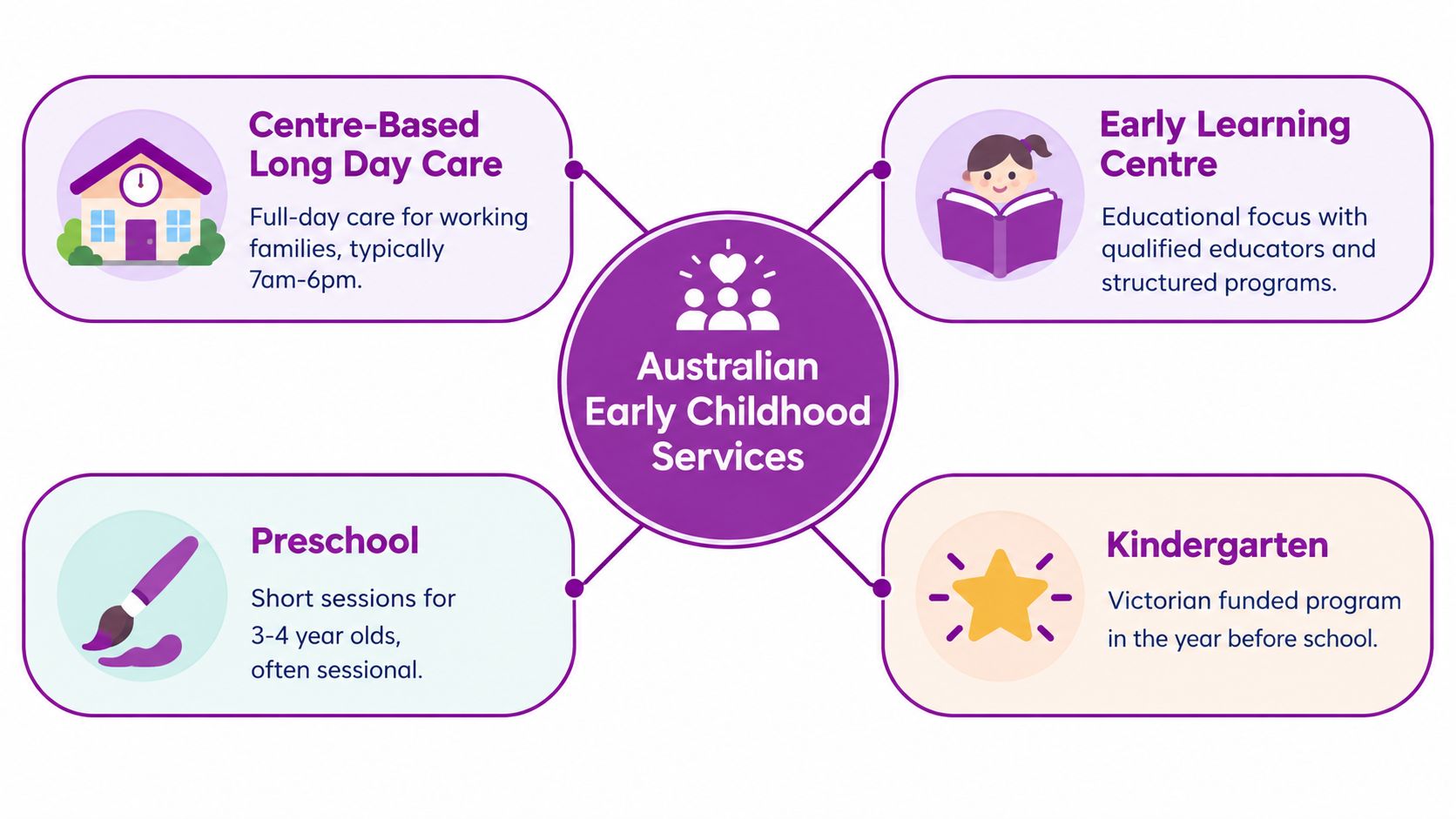
Centre-based long day care provides care in a centre across much of the working day. Families often call it daycare. Children may take part in play-based learning and age-appropriate routines, and some services also deliver a preschool program.
Early learning centre is commonly a description of a centre-based service that foregrounds learning and intentional teaching. It may offer the same extended care as long day care, alongside a planned program for older children. The name alone doesn't confirm teacher qualifications, kindergarten access or the quality of the program.
Preschool and kindergarten refer to programs focused on the years before full-time school. Australian states and territories use these terms differently. In Victoria, families commonly use “kindergarten” or “kinder” for funded programs before school. A sessional program may operate separately from long day care, while some centres combine the program with extended care.
What the national quality rating checks
Approved service types sit within Australia's National Quality Framework. The National Quality Standard assesses seven areas: educational program and practice; children's health and safety; physical environment; staffing arrangements; relationships with children; partnerships with families and communities; and governance and leadership.
An NQS rating is more useful than a marketing label, but it still needs context. Check the current rating and ask how the service's educational program works in your child's specific room. Australia recorded 18,990 approved early childhood education and care services, including 2,181 dedicated preschools, in 2024. In that year, 92.0% of centre-based day care services based their preschool program on the Early Years Learning Framework, according to the 2024 National Early Childhood Education and Care Workforce Census.
Those figures show why “daycare” shouldn't automatically be read as “care without education.” Ask what the service provides, not what its sign says.
Side-by-Side Criteria That Actually Predict Your Child's Day
A tour should help you picture an ordinary day, not just admire the garden or read a philosophy statement. Use these questions to compare the offer with your child's needs and your family's schedule.
| Criterion | Early learning centre | Long day care (daycare) |
|---|---|---|
| Program | Ask how intentional teaching appears in play and daily routines. | Ask whether educators document learning as well as care routines. |
| Philosophy | Reggio Emilia-inspired, play-based or another approach should be visible in children's projects and the environment. | Ask how the service balances child-led play, routines and guided experiences. |
| Educators | Confirm who leads the program and their qualifications. | Ask who works in your child's room and how the team maintains continuity. |
| Age groups | Check whether the centre serves infants through preschool age or focuses on older children. | Confirm room arrangements and how transitions between age groups happen. |
| Hours | Verify booked-day availability, drop-off and collection arrangements, and kindergarten attendance requirements. | Check whether the opening hours fit your actual commute and work pattern. |
| Learning records | Ask how teachers share observations, projects and progress. | Ask what families receive about learning, wellbeing and daily care. |
| Fees and extras | Confirm what the fee includes and whether kindergarten attendance changes the schedule. | Check inclusions, subsidy estimates, absence rules and any additional charges. |
A philosophy only matters if you can see it in practice. If a centre describes itself as Reggio Emilia-inspired, ask how children's interests shape projects, what educators observe, and how those observations influence what happens next. A scope and sequence overview can be a useful prompt for discussing how planned learning develops over time.
Staffing deserves more attention than glossy facilities. Ask which educators are likely to be in the room on your booked days, how the team handles breaks and absences, and how often familiar educators change. A dependable relationship with the people caring for your child can matter more to the daily experience than whether the centre calls itself a daycare or an early learning centre.
Curriculum, Reggio Emilia, and Victorian Kindergarten Funding
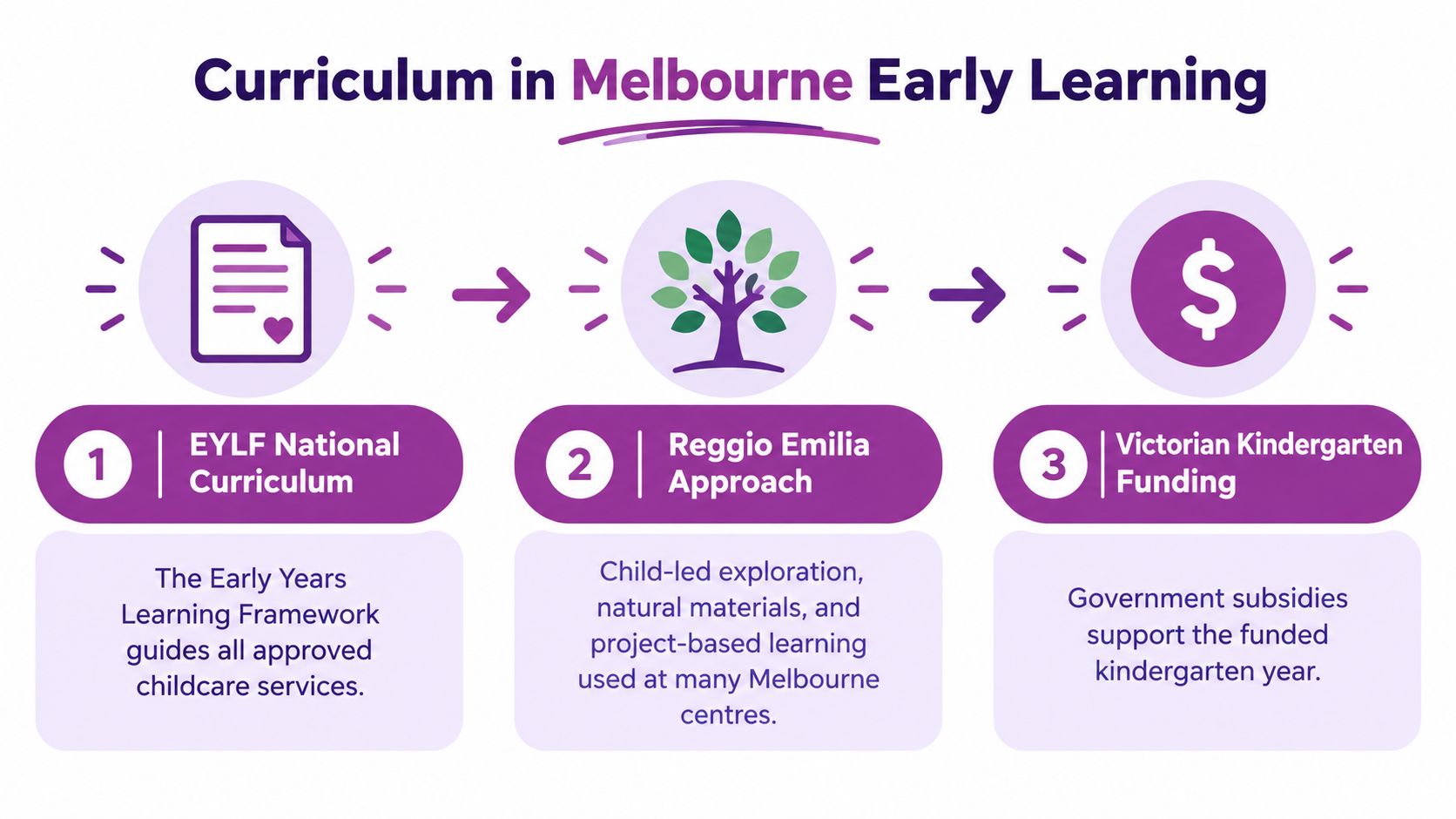
The Early Years Learning Framework (EYLF) guides early learning in Australia. It's not a school timetable for preschoolers. Educators use it to plan experiences, support children's development and make learning visible through play, conversation, exploration and relationships.
A Reggio Emilia-inspired approach is one way a centre may put that learning into practice. Children's questions can lead to investigations, shared projects and creative work. Educators might document a child's observations or display a group's evolving ideas, then use those insights to plan what comes next. Ask to see examples from the room, rather than relying on a philosophy label.
What funded kinder means for Victorian families
Victoria's funded kindergarten pathway includes Three-Year-Old Kindergarten and Pre-Prep. The policy framework is scaling funded Three-Year-Old Kindergarten to 15 hours a week for 40 weeks annually by 2029. The longer-term model provides 600 funded hours in Three-Year-Old Kindergarten and 1,200 hours through Pre-Prep, for a total of 1,800 hours before school, as described in the Victorian Government's evidence on two years of quality kindergarten.
For parents, the important distinction is how those funded hours fit into the day. A sessional kindergarten may mean separate drop-offs or organising another provider for the rest of the working day. An integrated program can combine long day care and funded kindergarten at one service, but families still need to confirm the actual hours available, attendance expectations and who teaches the program.
Ask for the weekly timetable, not just the program name. You need to know when your child attends funded kinder, whether those sessions fit your work hours, and how care is arranged around them.
If you're considering a particular educational approach, ask how it connects to curriculum and everyday practice. A centre's Reggio Emilia early learning approach should be explainable through examples of children's inquiry, educator planning and learning documentation, not just materials or room design.
Costs, Subsidies, and the Real Price of an Empty Day
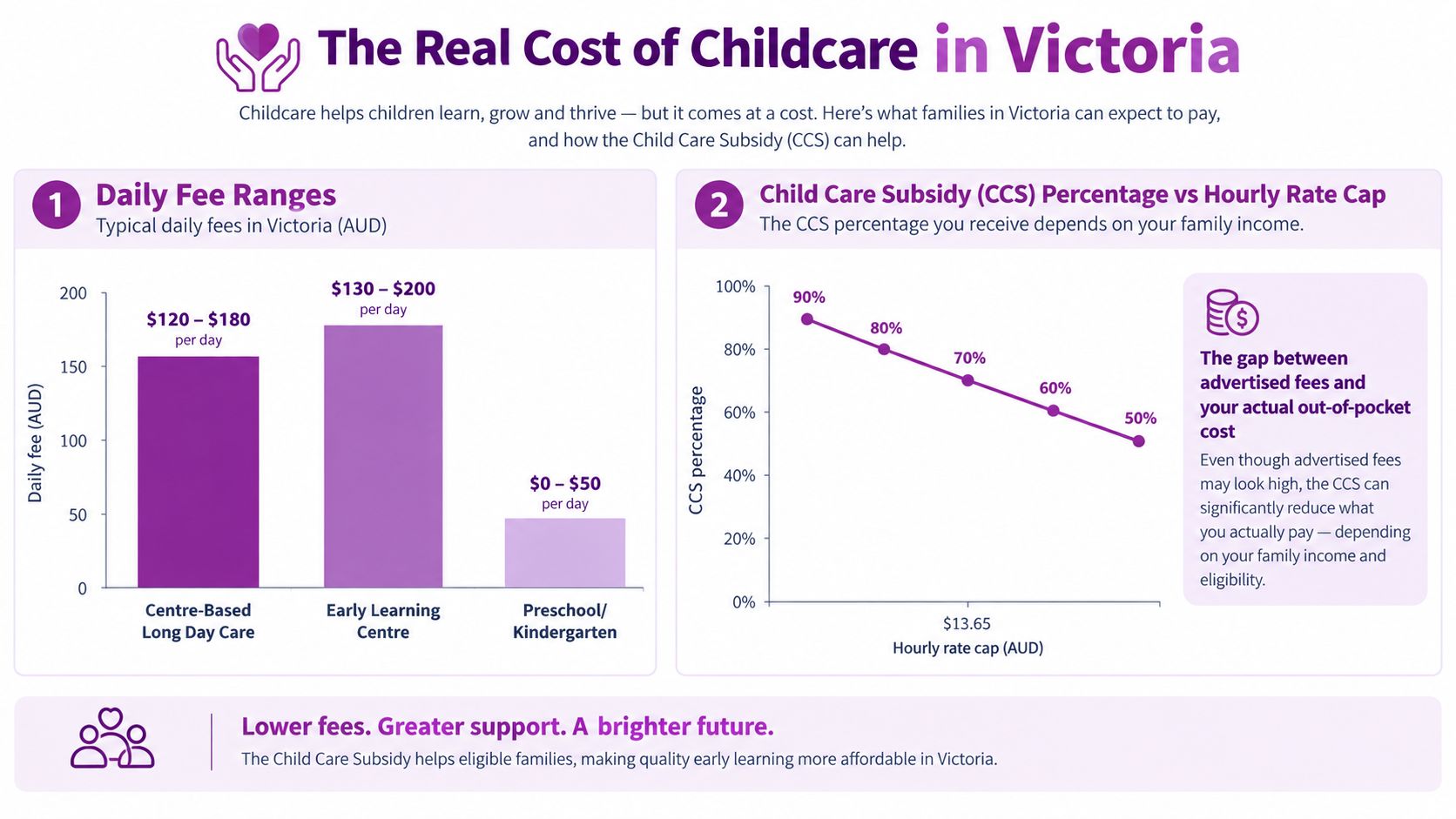
Don't compare a centre's headline fee with another service's estimated out-of-pocket cost. Ask for the full fee schedule, what's included, how the Child Care Subsidy applies to your family, and what you'd pay for the booked days you need.
The subsidy calculation depends on family circumstances and the applicable rules. A provider can give you its fees, but it can't confirm your personal subsidy outcome. Use an estimate as a planning tool, then check your situation through the appropriate government channels before committing.
Reliability belongs in the cost comparison
A low advertised fee doesn't help if the service can't offer the days your family needs or maintain a stable team. A 2025 Municipal Association of Victoria sector brief reported that 81% of councils experienced difficulty attracting qualified early-childhood professionals, and estimated a need for 11,000 additional staff over the reform period, according to the Victorian early childhood update.
That doesn't mean every centre has staffing problems. It does mean you should ask how the service handles educator absences, room coverage and changes to booked days. A centre that clearly explains its policies gives you more useful information than one that offers reassurance without practical detail.
To estimate your weekly cost, write down the days and hours you expect to use, ask the service for the applicable fees and inclusions, then enter your details into an official subsidy estimate. Compare like with like: meals, enrichment sessions, kindergarten arrangements and absence policies can change what the advertised figure means in practice. A childcare fees calculator may help you organise an estimate, but treat the result as a guide rather than a confirmed subsidy assessment.
Which Option Fits Which Melbourne Family
The right fit becomes easier to see when you start with the child's age and the parent's week, not the centre's branding.

A working parent in Springvale South has a baby and needs care across the workday. Prioritise a service with a dedicated infant room, calm settling routines, clear communication about feeds and sleep, and educators who can build familiar relationships. Long day care may meet the practical need; an early learning centre may also do so if it has an appropriate nursery and suitable hours. The label isn't the deciding factor.
In Dandenong North, a family with a three-year-old starting funded kindergarten should ask whether the centre delivers the funded program, how many hours the child can attend, and who leads the teaching. An integrated early learning centre may be a practical choice if its program works with the family's care schedule. Confirm the timetable and attendance requirements before enrolling.
For a Ferntree Gully household with an infant and a child approaching school, one multi-age service may simplify drop-offs and help parents coordinate routines. Check that the baby and older child each have a suitable room and program, and ask how educators prepare children for transitions between rooms and into school. Convenience is valuable, but not if it comes at the expense of the right experience for either child.
Compare services on booked-day reliability, educator continuity, program fit and travel time. If a centre can't explain what happens when an educator is away or a kindergarten session falls outside your work hours, keep looking.
Decision Checklist and Questions to Ask Any Provider
Take the same questions to every tour. You'll get a fairer comparison than relying on a brochure, a polished website or a quick look through the play space.
The national quality system had rated 93.0% of Australian centre-based day care services by 30 June 2025. A service receives Meeting NQS only when it meets or exceeds all seven quality areas, according to the Productivity Commission's Report on Government Services. Check the centre's current rating, then ask about Quality Area 1, which covers the educational program and practice.
Questions to put to the director
- Room staffing: Who will usually care for my child on the days we book, and what are their qualifications?
- Educator continuity: How do you keep familiar educators in the room when staff are on leave or unwell?
- Learning updates: How do you share observations, projects and daily information with families?
- Kindergarten delivery: Do you offer funded Three-Year-Old Kindergarten and Pre-Prep, who leads the program, and how does it fit around long day care?
- Booked-day reliability: How are waitlists managed, and what happens if the days we need aren't available?
- Absences and extras: What's the policy for absences or make-up days, and does the fee include meals, music or sport?
| Topic | Green flag | Red flag |
|---|---|---|
| Quality rating | Staff explain the current rating and can discuss their educational program. | The centre avoids questions about its rating or quality practices. |
| Educator continuity | The director explains how the room is staffed when an educator is absent. | You can't get a clear answer about who will care for your child. |
| Learning | Educators share specific examples of children's interests and learning. | The program description stays vague or relies on a slogan. |
| Kindergarten | Hours, attendance expectations and care arrangements are written down. | Staff can't explain how funded sessions fit with the care day. |
| Enrolment | Waitlist, absence and booked-day policies are clear. | You're urged to enrol before the service answers practical questions. |
Choosing With Clarity for Your Family
Start with your child: what kind of care, relationships and learning do they need this year? Then set out your family's real requirements, including commute, booked days, flexibility and kindergarten hours. Finally, compare both against the people, program and routines you see in person, not the centre's label.
In Victoria, a strong fit may combine EYLF-based learning, qualified educators, funded kindergarten and reliable long-day-care arrangements. But no feature matters if the centre can't sustain the routine your family depends on.
Book two tours, one at an early learning centre and one at a long day care. Take the same checklist to both and compare the answers side by side.
Kids Club Early Learning Centre offers long day care with age-specific programs, Reggio Emilia-inspired learning and funded kindergarten options for children from infancy to school age. Visit Kids Club Early Learning Centre to explore its centres in Springvale South, Dandenong North and Ferntree Gully, and discuss which care and kindergarten arrangements may suit your family.