
No single flexible childcare option fits every family. The right choice depends on whether your work pattern is predictable part-time, rotating shifts, or irregular casual hours, and whether you prioritise continuity or maximum scheduling freedom.
You may be trying to confirm a childcare booking while your manager changes next week's roster, your partner checks a different school pickup, and your child's centre asks whether you still need the day you reserved. The problem is not just finding care. It is finding care that matches the hours you work without paying for empty sessions or sacrificing the familiar educators and routines your child depends on.
Flexible childcare options work best when you match the booking structure, not just the advertised opening hours, to your family's schedule. A centre may open early and close late but still require recurring days. A family day care educator may offer a smaller setting but have limited backup if they're unavailable. In-home care can adapt closely to your household, but eligibility rules restrict access.
| Model | Best for | Flexibility level | Typical cost range |
|---|---|---|---|
| Part-time centre-based care | Predictable weekly workdays | Moderate | Varies by provider and subsidy |
| Casual or occasional care | Irregular short-term needs | High, subject to vacancies | Varies by provider and subsidy |
| Shift-based care | Rotating rosters and non-standard hours | High where offered | Varies by provider and subsidy |
| In-home care | Families who meet eligibility requirements and need care at home | Very high | Varies by provider and subsidy |
| Family day care hybrid | Families combining a smaller setting with another care arrangement | Moderate to high | Varies by provider and subsidy |
The most useful question isn't “Which option is most flexible?” Ask instead, “Which arrangement gives me dependable care for my core hours and a realistic solution for the gaps?”
Why Flexible Childcare Matters More Now
At 6:15 am, a parent in Melbourne's south-east is packing lunches while checking a phone. A shift has been moved forward, the usual grandparent backup isn't available, and the childcare centre's standard drop-off window doesn't solve the underlying problem. The child needs care before the centre opens, the parent needs to reach work on time, and a booking that looked suitable on paper no longer fits the day.
That tension appears in many forms. A nurse may work rotating shifts, a hospitality employee may finish late, and a casual worker may receive a roster with little consistency from week to week. A parent returning from leave may need care on selected days, while another household may combine centre-based care with school or kindergarten commitments. Flexibility means responding to actual family logistics, not merely offering a choice between three and five days.

The standard week no longer covers every roster
The need is clear in the Australian Government's review of the In Home Care program. 67% of IHC families had at least one parent or guardian working non-standard hours, compared with 26% of Australian families overall, according to the Australian Government's IHC program review. Approximately 80% of children using IHC received some care between 6:00 pm and 8:00 am, the review's definition of non-standard care.
That care often clustered around early mornings and evenings, with weekend use also reported. These are precisely the periods when many mainstream subsidised services don't operate, creating a mismatch between the hours parents are employed and the hours they can access care.
The review also found that 45% of IHC families didn't have the same work pattern each week, with reported arrangements including rotating shifts, split shifts, on-call work and work-related travel. This isn't a minor inconvenience. It changes how a family should approach bookings, backup care, transport and communication with educators.
Practical rule: Treat your roster as a childcare requirement, not an employment detail. Write down the earliest start, latest finish, weekend commitments and likely changes before you compare providers.
Flexibility supports participation, but children still need continuity
Australian childcare use has grown alongside changing employment and family patterns. ABS data recorded 48% of children under 12 using formal and/or informal childcare in 1996, while formal childcare participation increased from 12% in 1984 to 20% in 1996, as reported in the Australian Bureau of Statistics childcare data.
The practical lesson is straightforward. Flexible childcare options help parents remain in work, study, manage changing responsibilities and coordinate more than one child's schedule. But maximum freedom isn't automatically the best outcome for a young child. A good arrangement must also provide familiar relationships, predictable routines and an environment that supports learning and wellbeing.
The strongest solution often separates core care from contingency care. Reserve reliable sessions for the hours you regularly need, then use a clearly understood backup arrangement for roster changes, appointments or occasional overtime.
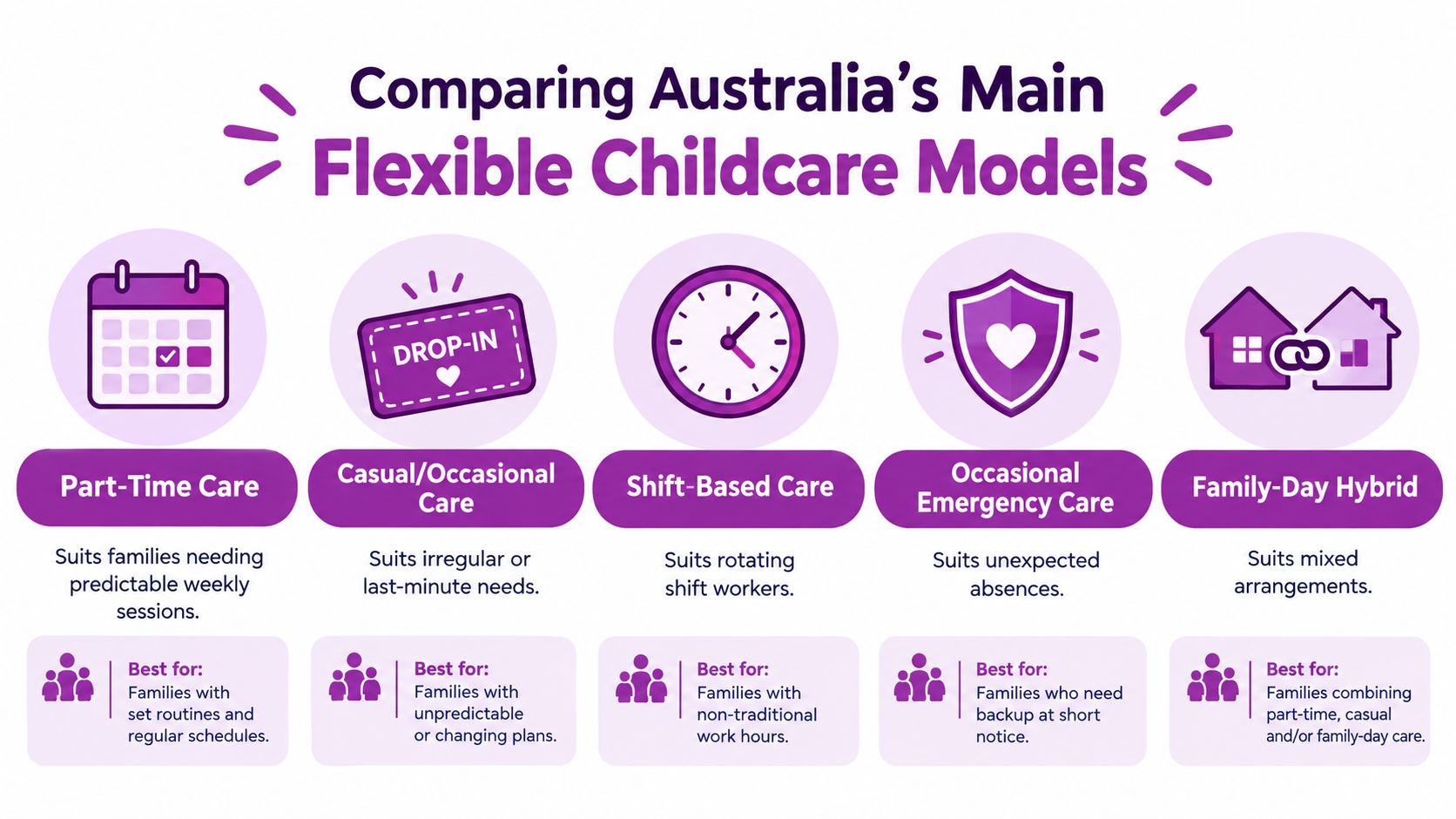
Comparing Australia's Main Flexible Childcare Models
Families often begin by asking whether they should choose a centre, a family day care service or care at home. That's too broad. Compare the arrangement against your working pattern, your child's age, your need for continuity and your tolerance for last-minute uncertainty.
Part-time centre-based care
Part-time care suits predictable schedules. If you work Mondays, Wednesdays and Thursdays most weeks, recurring bookings can give your child a stable rhythm and give educators a clear basis for planning. The trade-off is commitment. A centre may not be able to move your days every week, and a minimum session structure can mean you pay for hours you don't use.
For families comparing long day care arrangements, ask whether the service offers set days, variable attendance, session changes and a waitlist process. Don't assume “part-time” means “book any day whenever you need it”.
Casual and occasional care
Casual care is useful for irregular work, appointments, study days or occasional deadlines. It gives you more control over attendance, but availability usually depends on vacancies. If the service fills its places with recurring bookings, casual capacity may disappear during busy periods.
This option works best when you have a second plan. Keep a list of approved services, relatives or trusted carers rather than relying on one drop-in booking that may not be available when your roster changes.
Extended-hours and shift-based care
Extended-hours care can help when work starts early or finishes late, but opening hours alone don't prove that the arrangement suits shift work. Ask whether the centre accepts bookings outside standard patterns, whether educators remain consistent across those sessions, and how late changes are handled.
Shift-based care is most useful for rotating rosters when the provider understands that your required days may change. The financial risk is higher if the service requires recurring reservations but your employer confirms shifts late.
In-home care
The ACCC identifies in-home care as the most structurally flexible model because an educator provides care in the child's home. Eligibility is restricted to families unable to access other approved care types, so it isn't a universal alternative to centre-based care.
Supply also matters. Since 2018, 116 family day care services and 19 in-home-care services closed, according to the ACCC's childcare accessibility update. Families should therefore assess not only theoretical flexibility but also whether an eligible educator is available, what happens during illness and how continuity is protected.
Family day care and mixed arrangements
Family day care can provide a smaller, home-like setting and may suit families whose hours or local access don't align with a large centre. It can also work as one part of a mixed arrangement, alongside centre-based care, kindergarten or informal support.
The key question is backup. Ask who cares for your child if the educator is sick, takes leave or stops operating. A smaller setting may feel adaptable, but it still needs clear safeguards, approved-care status and a practical continuity plan.
Understanding the True Cost of Flexible Care
A Tuesday vacancy does not help if your roster needs Thursday. Flexible childcare costs more than the advertised hourly fee, so calculate booked hours, used hours, subsidised hours, cancellation rules and the cost of losing a place before you enrol.
From January 2026, the Child Care Subsidy activity test was replaced by the 3 Day Guarantee. All CCS-eligible families receive at least 72 subsidised hours per fortnight, while eligible families can still receive up to 100 hours, according to the Australian Government's 3 Day Guarantee fact sheet.
Those hours do not reserve the sessions your family needs. A provider may have Tuesday available but no Thursday vacancy, or may require recurring bookings to hold a place. Compare your entitlement with the service's booking rules, notice periods and minimum sessions.
Run the calculation using your real roster
Children using approved care attended an average of 27.8 hours per week in the March quarter 2026, and the average centre-based fee was $14.50 per hour, according to the relevant quarterly childcare data. At that fee, unused reserved sessions can become a substantial expense for families with changing rosters.
Build your budget around three columns:
- Required hours, covering work, commuting and handover time.
- Reserved hours, covering the sessions the provider requires you to book.
- Uncertain hours, covering shifts that may appear or change later.
A predictable part-time worker may accept reserved sessions because continuity and a secure place matter. A casual worker should question recurring bookings that go unused. A rotating-shift worker should confirm whether bookings can be changed before accepting an offer.
Look beyond the headline fee
Ask about enrolment charges, late collection fees, non-attendance rules, public holiday treatment, minimum sessions and cancellation notice periods. Get each policy in writing, then test the total against a difficult month rather than an ideal week.
Budget check: If your employer changes your roster, can you keep, cancel, swap or replace the booking without losing money or care access?
Review the provider's childcare fees and payment information alongside your CCS estimate. Compare the full cost of reliable access, including sessions you must reserve to keep the place, rather than choosing an arrangement only because its lowest possible weekly fee looks attractive.
How to Match Your Work Pattern to the Right Option
Start with the schedule you live, not the schedule you hope to have. Review recent rosters, identify the hours that are stable, and separate those from changes caused by overtime, rotating shifts, seasonal work or casual employment.
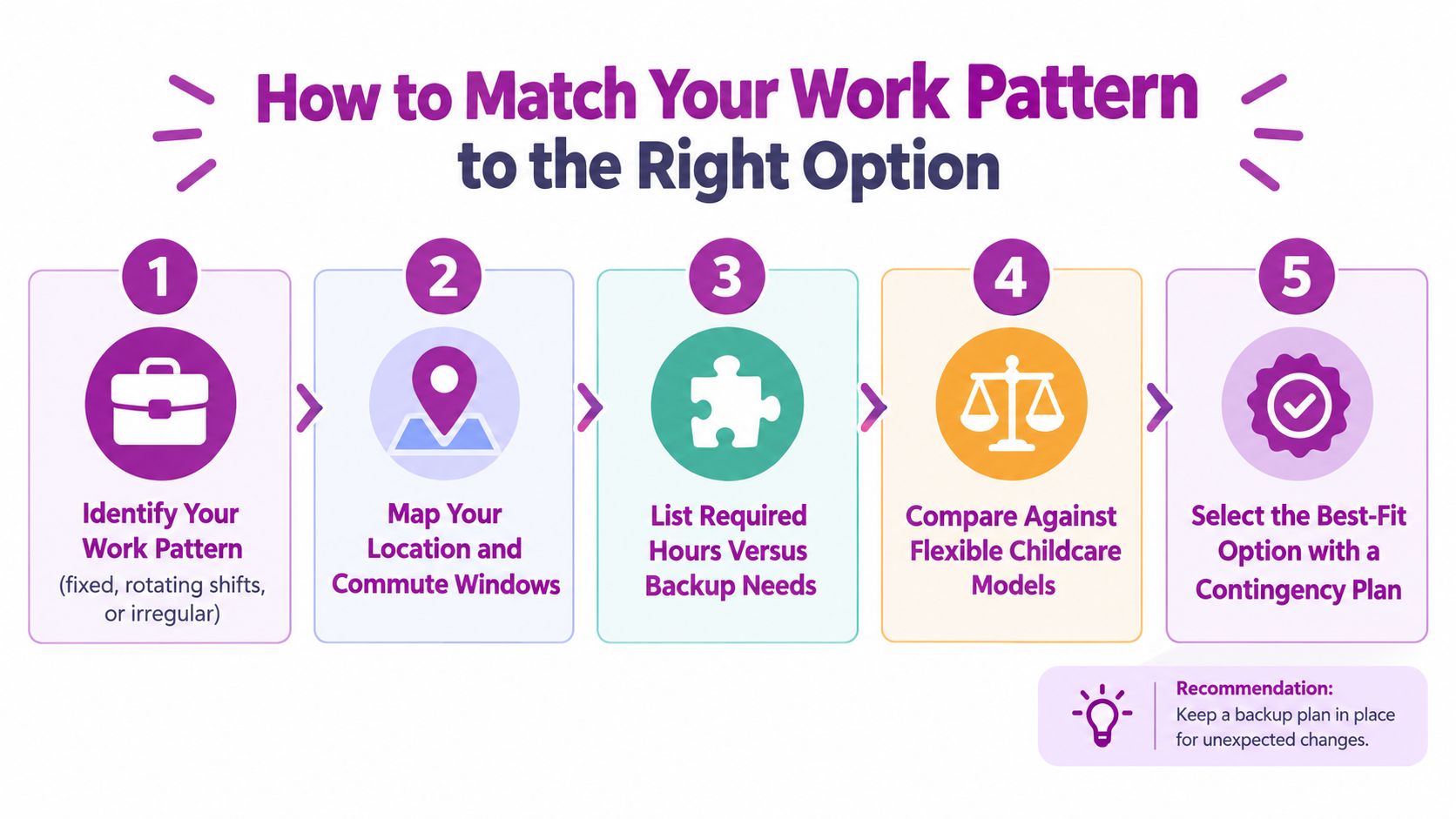
Use five practical checks
1. Classify your work pattern.
A fixed part-time schedule usually suits recurring centre sessions. Rotating shifts require a provider comfortable with changing days and clear notice rules. Irregular casual work needs vacancy access and a backup plan more than a promise of long opening hours.
2. Map the journey.
Include commuting time, parking, public transport connections, school runs and handover time. A service that appears flexible but sits outside your practical travel window may create daily stress.
3. Separate essential care from backup care.
Write down the hours you must cover for every roster, then list occasional needs such as appointments, overtime, school holidays or a partner's travel. Don't make one booking carry every possible scenario.
4. Rank your priorities.
Choose between continuity, scheduling freedom, location, cost and home-based care. You can value all five, but identifying the top two makes trade-offs clearer.
5. Confirm the contingency.
Ask what happens when your preferred session is full, your child is unwell, an educator is absent or your roster changes after the notice deadline. A flexible plan without a fallback is fragile.
The broader context matters. The ABS linked increased childcare participation with greater female workforce participation, longer working hours among full-time employees and the spread of shift work across more occupations in its historical childcare analysis. Families aren't unusual because their schedules differ. Providers need to explain how their systems respond to that difference.
Match common situations to realistic arrangements
For predictable part-time work, choose recurring centre-based or family day care sessions and preserve a small backup option for occasional changes.
For rotating shifts, prioritise a provider that confirms how far ahead you must submit bookings and whether you can retain continuity with the same educators.
For irregular casual work, avoid paying for a large recurring commitment unless the place is essential. Build relationships with more than one approved option where possible.
For a parent returning from leave, begin with the work pattern you expect to resume, then ask whether attendance can increase or change as the transition develops.
Blending Options for Maximum Flexibility
Many families don't need one arrangement to solve every childcare problem. They need a dependable base plus a controlled way to handle exceptions.
A common hybrid is recurring centre-based care for core workdays, with family support or occasional care for late meetings and roster changes. Another family may combine kindergarten or part-time care with a provider that covers longer workdays. Parents with multiple children may choose different settings because an infant's routine, a preschooler's program and a school-aged child's pickup time rarely align perfectly.
Build the arrangement around the stable layer
Reserve your most important sessions with the provider that offers the continuity your child needs. Use a second option only for defined gaps, such as an early start, a school holiday, an appointment or a short-term work increase.
This approach prevents a common mistake, overbooking every possible day “just in case”. It also makes the child's week easier to understand because the primary environment remains familiar while the backup arrangement has a specific purpose.
Coordinate the practical details
Multiple providers require organised administration. Keep a shared calendar with booking dates, collection permissions, medication information, contact numbers and notice deadlines. Check how each service records attendance and manages CCS claims before you commit to overlapping arrangements.
Introduce educators to the information they need without expecting one service to manage another. Share consistent details about sleep, food, comfort items and important routines, while allowing each setting to follow its own approved policies.
A workable hybrid has clear ownership: one provider handles the regular routine, and every backup arrangement has a named purpose, confirmed availability and an agreed handover process.
Review the mix when your work pattern changes. A plan that works during ordinary weeks may fail during school holidays, periods of overtime or a return to full-time employment. Flexibility should be adjustable, not permanently complicated.
Finding Flexible Care Near You in Melbourne
A provider's use of the word “flexible” doesn't tell you enough. Ask what flexibility looks like in a booking system, on a busy day and when a parent gives late notice.
For families in Springvale South, Dandenong North and Ferntree Gully, location is part of the calculation. A centre near home may suit a parent travelling toward the city, while a service near work may be more practical for late collection. Families in Mulgrave, Springvale, Dandenong, Boronia and Dingley Village should also compare the full journey, not just the suburb name.
Questions that expose the real policy
Ask each provider:
- Session structure: What are the available start and finish times?
- Variable attendance: Can booked days change, and how much notice is required?
- Casual access: Are occasional places available, or are all positions recurring?
- Cancellations: What happens when work changes or your child is absent?
- Continuity: Which educators and rooms will your child usually experience?
- Backup: What happens during educator leave, illness or service closure?
- Subsidy administration: How are attendance records and CCS claims managed?
- Infant care: How does the service support babies who need stable routines and familiar relationships?
A provider that answers these questions clearly is easier to plan around than one that relies on a broad promise. Also ask for policies in writing. Verbal flexibility can disappear when the centre is full or staff availability changes.
Kids Club Early Learning Centre is one local option offering long day care, flexible care options, practical enrolment support and programs for children from six weeks to six years across its Melbourne locations. Its approach includes Reggio Emilia-inspired learning, VIT-registered teachers, weekly music and sports programs, infant and toddler environments, and kindergarten pathways, so families can assess whether the booking structure and educational approach fit their needs alongside other local services. Use the centre's guide to childcare services near you as a starting point, then confirm current session availability directly.
Frequently Asked Questions About Flexible Childcare
Does flexible care affect development?
Not necessarily. The important factors are safe, approved care, responsive educators, age-appropriate learning and enough continuity for your child to build secure relationships.
What should I do when work changes at short notice?
Contact the provider immediately, ask about a swap or casual vacancy, and activate your backup plan. Don't assume CCS eligibility creates an available place.
Can variable attendance reduce my costs?
It can, but only if the booking rules allow it. Compare used hours with reserved hours, cancellation charges and the value of keeping a reliable place.
What if flexible sessions are full?
Join the waitlist, ask about alternative days, contact approved family day care services and retain a second arrangement for urgent gaps. Review your plan as your roster changes.
Kids Club Early Learning Centre offers flexible care options, long day care and developmentally aligned programs for children from six weeks to six years across Springvale South, Dandenong North and Ferntree Gully. Visit Kids Club Early Learning Centre to explore the available programs, discuss your work pattern and ask how current bookings can fit your family's routine.