
You might be standing in the kitchen while your child turns a cereal box into a “garage”, presses every button on a toy, or asks why the lamp works but the fan doesn't. Those moments can feel random, even messy, but they're often the first signs of design and technology thinking. This is not about screens taking over childhood. It's about children noticing a problem, testing an idea, and trying to make something work.
For many Melbourne parents, that's the question hiding behind the search term. You're not just asking what "design and technology" means, you're asking whether it belongs in a young child's day, and if so, what it should look like. In a Reggio-inspired setting like Kids Club ELC, the answer is usually found in children's hands, conversations, drawings, building, sorting, and shared problem-solving, not in passive device use.
What a Parent Really Means When They Ask About Design and Technology
A parent might ask this after watching a two-year-old stack blocks until the tower falls, or a four-year-old draw a robot with ten arms and a button for every job. They're usually not looking for a technical definition. They want to know what counts as learning, what counts as play, and where technology fits without crowding out the rest of childhood.
The honest answer is that design and technology in early learning is really about how children think. It shows up when they notice, compare, test, revise, and explain. A child sorting toy animals by size, choosing which block goes on top, or asking why a ramp makes a car move faster is already working like a young designer.
Practical rule: if a child is trying to make, fix, improve, or explain something, you're probably looking at design and technology learning.
That matters because parents often get pushed into a false choice between "good old-fashioned play" and "technology". The learning value comes from the child's inquiry, not from the device itself. A toy that lights up can be useful, but only if it invites questions, discussion, and experimentation.
If you want a centre example, Kids Club ELC's inquiry-based approach is a helpful reference point for how children can explore materials, ideas, and solutions through play and documentation, rather than through screen time alone. Their approach to inquiry-based learning is outlined in their early childhood learning approach.
The rest of this article follows that same logic. First, it clears up what the term means. Then it shows how children grow through it, what it looks like at different ages, how a Reggio-inspired centre brings it to life, and what you can do at home.
Understanding Design and Technology as Inquiry, Not Devices
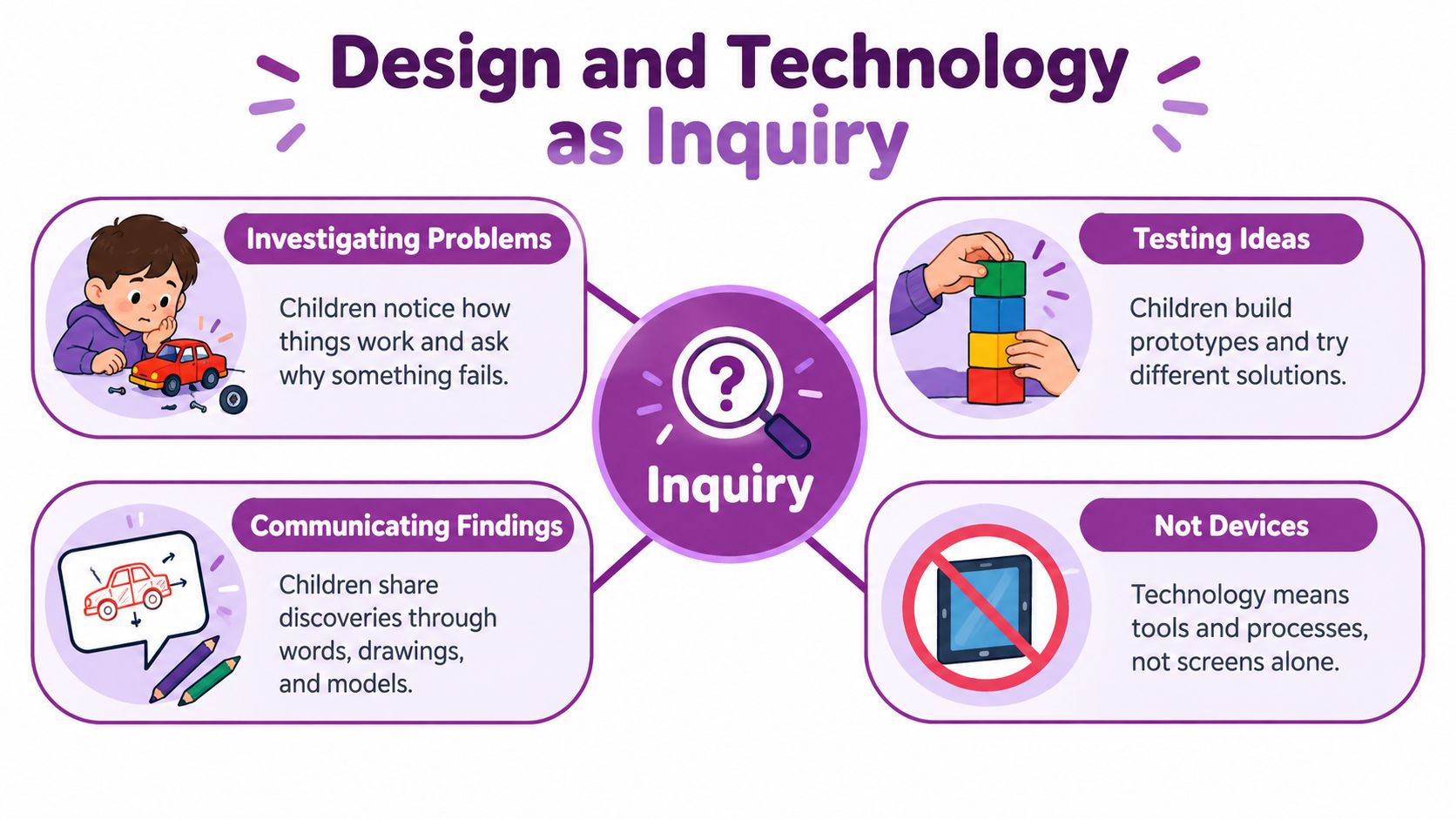
The easiest way to understand the phrase is to split it in two. Design is the part where children imagine or plan a solution. Technology is the part where they use tools, materials, systems, and processes to make that solution happen. In early childhood, that can mean cardboard, blocks, string, cameras, magnets, audio recorders, or programmable objects.
The Australian Curriculum frames Digital Technologies around data, digital systems, audiences, procedures, and computational thinking. In practice, children are learning to gather information, work out who something is for, choose steps in order, and think logically about how a solution works. The same framework also asks children to consider social, environmental, and economic impacts when they create digital solutions, which tells parents something important. Design and technology is never just about "can it work". It is also about "should we make it this way?"
The Early Years Learning Framework is just as clear that technology should support children in accessing information, investigating ideas, and representing thinking. That can happen with a camera, a light table, a measuring tape, a drawing app, or a set of blocks. What matters is whether the child is using the tool to think, communicate, and make meaning.
A child who builds a bridge, tests whether it holds a car, redraws the plan, and then explains the result is already working through the design cycle.
That's why sorting socks, arranging loose parts, building a tower, or sequencing steps in a routine all belong in this conversation. They help children notice patterns, predict outcomes, and refine ideas. In early learning, design and technology is not a separate subject floating above play, it is a way of describing the thinking inside play.
For parents, the simplest definition is this. Design and technology is what children do when they try to solve problems, make things, and explain how their ideas work. Screens may appear, but they're only one tool among many. The learning is in the inquiry.
Developmental Benefits That Parents Can Notice
A child rarely announces, “I'm building problem-solving skills now.” You see it instead when they stop, rethink, and try again after a tower collapses or a drawing doesn't match what they imagined. That is where design and technology becomes visible in everyday life.
Thinking, language, and making sense of steps
When a child follows the order in a cooking task, lines up blocks from smallest to largest, or works out which piece goes first in a puzzle, they're building sequencing and early computational thinking. They're also learning that actions have consequences. If the ramp is too steep, the car shoots off. If the tape is weak, the structure falls apart.
Language grows alongside this. A child who says, “This one is heavier,” or “Let's move it over here,” is practising comparison, explanation, and revision. Documenting ideas with drawings, photos, or little voice recordings also helps children turn thinking into words, which is a big step in literacy development.
Motor control, persistence, and shared work
Construction, cutting, stacking, threading, and sticking all support fine motor coordination. Running, carrying, balancing, and moving furniture for a group project support gross motor control. These aren't separate from design and technology, they're part of how the work gets done.
Socially, children learn to take turns, share materials, and recover when their idea doesn't win. That's where persistence becomes real rather than abstract. If a group is building a bridge, one child might hold, another might align, and another might narrate what's happening. The finished product matters less than the collaboration.
You can see why this links well with critical and creative thinking in early childhood. The child isn't just producing a thing. They're testing agency, judgement, and confidence.
Creative confidence grows here too. Open-ended projects let children discover that there isn't always one correct answer. That can be reassuring for children who don't thrive on worksheets or fixed outcomes. They learn that ideas can change, improve, and become visible through making.
What Design and Technology Looks Like at Each Age
Children don't need the same kind of challenge at every stage. What counts is that the task matches their developmental level and gives them something meaningful to figure out. A toddler exploring cause and effect needs a different setup from a pre-PREP child planning, documenting, and revising a group project.
| Stage | Age Range | Focus | Example Activities |
|---|---|---|---|
| Infants and toddlers | 6 weeks to 3 years | Sensory exploration, cause and effect, simple problem-solving | Stacking soft blocks, pressing buttons, exploring mirrors, moving objects, filling and emptying containers |
| Three-year-old kindergarten | Around 3 years | Short investigations, early planning, shared talk, documentation | Building with loose parts, photographing a creation, sorting materials, drawing ideas, using simple digital tools to record thinking |
| Pre-PREP | Around 4 years | Longer projects, collaboration, early sequencing, symbolic thinking | Designing a structure, testing stability, using sequencing cards, working with programmable objects, revising plans after feedback |
For infants, the point is not complexity. It is exploration. A child at this stage may shake a rattle, watch a shadow move, or discover that two objects make different sounds when tapped together. Those moments teach that actions have effects, which is a real foundation for later problem-solving.
Toddlers often want repetition. They will build the same tower, knock it down, and build it again. That repetition is not “just play”, it's experimentation with variation. A careful adult can support this by adding blocks of different sizes, containers, ramps, or fabric pieces and then pausing long enough for the child to make a decision.
Three-year-olds are often ready for short projects. They can use a camera to photograph a structure, tell a teacher what they made, or help decide which materials to use next. At this stage, shared language becomes powerful, because children can start naming their own process.
Pre-PREP children can take on longer, more complex tasks. They might build together, test and retest, or use sequencing cards and programmable toys to make a sequence happen. The learning stays developmentally appropriate because it's still grounded in play, but the planning becomes more intentional.
How Kids Club ELC Brings Design and Technology to Life
A typical day in a Reggio-inspired centre starts with an invitation, not an instruction sheet. An educator might place loose parts on a table, set up light and mirrors, or leave out materials that suggest building, sorting, or comparing. Children arrive, notice what's there, and begin to form theories with their hands before they can always explain them in words.
At Kids Club ELC, that kind of setting fits naturally with purpose-built infant and preschool environments, as well as weekly music and sports programs. Music becomes a design experience when children listen for pattern, respond to rhythm, and coordinate their bodies with others. Sports becomes a design experience when children move through space, adjust balance, and work out how their bodies and objects relate.
The centre's documentation practices matter too. Educators can photograph a structure, record a child's explanation, keep drawings, and capture a conversation about what changed after a second attempt. That documentation turns invisible thinking into something children and families can revisit.
The Australian evidence on early childhood technology use supports this kind of approach, where the child's inquiry stays central and tools are selected to support documentation, investigation, and collaboration rather than passive consumption. It also points to the value of adult scaffolding, privacy awareness, and clear learning intentions in digital practice, which is why educator judgement matters so much in the early years. The ERIC summary of Australian early-learning research supports that practical view.
Here, a quick look at how a morning can unfold helps. A child builds with blocks, another takes a photo of the structure, and an educator asks what might happen if the base widens. Later, children compare photos, talk about what changed, and act out the same idea in movement or music. The learning is continuous, but the materials shift.
That's also why registered teachers, dedicated spaces, and funded kindergarten programs matter. They help create consistency. Families get a setting where inquiry is planned, observed, and extended with care, rather than left to chance.
Simple Ways to Support Design and Technology Learning at Home
Home doesn't need a fancy kit. Most families already have the materials, routines, and conversations that support this kind of learning. What matters is whether you leave room for children to try, describe, and improve their ideas.
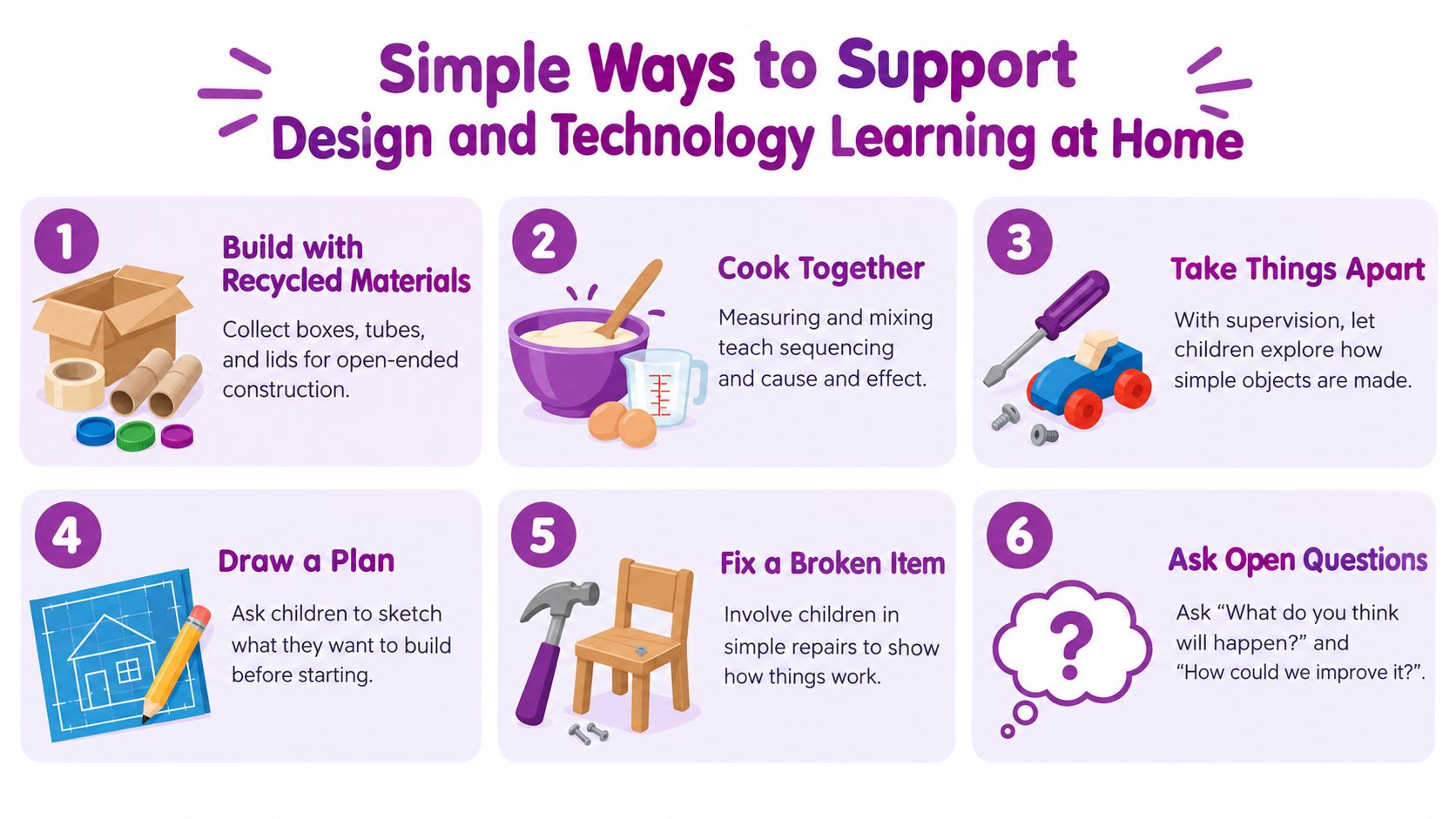
Here are a few low-pressure ways to start:
- Build with recycled materials. Save boxes, tubes, lids, and cardboard trays. When your child asks for tape, pause and ask what they're trying to hold together.
- Cook together. Measuring, pouring, stirring, and waiting all teach sequencing and cause and effect.
- Take things apart safely. With supervision, let children explore how simple objects are made. A broken toy or an old appliance casing can spark great questions.
- Draw a plan first. Ask your child to sketch what they want to make before they begin. The drawing doesn't need to be accurate, it just needs to represent an idea.
- Fix something simple. A loose screw, a wobbly chair leg, or a torn page can become a shared repair job.
- Ask open questions. “What do you think will happen?” and “How could we improve it?” do more than praise ever will.
If you want one quick test for whether an experience is educationally valuable, use this: is the child creating, talking, and moving back into real play? If the answer is yes, the experience is probably doing useful work. If it only holds attention without any thinking, making, or conversation, it may not be doing much at all.
The same logic applies to digital tools. A camera can be useful if it helps children document a construction walk, tell a story, or compare ideas. If it only replaces a child's decision-making with a preset sequence, it's less useful than cardboard and tape. The loose parts play approach is a good reminder that open-ended materials often do more for thinking than highly prescribed ones.
Building a Curious, Capable Learner Ready for What Comes Next
Parents often want reassurance that early learning still matters once children move beyond the toddler years. It does, because curiosity, agency, collaboration, and persistence are not side benefits. They're the habits that make later STEM, literacy, and digital learning easier to enter with confidence.
That's especially important in a country like Australia, where access and support aren't equal for every child. The clearest response isn't to flood children with devices or shut technology out entirely. It's to build strong early habits of inquiry, ethical thinking, and shared problem-solving so children learn how to approach tools wisely.
A strong centre-home partnership makes that much easier. Families bring everyday experience, cultural knowledge, and care. Educators bring planning, documentation, and a space designed for exploration. Together, those things help children see that their ideas matter and that their thinking can be made visible.
Kids Club Early Learning Centre works with families across Springvale South, Dandenong North, and Ferntree Gully, and it supports children from six weeks to six years with enrolment help, affordable fees, and programs shaped around inquiry and play. If you're looking for a local setting that treats design and technology as thinking, making, and collaborating rather than screen time alone, that's the kind of environment worth visiting.
If you'd like to see how this approach works in practice, visit Kids Club Early Learning Centre and explore their programs for infants, toddlers, kindergarten, and pre-PREP. It's a practical way to compare what your child needs now with the kind of learning environment that can support them next.