
You're at the kitchen table with two or three childcare fee sheets open, trying to work out which one will leave enough in the account at the end of the week. One centre has a lower daily rate; another includes meals and offers a funded kindergarten program. Neither headline tells you what your family will pay.
For Melbourne families, affordable childcare options aren't the services with the lowest advertised fee. The useful comparison is your likely out-of-pocket cost after the Child Care Subsidy (CCS), any Victorian Free Kinder offset, your attendance pattern, and charges that apply when your child is away. Get those parts clear before you book a tour or commit to a place.
This guide is for parents in Springvale South, Dandenong North, Ferntree Gully and nearby suburbs who want a realistic weekly budget. Start with the three things that move it most: your CCS percentage, the funded kindergarten hours available, and the number and pattern of care hours you need.
What Melbourne Parents Really Mean by Affordable Childcare
An advertised daily fee is a starting point, not a budget. The amount that matters is the fee left after subsidies and offsets, plus any charges for booked sessions your child misses and any essentials the fee doesn't include. Two services with similar daily rates can leave you with different weekly costs once those details are added up.
I've seen parents get stuck comparing price labels before they've confirmed the basics. A lower fee may look attractive until you learn that meals are extra, absences are charged, or the centre's funded kindergarten hours don't cover the full day you need. A higher fee may include things you'd otherwise pay for separately. Compare what your household will pay for the care you'll use, not an isolated daily rate.
Start with your weekly number
Ask each centre for a written fee schedule and a plain-language estimate of your out-of-pocket cost. The estimate should show the service fee, the CCS deduction, the Free Kinder offset if applicable, and any remaining gap. It should also state how the centre charges for absences, meals, nappies and other inclusions.
Then match that estimate to your own routine. A family needing full-day care around working hours shouldn't compare itself with a family booking only the kindergarten program. Nor should a household assume the same estimate applies if work hours, attendance days or subsidy eligibility change.
Practical rule: If a centre can't explain how it reached your estimated weekly gap, ask for the calculation in writing before you enrol.
Budget for the care you need, not the headline
For families in Springvale South, Dandenong North and Ferntree Gully, the right comparison may involve a trade-off between location, available days, funded kindergarten and the hours the family needs covered. Start with the schedule you can realistically maintain. Then compare services against that schedule, including what happens during public holidays, planned closures and absences.
This makes the decision more defensible. You're not choosing a centre because a daily figure looks small; you're checking whether the fee, program and attendance arrangement work together for your household.
How the Child Care Subsidy Works
A centre's advertised fee won't tell you how much CCS will take off your weekly bill. Start with your household's approved entitlement, then match it to the care you intend to book.
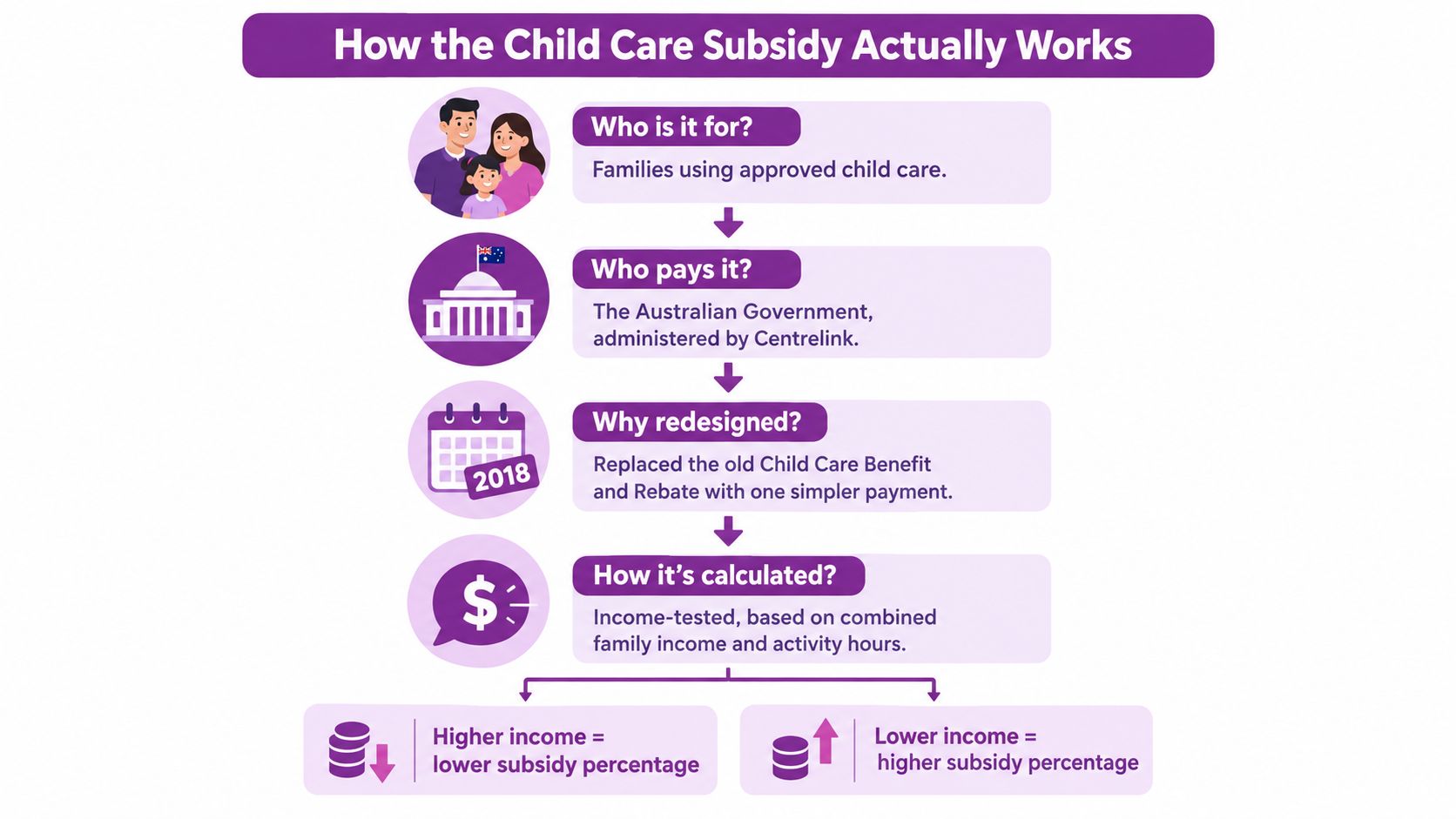
The Child Care Subsidy (CCS) is Australia's main affordability mechanism for approved childcare. Introduced on 2 July 2018, it replaced the former Child Care Benefit and Child Care Rebate. The income-tested payment goes to the approved service, which passes it on through reduced fees (Australian Government overview of the 2018 childcare package).
Your subsidy percentage is only part of the calculation. Household income, the hours of subsidised care you're entitled to, and the service's fee relative to the government's hourly cap all affect the result. Check the rules that apply to your household, including any requirements concerning recognised work, study, training or other approved activities. Use your approved entitlement when budgeting.
Follow the money
The service fee is the starting point. Your CCS percentage applies to the eligible portion, subject to the hourly cap and your approved hours. The centre receives the subsidy directly, and you pay the remaining gap.
That percentage doesn't cover the same share of every dollar charged.
For example, a family booking care at a fee within the relevant hourly cap has its subsidy calculated on the eligible fee. If the fee exceeds the cap, the amount above it sits outside that calculation. Even with the same CCS percentage, the family can face a larger gap. Booked care beyond the family's subsidised hours also needs to be accounted for.
CCS was introduced to direct more assistance towards lower-income households and support families undertaking recognised activities. Historical income thresholds and subsidy rates should stay out of your current budget: confirm the entitlement that applies to you now.
Check your household's entitlement first
The Additional Child Care Subsidy may provide extra help for families experiencing particular disadvantages or hardship. If your circumstances have changed, check whether you qualify before relying on a standard estimate.
Ask: Am I CCS-approved, what percentage applies to my household, and how many hours am I entitled to? Use the Kids Club CCS estimator as a budgeting aid, then confirm your entitlement through the relevant government process.
For Melbourne families, carry that entitlement into a weekly calculation alongside any applicable Free Kinder hours and your attendance pattern. Keep those inputs separate so you can see which one changes your out-of-pocket cost.
From Advertised Fee to Weekly Out-of-Pocket Cost
Put two Melbourne centre fee sheets side by side and compare the weekly amount your family will pay. The advertised daily rate is only the starting point. Your CCS percentage, any applicable Free Kinder hours and your attendance pattern determine how that fee translates into your household budget.
National figures provide a useful sense-check: in the June quarter of 2025, 1,423,900 children from 1,005,800 families used CCS-approved care across 15,214 services, averaging 26.7 hours per week at $13.40 an hour, equivalent to about $358 before subsidies, while government subsidy payments totalled $3.86 billion (June quarter 2025 CCS data).
Use that benchmark cautiously. A Melbourne centre's session fees and inclusions may differ, and your household's entitlement determines your share.
Stress-test the fee sheet
Ask each centre for a written weekly quote using the same booked days and hours. Have it show the gross fee, estimated CCS, any applicable Free Kinder offset and the remaining amount payable. Keep those amounts separate so you can see what changes the total.
Check the cost of a missed day.
Booked absences may still attract fees, so ask about the absence policy before treating time away as a saving. The hourly cap also affects the subsidised portion of the fee. Request a clear explanation of any amount outside CCS.
Check meals and nappies too. An inclusive fee can reduce extra household purchases; a lower advertised rate may leave you buying those items separately. Ask: "What will this arrangement cost our family, including the parts outside CCS?"
For another benchmark, in 2025 the median pre-subsidy price for 50 hours of centre-based care was $711 per week; for families earning up to $215,000 gross annually with one child attending 30 hours, average out-of-pocket costs were 3.9% of weekly disposable income after CCS, compared with 22.3% before CCS (Productivity Commission Report on Government Services, early childhood education and care).
Those averages cannot settle your budget. Allow for fees paid before subsidy reconciliation, booked absences, additional care hours and care for multiple children. Compare the written quotes on those terms before choosing a centre, and ask when each payment is due.
How Free Kinder and Pre-Prep Layer With CCS
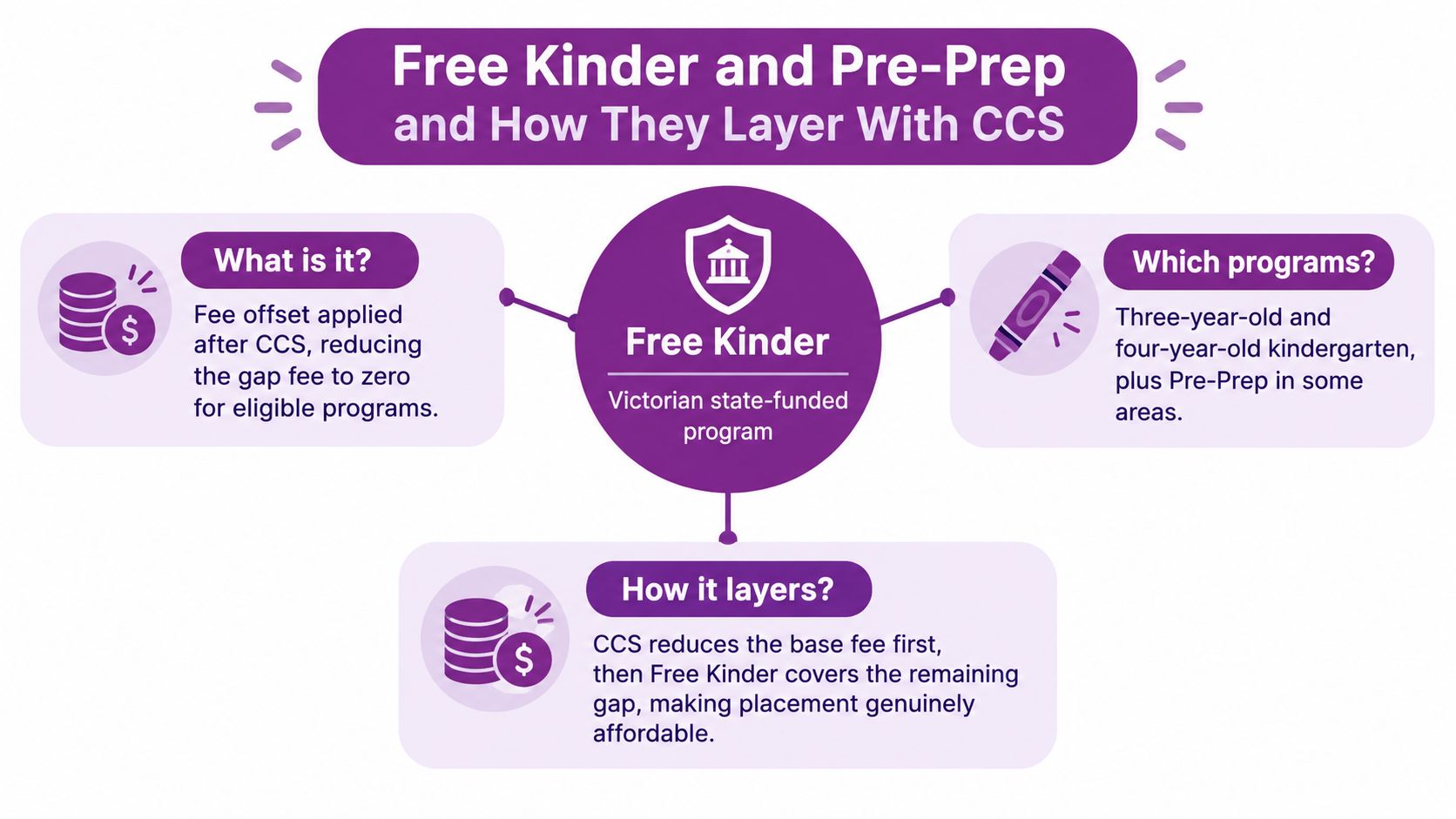
Free Kinder is a Victorian fee offset, not a promise that a long-day-care booking is free. For a Melbourne family booking full days, affordability depends on how the funded kindergarten hours fit those days, your CCS percentage and the care hours left to pay for.
In 2026, participating long-day-care services can apply the offset to funded Three-Year-Old and Four-Year-Old Kindergarten: the standard annual saving is $2,101 for a 15-hour program, including four-year-old programs, while the three-year-old range is $700.33 for a five-hour program up to $2,101 for 15 hours (Victorian Government kindergarten funding rates). Shorter three-year-old programs receive a smaller pro-rata offset.
CCS is applied first, then Free Kinder.
Families don't need to qualify for CCS to receive Free Kinder. The Victorian offset applies to the funded kindergarten program, so additional hours in a long-day-care booking can still leave a balance payable.
Separate kindergarten from care
A full day at a centre can contain both funded kindergarten and additional care. Those additional hours, along with any applicable meals or other charges, still belong in your household budget. An advertised “free kinder” place therefore needs a closer look before you commit to a booking.
Ask the centre to identify which hours in your proposed attendance pattern are funded kindergarten and which are additional care. Have them explain how the Free Kinder offset is allocated across your invoices after CCS. Get that explanation before choosing your days. A single weekly total won't show whether the funded program fits the care you need.
The video below explains how the two supports work together:
Understand the funded hours on offer
Victorian funded Three-Year-Old Kindergarten provides between 5 and 15 hours per week, while Four-Year-Old Kindergarten generally provides 15 hours and is transitioning into Pre-Prep, with funded hours progressively increasing toward as many as 30 hours in eligible settings (Victorian Government guide to Free Kinder).
Ask the centre which program your child can enrol in and the funded hours it offers. Don't assume the maximum Pre-Prep hours are available at every service. Match the actual program timetable to your work schedule before deciding whether it reduces the extra care you need.
Use the Victoria Free Kinder guide to review the program, then request an annualised estimate separating kindergarten from additional care. Base your decision on the weekly out-of-pocket amount after your CCS percentage and Free Kinder offset are applied to your chosen attendance pattern.
Evaluating Quality Alongside Affordability
Price matters, but it shouldn't be the only test. A lower fee doesn't help if the service can't meet your family's needs, while a higher fee may include programs or practical inclusions you'd otherwise arrange separately. Compare what the centre offers with what your child and household need.
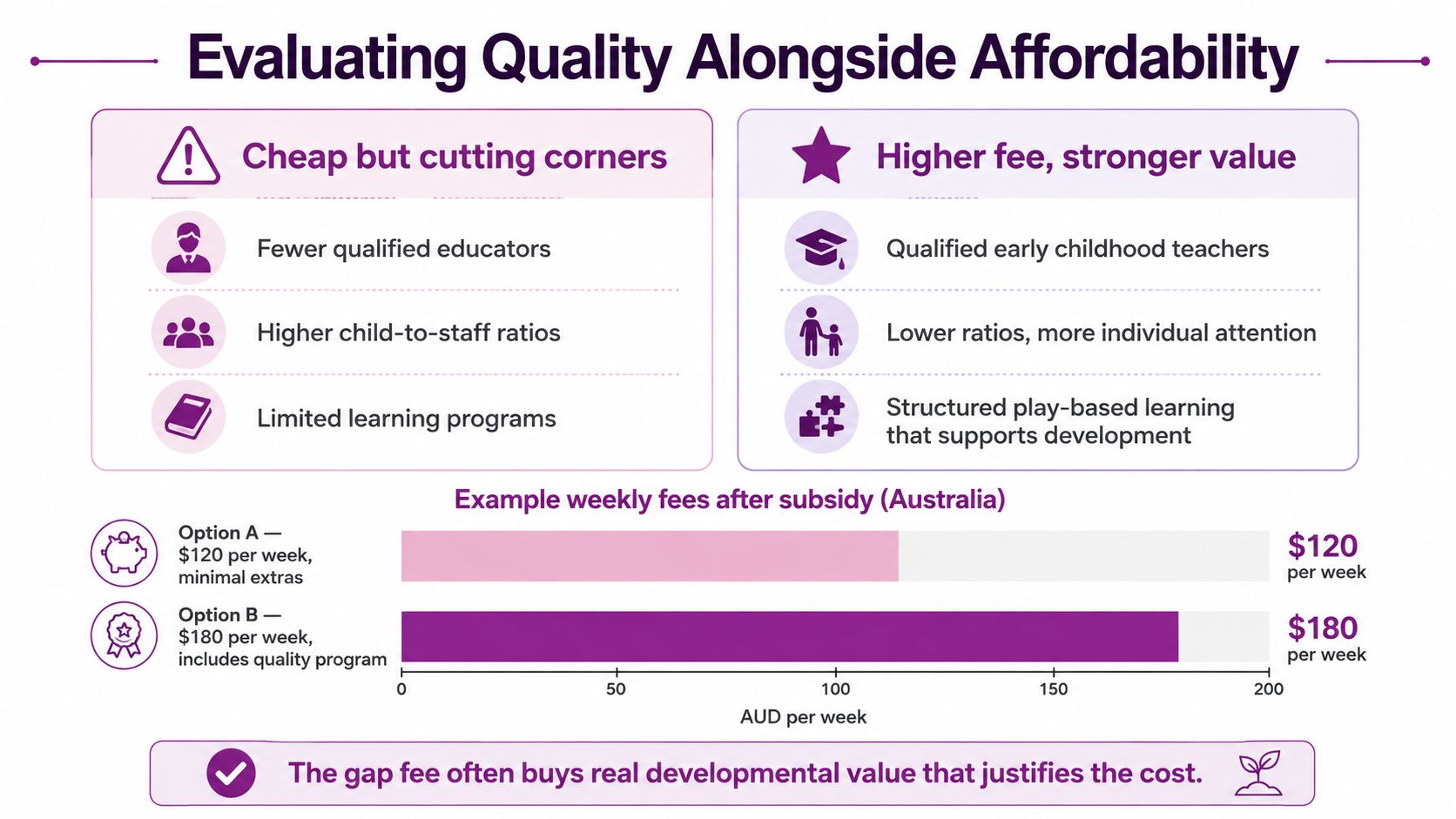
The chart's weekly examples are illustrative, not a verified price comparison. Don't treat its dollar amounts as local quotes or assume that a higher fee automatically means better care. Ask to see the program, meet educators and check what the fee includes.
Compare the service, not just the price
On a tour, ask who leads each room and what qualifications educators hold. Look at how children spend their time, how staff respond to them, and how the service supports transitions between rooms. For a funded kindergarten program, ask which hours are included and how the curriculum connects to the rest of the child's day.
Meals, nappies, music and sports can also affect the true household cost. If a centre includes items you'd otherwise arrange or pay for, account for that when comparing fees. Check the safety routines and the way the team communicates with families, too. A useful tour gives you specific answers, not just a polished brochure.
Look for fit and continuity
Kids Club Early Learning Centre offers a Reggio Emilia-inspired program led by VIT-registered teachers, with dedicated environments for infants and toddlers and for preschool-aged children. Its program includes weekly professional music and sports curricula at no extra cost, alongside government-funded kindergarten and a four-year-old pre-Prep program. Those are concrete points to ask about and compare with other services; they don't replace checking the fee schedule, staff and daily experience for yourself.
The best choice is the centre whose actual weekly cost, care hours and learning environment fit your family. Don't pay more for features you won't use, but don't choose on price alone if the service leaves important care needs or costs unresolved.
Enrolment Steps for Springvale South, Dandenong North and Ferntree Gully Families
Start by confirming your CCS position before you compare placements. Check that your household has applied, confirm the activity hours that apply to your circumstances, and find out what information needs updating if your work or study pattern changes. This gives you a more useful basis for asking centres about likely fees.
Next, shortlist CCS-approved services that match the days and hours you need. If your child is kindergarten-aged, ask whether the centre participates in Free Kinder and how its funded hours sit within the full booking. Families in Springvale South, Dandenong North and Ferntree Gully should also weigh the practical commute: a convenient location can make a regular care arrangement easier to sustain.
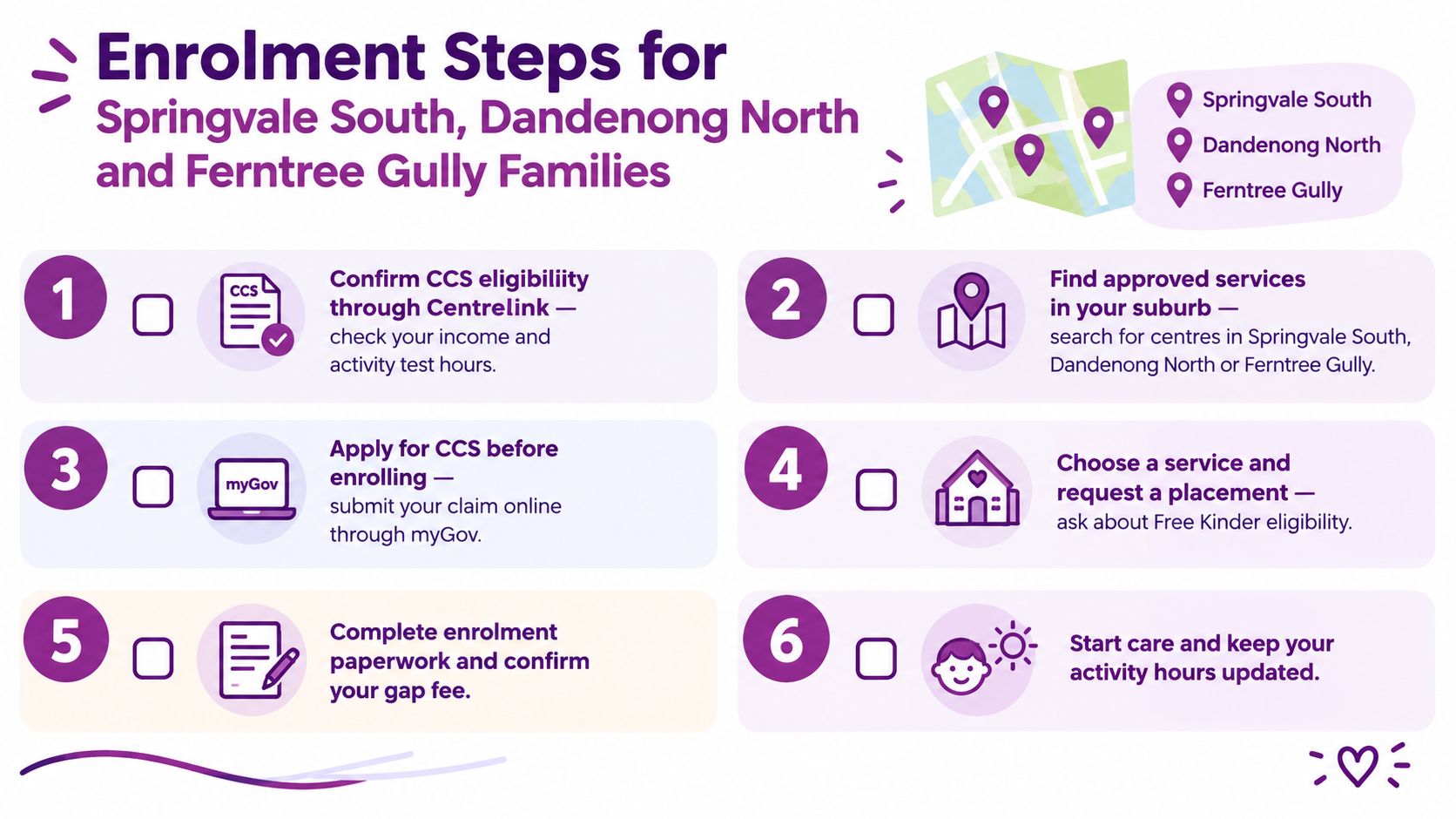
Kids Club Early Learning Centre has locations serving these Melbourne suburbs, with enrolment support for families comparing flexible care, infant-to-preschool continuity and funded kindergarten in one setting. If Ferntree Gully is on your shortlist, review the Ferntree Gully childcare information and ask the centre to explain how its available days fit your schedule.
Take this checklist to the tour
Bring your expected attendance pattern and ask for answers you can compare across centres:
- Written fee schedule: Request a clear split between funded kindergarten hours and additional care hours.
- Inclusions: Confirm whether meals, nappies and enrichment activities are included or charged separately.
- Absence policy: Ask what you'll pay when your child misses a booked day.
- Transition support: Find out how the service helps children move between rooms and settle into care.
- Invoice details: Ask how CCS and Free Kinder will be shown and what your estimated gap will be.
Before signing, make sure the service's estimate matches the days and hours you requested. If you change your booking later, ask for a revised estimate rather than assuming the original weekly figure still applies.
Your Affordability Toolkit Before You Enrol
Before you book a place, write down three things: your CCS percentage, the funded kindergarten hours available to your child, and the attendance pattern your family needs. These make the biggest difference to whether an advertised fee translates into a workable weekly budget. If you don't know one of them yet, treat any total as provisional.
Take the same questions to every provider, including Kids Club Early Learning Centre. Ask for the fee after subsidy, the separate Free Kinder calculation, what the centre charges for absences, and what's included in the daily fee. Compare the answers in one place so a lower headline rate doesn't distract you from extra charges or a less suitable schedule.
A trustworthy estimate shows its working. If you can't tell how the centre calculated your gap, you can't compare its quote fairly.
Watch for a price that sounds clear but leaves basic questions unanswered. Does it cover the actual hours you need? Are funded kindergarten hours distinguished from additional care? Do you know whether meals and nappies are included, and what happens when your child is away? Get those details in writing before you accept a placement.
Finally, think beyond the first invoice. An infant's care needs won't necessarily match the schedule or funding available once they reach kindergarten age. Ask how the service supports transitions from infant care through toddler and preschool rooms, and review your budget whenever your family's attendance pattern or subsidy circumstances change. That's how you make an enrolment choice that works for more than the first few weeks.
Kids Club Early Learning Centre offers care from infancy through preschool, alongside government-funded kindergarten, a pre-Prep program and weekly music and sports curricula at no extra cost. Compare your expected attendance and subsidy with the centre's written fee schedule, then visit Kids Club Early Learning Centre to discuss a placement that fits your family.