
A toddler drops to the supermarket floor because the crackers are in the wrong packet. A preschooler refuses to leave the playground, while a baby flings food from the high chair and watches it land. You've asked calmly, repeated yourself, and reached the point where your own patience feels very thin.
These moments don't mean you're failing, and they don't mean your child is deliberately making life difficult. Young children are still learning to manage strong feelings, wait, communicate needs and recover from disappointment. Positive discipline gives adults a practical way to guide that learning without using fear, pain or shame.
A Common Moment and a Better Way Forward
At the playground, a parent might say, “It's time to go,” while the child keeps climbing. The request is repeated, then sharpened: “Come on. Now.” The child cries, the parent lifts them away, and both arrive home upset.
A different response doesn't remove the disappointment, but it changes what the child learns. The adult moves close, acknowledges the feeling and gives a clear limit: “You really want another turn. It's time to leave. You can walk to the gate or I can carry you.” The child may still protest. Positive discipline isn't a promise of instant cooperation. It's a way to stay calm and teach through the protest.
The same approach works at mealtimes. Instead of treating thrown food as cheekiness, you can block the next throw, state what you expect and offer a suitable alternative: “Food stays on the table. If you're finished, you can give it to me.” The child receives a firm boundary without being labelled naughty.
Practical rule: Be warm about the feeling and firm about the limit.
This matters in Melbourne homes and early-learning rooms because adults often respond to the same behaviour in different ways. A child may hear one message at home, another at care and a third from a tired relative. Consistent words, predictable routines and calm follow-through make expectations easier to understand.
The evidence, Australian policy and everyday classroom practice point in the same direction. Children need adults who prevent avoidable problems, teach replacement skills, interrupt unsafe behaviour and help them repair relationships. Positive discipline is not about allowing everything. It's about making the limit teachable.
What Positive Discipline Actually Means
Positive discipline is relationship-based guidance that teaches children what to do. It combines warmth with clear expectations, rather than relying on fear, pain, humiliation or threats. An educator acts more like a coach helping a learner practise a skill than a referee handing out penalties after every mistake.
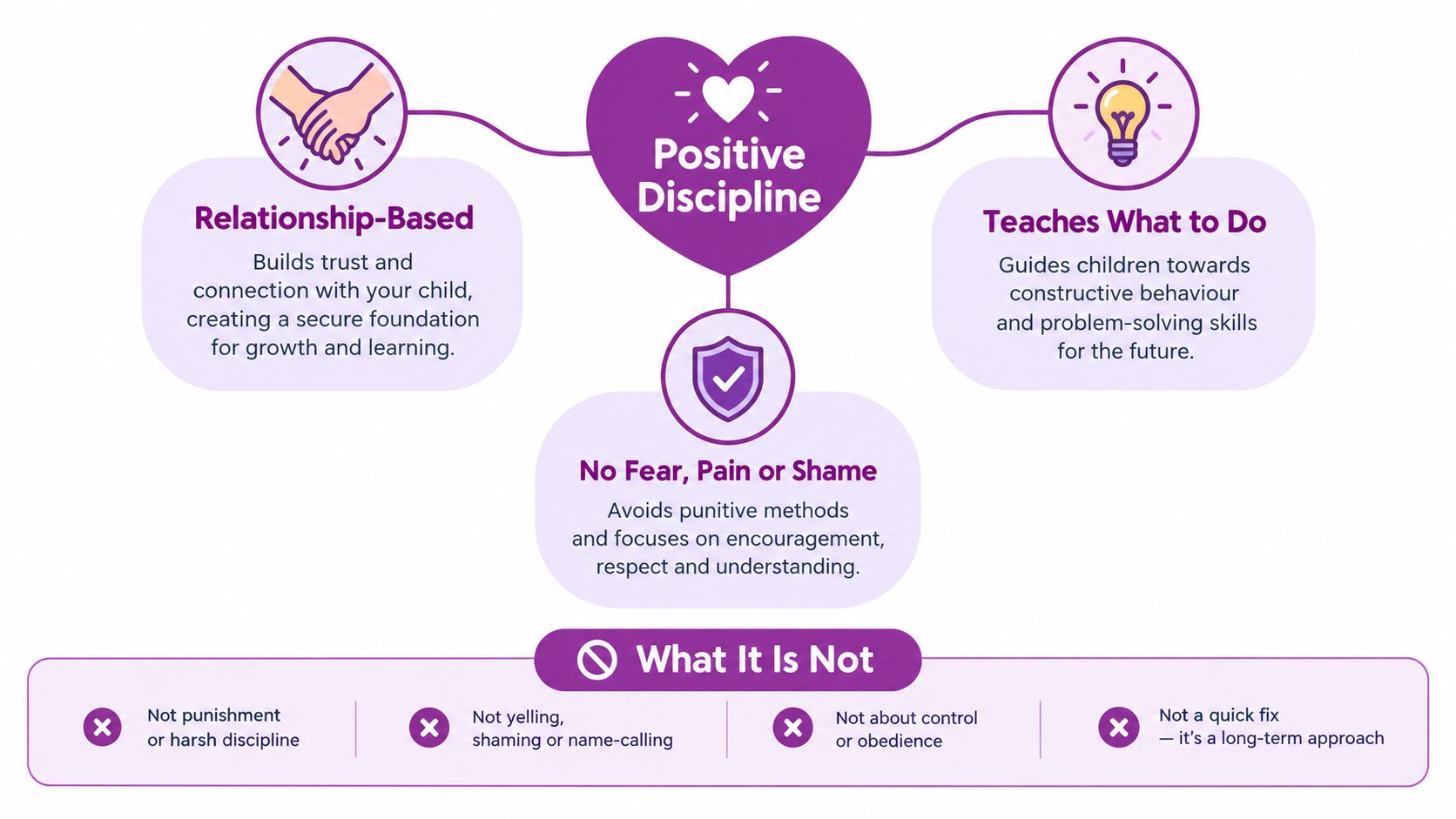
That distinction can be confusing. Positive discipline isn't permissive parenting, where adults avoid limits because they don't want children to feel upset. It also isn't punitive discipline, where adults seek compliance through intimidation or pain. The adult remains responsible for safety, routines and boundaries, while the child gets support to develop the skills needed to meet those boundaries.
Four building blocks
Warm relationships come first. Children are more available for guidance when they feel safe, known and connected. A greeting at the door, a calm tone and a few minutes of shared play can make later transitions easier.
Clear expectations tell children exactly what to do. “Use gentle hands” is more useful than “Don't be rough”. “Feet stay on the floor” gives a young child an observable action to practise.
Skill-building treats behaviour as information. A child who grabs may need help asking for a turn. A child who screams may need words for “I'm still using it” or “Help me”.
Predictable consequences connect the response to the behaviour. If water is repeatedly poured onto the floor, the adult may put the cup away and offer water again later, while helping the child wipe the spill. The response is calm, related and proportionate.
Positive discipline also leaves room for repair. A child can help rebuild a block tower, check on a friend or practise asking before taking. The purpose isn't to make the child feel bad. It's to help them understand what happened and rehearse a better choice.
The Australian Evidence and Why It Matters
A child who is shouted down or hit may stop in the moment, but that does not mean they have learned what to do next time. Australian evidence gives families a clear reason to move away from physical punishment. The Australian Institute of Family Studies reports that a meta-analysis covering more than 160,000 children found physical punishment associated with increased aggression, antisocial behaviour, emotional and mental-health difficulties, lower self-esteem, reduced cognitive ability and poorer parent-child relationships, as described in the Australian Institute of Family Studies evidence summary.
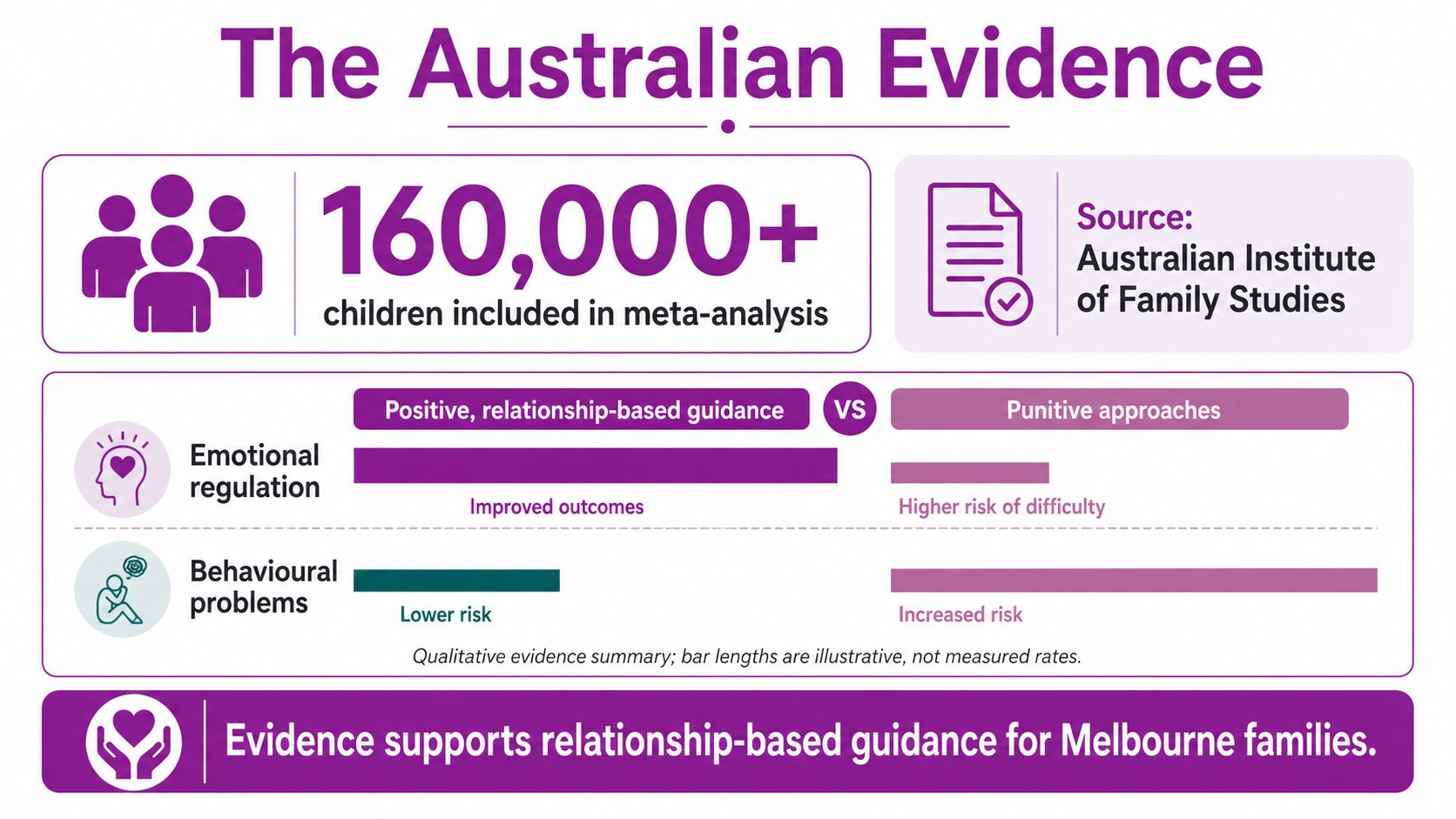
That shifts the practical question for parents and educators. A response should teach something useful, not just end the behaviour fast. Punishment may interrupt an action in the moment, but it does not reliably build emotional regulation, communication or problem-solving. Positive discipline focuses on those skills directly, so children can use them again later in the day, at home, in care, and in the middle of busy group routines.
Australian law also sets a firm professional standard in education and care. Section 166 of the Education and Care Services National Law prohibits corporal punishment in approved education and care services, including its use by providers, supervisors, staff, volunteers and family day-care educators. The prohibition also includes failing to prevent corporal punishment. At home, the legal position is still different across states and territories, because parents may still use physical force judged “reasonable”, as outlined in the Australian Institute of Family Studies resource on physical punishment legislation.
What families can take from this
For families using childcare or kindergarten, the standard is clear. An early-learning service should protect children's dignity and safety while teaching cooperation through guidance, co-regulation, redirection and repair.
At home, the same approach can start with one short sentence. “I won't let you hit. I'll help you keep your hands safe” gives a firm boundary and tells the child what happens next. That kind of response works like a handrail on stairs. The limit stays in place, and the child gets something steady to hold onto while they learn. Positive discipline keeps the limit teachable while still allowing everything that is safe.
Core Strategies You Can Use Every Day
Start with one small change. During a difficult routine, shorten your language, move closer and tell the child the action you want to see.
Make the expected action visible
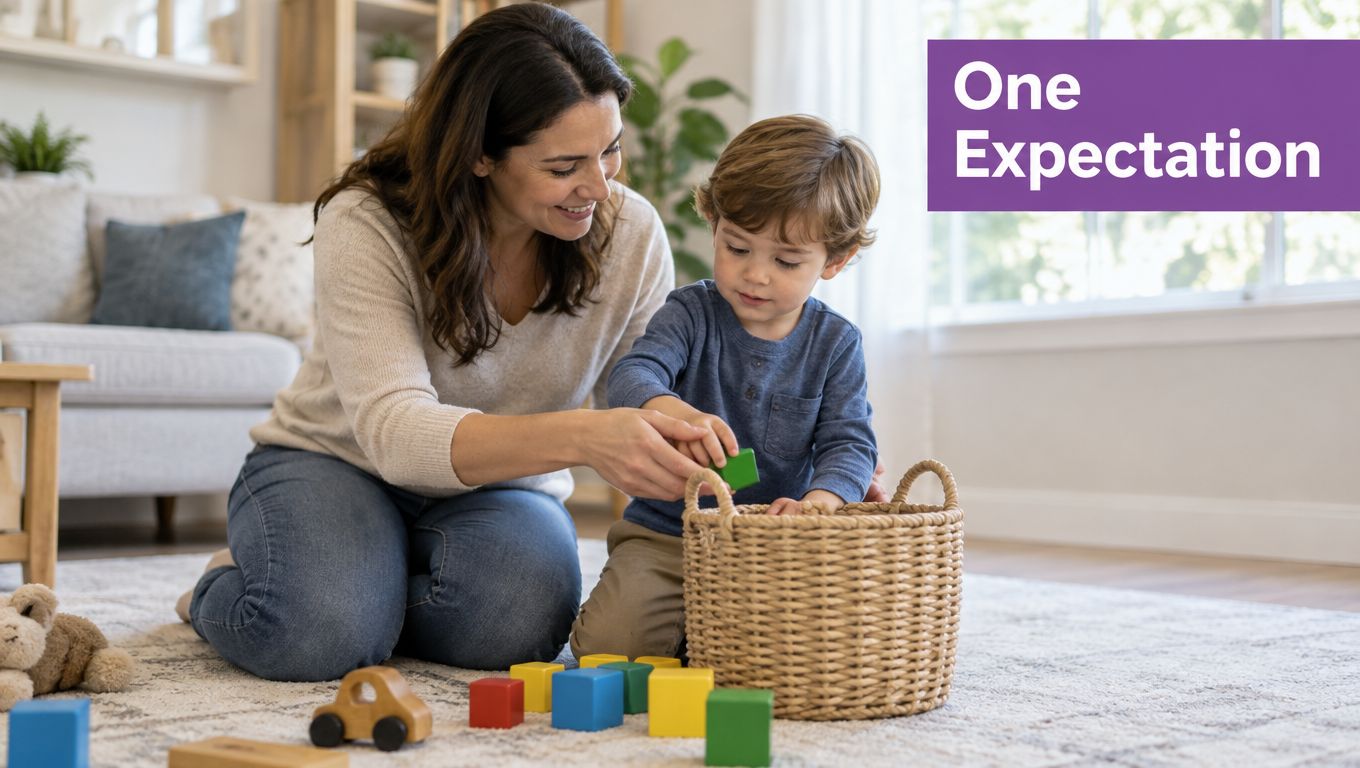
Give one observable expectation at a time. “Blocks stay on the mat” is easier to follow than a long explanation about mess, sharing and listening. After the child follows it, acknowledge the exact behaviour: “You put the block on the mat. That keeps the walkway clear.”
Limited choices can reduce unnecessary power struggles. Offer two options that both meet the adult's boundary: “Do you want to put your shoes on the chair or the step?” Choices aren't negotiations about whether the routine happens. They give the child a manageable way to participate.
Name feelings, then redirect
A feeling can be accepted without accepting unsafe behaviour. Try, “You're angry because the truck is being used. I won't let you grab it. You can ask for a turn or choose the bus.”
Redirection works best when it includes an acceptable action. Move a child away from hitting and offer a cushion to push, a drum to bang or words to practise. For ideas that support calm sensory exploration at home, families can use this guide to make sensory bottles.
Use related consequences and repair
A proportionate consequence answers the behaviour without adding shame. If paint is thrown, painting stops briefly while the child helps clean the table. If a child knocks down another child's construction, an adult can help rebuild or ask what would make the situation safer next time.
Repair doesn't need to be forced as a performance. A child who isn't ready to say sorry may still return a toy, fetch an ice pack or sit nearby while the other child settles. These actions teach responsibility more effectively than a demanded phrase the child doesn't yet understand.
The following video offers another visual example of adults supporting young children through behaviour and emotion:
Look for patterns with the ABC lens
When a behaviour repeats, record three parts:
- Antecedent: What happened immediately before? Was the child hungry, rushed, asked to stop playing or unable to reach a toy?
- Behaviour: What did the child do that you could see or hear? For example, they pushed, shouted or threw the cup.
- Consequence: What happened afterwards? Did the adult give extra attention, remove the demand, provide the toy or change the activity?
This isn't about blaming the child. It helps adults adjust the environment and teach a missing skill. If transitions trigger distress, give a warning, show a visual cue and offer a job such as carrying the bag. If grabbing happens during shared play, practise “Can I have a turn?” before the next conflict.
Adapting Positive Discipline by Age
The principle stays steady as children grow, but the adult's tools need to change. A baby can't reason through a long explanation. A preschooler can begin to discuss a problem, consider another person's perspective and help create a classroom solution.
| Stage | Primary focus | Everyday strategies | What to limit |
|---|---|---|---|
| Infants | Co-regulation, safety and predictable care | Stay close, reduce hazards, use a calm voice, keep routines familiar and redirect gently | Long explanations, delayed consequences and expecting self-control beyond the child's development |
| Toddlers | Feelings, simple language and safe choices | Name emotions, offer two choices, use short instructions and physically block unsafe actions | Repeated lectures, open-ended choices and labels such as “naughty” |
| Preschoolers | Problem-solving, participation and transition skills | Use visual routines, discuss group rules, give warnings and involve children in repair | Public shame, vague threats and consequences unrelated to the behaviour |
Infants need prevention and co-regulation
For babies, adults do most of the regulation. Move the tempting object, secure the environment and respond to tiredness, hunger or overstimulation before distress grows. A calm “You're upset. I'm here” paired with holding, rocking or a quieter space teaches safety through repeated experience.
Toddlers need short, repeatable language
Toddlers often understand more than they can express. Get close, use a few words and show the alternative: “You want the cup. I won't let you throw it. Cup stays on the table.” Then offer, “Water or milk?”
The developmental guide for five-year-olds is useful for seeing how expectations change as children gain language and independence. Even with older preschoolers, keep limits concrete and avoid asking questions when the adult has already made the decision.
Preschoolers can practise solutions
Preschool children can help create group agreements such as “hands are for helping” and “we walk inside”. Before leaving the park, show a visual or give a clear warning: “Two more slides, then shoes.” After a conflict, ask, “What happened? Who was affected? What could we try next time?”
The child still needs adult leadership. Problem-solving isn't a way to hand over responsibility for safety. It's a way to involve children in the skills they're ready to learn.
Common Challenges and How to Handle Them
Some parents worry that kindness will spoil a child. The confusion comes from treating warmth and firmness as opposites. A child can hear, “I love you, and I won't let you hit” in the same moment. The relationship stays secure while the boundary stays clear.
Public tantrums create a different pressure. At the supermarket, lower your voice rather than raising it, move the child away from hazards and say, “You wanted the chocolate. We're not buying it. You can hold my hand or sit in the trolley.” If the child can't manage either option, help them safely and leave when necessary. You don't need to win an audience.
Sibling conflict often escalates because children compete for adult attention. Separate bodies first, then listen to each child briefly. “You both wanted the same truck. I won't let anyone pull it. The truck will rest while we work out turns.” When everyone is calm, practise the words and decide what happens next.
Repeated behaviour can exhaust even a patient parent. Repetition isn't evidence that the boundary has failed. Young children need adults to respond in a similar way across many ordinary moments before the replacement skill becomes reliable.
Remember: A calm response can be consistent without being identical. Adjust the amount of help, but keep the safety limit and the expected action steady.
If you lose your temper, repair directly: “I shouted. That was too loud. I was frustrated, and I'm going to try again.” Repair models accountability without making the child responsible for the adult's emotions.
How Kids Club ELC Puts Positive Discipline Into Practice
At Kids Club Early Learning Centre, positive discipline can be translated into the ordinary rhythm of infant-toddler and kindergarten rooms. Educators use short instructions, emotion-coaching language, visual routines and shared reinforcement criteria so children encounter familiar guidance across the day.
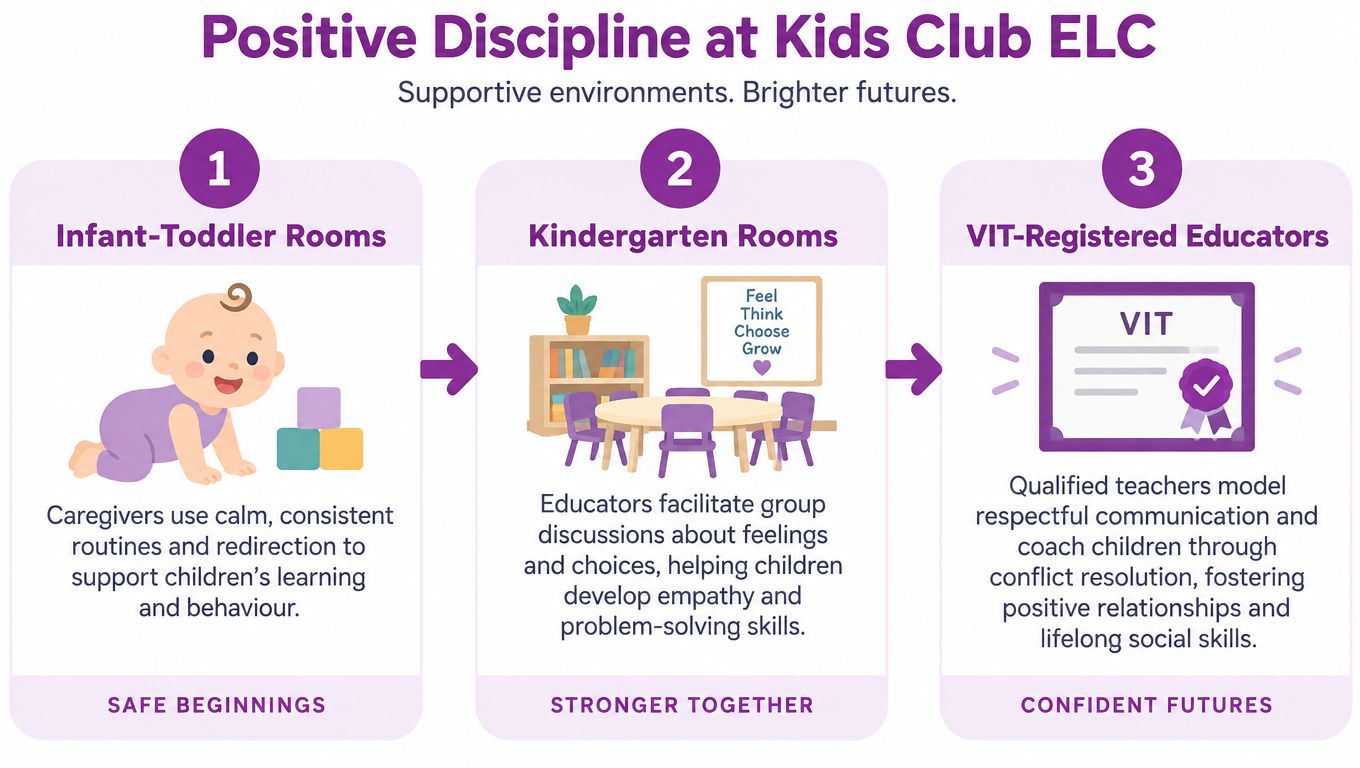
In an infant-toddler room, that may mean moving close, blocking an unsafe action and redirecting the child towards a safe object or activity. In a kindergarten room, educators can support children to name feelings, discuss choices and participate in repairing a conflict. The language changes with development, but the adult response remains respectful and predictable.
Educators also need to look beyond the incident. Recording triggers, antecedents, behaviour and consequences helps a team identify whether a child struggles during noisy transitions, shared resources, rest periods or particular social situations. The team can then adjust the environment, timing or teaching approach instead of treating the behaviour as a fixed personal problem.
This fits with a Reggio Emilia-inspired, inquiry-led approach because children are treated as capable participants in their learning. The Early Years Learning Framework principles and practices provide useful context for connecting relationships, play, identity and learning in early childhood.
Families strengthen the approach by sharing useful information with educators. Tell the room team which words your child uses for feelings, what helps during transitions and which routines are familiar at home. Ask what phrases educators use at the centre, then repeat the same simple language where possible. When home and care offer matching expectations, children don't have to decode a new response every time they struggle.
Bringing It All Together at Home
Build the relationship, name the skill, set the limit, then help your child repair and practise. Positive discipline doesn't mean every moment will be calm. It means your responses give children repeated opportunities to learn cooperation, communication and self-regulation without fear or shame. Choose one strategy this week, observe what happens and adjust gently rather than trying to change everything at once.
Families in Springvale South, Dandenong North and Ferntree Gully can learn more about programs for children from six weeks to six years, including infant-toddler care, kindergarten and pre-PREP options, by booking a visit.
Kids Club Early Learning Centre offers nurturing programs, VIT-registered educators and developmentally aligned environments where positive discipline is part of daily care and learning. Visit Kids Club Early Learning Centre to explore the programs in Springvale South, Dandenong North and Ferntree Gully and arrange a tour.