
In Victoria, Pre-Prep is the government's name for an expanded, funded Four-Year-Old Kindergarten year in the twelve months before school. The program remains play-based and teacher-led, with children learning through experiences rather than formal lessons. The number of funded hours is changing: the Victorian Government's early childhood update describes a shift from around 15 hours a week to 16 to 30 hours, depending on where a family lives and the cohort a child belongs to, with a goal of 30 hours for every four-year-old by 2036.
On Sunday night in Dandenong North, a kinder bag waits by the door with a hat, spare clothes and a note from the educator about the week's project. The bag hints at what families want to know when they search “what is Pre-Prep”: what their four-year-old will do, and how many of those hours are funded. The key is to look beyond a list of subjects. Longer hours still make room for play, conversation and learning through the ordinary rhythms of a child's day.
What Pre-Prep Means in Victoria
The bag by the door tells the story before any policy document does. A four-year-old's kindergarten week in Victoria is getting longer, and the name attached to the longer version is Pre-Prep.
In Victoria, pre-prep refers to the staged expansion and renaming of Four-Year-Old Kindergarten into a longer, government-funded program of play-based learning for children in the year before school, as the Victorian Government's early childhood update sets out. That's the definition in one breath. Everything after it is about hours, settings, and what those hours are spent doing.
The hours are easiest to hold in a single view.
| Stage | Who it covers | Weekly hours | Notes |
|---|---|---|---|
| Earlier Four-Year-Old Kindergarten | Four-year-olds before the reform | About 15 | Previous funded standard |
| 2025 rollout | Children in six Victorian local government areas | 16 to 30 | Staged start, not yet statewide |
| 2036 target | Every Victorian four-year-old | 30 | Universal access goal |
| Pre-Prep before school | Children who complete the full program | 1,200 hours in total | Across the Pre-Prep year |
| Plus Three-Year-Old Kindergarten | Children who also do the three-year-old year | 600 hours | Combined total 1,800 funded hours |
Read the first two rows against each other. The previous funded standard was about 15 hours a week. The reform began rolling out in 2025 across six Victorian local government areas, with programs initially ranging from 16 to 30 hours per week, so some families met the longer week first and others are still waiting for their area to open.
The long-term target is universal access to 30 hours of Pre-Prep each week for every four-year-old by 2036. Add the years together and the end point is 1,200 hours of Pre-Prep before school on top of 600 hours of Three-Year-Old Kindergarten, which comes to 1,800 funded kindergarten hours in total.
For families in Melbourne's south-eastern suburbs, including Springvale South, Dandenong North and Ferntree Gully, pre-prep therefore means the Victorian kindergarten pathway for four-year-olds, becoming longer and more in-depth, while still being delivered by qualified early-childhood teachers in approved kindergarten or long-day-care settings. The play-based learning at the centre of it supports language, early literacy, numeracy, social development, communication, independence and positive relationships rather than formal academic instruction.
The one-line version: Pre-Prep is the four-year-old kindergarten year, longer and funded, and still built on play.
One distinction decides how a working week fits together. Funded kindergarten hours and a full care booking are not the same thing, and treating them as interchangeable is where most of the confusion about "free" hours starts.
How Pre-Prep Differs from Kindergarten and Prep
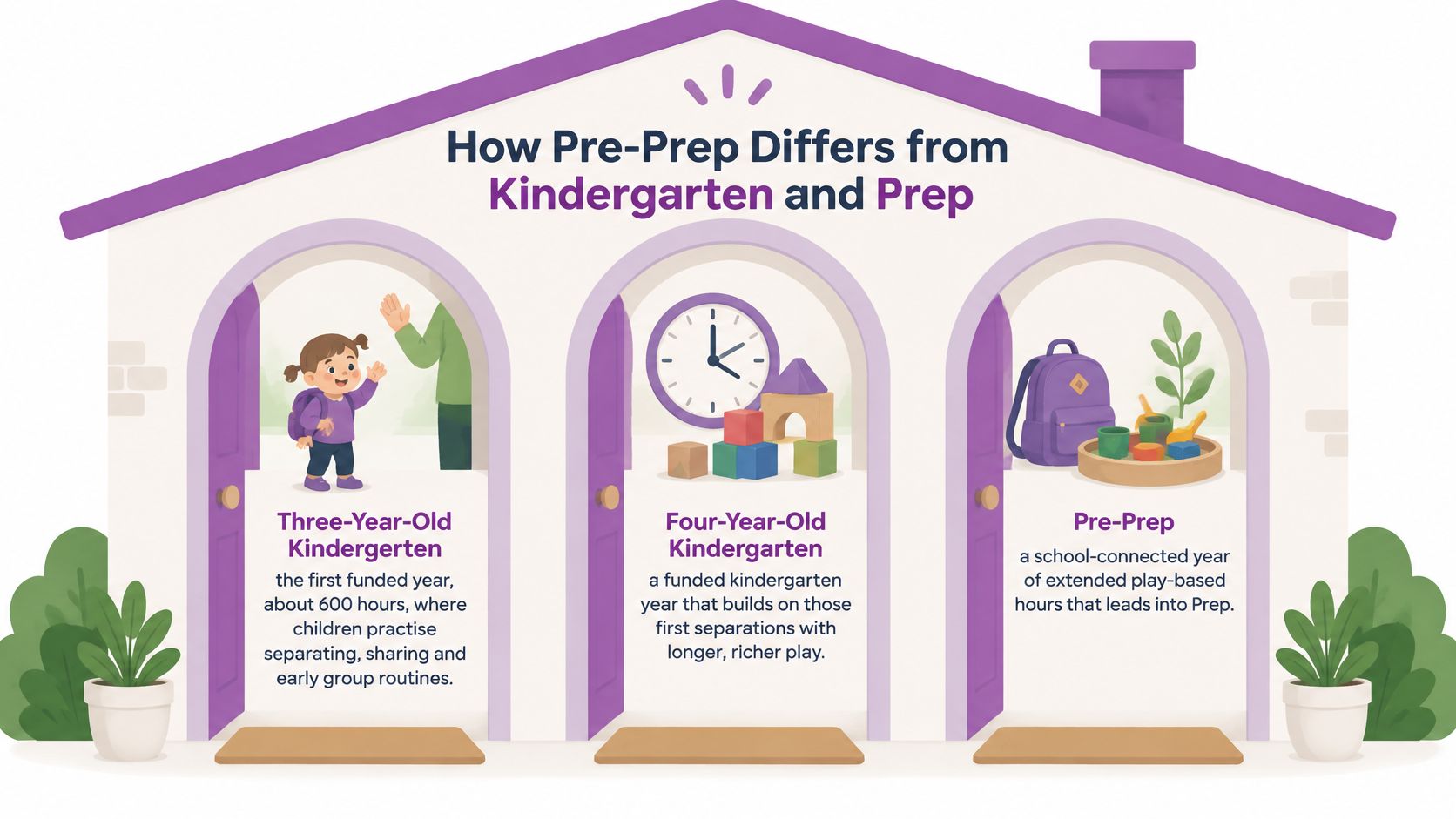
The names can blur together, but each marks a different part of a child's journey. Three-Year-Old Kindergarten comes first, Pre-Prep is the kindergarten year before school, and Prep is the first year at school.
| Program | When | Who leads it | What learning looks like | What it is not |
|---|---|---|---|---|
| Three-Year-Old Kindergarten | Before Pre-Prep | Qualified early childhood teacher | Play, relationships and early language | The school-entry year |
| Pre-Prep | Year before school | Qualified early childhood teacher using the VEYLDF | A longer, play-based four-year-old kindergarten year, with funded hours that vary by cohort and location | A mini-school or worksheet program |
| Prep | First year of school | School teacher | A school day and the school curriculum | Kindergarten or a funded Pre-Prep program |
The two rows parents mix up most
Pre-Prep and Prep belong to different settings. Pre-Prep stays within early childhood education: a qualified early childhood teacher plans play-based learning using the Victorian Early Years Learning and Development Framework, as the Victorian Government's family guidance on Pre-Prep explains. Children learn through experiences such as talking, creating, moving and playing with others, rather than through a school-style worksheet program.
In Prep, children begin a school day with a school teacher and the Victorian Curriculum.
Three-Year-Old Kindergarten comes earlier. In a group, a child can practise separating from a parent, sharing blocks and using words to ask for help. The guide to three-year-old kindergarten explains what that first kindergarten year can involve.
What a long day care setting changes
A long day care service may offer the kindergarten learning program within a longer care day. The teacher-led kindergarten hours are one part of that day; care outside those hours is separate from the funded kindergarten program.
A child's day can include both kinds of time, much as a book has chapters with different purposes. The distinction helps families understand what the kindergarten program provides and what their care booking covers.
A child can be ready for school while still learning through play.
Funded Hours for Priority Groups and Working Families
A family may have a place for the day, yet still need to know which hours are funded kindergarten and which are care. In Victoria, the answer depends on a child's eligibility and the program's funded hours.
From 2026, children in specified priority groups can access Pre-Prep statewide. The available hours vary; check the Victorian Government's guidance on when Pre-Prep will be available and ask the service what applies to your child.
| Situation | Funded hours | Yearly picture | Care still to arrange |
|---|---|---|---|
| Priority cohort from 2026 | Hours vary by eligibility and program | Set by the weekly hours and weeks offered | Care outside the funded kindergarten hours |
| Broader rollout enrolment | At least 16 hours a week where funding rules apply | 640 hours across 40 weeks | A long day care day or before- and after-care if needed |
| Additional funded year | One extra year of Three-Year-Old Kindergarten or Pre-Prep | One additional funded year | Care outside the funded kindergarten hours |
Who counts as priority
The specified groups include:
- Aboriginal and Torres Strait Islander children.
- Children from refugee or asylum-seeker backgrounds.
- Children who have had contact with Child Protection.
- Children supported through Early Start Kindergarten or Access to Early Learning.
If one of these descriptions may apply to your family, raise it during enrolment. The service can explain how eligibility is confirmed and what information is needed.
For children in the broader rollout, funding rules can require enrolment for at least 16 hours a week across 40 weeks, or 640 hours annually. That is the enrolment floor, not a promise that every hour of a child's week is funded.
Three checks before you assume care is funded
- Confirm your child's cohort. Ask whether priority-group eligibility applies and which funded hours are available.
- Separate the two parts of the day. Ask the service to show which hours are funded kindergarten and which are booked as care.
- Plan for the remaining hours. If the funded block does not cover your family's schedule, you may need long day care or another care arrangement.
Eligible children may access one additional funded year of either Three-Year-Old Kindergarten or Pre-Prep, not an extra year of both. Check eligibility before making plans around another funded year.
Ask the service: “Which hours are funded kindergarten, and which are booked as care?”
The guide to free kindergarten in Victoria explains how funded kindergarten hours relate to a care booking.
How Play-Based Hours Build School Readiness
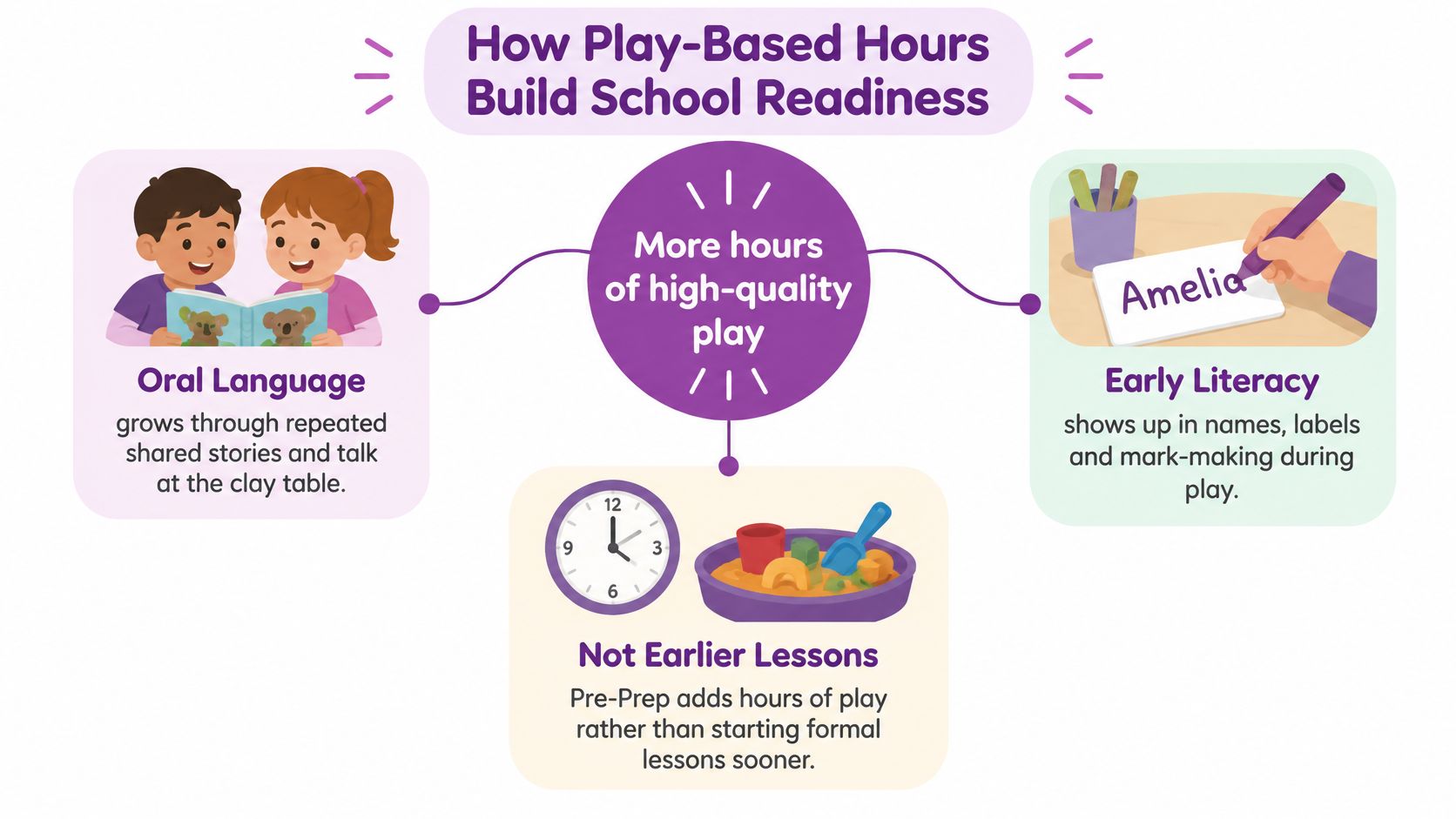
Extra hours don't make a four-year-old read earlier. They make the ordinary things that build reading happen more often, with more repetition and more adult attention.
The evidence base points that way. Victorian Government evidence summaries report that two years of kindergarten can produce larger long-term cognitive, emotional, social, health and academic benefits than one year, and that high-quality kindergarten is associated with stronger literacy, academic and social outcomes, according to the Victorian Government's Early Start Kindergarten material. Government material also links more play-based learning time with potential gains in early literacy, numeracy and self-regulation.
What growth looks like in a room
The mechanisms are ordinary once you know where to look:
- Oral language grows through repeated shared conversations and storytelling. The same picture book read four times in a week, with different questions each time, does more than a new book every day.
- Early literacy shows up in names on lockers, signs on the home corner, mark-making at the clay table, and a child retelling what happened at the water tray. Not a reading drill.
- Mathematical thinking shows up in purposeful counting, sorting, measuring and pattern work: how many cups for the table, which block is longer, what comes next in the tile row.
- Social learning shows up in collaborative projects that require children to negotiate a role, persist when a tower falls, and manage the feeling of not getting the part they wanted.
- Independence shows up in packing a bag, managing a toilet trip, opening a lunchbox and stretching across a longer day.
These are more developmentally aligned than treating school readiness as handwriting speed or rote number recall.
Why a longer week beats a longer worksheet
Thirty hours of worksheets would be a worse childhood than fifteen hours of play. The gain comes from what a longer week makes possible: return visits to an unfinished project, a second attempt at a friendship that didn't work on Monday, and more practice at waiting, sharing and recovering.
A group can build a garden map on Monday, discover on Wednesday that the path doesn't fit, and test a fix on Friday. That sequence is the readiness work. It asks for language, negotiation, measurement and persistence inside one idea.
The test of a good Pre-Prep room: one play idea stretches across the week, and the educators can tell you what it was for.
Extra hours only help while quality stays high. That's why the questions on a tour matter more than the brochure. Ask how a single play idea develops from Monday to Friday. Ask what happens when two children want the same role. Ask how the room builds number thinking without a worksheet.
Readiness, in the end, shows up as an educator-designed progression, purposeful play and conversation. Our explainer on play-based learning in early childhood unpacks how educators plan that progression deliberately rather than leaving it to chance.
A Week of Pre-Prep in a Real Room
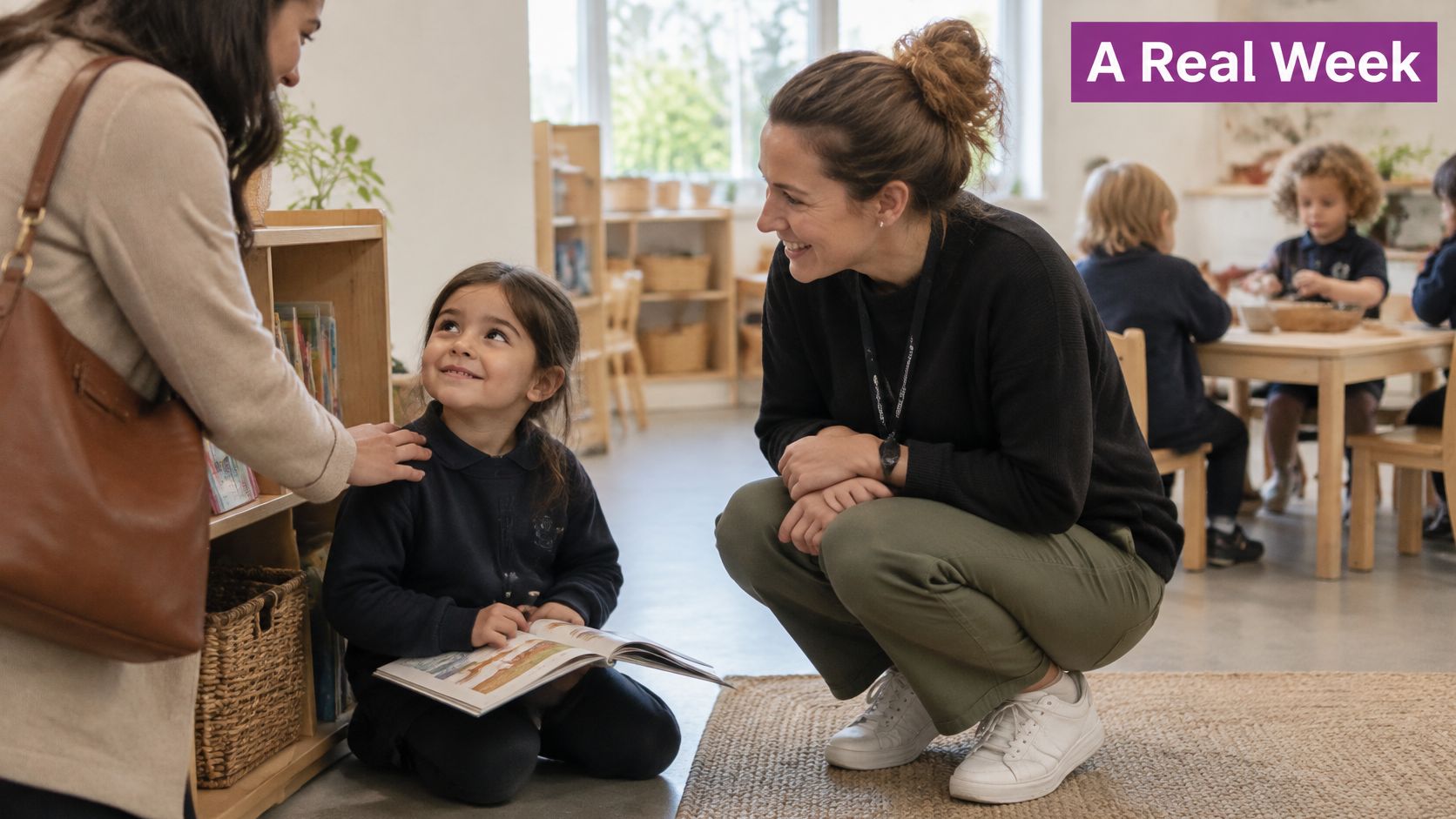
A typical play-based Pre-Prep week can feel less like five separate lessons and more like a story the children return to each day. A shared idea gathers new details, just as a garden grows a little at a time.
Monday, a story about a bear who loses a button invites children to listen, predict what might happen, and explain their ideas. The educator builds oral language through conversation and shared attention.
Tuesday, children build a road for toy cars. When it proves too short, they compare lengths and try measuring. The maths grows naturally from a problem they want to solve.
Wednesday, a pretend shop brings a turn-taking challenge. If two children want the same role, the educator can help them work out a way to share it. Negotiating becomes part of keeping the game going.
Thursday might bring a familiar routine, such as packing a bag or getting ready to go outside. Repeated chances to manage these small tasks help children practise independence at their own pace.
Friday, the group can return to an unfinished project, such as a garden map. The blank corner is an invitation to continue, not a sign that the week has gone wrong.
In long day care, care can extend around the teacher-led kindergarten time. The funded learning hours and the hours a family needs for care are related, but they are not necessarily the same.
Three things to notice on collection
- A child recalls a moment. They might tell you about a car that did not fit or a role they shared. The memory shows how an idea from the day stayed with them.
- Something is still in progress. A map or construction left unfinished can give children a reason to pick up the idea again.
- The educator can explain the play. Ask what children were exploring at the clay table or what the educator hoped they would practise. A clear answer connects the activity with the learning.
Confirm Hours Then Choose a Local Program
Work in order rather than collecting brochures. Confirm the year first: Pre-Prep is the four-year-old year before school, after Three-Year-Old Kindergarten, so a child who turns four mid-year needs a straight answer about which funded year they're entering.
Then ask the service which hours are funded kindergarten and which are paid care, and whether a priority cohort changes the band. Get the weekly split in writing.
Only then look at quality. You want a qualified early-childhood teacher, play with a purpose, and a room that builds talk, number thinking, friendships and independence rather than one that displays finished worksheets.
For families around Springvale South, Dandenong North and Ferntree Gully, Kids Club Early Learning Centre offers Pre-Kindergarten and Kindergarten Programs in a boutique, family-owned centre, which is one local place to see how a four-year-old program sits alongside care for younger siblings.
Three questions worth taking on a visit
- How does the teacher use the VEYLDF to plan what happens in the room, and could they show you an example from this term?
- How long is the kindergarten block on a typical day, and who leads it?
- How does the day work for a child who needs care beyond the funded hours?
Book that conversation before assuming the full funded week has already arrived for your child. Hours, cohort and setting decide more than any brochure sentence about being "school ready".
Kids Club Early Learning Centre offers a four-year-old pre-Prep program and funded three-year-old kindergarten across our Springvale South, Dandenong North and Ferntree Gully centres, with VIT-registered teachers leading play-based learning in purpose-built rooms. If you're still working out how many funded hours your child can access and what care you'll need around them, we can walk you through the weekly split before you enrol. Visit Kids Club Early Learning Centre to book a tour and see a Pre-Prep room in action.