
Two babies born in the same week can start childcare months apart. One family returns to work at four months. The other waits until their toddler is walking and talking. Both can work if the child, the family and the centre are ready together.
The Australian Institute of Health and Welfare states there is no single universally prescribed age at which a child must begin childcare. Preschool or kindergarten generally begins around age four. Victorian children are generally eligible when they turn four by 30 April, and they generally start school when they turn five by 30 April. Preschool attendance isn't compulsory, although Australian governments have supported universal access to a quality program in the year before full-time school since 2008.
So the best age to start childcare is the moment those three line up. The six stages below are a checklist, from early infancy to the year before school. Check the ratio, name the key educator, share the home routine, and ask your questions before you enrol.
1. Six Weeks to Six Months for Early Infant Care and Gradual Settling
Many families start here because leave ends, not because a calendar says they should. In 2008, 9% of Australian children under 12 months were usually in formal care, and parental work commitments were the main reason formal care was required, cited by 59% of families, in figures from the Australian Bureau of Statistics. Those numbers are national and dated. Treat them as a planning benchmark, not a rule for your baby.
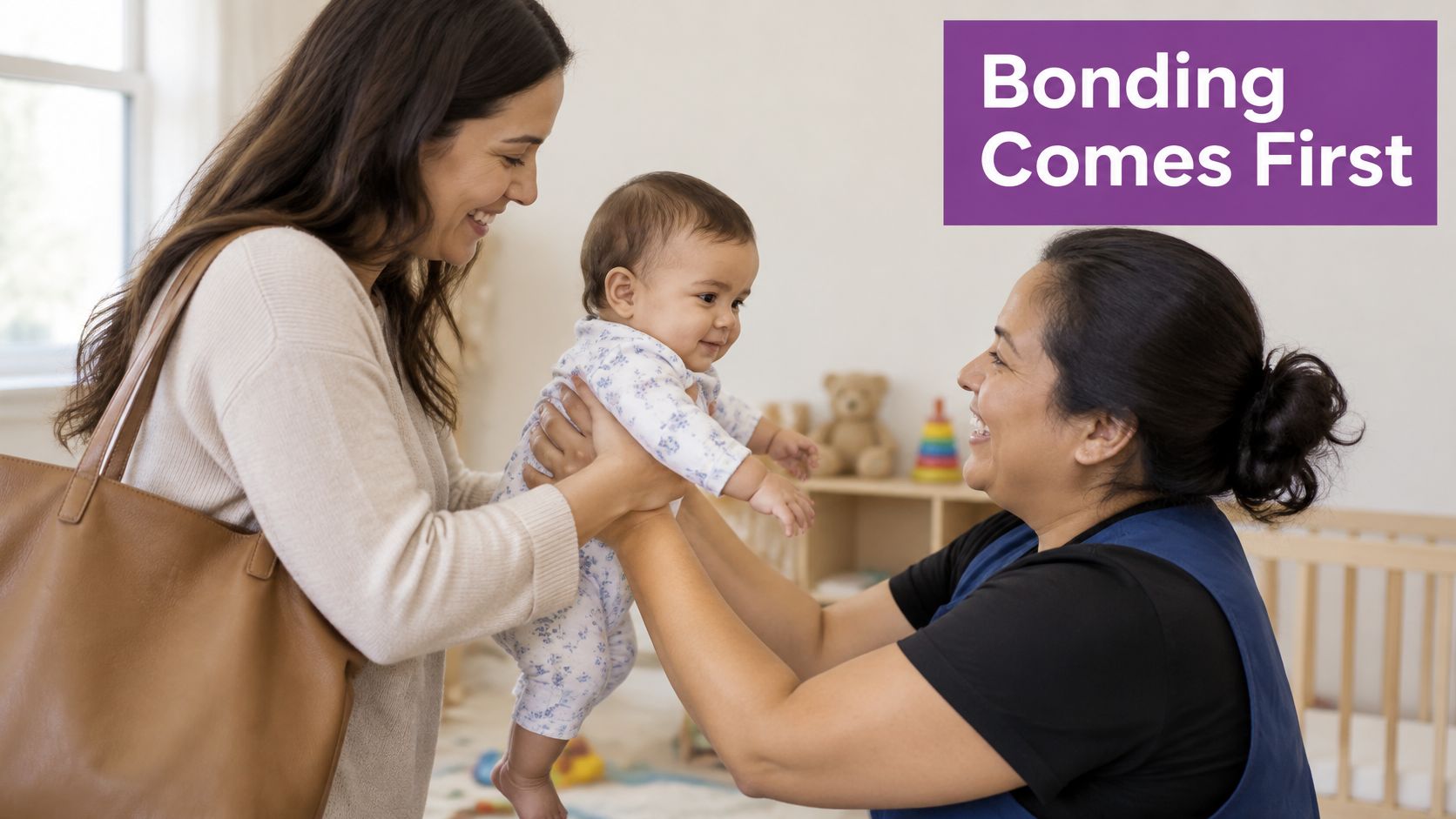
Say you return at four months. On the tour, ask who will be your baby's primary educator on most days. Babies this age are building their first bonds, and they settle when the same adult handles feeds, sleep and comfort. At our Ferntree Gully centre, the baby room runs at a 1:3 ratio, so infants get closer attention than they would in a larger group. Share bottle times, nap cues and how you soothe your baby, then update that note as the weeks change.
What to lock in before day one
- Key educator: Ask who cares for the same infants each day, and who covers when that person is away.
- Home routine: Write feeds, naps and comfort holds on one page and give it to the room leader.
- Gradual start: Use two or three short days first, and stay for the opening hour on day one.
- Daily contact: Confirm photos, a diary or an app before you leave the tour.
Practical rule: A short, planned goodbye beats a long, uncertain one. Your baby learns the pattern faster than the length of the visit.
Our day care for infants follows those early routines from six weeks, in rooms set aside for babies and toddlers. Infant places across Springvale South, Dandenong North and Ferntree Gully fill early, so enquire before your leave end date.
2. Six to Twelve Months for Mobility and Responsive Routines
This is often the loudest stage at the door. Your baby may crawl, pull to stand and show a clear preference for familiar faces. Stranger awareness usually shows up now, so drop-off tears don't mean you chose the wrong week. They mean your child knows who they want.

A nine-month-old we see settle well often has one goodbye, used every morning. A short song, a hug, then a wave at the window. Educators stay, you leave, and the same adult picks the baby up. Sneaking out feels kinder in the moment. It usually makes the next morning harder, because the child can't predict when you vanish.
Floor play and the questions that matter
The room should invite movement, not only sitting in a bouncer. Look for low tunnels, mats and tactile baskets, and ask how toys are checked and cleaned. Babies at this age babble and turn to their name, so you want educators who talk and sing through nappy changes, not only at group time.
- Goodbye script: Keep it short, warm and identical. Tell your baby you will be back after sleep or after lunch.
- Home milestones: Tell educators about new rolls, sits or sounds so they can match the play.
- Comfort item: Pack spare clothes and a small soft toy if the centre allows one.
- Safety check: Ask who supervises floor play when several babies are mobile at once.
If drop-off is still raw after a fortnight of the same goodbye, ask for a shorter day before you add hours. More time in the room isn't the first fix.
3. Twelve to Eighteen Months for Walking and First Words
Many children begin around their first birthday, once they're walking or close to it. Language is jumping, pretend play is starting, and frustration is frequent because the want arrives before the words. That mix is normal. It is also why the educator's response matters more than a colourful room.
Picture a toddler room with a low mirror, a tub of water and loose wooden pieces on the floor. A child who can't yet say "more" points, splashes and watches a peer copy them. Educators name the action in a short phrase, then offer a picture card at the table so the child can point to water or fruit instead of crying for it. That is the best age to start childcare only if your child is curious about other children and you can share how they already communicate at home.
Independence without rushing toilet learning
Readiness for the toilet varies widely at this age. Hand-washing and putting shoes in a bag are fair early goals. Sitting on a potty because the room is "on a program" is not.
- Language: Ask about songs, shared books and how objects are named during play.
- Home cues: Tell staff the signs and words your toddler already uses, including "no".
- Conflict: Ask how biting is handled, who calls you, and what you will hear the same day.
- Practice at home: Repeat one small job, such as washing hands before a snack, so the centre step feels familiar.
A Reggio Emilia approach fits this age when children explore open materials and small projects, rather than sitting for long group times. We use inquiry, creativity and collaboration in that way, with infant and toddler programs in dedicated spaces from six weeks to three years.
4. Two to Three Years for Social Play and Group Learning
Between two and three, many children hit a language burst and start to play with peers, not only beside them. Turns, simple rules and shared ideas become possible. Tantrums don't disappear. They get louder when a child can almost explain the problem and then can't.
A weekly music session is a clean test of the room. Songs with actions and a simple shaker teach waiting, copying and rhythm without a worksheet. A pretend shop with containers and play money does the same job for early maths talk. If you want that mix of movement and social play, ask what runs every week, not only on open day.
Watch how two-year-olds practise turn-taking in a music session before you decide this is your start window.
Keep home and the room on the same script
Toilet learning often moves forward now, and it stalls when home says "wee" and the centre says something else. Agree the words and the steps in week one. Read a short book at night so vocabulary isn't left entirely to the day.
- Emotions: Ask which phrases educators use when a child hits, snatches or melts down.
- Group size: Watch whether two-year-olds can hear an adult without being shouted over.
- Enrichment: Look for music and movement in the normal week, not as a paid add-on.
- Social practice: Notice whether children are helped to join play, or left to "work it out".
We include weekly professional music and sports in the program at no extra cost, because copying actions with a group builds confidence at this age. For a closer look at what peer play should look like, see our guide to social skills for children.
5. Three Years for Victorian Kindergarten and School Readiness
Three is a widely used transition in Victoria, not a universal start line. Some children have been in care since infancy. Others walk into a kindergarten room as their first formal group. In 2024, 69,802 children took part in Victoria's three-year-old kindergarten, 90.1% of eligible children, with an average of 13.8 teacher-delivered hours a week. In the same year, 78,554 children were in the 15-hour four-year-old kindergarten program, 96% of eligible children. The Victorian Government also reports that more than 143,000 children benefited from Free Kinder in 2024, and that 88% of services offered 15 hours of three-year-old kindergarten.
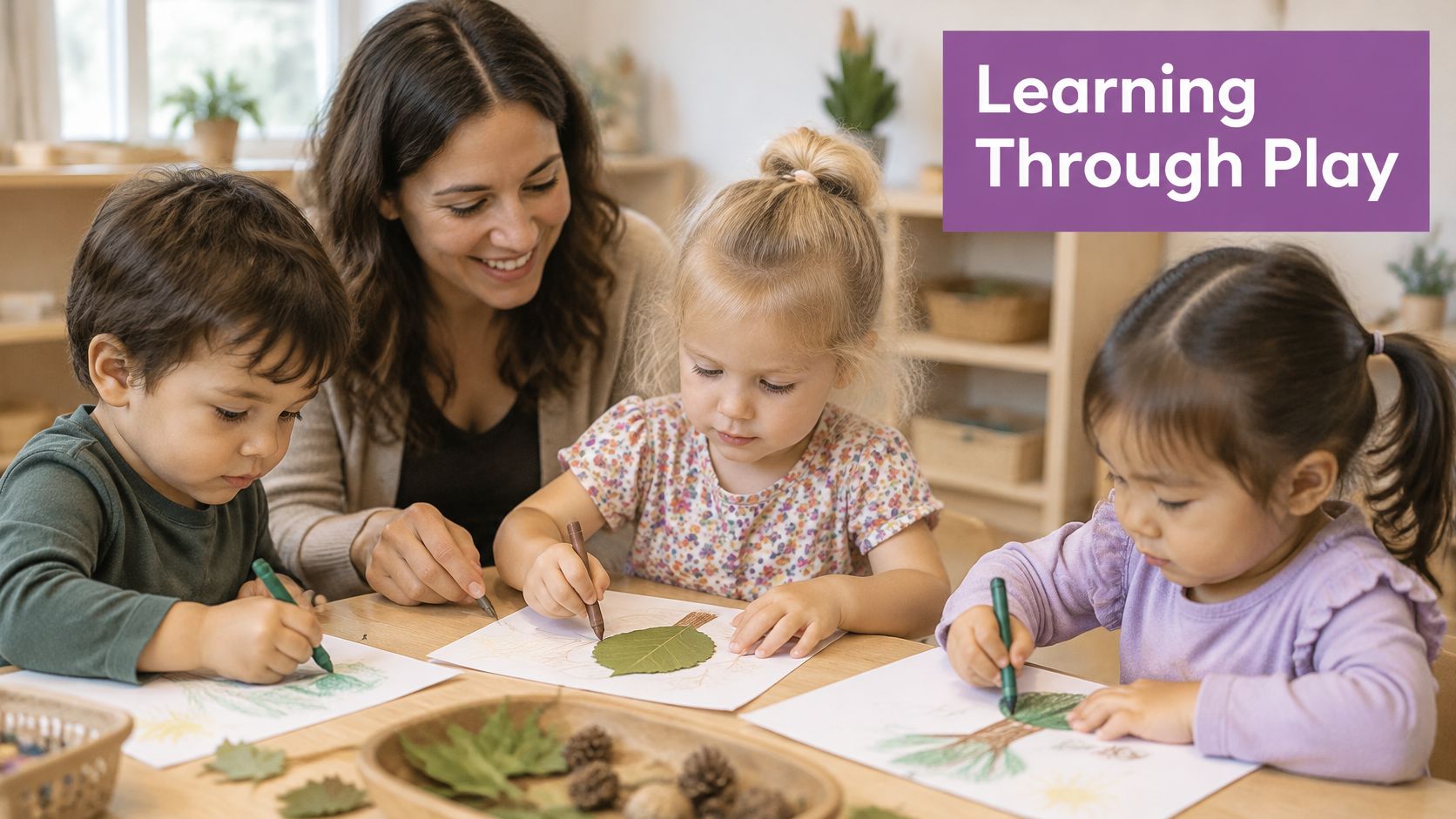
Those figures don't mean every child should start at three. They show that structured, play-based learning is the common offer at this age. A group might spend weeks on local animals, drawing them, acting them out, and meeting a vet. Children record ideas with marks and a short told story in a class journal. That is early literacy without a desk lesson.
Confirm the offer, then ease the first week
Funded hours and eligibility shift, so confirm the current arrangement with the centre before you enrol. We offer a government-funded three-year-old kindergarten program, led by VIT-registered teachers, in rooms for children aged three to six. Ask how play, literacy and numeracy sit in the same day, and how often you will see notes on your child's progress.
Visit the room and meet the teacher before the first full day. A familiar face cuts the first-week load more than a new backpack does.
At home, invite drawing and a told story about the picture. You aren't teaching school. You're giving your child practice at having an idea and sharing it.
6. Four Years for Pre-Prep Readiness and Literacy Foundations
For school readiness, the clearest Australian benchmark is a preschool program in the year before school. The Australian Bureau of Statistics found that 85% of four-year-olds attended preschool, compared with about 57% of three-year-olds. Among children who attended a preschool program in the year before school, parents reported good school adjustment for 94%, compared with 88% among children who attended neither. That link is encouraging, though family life and earlier experiences also play a part. Treat this as the foundation year. Earlier starts help in other ways, but this is the year the school system builds on.
Play with a purpose
A pre-Prep group can run a class shop with written price tags, counting and role-play. Another documents a garden with photos, drawings and simple captions. Children this age can plan a small task, follow a group routine and talk about what they think. Letters and numbers stick when they sit inside those jobs. A worksheet alone rarely does that.
Before you enrol, check these points:
- Balance: Ask how play-based learning carries the literacy and numeracy goals. If the answer is all worksheets, look elsewhere.
- Key educator: Ask who teaches the group and how long they have been in the room. A stable teacher matters more than a glossy program.
- Group size: Ask how many children share each educator during the main session.
- Home reading: Read daily, and help your child spot their name and a few common words.
- Independence: Practise dressing, packing a bag and tidying one shelf.
- Transition: Ask early about school visits or family information sessions.
Our four-year-old kindergarten is a pre-Prep program in that year before school, with literacy, numeracy, social-emotional learning and inquiry-led projects. The enrolment form asks for a tentative start date and the days you need, Monday to Friday, so decide your preferred hours before you apply. Continuity from an earlier room into this year means educators already know your child.
Childcare Stages at a Glance
| Item | Typical Age | Program Type | Main Focus |
|---|---|---|---|
| Six Weeks to Six Months: Early Infant Care, Bonding and Gradual Settling | 6 weeks to 6 months | Infant childcare | Bonding, individual routines and responsive care |
| Six to Twelve Months: Mobility, Stranger Awareness and Responsive Routines | 6 to 12 months | Infant childcare | Safe exploration, predictable routines and early communication |
| Twelve to Eighteen Months: Walking, First Words and Growing Independence | 12 to 18 months | Toddler childcare | Communication, exploration and growing independence |
| Two to Three Years: Social Play, Language Burst and Early Group Learning | 2 to 3 years | Group childcare | Social play, language and movement |
| Three Years: Victorian Three-Year-Old Kindergarten and Early School Readiness | 3 years | Three-year-old kindergarten | Play-based learning, inquiry and school readiness |
| Four Years: Pre-Prep Readiness, Literacy Foundations and Confident Learners | 4 years | Pre-Prep | Early literacy, numeracy and school readiness |
Choosing Your Family's Starting Point With Confidence
There isn't one correct age. Match your child's stage to your work hours, your budget and how settled you feel about leaving them. In 2025, 50.9% of Australian children aged 0 to 5 attended childcare services, compared with 42.3% in 2016, according to the Productivity Commission. More families are using care. That still doesn't pick the week for your child.
Before you book, write three things down. Note the readiness signs you see, such as comfort with a familiar adult or interest in other children. List the home routines you will hand over. List one question for the stage you're considering, whether that's the baby-room ratio, the goodbye plan, biting, funded kindergarten hours or the pre-Prep transition.
When you enquire, give your child's date of birth and a tentative start date, and say which days you need. Our tour booking form asks for that date of birth and a tentative start. Our enrolment form asks for a tentative start date and the days required, Monday to Friday. How clearly a team answers those points tells you as much as the room layout. Kids Club Early Learning Centre runs boutique long day care and kindergarten at Springvale South, Dandenong North and Ferntree Gully, with infant and toddler programs and rooms for ages three to six. Springvale South is open Monday to Friday, 6:30 am to 6:00 pm. Ferntree Gully is open Monday to Friday, 6:30 am to 6:30 pm.
Start with one question from the stage that matches your child. You'll be in a stronger spot to choose the moment, rather than a birthday everyone else used.
Kids Club Early Learning Centre offers nurturing long day care and kindergarten from six weeks to six years, including infant and toddler programs, government-funded three-year-old kindergarten and a four-year-old pre-Prep program. If you're weighing the best age to start childcare for your family in Melbourne's south-east or east, talk through readiness, routines and a gradual start with the team. Visit Kids Club Early Learning Centre to book a tour and ask the question that matches your child's stage.