
It's 5:40pm at the gate. Your three-year-old has gone boneless on the footpath because you brought the blue drink bottle instead of the green one, the baby has just fallen asleep in the pram at the worst possible moment, and your phone is buzzing with a message from work. You know connection matters. You just don't have twenty calm minutes and a gentle voice available right now.
Most advice about building positive relationships assumes conditions you rarely get: an unhurried morning, a child who has slept, a parent running on more than five hours. The better news is that connection rarely depends on long conversations. It's built from short, repeated, imperfect moments, and most families are closer than they think. Australian national reporting found that 50% of parents with resident children were very satisfied with their relationship with their children, with satisfaction particularly high among parents of children aged 0 to 2 years, according to Australian Institute of Health and Welfare data on Australian families. Warmth at home is common. What parents and educators usually need is a way to keep it steady on the difficult days.
What follows is what connection looks like at each age from six weeks to six years, how to run it as a repeatable routine, and how to hold onto it when the day falls apart.
Age-by-Age Techniques That Build Connection
Four bands, one principle. Notice what the child is doing, name it back to them, and stay close enough that they can return to you. What changes with age is how much language the child can carry and how much control they can share.
| Age | Connection technique | Everyday routine | Warning sign |
|---|---|---|---|
| 6 weeks to 12 months | Mirror expressions and sounds, respond within seconds to cues | Nappy changes and feeds treated as talk time | Crying that doesn't settle after the basic checks |
| 1 to 3 years | Name feelings and offer two choices | Dressing and bath, with a song that runs in the same order | Tantrums that are frequent and never settle with comfort |
| 3 to 4 years | Ask open questions and follow the child's current interest | Shared dinner conversation plus one special helping job | Clingy drop-offs with no goodbye ritual that works |
| 5 to 6 years | Negotiate a rule together and invite problem-solving | Bedtime reflection and shared reading | Friendship conflict where the child withdraws or avoids peers |
The case for treating these everyday interactions as a core practice rather than an optional extra is long-standing. Growing Up in Australia: the Longitudinal Study of Australian Children launched in 2004 with a first wave of 10,090 children and families, including infants aged 3 to 19 months and children aged 4 to 5 years, and it tracks relationships, family harmony, peer interactions and emotional wellbeing across childhood rather than relying on isolated observations.
With a baby, you're building the expectation that signals get answered. During a nappy change you already have a captive audience, so slow down and copy what you see: open your mouth when they open theirs, echo the sound they make, pause and let them answer. Responding within seconds teaches cause and effect, and it teaches that someone is listening. Crying that continues after you've checked hunger, a wet nappy, tiredness and temperature is a cue to speak with a maternal and child health nurse rather than to keep pushing the same strategies.
With a toddler, put words on the frustration before you fix it. "You're frustrated the block won't fit" does more than a distraction, because it gives the feeling a name the child can eventually use themselves. Then offer two real choices, both of which you can live with: the red cup or the blue cup, walk to the bath or hop. Narrate their play out loud and let a song carry the dressing and bath routine, since the same order every night is what makes a toddler feel in charge of a predictable world.
At three and four, follow the interest instead of leading it. "What made the tower wobble?" gets more than "Did you have a good day?", and a dinner table where you ask about the worm they found at the centre teaches them their attention is worth sharing. Give them one special helping job that only they do.
By five and six, hand over some control. Agree on a household rule together, such as what happens with screens after dinner, and let them argue their case. Bedtime reflection, three questions about what was good, hard and funny, closes the day with the message that you want their version of events.
Three signs the connection is working
- They seek you out. Not constantly, but reliably, especially when something has gone wrong.
- They recover quickly after a brief upset. A two-minute cry that ends in a cuddle and a return to play is a healthy pattern; a child who stays dysregulated for half an hour is telling you something.
- They repeat a game or a phrase you shared. Repetition is how young children say "that mattered, let's do it again".
How to Build Connection in Five Steps
On a rushed morning, a child may cling at drop-off while an adult is already thinking about the next task. Connection grows through small, responsive moments like these, repeated in a predictable way. Observe the child, respond to their cues, and adjust your approach as you learn what helps them feel safe and understood.
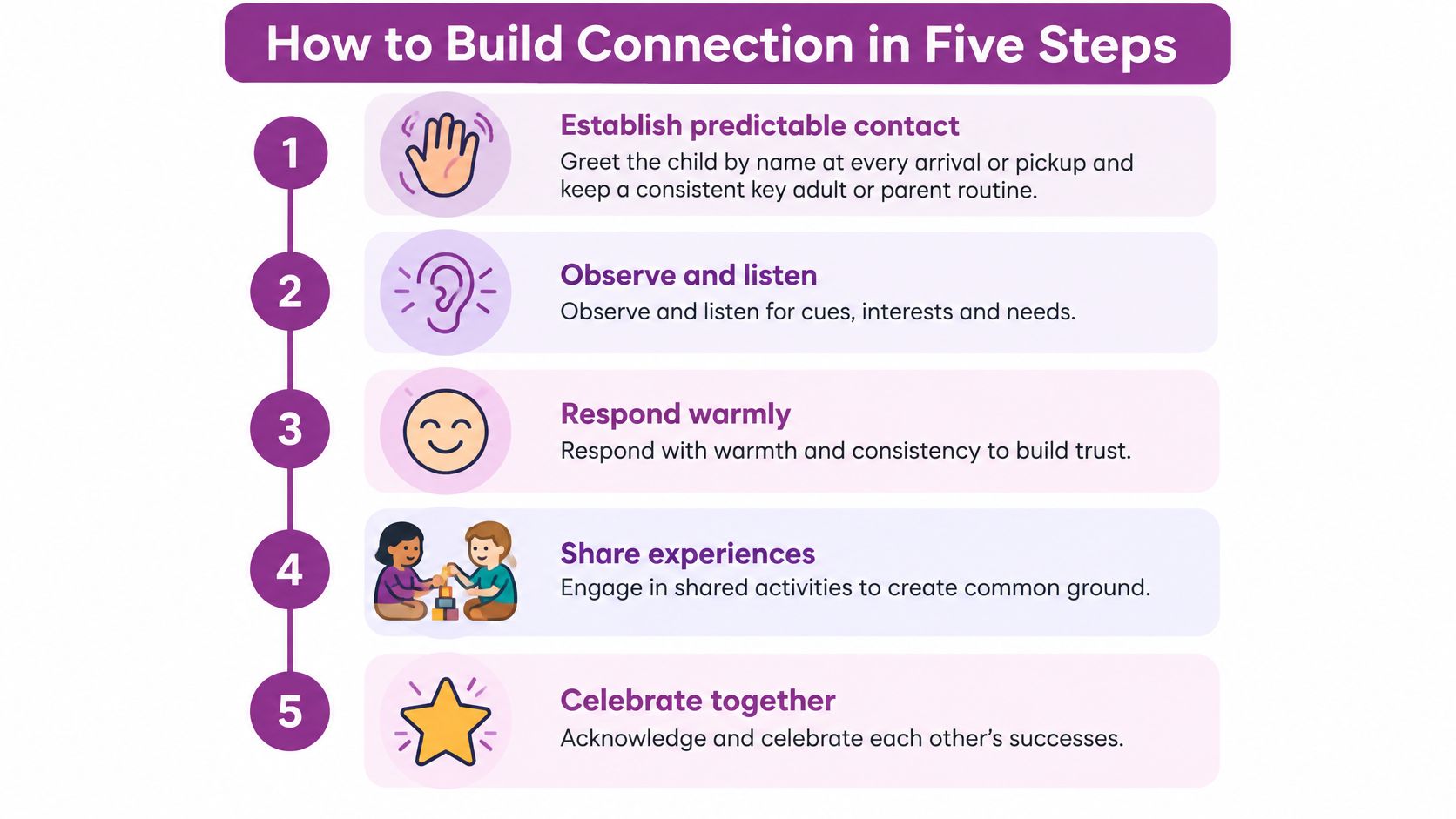
- Establish predictable contact. Greet the child by name at arrival and pickup, and keep a familiar adult or home routine where possible. A greeting and a moment of eye contact help a child understand that they have been noticed. When everyone is in a hurry, even a brief hello can make the handover feel more personal.
- Observe and listen for cues. Notice what the child points to, repeats, avoids, or returns to in play. Spend a moment watching before asking questions. Silence can give a child room to show you what has their attention.
- Respond promptly and sensitively. Acknowledge the child's idea or feeling: “You built a bridge over the water.” Specific words show that you are paying attention and invite the child to keep exploring. When something goes wrong, a calm response helps the child experience that mistakes can be worked through.
- Document and adapt. Use what you observed to make one practical change. If a child keeps carrying toy animals to the window, place the animal basket nearby so they can continue their play.
- Review with the family or your team. Share one specific observation and ask what the family has noticed. These small exchanges help adults build a fuller picture of what interests and supports the child.
A weekly quality check and a one-week trial
Use a few observations during the week to reflect: Was I responsive? Did the child ask for help or name a need? Did the family hear back from me? The questions are prompts for noticing patterns, not a scorecard. If an answer is often no, consider one small adjustment to your routine or response.
For a one-week trial, repeat steps one to three at familiar moments, such as arrival, lunch, and bedtime. Keep the approach simple enough to manage on an ordinary day. If the routine slips, return to it at the next opportunity; connection is built through repeated contact, not perfect consistency.
Keeping Connection Going on Hectic Days
Connection is straightforward on a Tuesday when everyone has slept. The other days decide what a child learns about relationships. A rushed drop-off before a 7am shift, a broken night with a toddler who's cutting molars, rent pressure, or three children wanting the same adult at 6pm all squeeze out the calm conversation the advice columns assume.
Australian evidence on families with children aged 0 to 5 names this gap directly. Parents commonly meet apprehension, logistical difficulty and uncertainty about where to find support when adversity affects their capacity or their child's wellbeing, according to a review of Australian evidence on family support. That review also found parents respond better when professionals listen with real attention and offer emotional as well as practical help, instead of handing out instructions. Access, trust and the quality of adult support are relationship factors too.
So build the day around three small pieces rather than a longer routine.
One predictable ritual. Sixty seconds is enough: a goodbye handshake that's the same every morning, or one sentence at bedtime that never changes. The ritual survives rushed mornings because it takes less time than finding the other shoe.
A brief repair after conflict. Name what happened, own your part, reconnect: "I yelled about the shoes. That wasn't fair. Let's try again." Children learn more from watching a rupture get fixed than from never seeing one, and that repeated pattern is the everyday groundwork for building resilience in children.
A clear escalation path. When ordinary strategies aren't enough, talk to your child's educator first, then a maternal and child health nurse, your GP or a family support service. Asking early is a relationship skill, not a failure of one, and it's worth saying that out loud to families who hesitate.
The test on a tired day: which one ritual can I keep even when everything else slips? Keep that one and let the rest go.
Protecting Children When Adults Disagree
A disagreement about bedtime can start while everyone is tired and still end with two adults speaking respectfully. Children do not need adults to agree on everything. They need to see that disagreement can be handled without making them feel unsafe or responsible.
The Australian Institute of Family Studies reports that children whose parents have happier relationships and experience less conflict tend to have stronger friendships and better communication with peers. The emotional climate children observe matters more than constant harmony.
Healthy disagreement stays specific and ends with a repair. Hostility looks different: insults, silent treatment, door-slamming, or asking a child to carry messages, take sides, or report on another household. Children may sense the tension before they can explain it.
Three everyday habits can help. Repair where children can see it: a calm apology or a return to respectful conversation shows that conflict can settle. Keep children out of the middle: speak directly to the other adult rather than sending a child with a message or asking them to describe what happens elsewhere. Keep warmth steady across households: agree on a few shared routines, such as a familiar goodbye, and describe the other parent respectfully.
Notice whether a child starts taking sides, seems anxious at handovers, or pulls back from friends they used to seek out. These signs are a reason to offer reassurance and consider seeking support.
For the co-parent conversation: which two routines can we keep the same in both homes this month?
Guided Play That Builds Friendships
At the sandpit, two children reach for the same spade. One begins digging while the other watches from the edge. An adult can help them find a way into the play together, then step back as their ideas take over.
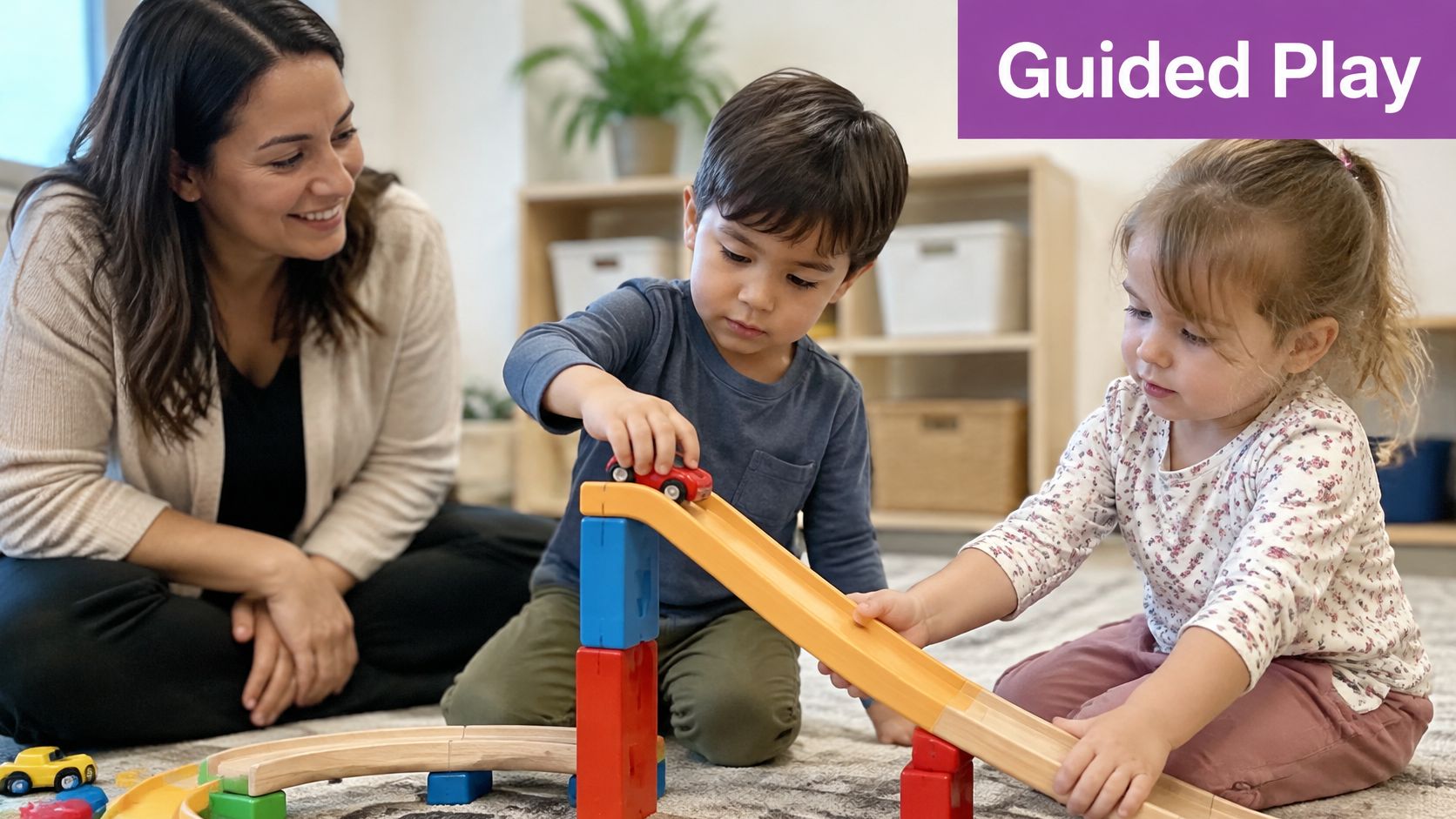
A shared project gives children a reason to talk, take turns and solve small problems. Start with something both children are interested in, such as ramps, dinosaurs or a puppet show. Give each a meaningful role: one child might plan the ramp while the other builds it. Roles can change as the play develops.
Make the goal clear and achievable, such as building a ramp that lets a toy car reach the bottom. Model useful words in the moment: “Your turn,” “I don't like that,” or “Can I have it when you're finished?” Then pause. Children need room to try the words themselves, even if their first attempt is awkward.
When a disagreement interrupts play, stay calm and ask, “What happened?” “What do you need?” and “How can we make it fair?” These questions help children describe the problem and consider a solution, rather than waiting for an adult to decide who was right. If they need help, offer a simple option, then let them return to the game.
Watch for whether both children have a part to play. If one controls all the materials, or the other drifts away, adjust the roles or offer a new shared task. Afterward, briefly revisit what worked. A child might point to the finished ramp or tell you how they took turns. That small reflection helps make the next shared game easier.
Groupings based only on existing friendships can leave other children out. Pairing children with different strengths, sharing materials fairly and stepping in early enough to support a repair can help more children join in. Guidance on personal and social capability can help adults recognise the skills children are practising as they play.
Transitions and Partnering With Educators
Starting care, moving rooms and beginning school are the points where connection is most easily lost and most easily protected. These transitions are near-universal: in March 2025, around 1.4 million children from 1.0 million Australian families attended government-approved early childhood education and care services, according to Australian Parliament reporting based on ACECQA data.
A settling plan takes an afternoon to arrange and pays off for months.
- Book a shorter first session and stay for part of it, so the child meets the room with you present.
- Share the practical detail early: comfort object, photos, sleep and eating routines, and the words your child uses for the toilet.
- Agree on a goodbye ritual the child can predict, and leave the same way every time.
- Review the settling weekly with the key educator, asking what went well rather than only whether there were tears.
- Plan the handover to school a term ahead, with a visit and a story about what happens next.
Day to day, the partnership runs on small exchanges. Send a one-line note about what your child explored, ask how their interest has been used in planning, and agree on one shared goal per term so home and centre aren't working on different things.
Reggio Emilia-inspired practice gives that partnership a structure. The child's ideas guide the curriculum, documentation makes learning visible to families, the physical environment is treated as a teacher in its own right, and long-term projects grow from what children notice rather than from a theme chosen in advance. When you visit a centre, ask how transitions are planned, who the key educator is, and how often that person changes.
Choose a Centre That Shares Your Approach
You now have the age band, the five steps and the repair script. What's left is choosing a setting that runs the same way you do.
Take these questions on a visit.
- Key educators: does each child have one, and how often does that person change?
- Language and choice: how are educators trained to narrate children's ideas and offer genuine choices rather than generic praise?
- Interests in planning: how are children's fascinations documented and used in the program?
- Daily information: how does the centre tell families what happened, and who do you speak to if something's wrong?
- Settling and transition: is there a written plan for starting, moving rooms and leaving for school?
At Kids Club Early Learning Centre, a boutique, family-owned centre, the approach is Reggio Emilia-inspired, learning through inquiry, creativity and collaboration, with VIT-registered teachers leading the rooms. The early years learning framework principles and practices we work from align closely with the steps above, which matters when you're comparing what a centre writes in its brochure to what happens at 8am.
Visit at drop-off rather than at midday. Tours show you the rooms; drop-off shows you the greetings, the goodbye rituals and whether a crying child is picked up or walked past.
Three next steps. Book a visit at Springvale South, Dandenong North or Ferntree Gully, bring the age table from this article with your child's band marked, and ask the five questions above before you decide.
At Kids Club Early Learning Centre, we build connection the way this article describes it: predictable greetings, named key educators, and educators who stay with a dispute until children can repair it themselves. Our Reggio Emilia-inspired rooms for six weeks to six years are designed around children's interests, with daily updates so families know what happened in the day. If you'd like to see it in action, visit Kids Club Early Learning Centre and book a tour at one of our Melbourne centres.