
You're packing a childcare bag while your child struggles with a zip, tells you a complicated story and protests about leaving a favourite toy behind. You might wonder whether you should be practising letters instead. Yet that ordinary morning already involves movement, language, problem-solving, feelings and relationships.
Whole child development means noticing how those abilities work together, rather than measuring progress only by what a child can count or read. It also means looking at the support around the child, including your own wellbeing. You don't need to turn every moment into a lesson to help your child grow.
The Six Domains of Whole Child Development
Whole child development is the combined growth of physical, cognitive, social-emotional, language, creative, and identity and wellbeing abilities, which develop together rather than in separate stages.
Think of a garden with connected beds. Sun, water and healthy soil need to reach the whole plot, not just the plants that flower first. Similarly, a child needs opportunities to move, think, communicate, create and belong.
The diagram offers a way to picture those connections.
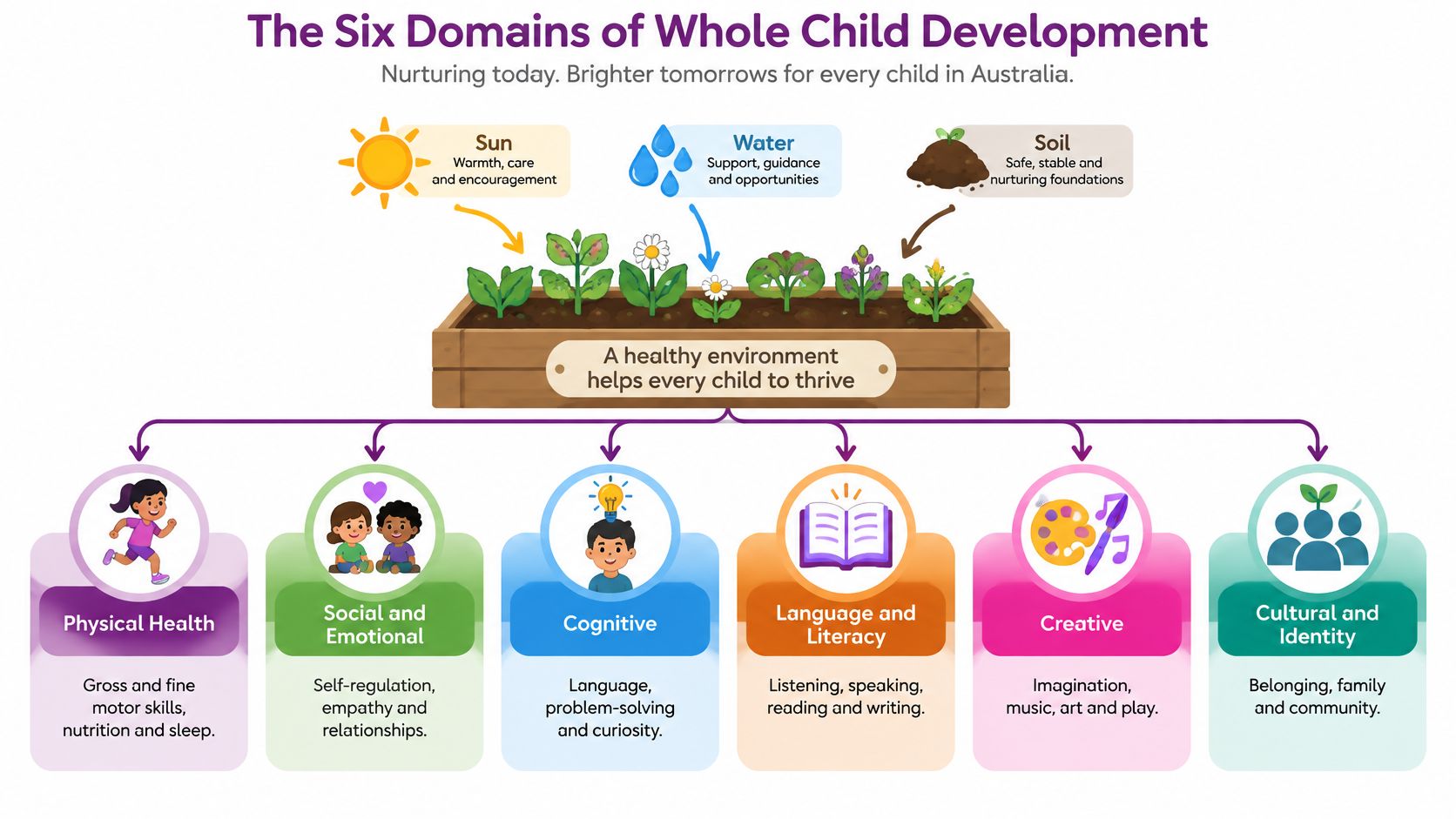
The six domains and what to look for
These are everyday examples, not pass-or-fail tests. A child's age, opportunities, disability and preferred ways of communicating all affect what you might observe.
| Domain | What it covers | Everyday sign |
|---|---|---|
| Physical | Gross and fine motor skills, sleep, nutrition and healthy growth | Climbs confidently or develops control when holding a drawing tool |
| Cognitive | Thinking, memory, problem-solving and early reasoning | Sorts objects by colour and tries another approach when a puzzle fails |
| Social-emotional | Cooperating, taking turns, naming feelings and recovering from upsets | Joins play and accepts help to settle after frustration |
| Language | Understanding, speaking, listening and using communication to connect | Follows familiar instructions and retells events in order |
| Creative | Imagination, art, music, movement and inventive play | Invents a game, sings spontaneously or builds something with a plan |
| Identity and wellbeing | Sense of self, belonging, culture and feeling safe | Shares family experiences with pride and seeks comfort from trusted adults |
Identity and wellbeing run through every other domain. A child who feels accepted can bring their family stories into pretend play, ask for help with a difficult task and try unfamiliar materials without feeling that mistakes make them less capable.
The domains also influence each other. A tired child may find listening difficult; a child who feels safe may be more willing to explore. During block play, the same child might balance pieces, negotiate with a friend and invent a story about their construction.
Try observing before teaching: Choose a couple of domains and jot down what your child does during ordinary routines over the next few days.
Write what happened rather than a judgement. “Asked for help when the tower fell” tells you more than “good problem-solver”.
Milestones by Age and When to Raise a Concern
Milestones describe developmental ranges, not deadlines. Children don't progress evenly across every domain, and a skill demonstrated comfortably at home may be harder to use in a noisy group.
Still, reassurance shouldn't mean dismissing a parent's concern. The table offers broad conversation starters, not a clinical screening tool or a reason to delay seeking advice.
Typical milestones and red flags by age
| Age band | Milestones to expect across this period | Red flags to raise with a GP or nurse |
|---|---|---|
| Infancy | Increasing head control, smiling at familiar faces, reaching for objects and babbling | Concerns about responses to faces or sounds, movement, feeding or emerging communication |
| Toddler years | Developing walking, pointing to share interest and using words or other intentional communication | Little shared attention, concern about hearing or movement, or limited ways to communicate needs |
| Preschool years | Increasingly connected speech, playing alongside and with others, and following familiar instructions | Speech familiar adults struggle to understand, difficulty accessing play, or persistent communication concerns |
| School-entry years | Telling simple stories, taking turns and managing familiar routines with support | Persistent difficulty participating, marked distress during separation, or loss of previously gained skills |
Understand the child's context
A single school-readiness checklist can miss barriers outside the child. UNICEF Australia's report on children's wellbeing identified 783 communities experiencing high early-childhood disadvantage, representing more than 703,000 children aged birth to six, with Aboriginal and Torres Strait Islander communities and regional, rural and remote areas disproportionately represented.
That finding doesn't determine an individual child's future. It reminds us to consider access to services, culturally safe support, disability adjustments and opportunities to participate.
For bilingual children, ask what communication looks like across their languages, not just in English. A child may use fewer English words while telling detailed stories in a home language. Share those examples with educators rather than assuming an English-only observation captures everything.
Children with disability may communicate or participate differently. The useful question is whether the environment gives them an accessible way to join in, express choices and keep learning.
For families considering school-entry experiences, our information about learning for five-year-olds can help frame questions about participation rather than academic performance alone.
- Record the observation. Note the situation, what your child did and what helped.
- Compare perspectives. Ask the educator whether they notice the same pattern in play, routines or group experiences.
- Seek a check-up. Contact your GP or Victorian Maternal and Child Health nurse when concerns persist, affect daily participation or worry you.
Don't wait for a monitoring period if your child loses a skill. Raise that promptly with a health professional.
What Australian Evidence Shows About Whole Child Outcomes
In the 2024 Australian Early Development Census key findings, 23.5% of Australian children were developmentally vulnerable on at least one domain, and 12.5% on two or more, compared with 22.0% and 11.4% respectively in 2021.
These national results show why school readiness needs a broader view than recognising letters or counting confidently.
The graphic highlights the headline findings.
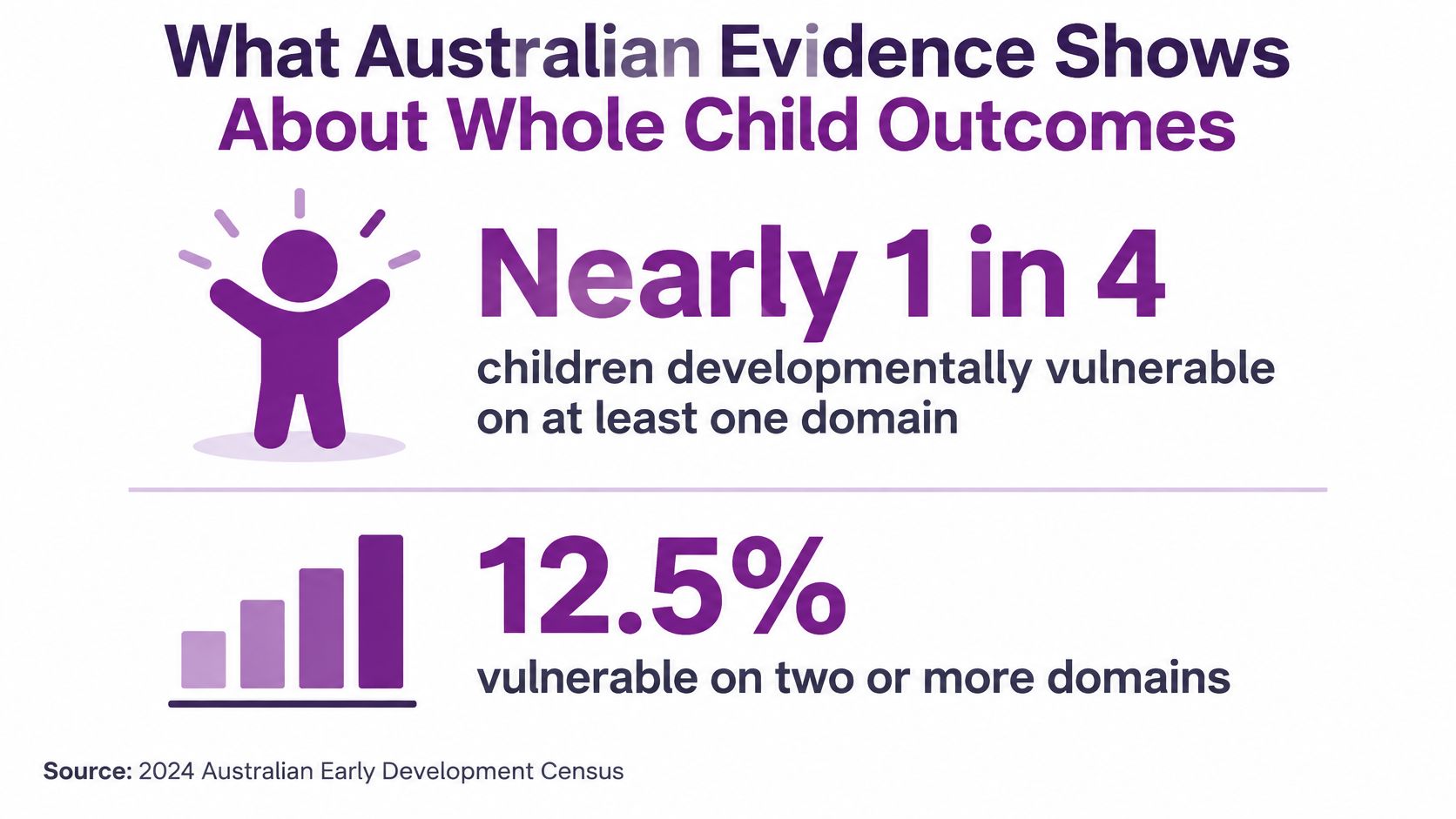
AEDC national results, 2021 and 2024
The Australian Government Department of Education's AEDC overview also reports that the proportion developmentally on track across all domains fell from 54.8% in 2021 to 52.9% in 2024.
| Measure | 2024 | 2021 |
|---|---|---|
| Vulnerable on one or more domains | 23.5% | 22.0% |
| Vulnerable on two or more domains | 12.5% | 11.4% |
| On track across all five domains | 52.9% | 54.8% |
The AEDC assesses physical health and wellbeing, social competence, emotional maturity, language and cognitive skills, and communication skills and general knowledge. These categories differ from the everyday framework above because the census groups abilities for population reporting.
The AEDC is a population benchmark, not an individual diagnosis. It helps communities identify where support may be needed. It doesn't explain why a particular child finds an activity difficult, and it doesn't establish that a specific teaching approach caused the national changes.
What balanced learning looks like
Say a child avoids a drawing activity involving letters. An educator should consider more than letter knowledge: is gripping the tool uncomfortable, is the room overwhelming, or does the child need help managing frustration?
Useful responses combine domains rather than adding isolated drills:
- Movement and self-care with co-regulation. An educator helps a child manage the steps and feelings involved in putting on outdoor clothing.
- Collaboration with sustained conversation. Children build a bridge together while an adult helps them explain and negotiate their ideas.
- Storytelling with inquiry. Children retell a familiar story, then test how to construct a shelter for its characters.
Our explanation of Early Years Learning Framework outcomes offers another way to recognise learning beyond pre-academic tasks.
When considering a program, ask: How do educators notice and respond to development across all domains, rather than recording academic skills alone?
Home Strategies That Support Child and Caregiver Wellbeing
Dinner needs cooking, your toddler is crying at your feet and you haven't had a quiet moment since waking. Adding a developmental activity can feel like another demand you can't meet.
The better question is what support would make this moment manageable for both of you.
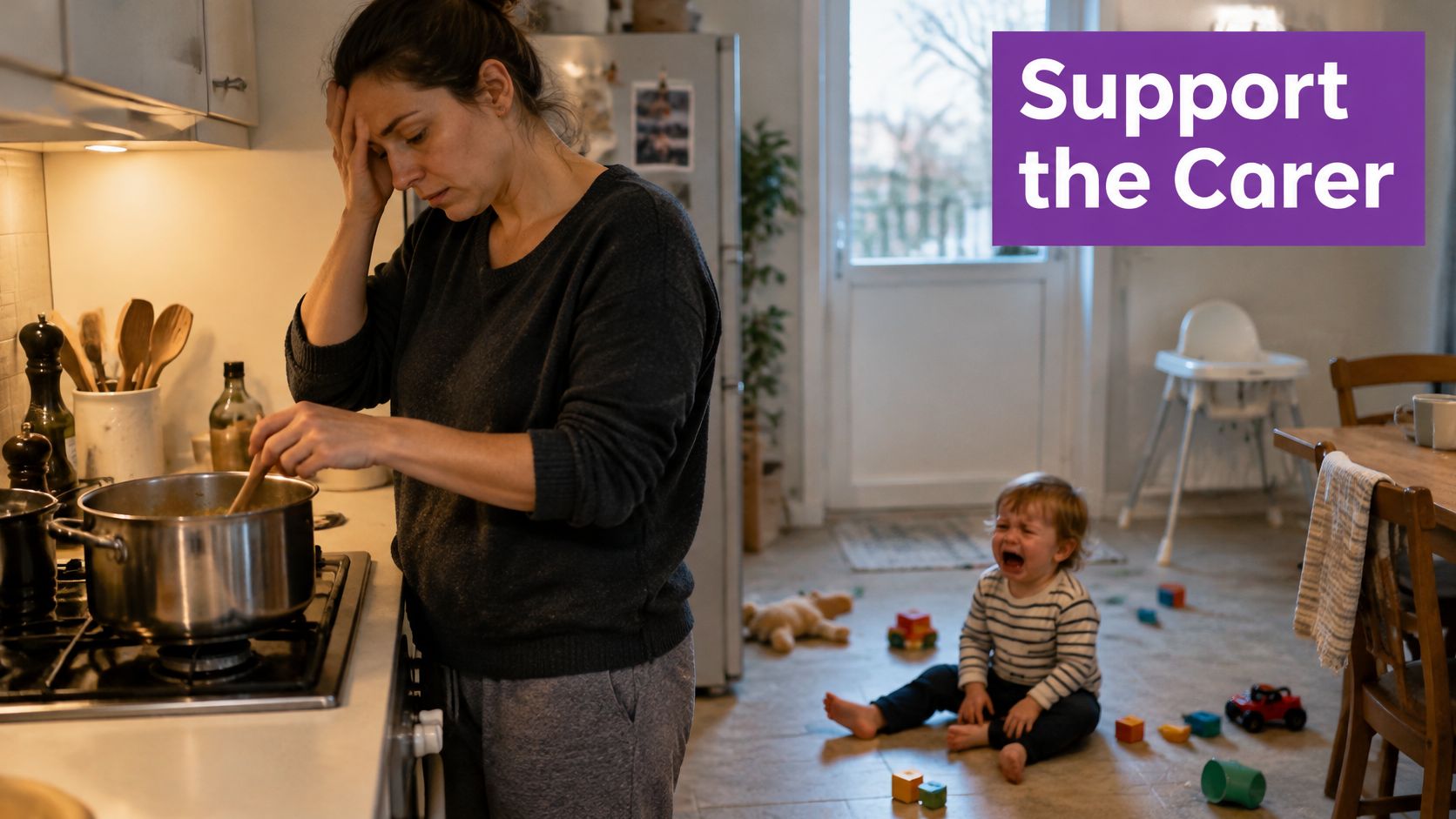
Caregiver wellbeing belongs in the developmental plan. A 2026 Australian Institute of Family Studies review of protective factors, covering 136 studies, including 51 Australian studies, found that parenting programs improved parental mental health, parenting confidence, child behaviour and development, and parent–child relationships.
That doesn't mean every program suits every family. It does support taking adult support seriously, rather than expecting a stressed parent to solve everything through more child-focused activities.
Make connection manageable
These suggestions are options, not another checklist you must complete.
- Choose a small screen-free ritual. Sit together with blocks, draw beside each other or follow your child's pretend game. Let the activity be simple enough to repeat.
- Tell a bedtime story in your strongest language. A familiar family story counts. You don't need to translate every sentence into English.
- Arrange a regular connection. Call a grandparent or trusted friend, or organise a shared meal when practical. Ask for company or specific help.
- Use nearby public spaces. A park offers movement; a library offers books and a change of scene. Choose outings that fit your energy and access needs.
- Ask educators for one workable strategy. Describe the difficult routine and ask what helps your child during a similar moment in care.
For example, tell the educator that getting dressed has become a daily struggle. Ask whether offering clothing choices, showing the sequence or allowing more preparation time helps your child participate.
This video offers another opportunity to reflect on everyday support.
Notice when you need more support
Broken sleep, a short temper, withdrawing from your child or feeling that every interaction is a task can be signs you're overloaded. They aren't a diagnosis, but they're worth discussing with someone you trust or a health professional, especially if they persist.
Your child doesn't need a constantly cheerful parent. You need enough support to respond, recover and reconnect.
Our guide to building resilience in children can help you think about manageable responses to everyday difficulties. Home doesn't need to become an intensive enrichment program: ordinary warmth, predictable routines and conversation give you a practical place to start.
What to Look for in an Early Learning Centre
On a centre tour, ask for examples rather than relying on a brochure. A display of finished artwork tells you something different from documentation showing what a child tried, changed and discussed.
Use these criteria to compare what educators say with what you can observe.
Centre criteria and the questions to ask
| Criterion | What good looks like | Question to ask on a tour |
|---|---|---|
| Educator qualifications | Appropriately qualified, experienced staff with clear teaching responsibilities | Which staff are VIT-registered teachers, and who will work with my child? |
| Curriculum balance | Language, movement, music, sport and creative play within the program | What does a typical week look like for my child's age? |
| Learning approach | Inquiry-based learning with children's ideas recorded | How do you document learning and share it with families? |
| Social-emotional support | Predictable routines and responsive help with conflict | How do educators support a child who is upset or struggling to share? |
| Transitions | Planned moves between rooms and towards school | How do you prepare children for changes? |
| Health and inclusion | Clear records and practical adjustments for individual needs | How are allergies, dietary requirements and special needs recorded and shared with staff? |
At Kids Club Early Learning Centre, we use the Reggio Emilia approach, supporting inquiry, creativity and collaboration. Our experienced teachers and educators are VIT-registered, and our programs include professional music and sports curricula each week at no additional cost.
Those features are useful starting points, not substitutes for watching interactions. At any Melbourne centre, look for educators who listen, explain and adapt an activity so children can participate.
Watch the learning process
Curriculum balance should be visible in what children can access. Movement supports physical development; open-ended materials invite creative thinking; conversation helps children explain their reasoning.
Documentation should show more than completed tasks. Ask to see how an educator notices a child entering group play, managing disappointment or persisting with a construction. These observations make social-emotional learning visible.
- Visit during an ordinary session. Watch how educators speak at children's level and respond when plans change.
- Ask about an unfinished investigation. Find out how children's questions influence what happens next.
- Discuss individual access needs. Describe your child's communication, sensory or physical requirements and ask what participation would look like.
- Examine transitions. Ask who supports the child, what information follows them and how families contribute.
A useful comparison: Record a concrete example beside each criterion. A reassuring answer is stronger when you can also see the practice.
Before deciding, mark each criterion as observed, explained or still unclear. This helps you distinguish a centre that presents well from one where you can understand how your child will be supported.
Enrolment Timing and Booking Your Tour
Start exploring care well before your preferred start date. That gives you room to visit, compare daily travel and organise paperwork without rushing a decision.
Program names don't always tell you the entry requirements or available session arrangements. Check the details for your child's date of birth and intended start date rather than assuming every service uses the same arrangements.
Prepare for the practical details
- Check eligibility early. Confirm the relevant program's entry requirements and any funding conditions.
- Ask about availability. Find out how waiting lists work and whether your preferred days are available.
- Gather health information. Prepare immunisation records, relevant medical plans and any allergy action plan.
- Discuss settling in. Ask about familiarisation visits, comfort items and a manageable drop-off routine.
- Get arrangements in writing. Confirm fees, session times and what's included before accepting a place.
We have centres in Springvale South, Dandenong North and Ferntree Gully. Consider which location fits your regular travel, including who could collect your child if your plans change.
Make the tour useful
Our tour booking form asks for your child's date of birth and tentative start date. It also asks you to list special needs, such as allergies or dietary requirements, so share the information that will help us discuss your child's care.
Where practical, book a visit when your child is usually comfortable and alert. Bring your comparison notes and ask to see how educators document learning.
Choose the centre where you can see the whole child being supported, not only the domain that first prompted your search.
Frequently Asked Questions About Whole Child Development
Is slower progress always a problem?
No. Uneven progress can be part of individual development, but don't dismiss difficulties that affect everyday participation. Ask for advice when you're concerned, and seek prompt assessment if your child loses a previously gained skill.
Does my child need enrichment activities at home?
Not necessarily. Shared cooking, dressing, conversation and play offer useful opportunities without a busy activity schedule. Choose experiences your family can sustain rather than turning home into another classroom.
Is the AEDC a diagnosis for my child?
No. You can't use a national result to decide whether your child has a developmental condition. Individual concerns need discussion with educators and an appropriate health professional.
Will a bilingual child fall behind in English?
Not necessarily. Look at how your child understands and communicates across their languages, and share home-language examples with educators. Don't abandon meaningful family communication to increase English practice.
What if my child isn't on track in one domain?
Arrange a conversation with your GP or Maternal and Child Health nurse. Bring specific observations and ask the centre what adjustments could help your child participate while you seek advice.
- Bring strengths too. Describe what your child enjoys and does comfortably.
- Agree on a next step. Clarify what you'll try, who will help and when you'll review it.
At Kids Club Early Learning Centre, we offer nurturing early learning and government-funded three-year-old kindergarten, with opportunities for inquiry, creativity and collaboration. Visit Kids Club Early Learning Centre to arrange a tour and discuss how we can support your child's development, interests and individual needs.