
You arrive at childcare, collect your child's bag and notice a folder waiting near the sign-out desk. Inside is a learning story, perhaps with a photograph, a few lines about what happened and a note about what your child might try next. It may look like a keepsake, but it's also part of a wider system of observation, planning, assessment, communication and recordkeeping.
Good documentation practices in early childhood settings connect the learning families can see with the compliance records they rarely see. They help educators remember important moments, help children recognise their own ideas and progress, and give families a clearer view of life at the centre. They also create evidence that the service is meeting its responsibilities.
A Quick Story From Pickup Time
At pickup, Mia's educator hands her father a printed page tucked into the family folder. The page shows Mia beside a block tower that reaches almost to her shoulder. One block is tilted near the top, and Mia is holding another piece carefully between both hands.
The story explains that Mia's first attempt fell over. Rather than walking away, she changed the base, tested different blocks and asked another child to pass her a longer piece. In the margin, the educator has written a simple observation: Mia persisted when her first design didn't work.
Her father reads the page in the car before driving home. He already knew Mia liked blocks, but the story shows something less visible. It captures how she approached a problem, how she communicated with a peer and what she did when the result wasn't immediate.
That page doesn't stand alone. Before writing it, the educator watched Mia's play, noticed the decisions she made and considered how the experience connected with the educational program. The observation may later contribute to an assessment, a planning discussion or a conversation with Mia's family.
A learning story is more than a picture of an activity. It is one part of the centre's record of what a child is exploring, developing and communicating.
The folder may contain stories, drawings, photographs, family comments and assessment summaries. Behind it sits another layer of information, including attendance, enrolment, medical and incident records. Together, these records show how documentation practices support both everyday learning and responsible centre operation.
What Documentation Practices Really Mean
Think of documentation as a map of a learning journey, not a school report. A report usually summarises a period of learning after much of the activity has already happened. Documentation is collected along the way, while educators are noticing children's interests, questions, relationships and working theories.
A record might be a photograph of children investigating shadows, a short note about a toddler attempting a new self-help skill, a transcript of a child's words or a sample of mark-making. Educators then reflect on what the record tells them and decide whether the environment, materials or interactions should change.
The purpose for children
Documentation makes children's thinking visible. When an educator revisits a photograph with a child, the child can explain what was happening, remember a strategy or notice a detail that wasn't obvious at the time.
This process also informs planning. If several children return to water play and keep comparing which objects float, educators might add new materials, introduce vocabulary or create more opportunities for prediction and testing.
The purpose for families
For families, documentation provides a window into the day. A note saying “played outside” gives little insight. A story describing how a child negotiated a turn, persisted with a challenge or comforted a friend gives families something meaningful to discuss at home.
Families can also add knowledge educators may not see at the centre. A child's interest in cooking, a family tradition, a new word used at home or a weekend discovery can help educators plan experiences that feel connected to the child's life.
The purpose for educators
Educators use documentation to reflect on their decisions and remain accountable for the program they provide. It helps them ask whether the environment offers enough challenge, whether children's voices are shaping the curriculum and whether individual needs are being recognised.
The ACECQA explanation of documentation states that services must document the educational program, child assessments or evaluations, and information for families. The same source also explains that there are no mandated templates, so a useful record needs to be understandable and relevant rather than merely formal-looking.
The Main Types of Documentation Used Each Day
Families often see several formats in the same folder and wonder whether they all serve the same purpose. They don't. Each type captures a different part of the learning and planning cycle.
Learning stories
A learning story is a narrative observation. It describes a significant moment, includes the child's actions or words and explains what the educator noticed about the learning.
For example:
“When Oliver reached the swing, another child was already waiting. Oliver watched, then said, ‘Can I have a turn after you?’ He waited nearby and reminded his friend when the swing became free. Oliver was practising communication, patience and cooperation.”
The educator might then add a reflection about supporting children to negotiate shared spaces. A next step could involve offering more group games that require turn-taking.
Portfolios
A portfolio is a curated collection, not a pile of every paper a child has touched. It may include learning stories, drawings, photographs, family comments, project records and examples of educator planning.
A portfolio helps show patterns over time. One painting may be interesting, but several samples can reveal how a child's grip, confidence, colour choices or storytelling changes. Family contributions add another perspective, so the portfolio becomes a shared record rather than an educator-only account.
Observation notes
Observation notes are often brief and factual. Educators write them during the day or soon afterwards, sometimes on a tablet and sometimes on paper kept in the room.
An entry might say:
“At 10.15 am, Aisha placed three round lids into a container, removed them and repeated the action. She looked towards the educator and said, ‘Again.’”
This note doesn't need to sound polished. Its value is that it records what happened accurately. Later, educators can connect several observations to an assessment or use them when planning the next experience.
Assessment records
Assessment records bring observations together. They may summarise a child's developing skills, interests, participation and progress in relation to learning outcomes. They can also support transition communication when a child moves rooms or prepares for school.
The ACECQA guidance on assessment and evaluation explains that the amount of documentation depends on how often and how long children attend. That means assessment shouldn't be reduced to a fixed number of pages. The record should be sufficient to understand the child and inform meaningful planning.
These formats work together. A quick observation may lead to a learning story, several stories may shape a portfolio and the portfolio may inform an assessment discussion with the family.
Legal and Privacy Rules Families Should Know About
At pickup, a parent may see a learning story about block building beside a medication form or attendance entry. These records belong to the same centre workflow, but they serve different purposes. Some help educators plan learning. Others show that the service has met its legal duties and protected children's information.
Under Part 4.1 of the Education and Care Services National Regulations, services must document the educational program, child assessments or evaluations, and information for families. Regulation 74 covers assessments, Regulation 75 concerns access to the displayed program, and Regulation 76 covers information and records available to parents on request. Families can check the Education and Care Services National Regulations for the rules behind these requirements.
The record system works like a secure family folder with separate sections:
- Enrolment information includes contacts, permissions and relevant health details.
- Attendance records show when a child attends and record absences.
- Medical, medication and incident records document treatment, care and significant events.
- Educational records bring together the program, observations, assessments and evaluations.
- Family information helps parents understand the program and their child's participation.
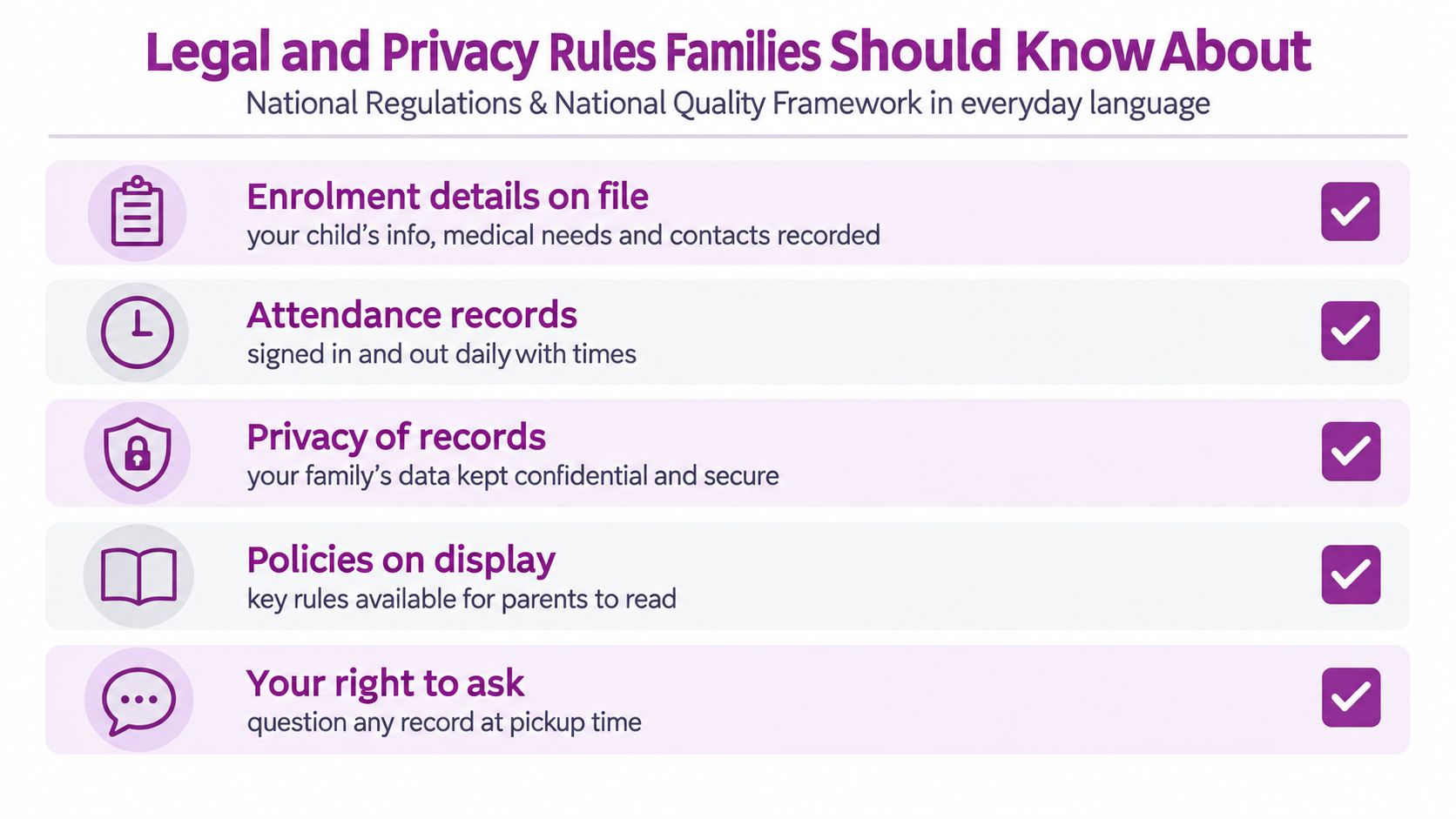
Parents can request information about the program and copies of their own child's records. The service must protect other children's privacy, so a group photograph or story may need editing, redaction or separate permission before it is shared.
Consent applies to photographs, videos and digital platforms such as Storypark or Seesaw. Ask which platform the service uses, who can access it, what permissions you have given, and how requests to withdraw consent are handled. The Kids Club policy and procedures information gives families an example of where centre-specific rules may be explained.
Retention periods matter too. The Commonwealth Department of Education requires many records, including attendance, absence, invoices, receipts and subsidy-related evidence, to be kept for seven years, according to its early childhood record-keeping guidance. State requirements can differ. NSW guidance says some child-related records are generally kept for three years after a child's last attendance, while incident, injury, trauma and illness records may need to remain until the child turns 25, as set out in NSW Regulatory Authority guidance. Ask the centre or relevant state authority about a particular record.
What Documentation Looks Like at Every Age
Documentation changes because children's care, communication and learning change. The same centre may use a feeding record for a baby, a short play observation for a toddler and a project portfolio for a kindergarten child.
In the nursery, educators record routines such as sleep, meals, bottles, nappy changes and health observations. These records help families and educators maintain continuity between home and care. A tablet note might record that a baby watched another child roll a ball, reached towards it and repeated the movement after the ball was returned.
Toddlers need records that capture both care and emerging independence. An educator may write, “Noah carried his plate to the table, pointed to the fruit and said ‘more'.” That brief observation can support planning for communication, self-help skills and mealtime participation.
Three-year-old kindergarten documentation often includes learning stories, group investigations and portfolio entries connected with the EYLF principles and practices. A group project about insects might include children's questions, drawings, photographs of close observation and a reflection on how educators extended the inquiry.
Pre-PREP and kindergarten transition records may include more structured assessment conversations, reflective journals and transition statements. These records help communicate children's strengths, interests, communication styles and approaches to learning as they prepare for their next setting.
| Age Group | Main Documentation Types | Example Snapshot |
|---|---|---|
| Nursery and toddlers | Routine records, health notes and short observations | A note about attempting a new self-help action during lunch |
| Three-year-old kindergarten | Learning stories, project records and portfolio entries | Children's theories and drawings from an insect investigation |
| Pre-PREP and kindergarten | Assessment check-ins, reflective records and transition statements | A summary of interests, communication and learning approaches |
ACECQA notes that documentation should be readily understandable to educators and parents, and that its amount depends on attendance patterns. A child attending part-time doesn't need a thinner understanding of their learning. The record should reflect the opportunities the child has had and give educators enough information to plan responsively.
Mandatory Records and Good Practice Side by Side
Families sometimes assume every attractive page in a portfolio is legally required. Usually, it isn't. A centre may choose learning stories and photo journals because they strengthen relationships and make learning visible, while other records exist because regulations or funding arrangements require them.
| Category | Examples | Why It Exists |
|---|---|---|
| Mandatory records | Attendance, enrolment details, medical information, medication records and incident or injury records | Shows that the service recorded essential care, safety and operational information |
| Required educational records | Educational program, child assessments or evaluations and information available to families | Demonstrates planning, assessment and communication responsibilities |
| Centre-led good practice | Learning stories, photo journals and portfolio compilations | Helps children and families see learning over time |
| Family partnership records | Family voice contributions, home observations and cultural information | Brings family knowledge into curriculum planning |
| Reflective practice | Planning walls, educator reflections and team discussions | Helps educators review what worked and decide what to offer next |
The distinction doesn't make one tier more valuable than the other. A medication record may never appear in a child's portfolio, but it protects the accuracy of daily care. A learning story may not be a mandatory template, but it can help a parent understand a child's confidence, friendships and interests in a way a checklist cannot.
The National Archives of Australia describes reliable public information as information that is accurate, complete, findable, secure, usable and kept for as long as needed. Those principles offer a useful way to judge centre systems too. A record should answer basic questions clearly: who recorded it, what happened, when it happened and where it is stored.
Good documentation doesn't mean documenting everything. It means keeping the right evidence, in a form people can understand and use.
Practical Tips for Teachers Writing Documentation
Educators often write between meals, rest routines, outdoor play and conversations with families. A practical system needs to work in those short windows, not rely on a quiet afternoon that may never arrive.
Start with the facts. Record the time, name the children involved, describe what you saw and note the child's words where relevant. Then identify the learning or disposition shown. Reflection can come later, but the original observation should stay close to the event.
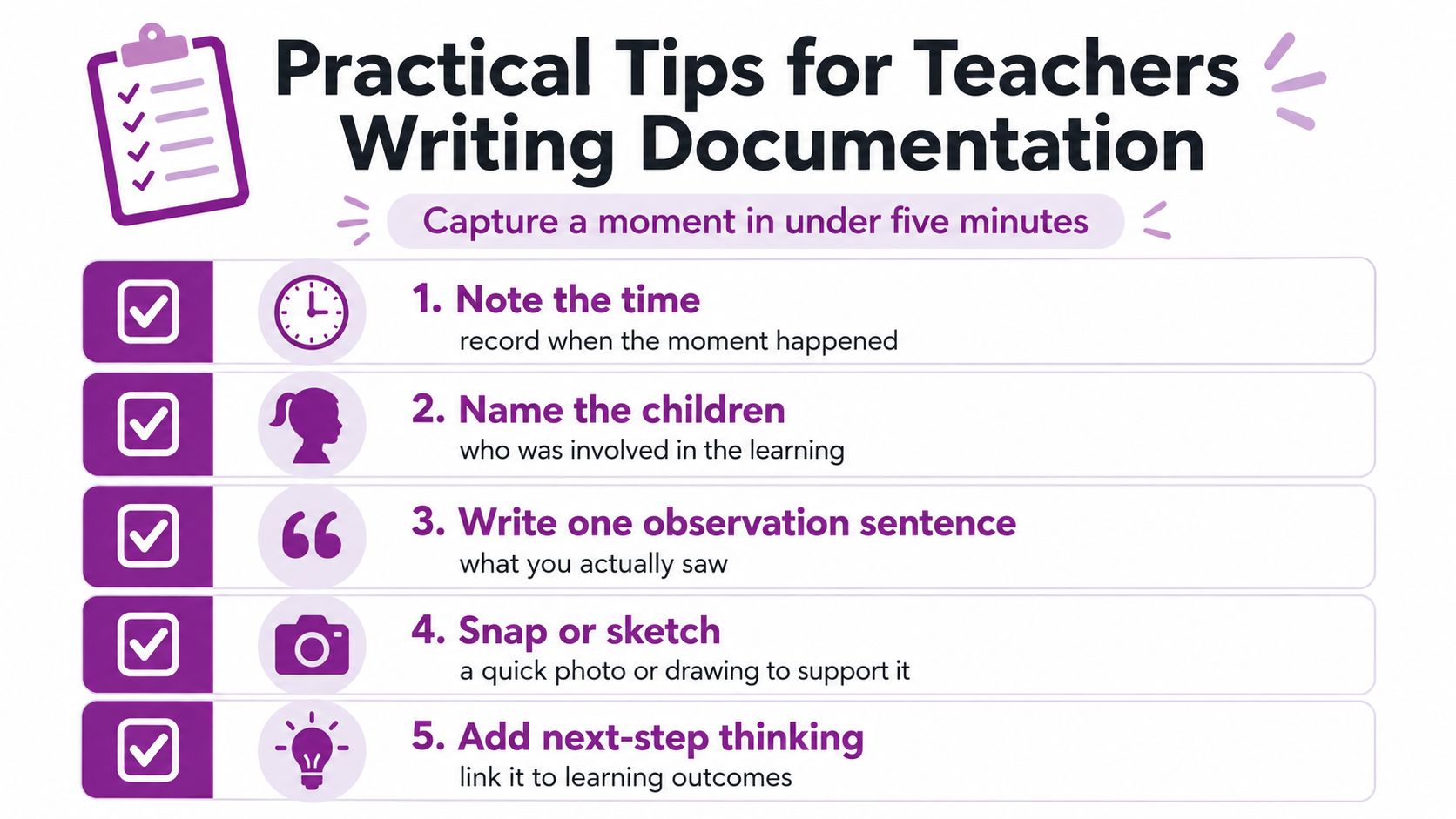
A short writing checklist
- Write what happened: Use observable actions rather than assumptions about motivation.
- Use respectful language: Describe a child's current participation without labels such as “lazy”, “naughty” or “behind”.
- Include the child's voice: Record words, gestures, choices or expressions when they add meaning.
- Name one next step: Explain what educators might offer, change or revisit.
- Connect thoughtfully: Link the entry to relevant learning outcomes without copying long framework wording.
A strong entry doesn't need to be long. “Ella chose the quiet reading space, turned each page and retold the story using the pictures” gives the team useful information about communication, concentration and meaning-making.
Educators should flag significant concerns or incidents with the educational leader rather than burying them in a learning story. Routine observations can be batched for writing, but safety, health and child protection information needs to follow the centre's required process immediately.
The Reggio Emilia approach at Kids Club places value on making children's ideas visible through photographs, notes, conversations and displays. That kind of documentation works best when it stays connected to children's real questions instead of becoming decorative paperwork.
Writing two or three meaningful stories in one planned sitting can help educators share learning consistently. The important safeguard is reviewing the entries so every child's experiences are represented and the records remain accurate.
How Parents Can Read and Contribute
A documentation folder can feel surprisingly formal when you first open it. You don't need specialist knowledge. Start with one recent story and read it as a conversation about your child, not as a test result.
Look for the date, the situation, your child's words or actions, the educator's reflection and the possible next step. Ask yourself what the story reveals about how your child approaches people, materials or problems. A photograph is useful when it helps explain the moment, not just because it looks appealing.
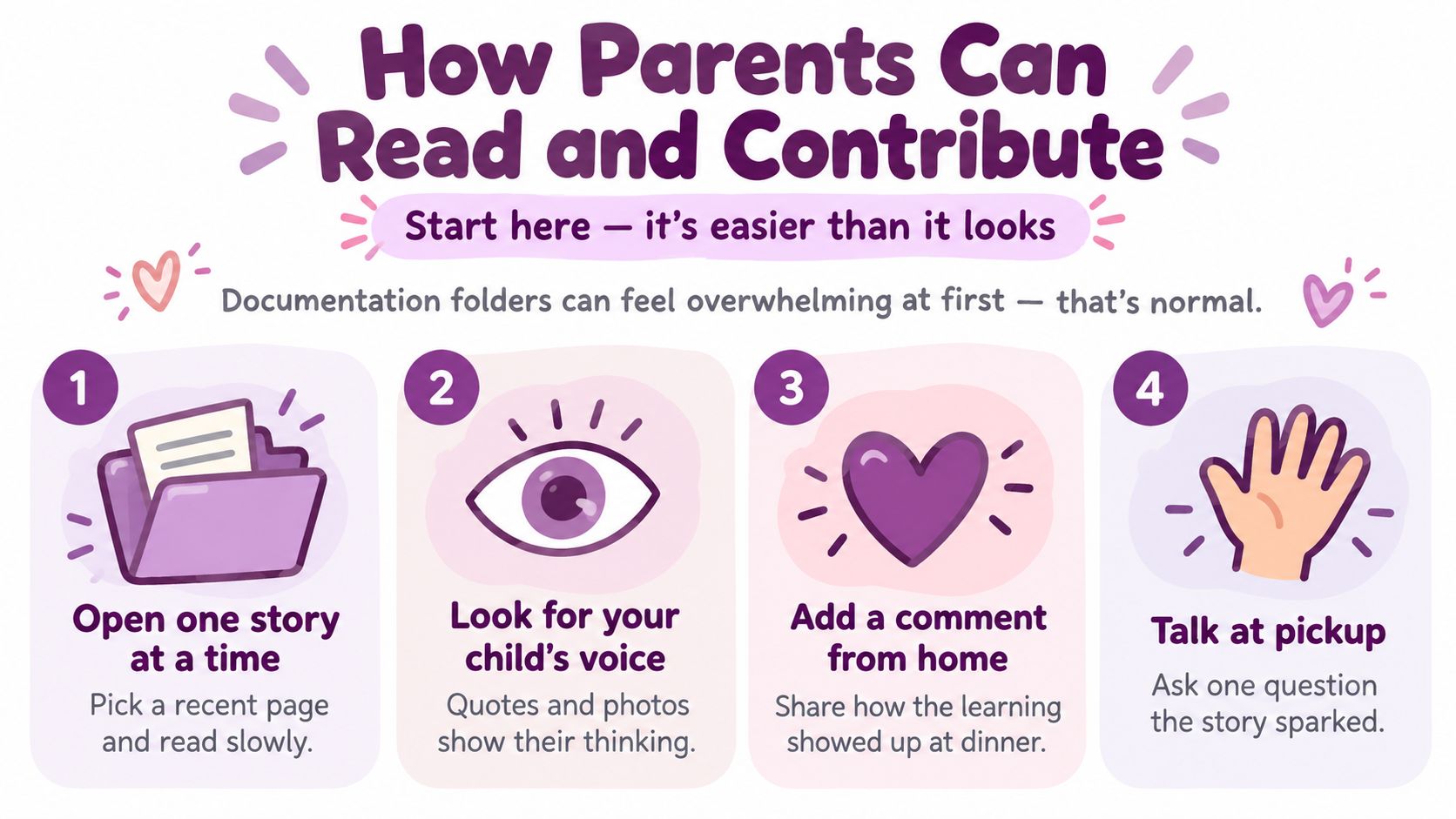
Add the home perspective
A short family note can change the direction of planning. You might write:
- At home: “He has started sorting the cutlery by size.”
- Family connection: “Our grandmother taught her the word for butterfly in our home language.”
- Child's interest: “She keeps asking how bridges stay up.”
- Weekend observation: “He drew the local park and described where the creek flows.”
These details don't need polished wording. They give educators information about the experiences, language, relationships and questions that matter to your child outside the centre.
At pickup, try a question that invites observation rather than a yes-or-no answer. “What did you notice today?” can reveal more than “Was she good today?” You can also ask, “Can I see the latest story?” or “What might we try at home to extend this interest?”
If a story is unclear, ask the educator to explain the context. If you want a broader view, request time with the educational leader to look through the portfolio together. A family folder works best when parents feel welcome to question, add context and correct details that don't match their understanding.
Kids Club Early Learning Centre offers age-appropriate programmes for children from six weeks to six years, including infant and toddler care, three-year-old kindergarten and a four-year-old pre-PREP programme. Families can ask how educators record learning, how portfolios are shared and how home observations contribute to planning when they visit Kids Club Early Learning Centre.