
A child points to a green stripe on a hat and says, “Green!” Another child stacks a round lid on a square block, then calls everyone over to inspect the result. These moments can look small, but they show children organising what they see, testing ideas, building vocabulary, and sharing meaning.
In a Melbourne home or early learning room, shapes and colours are everywhere. Wattle blossoms, gum leaves, fruit at the greengrocer, road signs, blocks, fabric, paint and sporting colours all give children reasons to notice, compare and represent the world around them. With a Reggio Emilia lens, the adult's role isn't to rush children towards a worksheet. It's to prepare rich experiences, listen carefully and extend the thinking already happening.
Why Shapes and Colours Matter From a Child's First Years
A two-year-old reaches for a wattle-patterned hat near the door. Before the adult can finish saying “That's your hat”, the child touches the green stripe and names the colour. A second child notices the curved brim and traces it with a finger. Neither child is reciting a lesson, yet both are making useful distinctions.
They're asking, through action, how objects are alike and different. The stripe is green rather than yellow. The brim is curved rather than straight. The hat belongs on a head, but its pattern can also be represented in paint, collage or drawing. This is the beginning of classification, spatial thinking and symbolic representation.
Babies start noticing contrast, edges, movement and repeated visual features from their earliest experiences. As children grow, they connect what they see with words, gestures and actions. Naming a colour gives a child a way to communicate a preference. Comparing a circle with a triangle gives them language for describing objects. Sorting lids, blocks or leaves helps them notice attributes and make decisions.
Practical rule: Follow the child's attention first, then add one useful word or question.
An intentional environment makes these discoveries easier. Educators might place coloured fabric beside natural materials, offer blocks in varied forms, or arrange loose parts so children can group, line up and rearrange them. Families can do something similar with bottle lids at the kitchen table, laundry during folding, or fruit selected at the market.
The environment itself can become part of the teaching. Thoughtful early learning environments invite children to return to an idea, notice a change and communicate what they've found. A child who first sorts objects by colour may later sort them by size, texture or purpose.
Australia also offers meaningful local references. The national colours, green and gold, were officially proclaimed in 1984, while the Golden Wattle became Australia's floral emblem in 1988. National Wattle Day followed in 1992, and the opal was proclaimed the national gemstone in 1993, forming a sequence of national symbols across a decade. The Australian Government's teacher guide on national symbols provides the historical reference for these milestones.
For young children, the value isn't memorising dates. It's connecting colour with familiar places, plants, celebrations and identity. Green-and-gold streamers, a wattle branch observed safely, or a drawing of a golden flower can turn an abstract colour word into something connected to Australian life.
The Learning Science Behind Colour and Shape Recognition
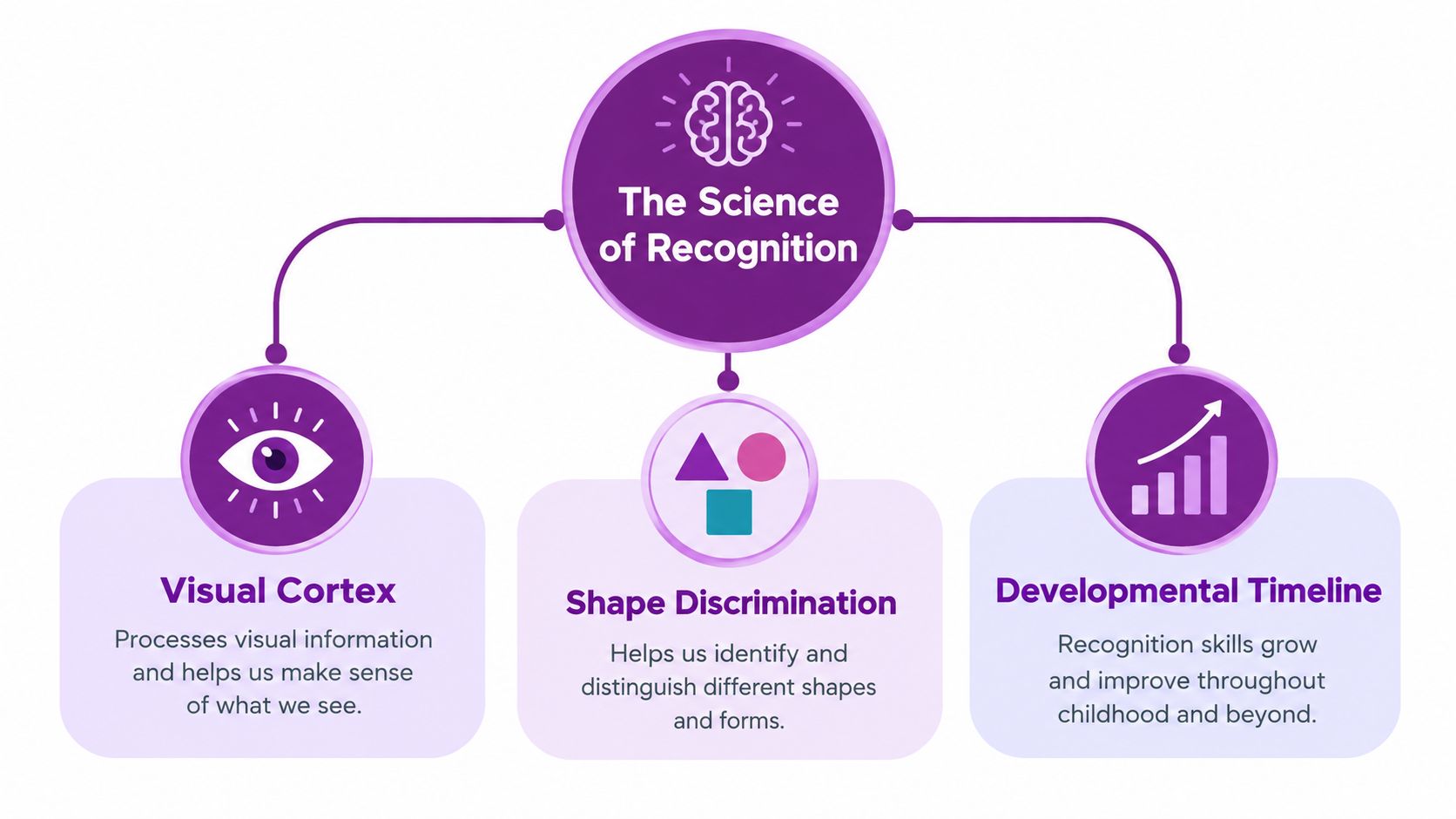
Colour and shape learning develops through several connected experiences rather than one isolated skill. Children look, notice, move, handle, compare and talk. Each action gives the brain more information to organise.
Seeing differences and building categories
Infants are drawn to contrast and clear boundaries. A high-contrast card, a patterned cloth or a bright object against a plain background gives the eyes something distinct to follow. As children gain experience, they begin to recognise recurring features and connect them with categories such as “red”, “round” or “big”.
Shape discrimination supports early geometry because children learn to attend to sides, corners, curves, size and orientation. A square may look different when turned, while a triangle can have different side lengths. Adults can support this by describing what they see rather than treating shape names as a memory test.
Colour work also has a strong inquiry element. Victorian early childhood literacy guidance identifies red, blue and yellow as primary colours and describes how combining them can produce orange, green and purple. Adding white or black changes a tint or shade, so children can observe cause and effect through mixing, rather than just repeat colour names. The Victorian fine arts guidance is a useful reference for this approach.
Moving, speaking and representing
A child who grips a chunky block, threads coloured pasta or places a lid into a sorting bowl is developing more than recognition. They're coordinating hand and eye movements, judging position and adjusting force. These physical experiences make ideas about shape and colour more memorable because the child is acting on the materials.
Language adds another layer. Instead of asking only, “What colour is this?”, try, “You put the dark green leaf beside the pale green one. What's different?” This invites comparison and introduces descriptive language. With shapes, “The circle has a curved edge and no corners” is more useful than repeated drilling alone.
The Australian Government's Learning Potential resource on colours and shapes places these ideas within early mathematics for children aged four to six. It describes art and craft through shapes, colours, sizes and patterns, and connects Foundation learning with recognising circles, triangles, squares and rectangles, as well as describing two-dimensional and three-dimensional objects.
The Australian Curriculum has changed over time, including the approval of the “Shape of the Australian Curriculum” in 2009 and approval of revised version 4.0 by the ACARA Board in late 2012. Those milestones show that foundational learning is deliberately structured within national education planning, not left to chance.
Educators see the practical expression of this during mat time, block play, drawing and group sorting. Children are preparing for later mathematical language while also learning to listen, describe, remember, plan and represent.
Developmental Milestones From Infant to Preschool
Milestones are useful guides, not deadlines. Children develop unevenly, and a child may recognise a colour before naming it, or build a complex structure before using formal shape vocabulary. Watch what children notice, what they attempt and how their actions change over time.
| Age Range | Shape Skills | Colour Skills | Everyday Example |
|---|---|---|---|
| Infancy | Tracks bold edges, curves and contrasting forms; reaches towards visually interesting objects | Notices strong contrasts and repeated colour patterns | Follows a high-contrast fabric square during tummy time |
| Toddler years | Explores containers, lids, blocks and simple inset puzzles; begins using words such as round or square | Matches familiar colours and may name some basic colours | Groups bottle lids, then points out green-and-gold sports clothing |
| Preschool years | Recognises familiar forms in the environment, compares attributes and combines shapes in construction | Sorts, mixes and describes shades or colour combinations | Finds a circular sign, a triangular symbol or a golden wattle flower on a walk |
Infancy
During the first year, look for visual attention rather than correct naming. A baby may follow a patterned object with their eyes, reach towards a bright fabric square or pause when a familiar colour appears during a nappy change. Offer safe, large materials and place them where the child can see without being overwhelmed.
Use short language: “You're looking at the black and white stripes.” “The red cloth is moving.” The aim is shared attention and a growing connection between seeing, hearing and acting.
Toddler years
Between one and three, children often enjoy matching and sorting, although their choices may change from one day to the next. A child may group all the green lids together, then decide that large and small matter more. That change shows flexible thinking, not failure.
By around eighteen months, a child may point to or attempt familiar colour words, particularly when adults use them often in meaningful routines. Basic shape words may emerge through play with balls, plates, blocks and signs. Accept approximations and model the correct word naturally.
Preschool years
From three to five, many children begin combining attributes. They might look for small blue objects, build a house from rectangles and triangles, or describe a leaf as long, green and pointed. They may also spot shapes outside the learning space, such as a circle on a wheel or a triangle on a road sign.
Drawing and storytelling provide valuable evidence. “I used a purple circle for the moon” shows a child connecting visual choices with representation and language. Keep observing without turning every conversation into a quiz.
Age-Appropriate Activities for Home and the Classroom
The strongest activities use materials children already understand. A basket, a leaf, a piece of fabric or a set of blocks can become a prompt for mathematical thinking when an adult slows down and listens.
| Age Band | Activity | Materials | Learning Goal |
|---|---|---|---|
| Infants | Contrast and naming game | High-contrast fabric squares, safe colour cards | Visual tracking, shared attention and early vocabulary |
| Toddlers | Sorting basket | Baskets, bottle lids, blocks or large fabric pieces | Matching, grouping and noticing one attribute |
| Preschoolers | Colour-mixing investigation | Water, clear containers, child-safe food dye, droppers | Prediction, cause and effect, tint and shade language |
| Preschoolers | Shape construction | Blocks, paddle pop sticks, cardboard pieces, natural loose parts | Spatial reasoning, planning and representation |
For infants
Place two or three large fabric squares where a baby can see them during floor play. Move one slowly, pause, and name what the child is watching. During a nappy change, describe the pattern on a cloth or the shape of a nearby object, keeping the interaction warm and brief.
In a centre, educators can attach high-contrast fabric panels to a low, secure exploration area. Rotate the materials when children stop returning to them, and record which textures, patterns or colours attract sustained attention.
For toddlers
Offer a sorting basket with large, safe objects. Begin with one clear idea, such as placing green lids together, then allow the child to reorganise the collection. Say, “You found another green one,” or “This lid is round, but it's bigger.” Avoid correcting every decision.
Sticker matching works well for children who enjoy placing and peeling. Draw simple shapes on paper and offer matching stickers. Threading large coloured pasta pieces onto a thick cord can extend colour matching while strengthening hand control. Use supervision and materials appropriate to the child's age.
A shape hunt can happen in the backyard or on a short walk. Look for round wheels, rectangular signs, curved gum leaves or the clustered form of wattle flowers. The point is not to force a perfect match. It's to help children notice that geometry and colour exist beyond toy boxes.
For preschoolers
Invite children to build a structure with a condition: “Can you make a shelter with a triangle at the top?” Let them test, revise and explain their choices. Add mirrors, cardboard tubes and natural materials so they can explore reflection, balance, curves and repeated patterns.
For colour mixing, place small amounts of coloured water in clear containers and ask children to predict what might happen before combining them. Follow their observations with language such as “lighter”, “darker”, “more blue” or “a new colour”. The Victorian guidance linked earlier provides the Australian context for primary and secondary colour exploration.
Loose parts can make the activity more open-ended. In a Reggio-inspired room, educators might offer gum leaves, seed pods, smooth stones, fabric scraps and wooden pieces, then photograph a child's arrangement and revisit it later. Ask, “What could we change?” or “How did you decide where that piece belongs?”
A Reggio Emilia Approach to Shapes and Colours
A Reggio Emilia approach treats colour and shape as ideas children can investigate, not facts they must repeat on demand. The educator prepares an environment that offers choices, then observes how children use those choices to form theories.
A low light table with translucent acrylic shapes can make overlapping forms visible. Mirrors can encourage children to explore reflection and symmetry. Natural materials, coloured cellophane, wire, cardboard and transparent containers can create a provocation that has no single correct outcome.
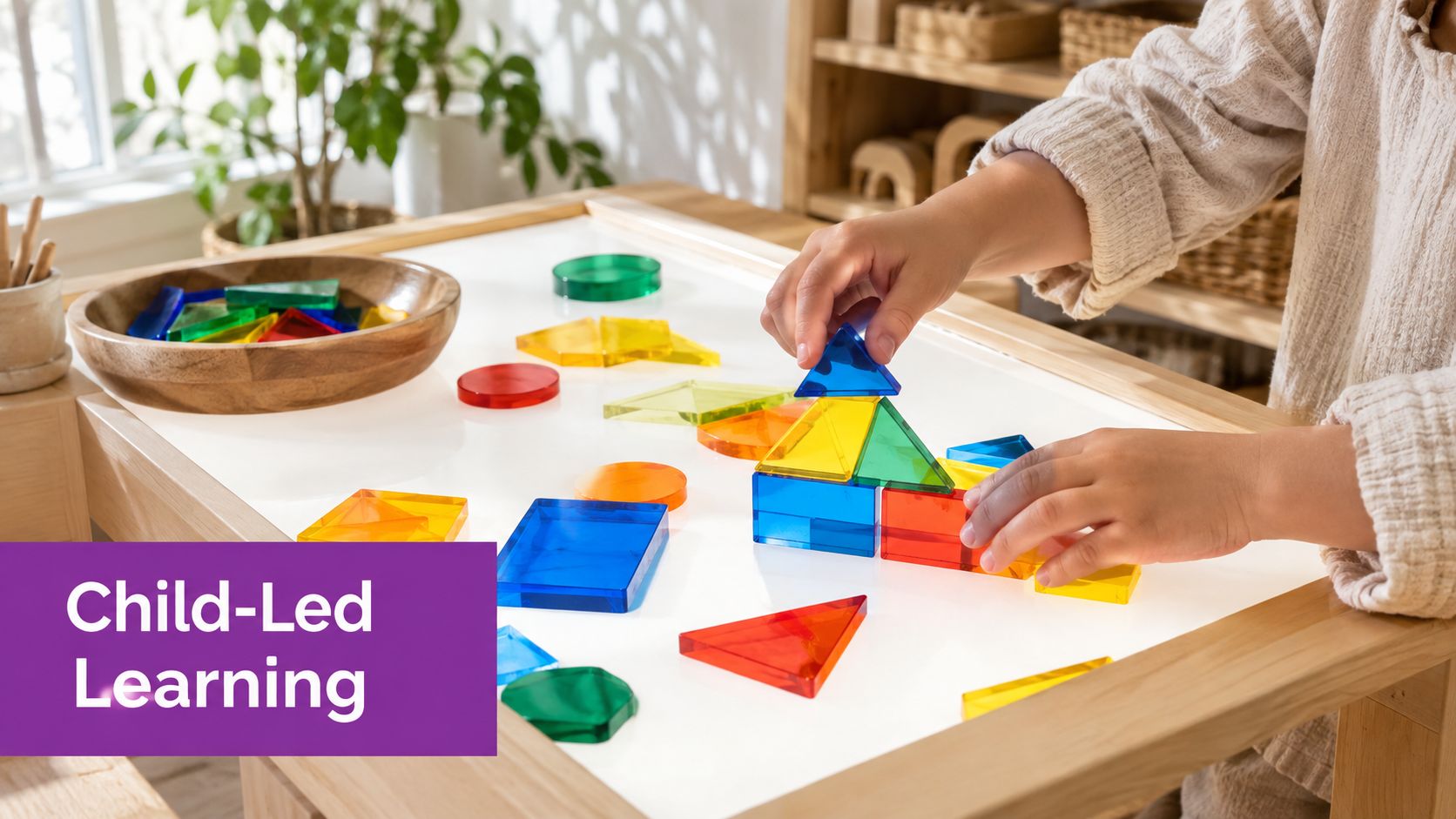
The Reggio Emilia approach at Kids Club Early Learning Centre places value on children's ideas, relationships, creativity and inquiry. In practice, that may mean an educator notices children arranging yellow petals beside green leaves and offers paper, paint, clay or construction materials to help them represent what they see.
One concept, many languages
The idea of the Hundred Languages of Children is especially useful here. A child may explore the same concept through:
- Drawing, by making repeated circles or representing a wattle flower.
- Building, by balancing triangles, rectangles and cylinders.
- Sculpting, by shaping clay into coils, discs and free-form pieces.
- Dramatic play, by using colour to assign roles, places or emotions.
- Movement, by making curved, straight, wide or narrow pathways.
Each form of expression offers different evidence. A child who doesn't name a triangle may still select triangular pieces accurately during construction. Another child may explain colour mixing through a painting before using the formal terms tint or shade.
Documentation should capture this process. Photograph a colour experiment, transcribe a child's explanation, save a drawing, or record how a structure changed after it fell. These records help educators plan the next provocation instead of repeating an activity the child has already mastered.
An atelier-style invitation can use Australian materials without becoming a themed craft. Place wattle-inspired yellow paper shapes, green leaves, mirrors, gold-toned fabric and wooden forms on a table. Ask open questions such as:
- “What do you notice when these shapes overlap?”
- “How could you show the difference between a leaf and a flower?”
- “Which materials make the light look different?”
- “What might happen if we turn the shape around?”
The educator doesn't need to supply the final image. Children's theories, revisions and conversations are the learning.
Printable Ideas and Everyday Resources That Reinforce Learning
Printables work best as prompts for real activity, not as replacements for handling materials. A simple sheet can send a family outside to observe, sort, compare and talk.
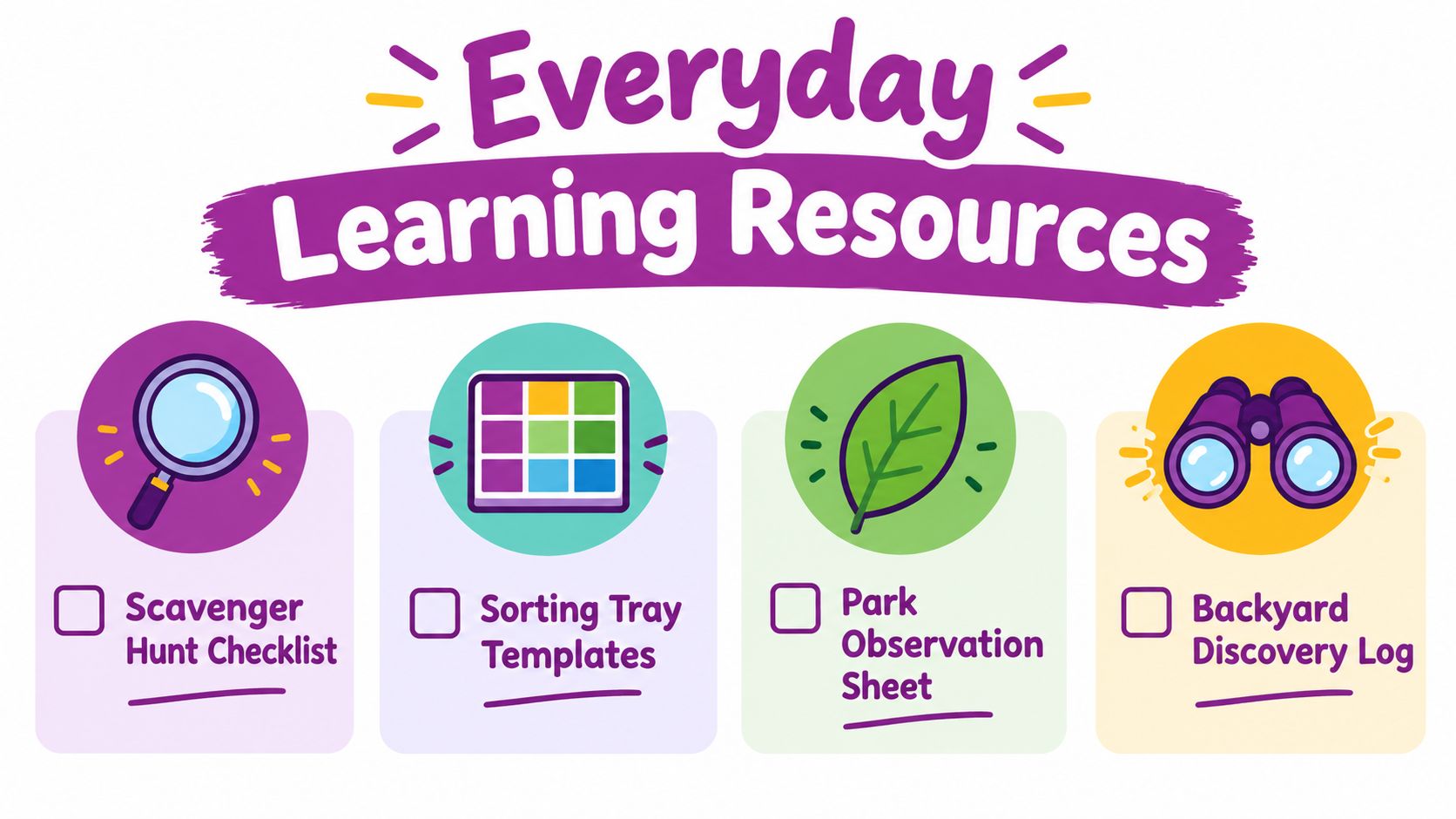
Useful printable prompts
- Park scavenger checklist: Include a circle, a straight line, a green leaf, a yellow flower and something that feels rough. Children can draw what they find instead of collecting it.
- Sorting tray template: Draw broad sections for colour, shape or size. Let the child choose the sorting rule and explain it.
- Colour-mixing prediction sheet: Provide spaces for “before”, “prediction” and “after”. A child can use marks, drawings or words.
- Shape-matching cards: Pair familiar forms with photographs of objects, such as a circular wheel, rectangular door or triangular sign.
- Backyard observation log: Record weather, colours, patterns and shapes noticed over several visits.
Use the same resources differently as children grow. A toddler might match a red card with a red lid. A preschooler might sort the same objects by shape, then draw a map showing where each group belongs.
Household loose parts offer more flexibility than a large collection of purchased materials. Buttons, paddle pop sticks, bottle lids, fabric scraps, cardboard tubes and clean containers can support arranging, counting, matching and construction. Check every item for safety, especially around children who still mouth objects.
Educators can use a completed sheet as an observation record rather than a product to grade. Note the child's language, the sorting rule they chose and whether they changed their mind. Families can store sheets with photographs or drawings to revisit during conversation.
Simple storage keeps the invitation active:
- Separate materials by type, using shallow baskets so children can see the choices.
- Rotate one feature, such as adding transparent pieces while keeping the same shapes.
- Keep unfinished work available, when safe, so children can return to an idea.
- Display children's words, not only finished pictures.
- Reuse printables, adding new objects or changing the question.
For a sensory extension, families can explore safe visual materials alongside a DIY sensory bottle idea, always following age-appropriate supervision and checking that containers are securely sealed.
Connecting Shapes and Colours to Kindergarten Readiness
Kindergarten readiness isn't about children completing a stack of worksheets. It's about entering a group with ways to observe, communicate, sort, follow visual cues, manage materials and persist when an idea needs changing.
The national early mathematics guidance connects art and craft with shapes, colours, sizes and patterns, while Foundation learning includes familiar two-dimensional forms and descriptions of three-dimensional objects. These foundations also support language because children need words for comparing, explaining and representing what they notice.
A Reggio Emilia-inspired classroom develops these capabilities through sustained investigations. Children may return to a wattle display, revise a block structure, record colour changes or explain a drawing to a friend. The educator listens for vocabulary and offers the next useful word without taking control of the inquiry.
A gentle home checklist
Try these small invitations across the week:
- On a walk, notice one circle, one rectangle and one natural shape.
- During laundry, sort a small group of clothing by colour, then try another rule.
- At mealtime, describe an object using colour, shape, size or texture.
- During drawing, ask your child to tell you about the shapes they used.
- At playtime, revisit a favourite construction or colour provocation and ask what could change.
Children don't need flashcards to become capable learners. They need adults who notice with them, provide language, offer interesting materials and value their explanations. A green leaf, golden flower, round lid or triangular block can be the beginning of a rich conversation.
Kids Club Early Learning Centre offers Reggio Emilia-inspired environments where children from six weeks to six years explore materials, ideas and relationships through inquiry, including playful experiences with shapes and colours. Visit Kids Club Early Learning Centre to learn about the centres in Springvale South, Dandenong North and Ferntree Gully, and arrange a conversation about care and kindergarten options.