
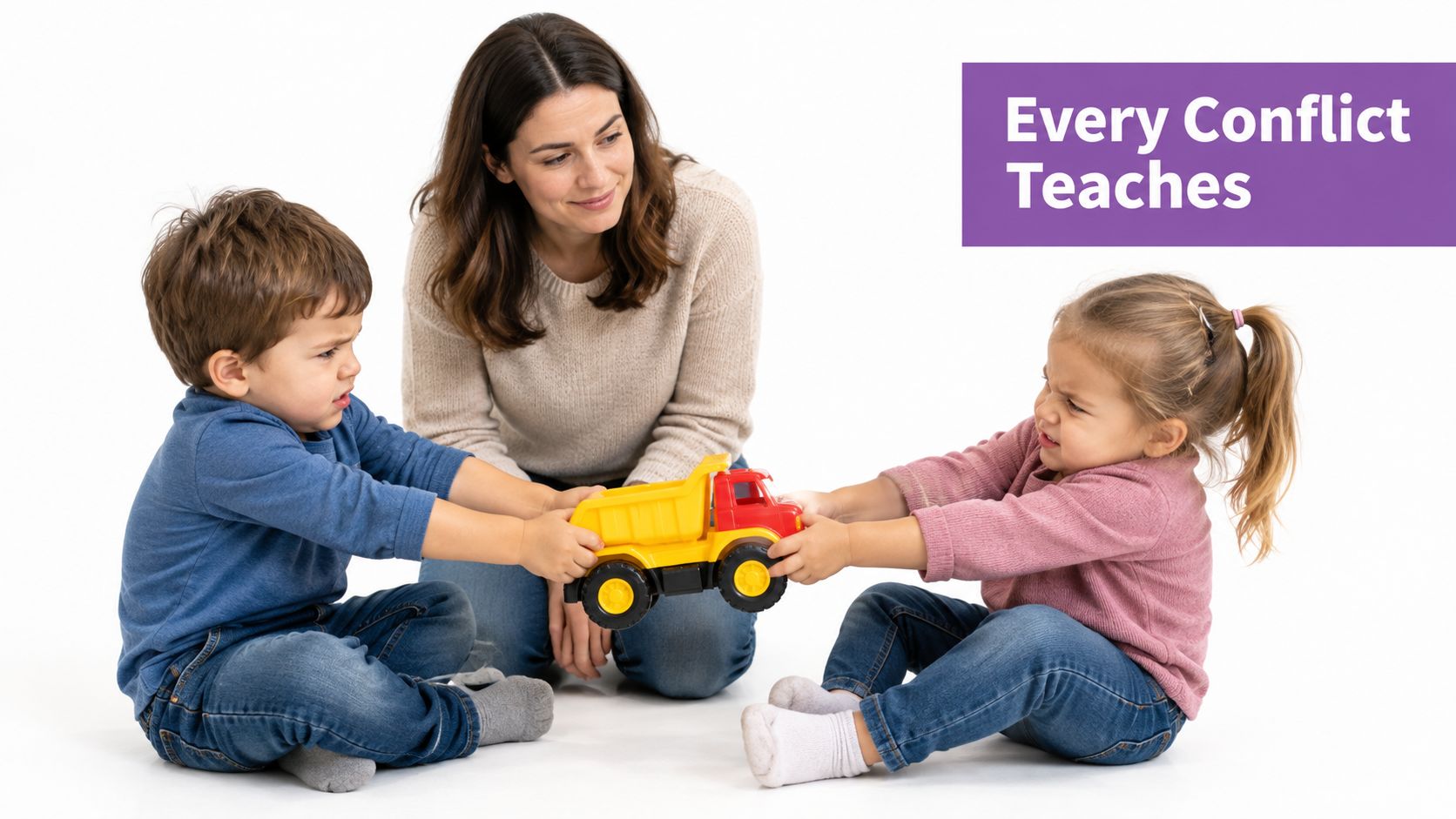
You reach for the popular dump truck just as two children grab it from opposite sides. One child pulls, the other shouts, and within seconds someone is crying. Your first impulse may be to stop the argument, find the guilty child, and insist on sharing. A more useful response is to see the moment as practice for skills children are still developing, including emotional regulation, boundary-setting, empathy and problem-solving.
Reframing Early Childhood Disputes
A toy dispute can feel surprisingly serious when you're the adult nearby. The noise is sharp, the children's bodies are tense, and you may worry that one child is becoming aggressive or that you've failed to teach good manners. Yet a young child who holds tightly to a toy isn't necessarily being selfish or unkind. They may not yet have the language, impulse control or perspective-taking skills needed to manage a competing desire.
A dispute is a learning moment
The adult task isn't to make every disagreement disappear. It's to keep children safe, help them settle, and show them what respectful problem-solving looks like. A calm response might sound like:
“You both want the truck. I won't let you pull it from each other. We'll work out what happens next.”
That sentence sets a physical limit without labelling either child as naughty. It also gives the children a shared description of the problem. In early learning settings, ordinary disputes provide repeated opportunities to practise waiting, requesting, listening, coping with disappointment and repairing relationships.
Australian early learning practice places social and emotional capability close to the centre of school readiness. The personal and social capability guidance reflects the practical skills children need to participate with others, rather than treating social behaviour as an optional extra after academic learning.
Change the question you ask
“Who started it?” can lead adults into an investigation that young children aren't ready to explain accurately. Try asking, “What happened?”, “What's the problem?”, and “What could we try?” These questions move attention from blame towards understanding and action.
You'll still need to intervene firmly when a child bites, hits, throws an object or blocks another child from moving away. Reframing conflict doesn't mean permitting unsafe behaviour. It means treating the boundary as the beginning of teaching, not the end of the interaction.
Understanding Normal Peer Conflict Patterns
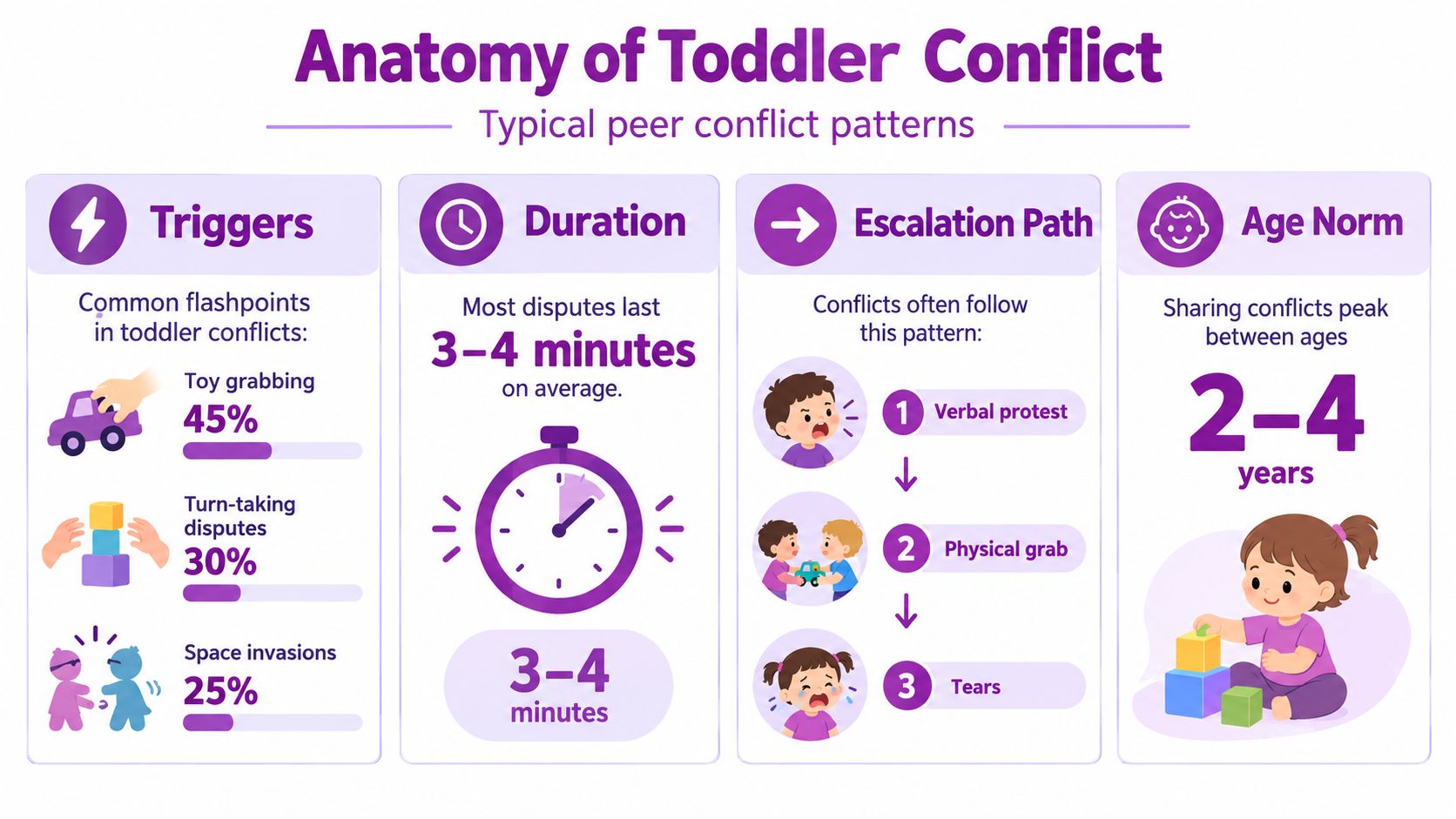
Young children often disagree because they want the same object, space or adult attention at the same time. They may also protest when another child changes the rules of a game, touches their construction, or moves too close. These triggers can look deliberate to an adult, but children are often responding to an immediate feeling of loss, frustration or intrusion.
Australian research on toddler peer interactions offers a useful baseline. Seventy-one per cent of conflict events were low intensity, and 64% involved no aggression, according to the study described in Australian reporting on toddler peer conflict. The findings suggest that many early disputes are brief negotiations carried out with limited language and developing self-control, not evidence of hostile intent.
What children try before they can negotiate
Toddlers don't usually begin with a polished request such as, “May I have a turn when you're finished?” They may stand firm, hold the object, reach for it, protest, or move away. In the Australian study, standing firm was the most common resolution strategy at 50%, followed by yielding at 43% and bargaining or negotiation at 7%. These figures help explain why adult coaching matters. Children may be attempting to solve the problem, but their available strategies are still simple.
A child who stands beside a ride-on toy and says, “Mine,” may be communicating a boundary. Another child who gives up the toy may be ending the dispute without yet understanding how to ask for a future turn. Neither response should automatically be praised as mature cooperation or criticised as poor behaviour. Watch the pattern, the intensity and the effect on the other child.
Normal disagreement or a concern?
A developmentally typical disagreement generally has a clear trigger, involves children with roughly equal power, and settles with support or a change in activity. A repeated pattern deserves closer attention when one child is consistently frightened, isolated, injured or unable to participate. Adults should also take notice when the same behaviour appears across situations, lasts beyond the immediate dispute, or is accompanied by wider changes in mood, attendance, sleep or engagement.
This distinction protects children from two errors. If adults overreact to every protest, children lose chances to practise. If adults dismiss repeated harm as “just kids being kids”, a child may miss needed support. Observe first, record patterns where appropriate, and share specific examples with the early learning centre or school.
A Step-by-Step Mediation Framework
Children learn more from the way you intervene than from a lecture delivered afterwards. Your voice, posture and choice of words show whether conflict is a battle for adult judgement or a problem people can solve safely.
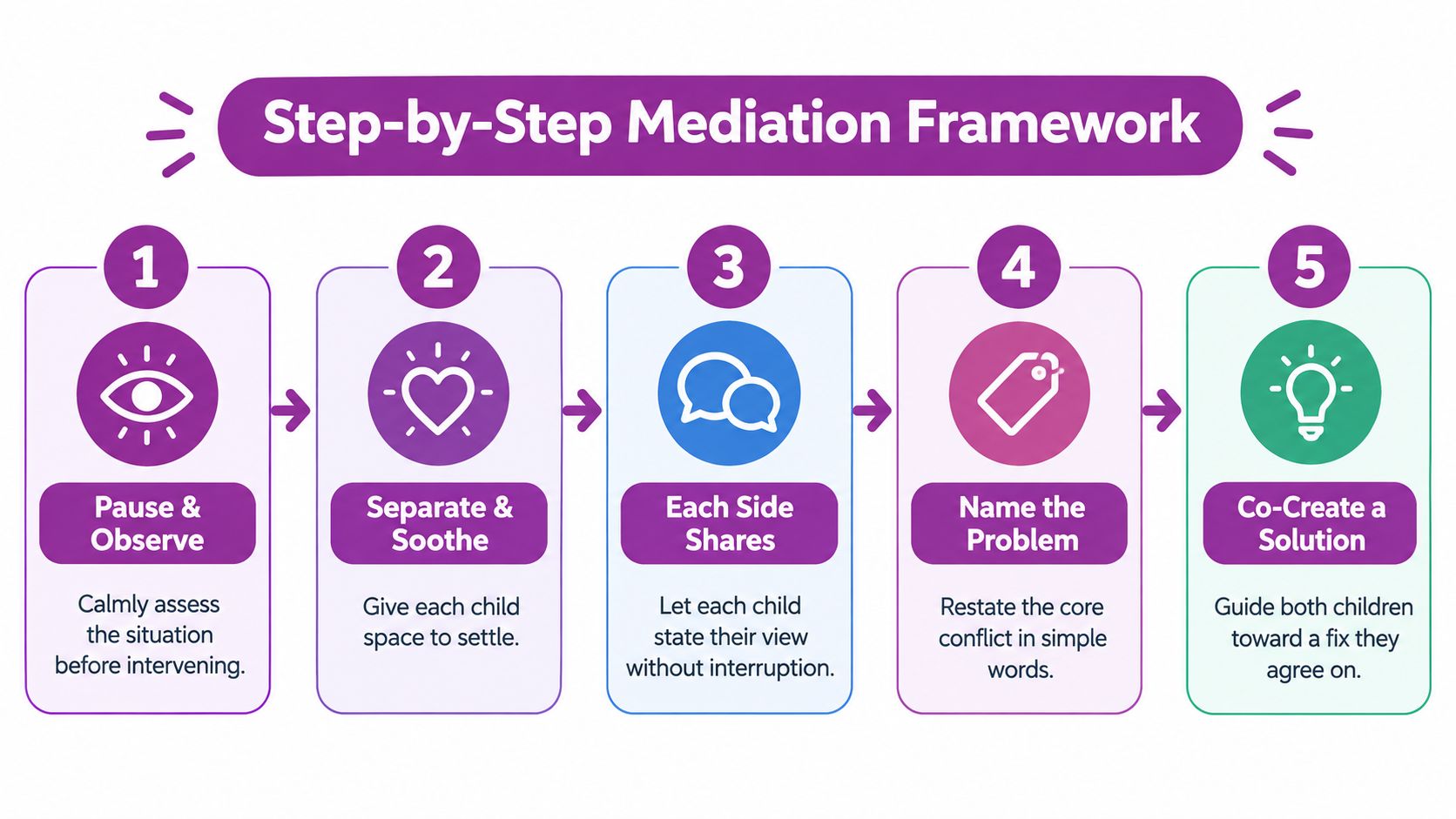
Pause and observe
Move close enough to prevent harm, but don't rush in just because children are speaking loudly. Look for the trigger, the children's body language and whether either child can still listen. If hands are pulling, hitting or grabbing, calmly place yourself between the children and secure the object.
Get down to their eye level where possible. Use a low, steady voice and short sentences. Avoid demanding an immediate apology while children are crying or shouting, because an overwhelmed child may not be able to process the request.
Separate and soothe
Safety comes first. Say, “I won't let you hit,” or “I'm moving the truck while we make a plan.” Give each child enough physical space to release the struggle. You might offer a drink, a quiet corner, a cuddle if the child wants one, or a few slow breaths together.
Name the feeling without endorsing unsafe conduct:
- “You're angry because the truck was taken.”
- “You wanted a turn, and waiting felt hard.”
- “You're upset because your tower fell.”
Validation isn't agreement about who owns the object. It tells the child that you understand the emotional experience, which makes later problem-solving more possible.
Let each child speak
When the children are calmer, invite one child to speak while the other listens. Keep the account simple and concrete: “Tell me what happened.” If a child is too young to explain, offer a tentative description and allow correction: “You were using the truck, then Sam reached for it.”
Don't force children to produce matching stories. You're not conducting a courtroom hearing. Your purpose is to help each child feel heard and to identify the practical problem underneath the competing accounts.
Name the problem clearly
Restate the issue without assigning character labels. “The problem is that both of you want the only blue truck.” Or, “The problem is that the blocks were moved before the builder was finished.” A precise description gives children something manageable to solve.
This is also the point to state the relevant boundary. “People can say stop. They can't push.” “If you want to join, ask before taking.” Children need both empathy and limits.
Co-create a solution
Ask, “What could we try?” Young children may need two or three realistic choices:
- One child uses the truck while the other chooses a different vehicle.
- The children push it together.
- The truck rests nearby while an adult helps organise turns.
Avoid offering choices you can't support. If there's no agreement, you can decide while explaining why: “You're still finding it hard to choose safely, so the truck will have a rest. We'll try again when your bodies are calm.”
Practise the words after the resolution: “Can I have a turn when you're finished?” “Stop, I'm still using it.” “Let's build it together.” For more ideas about helping children develop these responses, see social skills for children.
Here's a short demonstration of calm adult guidance in action:
Return to the event later, when the children are settled. Ask, “Did our plan work?” If it didn't, treat that as useful information rather than failure. A solution can be adjusted.
Tailoring Strategies by Age and Development
Conflict resolution for children must match what a child can understand and control. A toddler may recognise “stop” and “turn” but be unable to wait through a long explanation. A child preparing for school may be able to compare options, consider another person's view and suggest a compromise, although strong emotion can temporarily reduce those abilities.
The table below offers a starting point. Children develop unevenly, so use the child's current language, regulation and social experience rather than relying only on age.
Age-Specific Conflict Resolution Approaches
| Age Group | Typical Triggers | Adult Mediation Strategy |
|---|---|---|
| Infants and young toddlers | Reaching for objects, crowded spaces, changes in routine and competing adult attention | Move close, block unsafe contact, use very short phrases such as “Stop. Gentle hands.” Label one feeling, redirect where needed, and model giving an object back. |
| Toddlers | Toy grabbing, turn-taking, possession, parallel play and frustration when another child interferes | State the boundary, acknowledge the feeling, offer two concrete choices, and use repeated language such as “My turn, your turn.” Keep the explanation brief and show the action physically. |
| Older toddlers and young preschoolers | Rules changing during play, interrupted creations, joining games and disagreements about roles | Help each child describe the problem, introduce words for requesting entry or a turn, and offer a small set of solutions. Expect support with waiting and follow-through. |
| Three- and four-year-old kindergarten children | Group play, fairness, exclusion, imagined rules and competing ideas | Ask open questions, encourage children to suggest options, and discuss likely consequences. Guide them towards a plan that protects participation and safety. |
| Pre-PREP children | More complex games, friendship tensions, repeated misunderstandings and strong preferences about rules | Invite independent problem-solving first, then coach respectful negotiation. Help children reflect on what worked, how another child may have felt, and what they'll try next time. |
Why the same script changes
With a two-year-old, “Tell her how you feel” may be too abstract. You can model the sentence: “Say, ‘Stop. I'm using it.’” Then help the child act on it. The adult carries more of the language and structure while the child practises a small, repeatable response.
With an older kindergarten child, you might ask, “You both want to lead the game. How could you make room for both ideas?” The child may suggest alternating leaders, combining the ideas or choosing a different role. You're still available, but you're gradually transferring responsibility.
Don't expect older children to negotiate perfectly every time. A capable five-year-old can still lose access to reasoning when tired, hungry, overstimulated or profoundly disappointed. Developmentally appropriate practice means adjusting the amount of adult support, not withdrawing support as soon as a child reaches a particular birthday.
Building Social Competence Through Proactive Routines
Children are more likely to use conflict-resolution language when they've rehearsed it before the argument. Waiting until a child is grabbing a puzzle piece to teach emotional vocabulary places too much demand on a developing brain. Calm routines give children a safe place to practise noticing feelings, communicating needs and considering another person's perspective.
Australia's Early Years Learning Framework version 2.0 was released in 2022 and applies from birth to five years. Its focus on respectful interaction, emotional management and collaboration supports the idea that social competence belongs in everyday early learning, not only in response to challenging behaviour.
Practise when everyone is calm
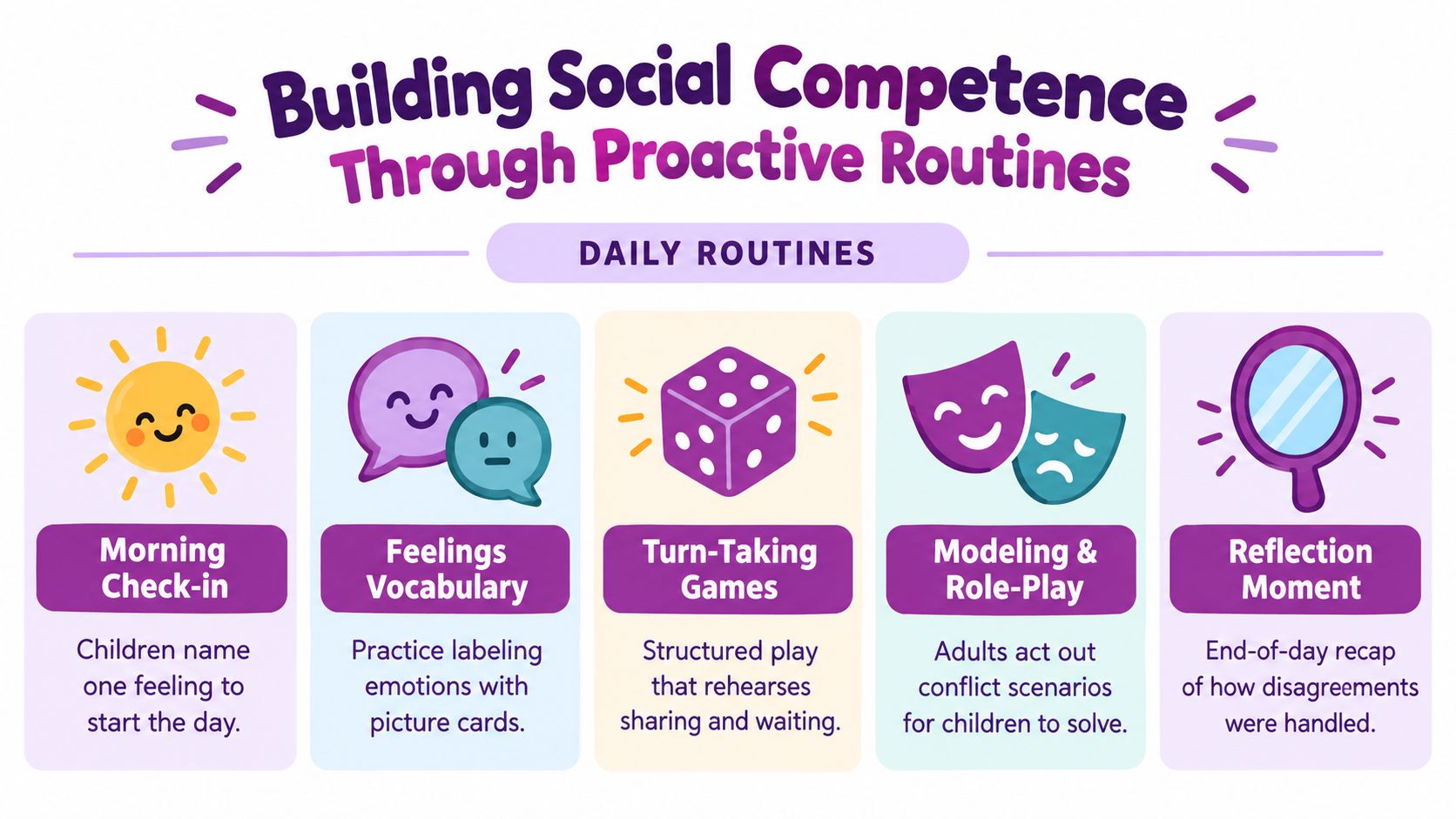
A morning check-in can invite children to name a feeling using a face card, colour or gesture. The adult can add a short sentence: “You're feeling worried. I'll stay close.” This builds a bridge between body sensations, feeling words and help-seeking.
Stories and puppets work well because children can examine a problem at a safe distance. A puppet might snatch a pretend cup and then pause. Ask, “What could the puppet say?” Accept simple responses such as “Stop”, “Can I have it?” or “Get help”. Then model the respectful version and rehearse it together.
Turn routines into social practice
Games that involve waiting, passing, building together and following a shared sequence give children repeated experience with delayed access. Keep the structure visible and predictable. A child who knows what happens next can spend more energy noticing others rather than defending their place.
Educators can also invite children to create group expectations in plain language:
- Gentle bodies: Hands, feet and objects stay safe.
- Listening ears: One person speaks while others listen.
- Fair turns: Everyone gets a chance to participate.
- Help-seeking: Children can ask an adult when a problem feels too big.
Rules become more meaningful when adults refer to them during real play. “You wanted the paintbrush. Our fair-turn rule says we can ask when it's free.”
Rehearse, reinforce and reflect
Queensland education guidance recommends role modelling, supporting peer friendships, developing shared expectations, discussing right and wrong, and using stories about social conflict and resolution. A Queensland case study on social and personal learning presents these practices as part of helping children handle conflict more independently.
Another Australian education resource describes explicit teaching of a common social language and a seven-step process involving reframing, modelling, rehearsing, reinforcing and reflecting. It also highlights the value of helping children label feelings, express them appropriately and role-play responses until those responses become familiar habits. The social competence guidance can help educators and families use consistent language across settings.
In the end, ask a small reflective question: “What helped when the blocks were knocked down?” Keep the answer practical. “You used your words.” “You asked for help.” “You moved back until your body was calm.”
Navigating Complex Behaviours and Digital Conflicts
Not every repeated dispute should be managed as an ordinary sharing problem. A child may be involved in a wider pattern of classroom disruption, bullying, anxiety, exclusion or difficulty with self-regulation. The useful question isn't merely, “Who was wrong?” Ask whether the behaviour is recurring, whether one child has less power, whether safety is affected, and what adults observe across different settings.
Australian education policy recognises disruptive behaviour as a live school issue. NSW guidance recommends using information such as attendance, student-reported bullying, teacher observations and suspension records to identify patterns and target support. Families should therefore share concrete observations with educators, including what happened before the incident, what the child did, who was affected and what helped the child recover.
A classroom environment can also shape how often conflict interrupts learning. Reporting connected with OECD data found that 41% of Australian students said science lessons were disrupted by noise and disorder, compared with an OECD average of 31%. The Australian education guidance on positive student behaviour places this issue alongside the need for structured, data-informed support.
Online conflict needs adult structure
The old advice to “talk it out” isn't always safe or suitable when conflict moves into group chats and social platforms. A child may be excluded from a chat, have a private message shared, receive repeated messages after asking someone to stop, or face an offline disagreement that intensifies online. In these situations, direct contact can increase pressure rather than repair the relationship.
A landmark Australian law required major social media platforms to block under-16s from December 2025, as reported by Reuters in its coverage of child social media access. The policy shift reinforces that online interaction is part of child safety. Parents should preserve relevant messages, avoid encouraging retaliation, check privacy and blocking tools, and involve the school when online behaviour affects attendance, safety or peer relationships.
Safety first: Mediation is appropriate only when children can participate freely and safely. Repeated harm, threats, coercion or serious distress require adult protection and coordinated support, not pressure to reconcile.
At home and in early learning settings, resilience grows through predictable relationships, clear limits and opportunities to recover after mistakes. The building resilience guidance offers a related way to think about coping, persistence and help-seeking. Keep records of recurring concerns, ask educators what they're seeing, and seek professional advice when a child's wellbeing or safety is changing.
Kids Club Early Learning Centre uses everyday play, guided questions and developmentally aligned routines to help children practise emotional regulation, communication and conflict resolution with peers. Visit Kids Club Early Learning Centre to explore childcare, kindergarten and pre-PREP programs in Springvale South, Dandenong North and Ferntree Gully, and speak with the team about your child's needs.