
In Australia, 8.2% of children, or 24,232 children, had a limited command of language at school entry, while 6.6%, or 19,417 children, couldn't attach sounds to letters or showed no interest in trying. An early literacy program helps prevent these gaps by building oral language, phonological awareness, print knowledge and shared reading through play and everyday routines before school.
You may be comparing childcare and kindergarten options while your child repeats the same picture book, points to a familiar sign or makes up sounds for a name. Perhaps they can recognise the logo on a shopfront but aren't ready to write their name. Those moments are early literacy in action, not a sign that your child should be sitting through formal reading lessons.
An early literacy program is a planned set of experiences for children before school. Educators talk with children, introduce new vocabulary, play with sounds, read books together, explore letters and provide opportunities to draw, scribble, dictate stories and notice how print works. The learning often looks like play because young children develop language through meaningful interaction, repetition and investigation.
For a Melbourne parent, the phrase might describe literacy experiences in a long day care service, a community or private kindergarten, occasional care program or supported playgroup. The setting matters less than what children experience there. Look for educators who make conversation richer, revisit favourite stories, notice children's attempts to communicate and deliberately connect play to language and print.
What Early Literacy Programs Really Mean for Young Children
At a Melbourne early learning service, a three-year-old may point to a stop sign, mix the sounds in a friend's name, then request the same story again. These ordinary choices show different parts of literacy developing. The sign reflects attention to familiar print, sound play builds awareness of spoken language, and repeated reading strengthens vocabulary, story sequence and understanding of characters.
Learning happens through ordinary moments
An early literacy program organises these experiences without turning them into miniature school lessons. During book sharing, an educator might ask what could happen next, pause for children to complete a repeated line or follow the words with a finger. Outdoors, a worm investigation can introduce words such as curl, soil, smooth and movement.
At a Reggio-inspired provider, children's questions can guide the investigation. Music gives them rhythm, rhyme and syllables to notice. Sports create chances to follow instructions, describe movement and negotiate rules. Funded kindergarten can provide a planned setting for educators to observe these attempts and respond deliberately. These experiences are connected, not separate add-ons.
The four strands support one another:
- Oral language grows through back-and-forth conversation, storytelling, explanations and new vocabulary.
- Phonological awareness develops as children notice rhyme, syllables, rhythm and sounds in spoken words.
- Print knowledge includes understanding that books have covers, words carry meaning and print follows a direction.
- Shared reading gives children repeated, interactive contact with stories, language and book conventions.
The Victorian Early Childhood Literacy Teaching Toolkit reflects this broad approach. It identifies shared book reading, concepts of print, phonological awareness, oral language and vocabulary, and alphabet knowledge as areas for intentional teaching in early childhood.
What parents should expect
A quality program does not rely on long worksheet sessions or isolated letter-card memorisation. Educators weave literacy into dramatic play, construction, music, meals, routines and small-group experiences. A child might make a sign for a pretend veterinary clinic, dictate a story about a block structure or clap the parts of a friend's name.
A useful test: Ask whether children are talking, listening, noticing sounds, enjoying books and experimenting with marks throughout the day, rather than only during a named literacy session.
The aim is to build language, confidence and early knowledge so later reading and writing instruction has something meaningful to connect with.
Why the Years Before School Shape Reading for Life
A child who arrives at school after years of conversation, songs, stories and shared books has had many chances to practise language. Another child may have had fewer books, less sustained adult conversation or less exposure to classroom language. These differences do not judge families. They show why early learning services need to offer rich, responsive language experiences to every child.
Australian evidence explains why early support matters. Victorian government reporting found that 8.2% of children, or 24,232 children, had a limited command of language at school entry, while 6.6%, or 19,417 children, were unable to attach sounds to letters or showed no interest in trying. A Victorian literacy teaching resource reports that up to 90% of children with persistent language problems at age five continue to have poor outcomes.
A delayed speech pattern does not decide a child's future. Early action gives adults time to respond before a difficulty becomes more visible in formal schooling. Conversation, book sharing, sound play and targeted support can fit into routines children already enjoy, much like adding practice to a familiar game rather than creating a separate lesson.
Reading the local picture
Victoria's policy direction treats early literacy as a shared responsibility for families and early childhood services. Its structured toolkit covers oral language, vocabulary, phonological awareness, print concepts and alphabet knowledge. Local library provision has also operated at substantial community scale. A Whitehorse and Manningham literacy strategy recorded 65,921 attendances at early literacy programs.
The same strategy cited Australian Early Development Census data showing that 92.0% of preschool-age children in Whitehorse and 89.3% in Manningham were on track in language and cognitive skills, compared with 84.7% across Victoria. These figures do not prove that one program caused the difference. They do show why accessible, local literacy experiences matter when families choose care and kindergarten.
For a parent considering a provider in Melbourne's south east, the question is practical: how does the service turn its everyday program into language growth? At a Reggio-inspired centre, a child's interest in building, music or sport can create reasons to explain, listen, sequence events and learn new words. Funded kindergarten can provide another setting for educators to observe progress and plan support. These experiences work together when literacy is treated as part of play and relationships, not as an add-on.
| Indicator | Typical age | What it helps educators consider |
|---|---|---|
| Oral language and vocabulary | Before school | Whether children can understand, use and discuss increasingly rich language |
| Sound awareness | Before school | Whether children notice rhyme, rhythm, syllables and initial sounds |
| Print and alphabet knowledge | Before school | Whether children understand how books, words, letters and sounds work |
| School-entry language risk | School entry | Whether additional support may be needed before difficulties become entrenched |
A centre should explain what educators observe, how they respond and how families can continue language-rich practices at home. The goal is reassurance through clear information, not fear.
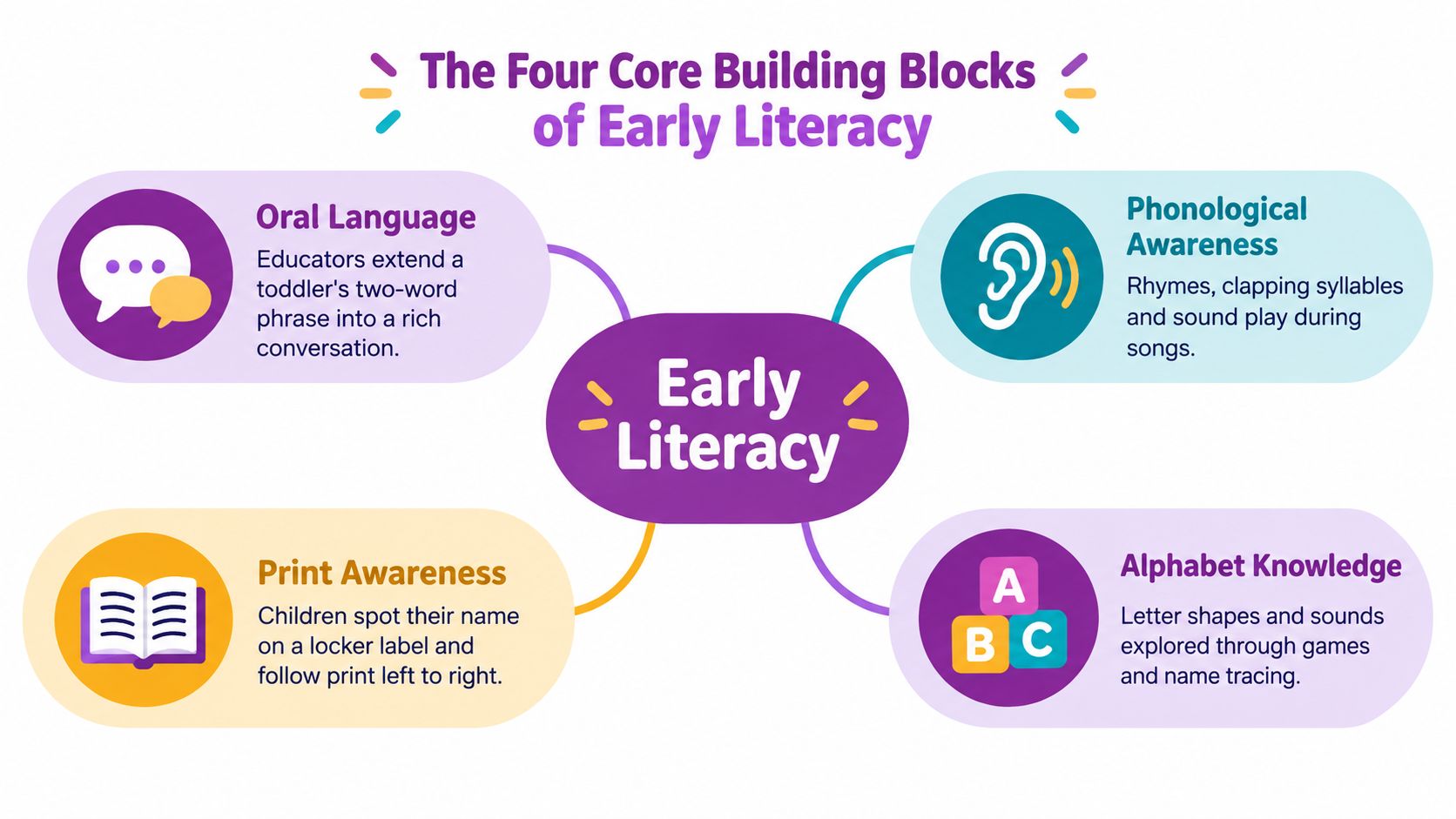
The Four Core Building Blocks of Early Literacy
Early literacy is easier to understand when you can see the building blocks in an ordinary room. They don't sit in separate boxes. An educator may use one conversation to develop vocabulary, sound awareness, print knowledge and story skills at the same time.
Oral language
A toddler says, “Worm hiding.” The educator doesn't correct the child with a test-like prompt. They extend the idea: “The small worm is hiding under the damp soil. What do you think it needs?” This gives the child new words, a model for a longer sentence and a genuine reason to reply.
Strong oral language work includes questions that invite more than yes or no, patient listening and explanations connected to children's interests. Vocabulary becomes easier to understand when children can see, touch or act out the idea.
Phonological awareness
Children can play with spoken language before they understand how letters represent sounds. In a small group, an educator might clap the syllables in children's names, chant a rhyme or notice that ball and bag begin with a similar sound. Songs and movement make this work memorable without making it feel like a drill.
The focus is on hearing and manipulating parts of words. Children might finish a rhyming line, sort objects by their beginning sound or tap out the beats in a word.
Print knowledge and alphabet knowledge
A child notices the M on a friend's bag and asks what letter appears on a cubby label. The educator can connect the symbol to a name, compare it with another letter and explain that print carries a message. In other moments, children may follow a recipe picture, help make a sign or watch an adult write down their words.
Print knowledge includes how books work, where a story begins, how print moves across a page and why adults write labels. Alphabet knowledge adds recognition of letter shapes and, gradually, the sounds those letters represent.
Shared reading
Reading the same picture book repeatedly is valuable because children gain something new each time. One reading might focus on the pictures, another on a character's feelings and another on a repeated phrase or unfamiliar word. Open questions such as “Why did the fox hide?” encourage children to explain rather than only name objects.
These strands overlap throughout the day. Quality early literacy programs layer them into play, routines and relationships, so children develop skills with a reason to use them.
Play-Based Learning Versus Direct Literacy Instruction
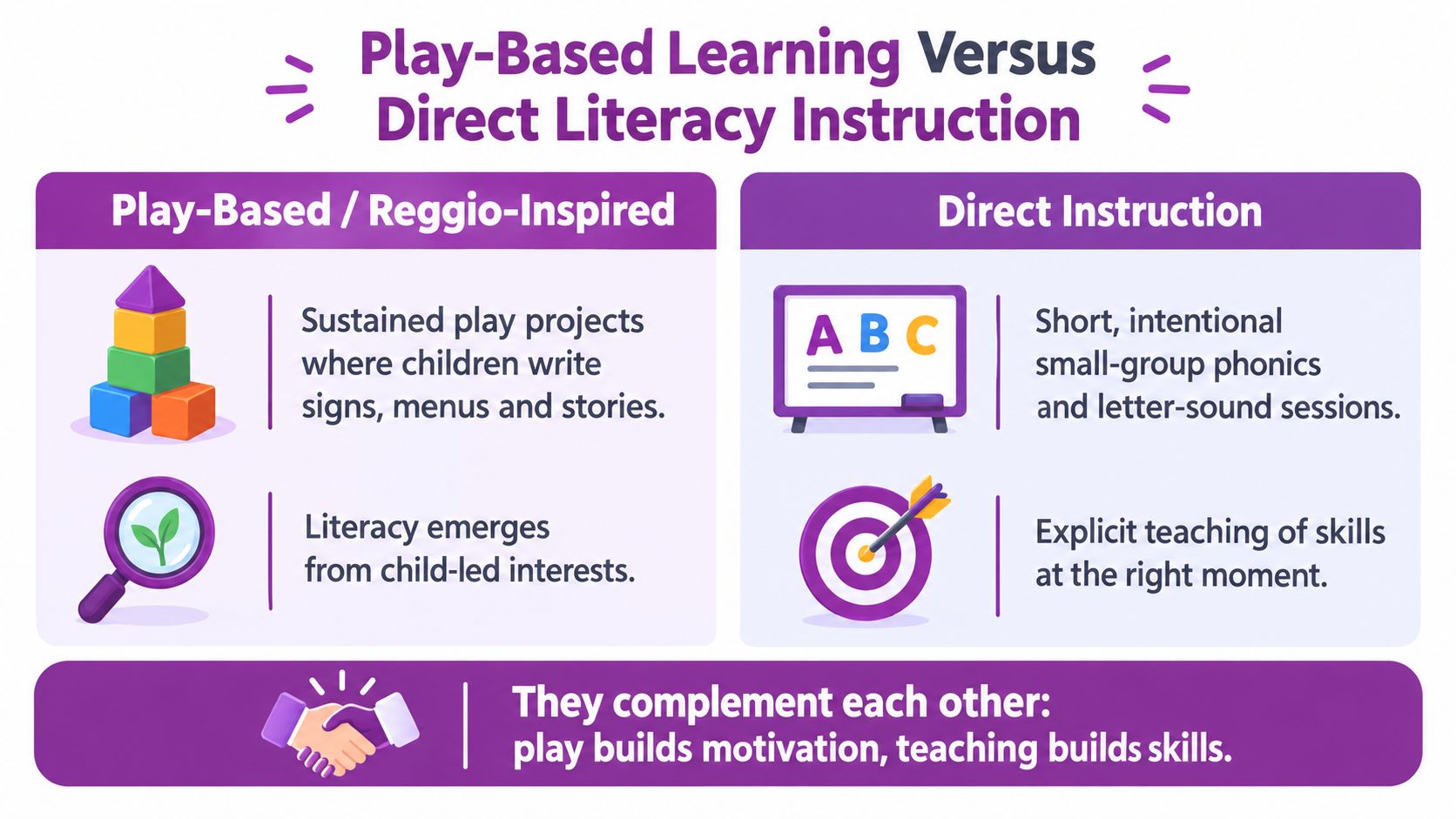
The choice isn't really between play and teaching. The stronger question is how a service uses both. A child-led investigation can create the context for meaningful language, while a short educator-led activity can make a particular sound or letter easier to notice.
What play contributes
In a Reggio-inspired room, children might build a fire station from boxes, negotiate roles, create a sign and retell an event from the investigation. Mark-making in sand, paint or a writing corner can become early writing when children use symbols to communicate an idea. Sustained pretend play also gives children reasons to explain, listen, sequence events and solve disagreements with words.
Play builds motivation because the language has an immediate purpose. A menu matters in a pretend café. A map matters when children are planning where a structure should go. Story retelling matters when a group wants to show another child what happened.
Families can explore how play supports development in this guide to play-based learning in early childhood.
What direct teaching contributes
Explicit instruction makes specific skills visible. An educator might model how to hear the first sound in sun, practise a few letter-sound relationships with a small group, guide children in forming marks or revisit a book's print direction. These short moments are especially useful when an educator has identified a child who needs more support with a particular foundation.
Direct teaching isn't the same as making the entire day rigid. The best practice is intentional and responsive. An educator chooses a skill, explains it clearly, gives children a chance to practise and then returns it to meaningful activity.
The blended model
| Play-based and Reggio-inspired learning | Direct literacy teaching |
|---|---|
| Develops vocabulary through shared projects | Makes sound and letter relationships explicit |
| Encourages storytelling, negotiation and mark-making | Provides focused practice with a clear purpose |
| Builds confidence and motivation | Supports accuracy and growing skill knowledge |
| Follows children's questions and interests | Responds to observed learning needs |
Funded kindergarten programs can include both approaches. Children may spend most of the morning investigating a question, then join a brief shared reading or sound game before returning to the project. During a centre tour, ask whether educators can show examples of both child-led learning and intentional literacy teaching. If one is absent, ask how the service fills that gap.
How to Recognise a High-Quality Early Literacy Program
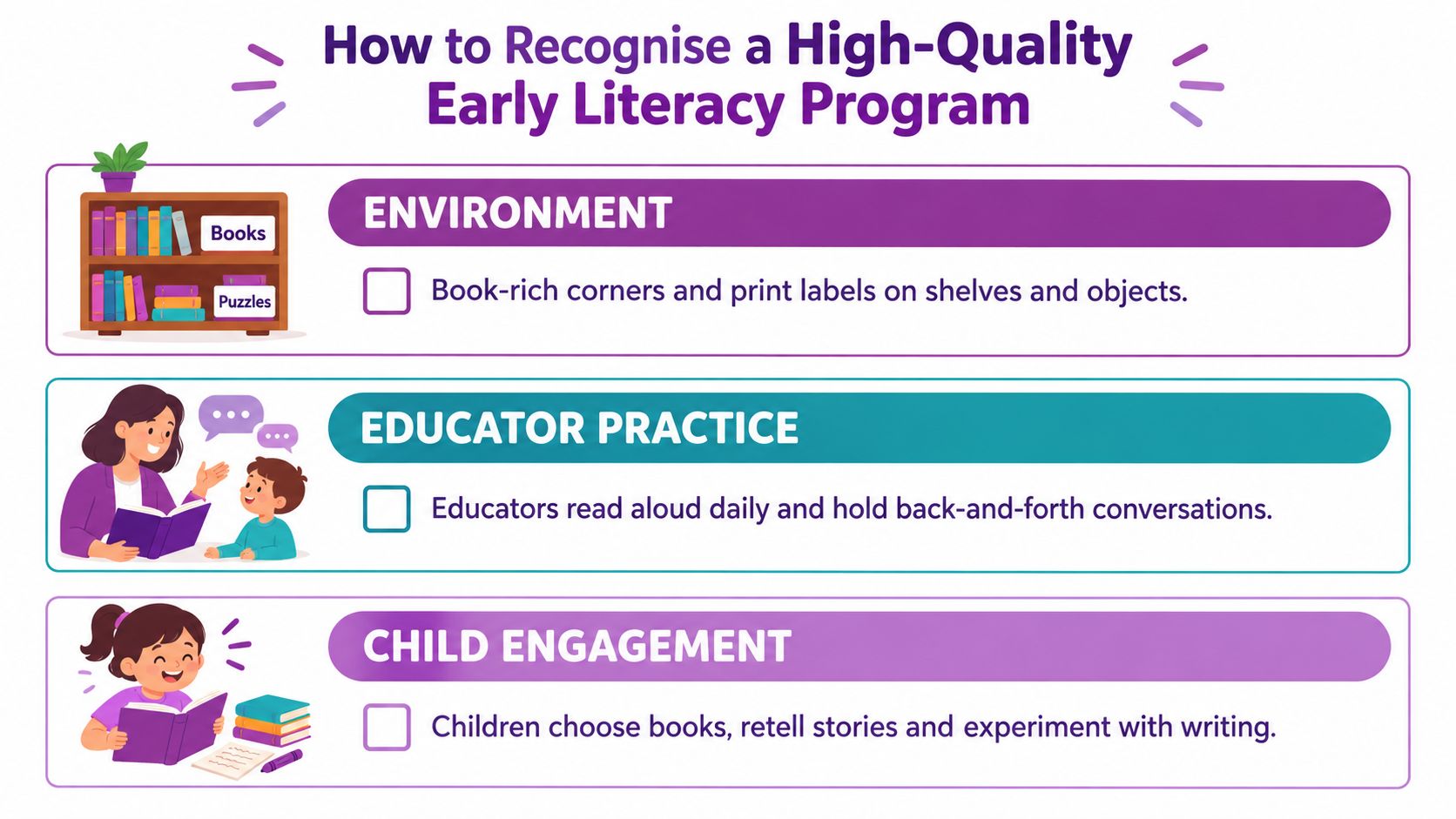
You don't need to test a centre during a tour. Watch what children and educators really do. A literacy-rich environment feels active and social, not like a room arranged mainly for adults to display resources.
Start with the environment
Look for books that children can reach independently, including picture books, information books and stories that reflect the families in the room. Notice whether shelves, objects, dramatic-play areas and storage spaces carry useful labels. Writing tools should be available for drawing, message-making, lists and pretend play, not locked away for special occasions.
Children don't need a room covered in print. They need print that has a purpose and educators who help them interpret it.
Observe educator practice
Listen for educators who extend children's words rather than correcting every mistake. During a read-aloud, look for pauses, questions and discussion, not only rapid page-turning. An educator might track print with a finger, invite a child to predict an event or write down a child's dictated story.
Ask how educators document individual growth. Useful answers may include observations of oral language, samples of children's mark-making, notes about sound games and conversations with families. The Early Years Learning Framework principles and practices can help parents understand the broader learning approach behind these observations.
Notice children's engagement
Children may choose books, retell familiar stories with a friend, make marks on a sign or ask what a letter means. Not every child will join a group activity immediately, so look for educators who offer different entry points rather than forcing participation.
Red flags don't always mean a service is unsuitable, but they deserve a question:
- Worksheets replacing play: Ask how paper-based tasks fit within broader experiences.
- Rigid flashcard drills: Ask whether educators teach sounds and letters through meaningful activities.
- Few visible books: Ask how often children access stories and information texts.
- Silent reading expectations: Ask how educators support conversation and shared interpretation.
- No individual examples: Ask how the team knows what each child is learning.
Ask this on your tour: “Can you show me how you notice a child's language or sound development, and what you do next?”
How Kids Club ELC Brings Early Literacy to Life
At Kids Club Early Learning Centre, literacy can begin with a question rather than a worksheet. In a Reggio-inspired room, children might investigate natural materials, movement or construction during a morning provocation. An educator records a child's explanation through drawing, dictation or an emerging attempt at writing, then uses that interest to extend vocabulary and conversation.
A child who is drawing a bridge may describe it as “big and strong.” The educator can introduce words such as support, balance, connect and structure, write down the child's explanation and invite the child to revisit the idea with peers. That one investigation provides oral language, mark-making, storytelling and print experiences.
Music makes sound noticeable
Music sessions give children repeated opportunities to hear rhythm, rhyme, beat and changes in sound. Clapping along to a song, finishing a repeated line or noticing that two words sound alike supports the listening skills behind phonological awareness. The learning doesn't need to be announced as a phonics lesson for children to practise hearing and manipulating spoken language.
Sports creates a different language setting. Children use words to describe speed, direction, rules, turns, teamwork and body movement. An educator might ask a child to explain how they moved around an obstacle or to retell what happened in a group game. That kind of talk helps children build vocabulary and organise events into a sequence.
Kindergarten makes the learning visible
Government-funded three-year-old kindergarten and the four-year-old pre-PREP program provide a structured context for literacy, numeracy, social-emotional learning and exploration. Educators can connect observations from play, music, sport and shared reading to documented learning, portfolios and conversations with parents.
For a family, that documentation helps answer practical questions. What language is my child using? How are they responding to stories? Are they noticing sounds or experimenting with print? What should we try at home? Transition support can then carry useful information into the move toward local primary school.
The point isn't that every activity must become a literacy exercise. Literacy acts as the connective tissue of the day. Children communicate plans, listen to others, interpret symbols, remember stories and create messages while they play, move, sing and investigate.
Practical Ways Parents Can Support Literacy at Home
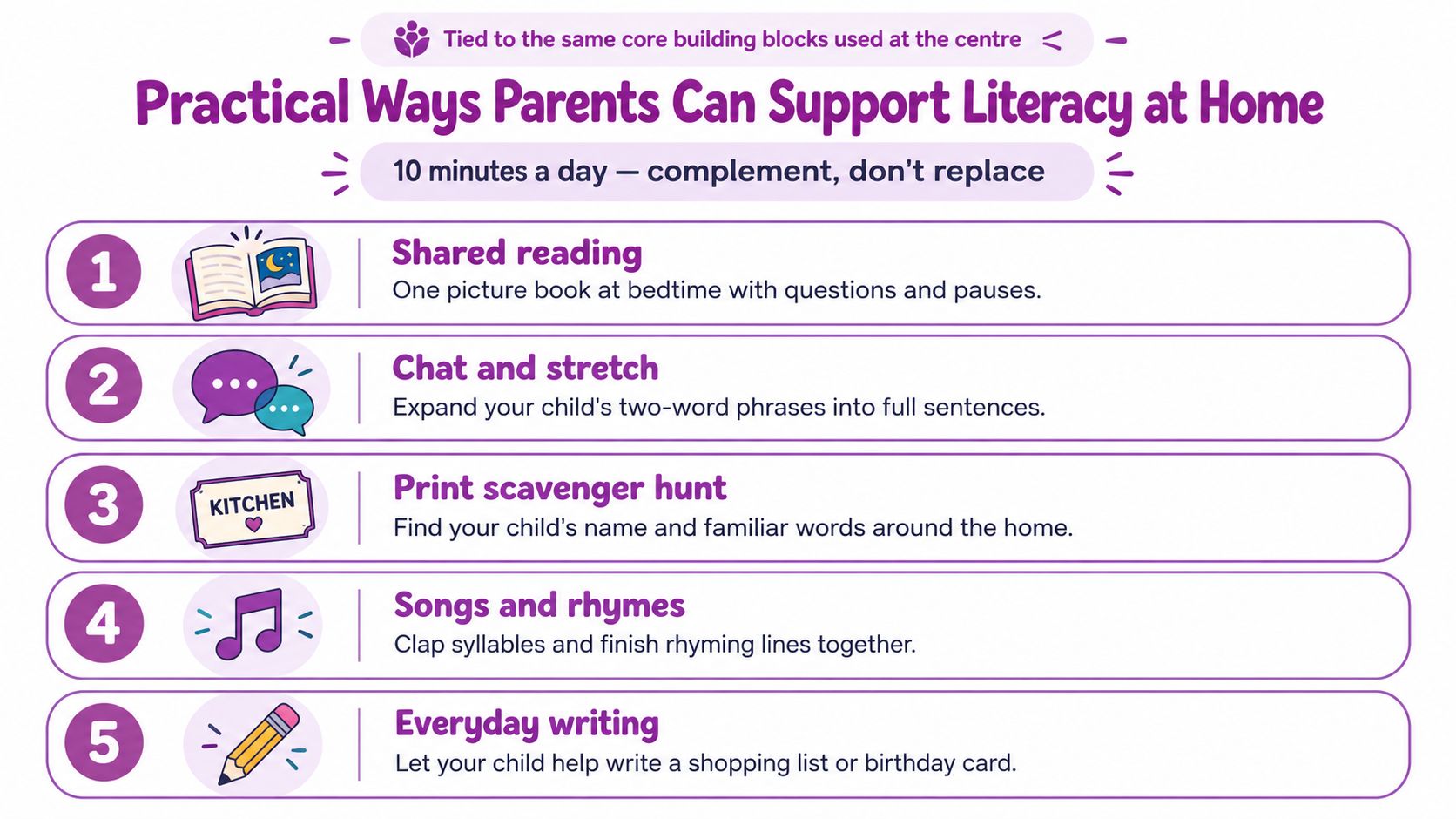
Home practice should complement an early literacy program, not become a second shift for parents. A few attentive minutes built into routines can give children meaningful opportunities to talk, listen, notice sounds and use print.
Five manageable invitations
- Share one book at bedtime: Pause before turning the page and ask what a character might do next. On a busy evening, discuss one picture and one interesting word instead.
- Stretch a short phrase: If your child says, “Dog run,” respond with, “Yes, the small dog is running quickly across the grass.” At the supermarket, expand one comment about a product or action.
- Play with sounds: Clap the syllables in family names or sing a rhyme and pause for your child to finish it. In the car, choose one familiar word and listen for another that begins similarly.
- Notice useful print: Find your child's name on a bag, drawing or label, then talk about what the writing tells you. If you're cooking, let your child help identify a label or make a pretend shopping list.
- Tell a small story: Take turns adding one event to a story about the day. When time is tight, ask your child to tell you one thing that happened before dinner and one thing that happened afterwards.
A book doesn't need to be long or new to be useful. Repetition helps children join in, anticipate language and understand story structure. If you're choosing titles for a young child, this guide to books for a one-year-old offers a starting point for building a small, accessible home library.
Australian evidence on Let's Read describes early literacy support as a combination of family reading practices, home literacy resources and professional capacity, rather than a single activity. The Royal Children's Hospital Centre for Community Child Health overview supports the idea that families and educators should work together around shared reading and emergent literacy.
You don't need flashcards to make a difference. Conversation, attention, songs, storytelling and returning to favourite books give children reasons to use language every day.
Getting Started With Enrolment in Melbourne's South East
Choosing a service becomes easier when you separate three decisions: the care your child needs now, the kindergarten program available later and the way educators will support language across both. Families in Springvale South, Dandenong North and Ferntree Gully can begin by booking a tour, even if they aren't ready to enrol immediately.
Understand the kindergarten pathway
Ask the centre to explain how its government-funded three-year-old kindergarten works and how funding is applied to fees. Then ask how the four-year-old pre-PREP program prepares children for the transition to school. The names and arrangements can vary between services, so request the current fee schedule, session information and eligibility details rather than relying on a general description.
Take a short list to the tour:
- Literacy planning: How do educators support oral language, sound awareness, print knowledge and shared reading?
- Observation: What examples will families see in portfolios or learning updates?
- Inclusion: How does the service support children who speak another language at home or need extra communication support?
- Daily routine: Where do books, music, writing and conversation fit across the day?
- Transition: How are families supported as children move into kindergarten and primary school?
- Availability: Can the centre confirm current vacancies, Term 1 places and mid-year intake options?
A good answer should connect literacy to real experiences. You might hear about educators recording children's words, using songs for sound play, revisiting stories in small groups and involving families in learning conversations. You should also feel comfortable asking what happens when a child isn't yet joining in or communicating as expected.
For this week, choose one practical action. Contact the service, request the parent handbook and book a tour at a time when you can observe the room rather than rushing between commitments. Bring your child's routine, interests, languages and care needs, then ask the team to show how those details would shape the program.
Kids Club Early Learning Centre offers Reggio Emilia-inspired learning, VIT-registered educators, weekly music and sports, and government-funded three-year-old kindergarten with a four-year-old pre-PREP program across Melbourne's south east. To see how those experiences support early literacy through play, conversation and intentional teaching, visit Kids Club Early Learning Centre and request a centre tour, parent handbook and current vacancy details.