
The first invoice often arrives at the worst possible time. One parent is paid on Wednesday, the other is paid fortnightly on Thursday, and a casual Wednesday care day has pushed the amount above the figure quoted during the tour. The family isn't necessarily short of income. The problem is that childcare fees, subsidy adjustments, deposits, absences and changing care days don't always land on the same rhythm as the household budget.
For Melbourne families, choosing among payment plan options is therefore a cash-flow decision, not just an administrative preference. The right arrangement should fit the way your wages arrive, how steady your booked care is and whether your Child Care Subsidy, or CCS, has been confirmed before the first debit.
Why Payment Plan Options Matter for Melbourne Families
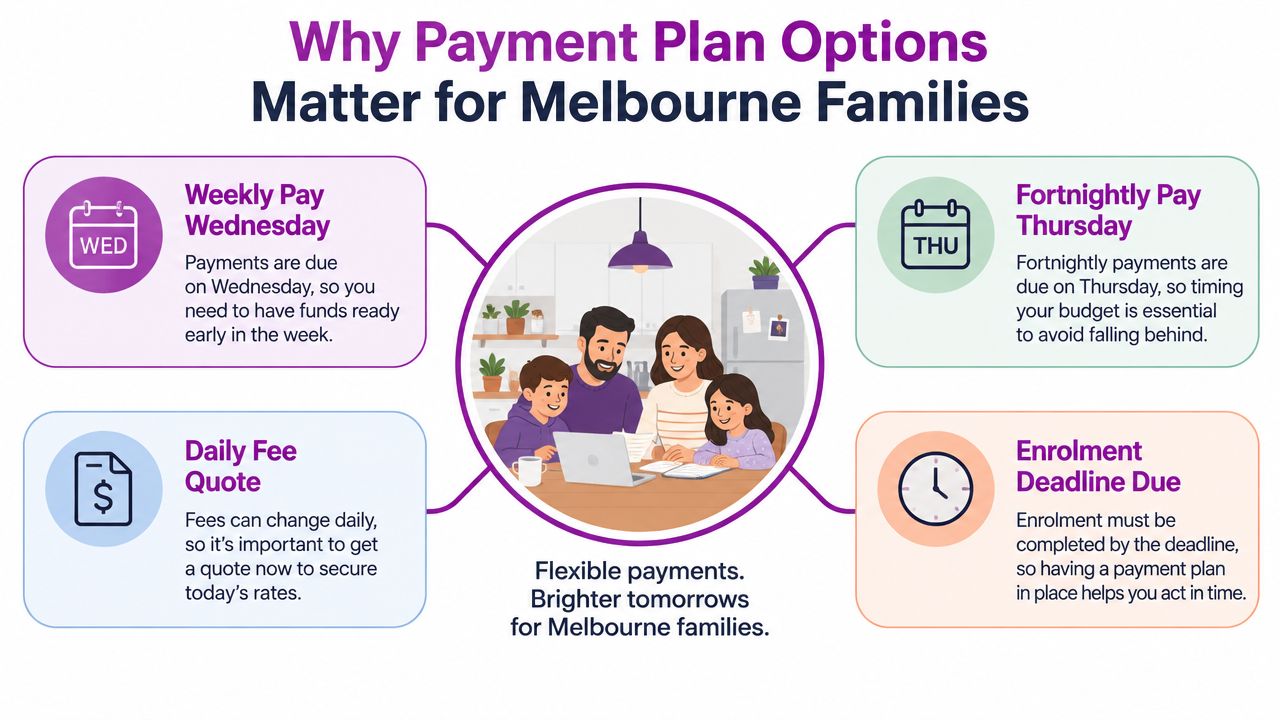
At the kitchen table, the parent opens the enrolment confirmation while checking two bank balances. The centre in Brunswick has quoted a daily fee. The partner's fortnightly pay lands Thursday, but the parent's weekly pay arrived Wednesday. A casual Wednesday has already been added to the booking, and the first invoice includes a deposit as well as the regular gap fee.
That family doesn't need another vague promise about “flexibility”. They need to know which day the centre will debit the account, whether the subsidy has already reduced the invoice, and what happens when care changes. Those details determine whether the plan feels manageable or whether every statement becomes a small financial emergency.
Melbourne households commonly jugate different pay cycles, Centrelink timing, roster changes and school or kindergarten transitions. A parent working shifts may need casual days one week and fewer days the next. A family with two children may move from infant care to kindergarten while a sibling remains in a full-time room. A public holiday or absence can also change the amount payable, depending on the centre's fee policy and attendance rules.
The invoice matters more than the advertised fee
A quoted daily fee is only the starting point. The amount a family needs to fund is usually the gap after CCS, plus any deposit, casual-care adjustment or balance carried from an earlier statement. CCS is generally paid directly to the approved provider as a reduction in fees, rather than sent to the parent as a cash refund, according to the Australian Bureau of Statistics explanation of childcare costs and support.
Before accepting a plan, ask for a sample statement. You want to see the gross fee, subsidy offset, gap fee, payment date and treatment of extra days in one place. The childcare fees and payment information should be read alongside the enrolment agreement, not treated as a replacement for it.
Practical rule: Choose the debit rhythm you can maintain during an ordinary, expensive fortnight, not the rhythm that works only when no one is sick, rostered on extra shifts or moving rooms.
The rest of the decision becomes simpler once you match the plan to the actual problem. Weekly payment suits households that need smaller, frequent debits. Fortnightly payment can mirror salaried wages. Casual billing is useful when attendance changes, but it becomes costly and unpredictable when used to patch a regular booking.
The Main Childcare Payment Plan Options Explained
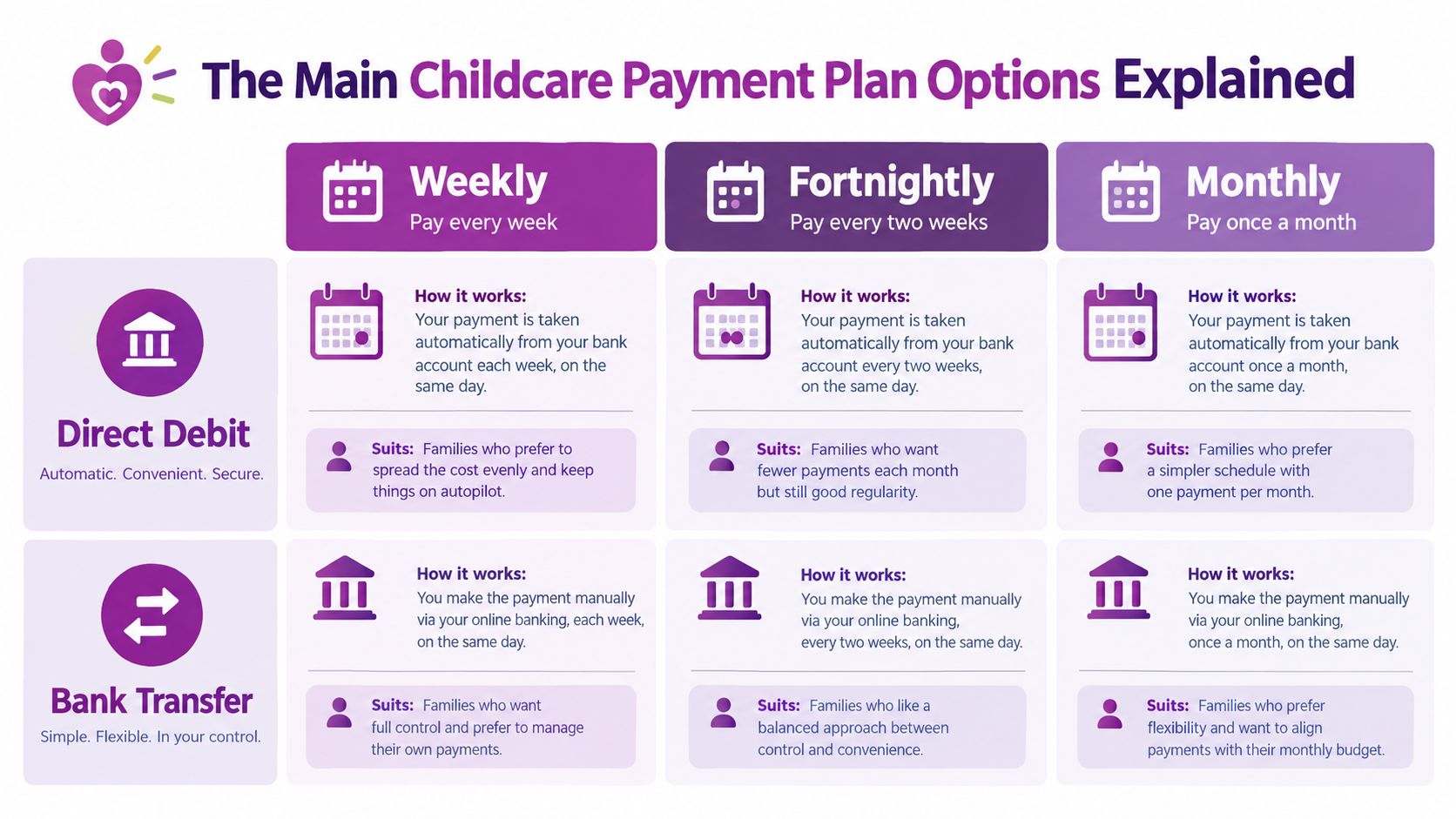
Most centres present the same basic choices, although their dates, deposit rules and collection policies differ. Read the terms carefully because a “weekly plan” may mean a weekly debit of the previous week's invoice, while another centre may estimate the coming week and reconcile later.
Weekly and fortnightly schedules
Weekly payment divides the regular gap fee into smaller amounts. This approach involves buying groceries every week rather than paying for the month's food in one shop. It suits sole parents, shift workers and households with weekly wages because a single statement is less likely to consume a large portion of one pay.
Fortnightly payment matches a common salary cycle and reduces the number of transactions. It works well when both parents receive predictable wages or when a family wants one household budget event for childcare. The trade-off is simple. Each debit is larger, and a missed pay or unexpected casual booking affects a bigger instalment.
Monthly payment can suit families with stable monthly income, but it gives changing care patterns more time to accumulate before the account is settled. I recommend it only when the household already budgets monthly and can absorb a larger reconciliation.
Direct debit and bank transfer
Direct debit is the practical default for most ongoing bookings. It resembles a gym membership authority, except the amount may change when attendance, subsidy or casual days change. Victoria's payment and collection fees policy identifies direct debit from a nominated bank account as the default method, with alternatives considered only in exceptional circumstances.
Bank transfer gives parents more control over the exact payment action, but it creates another task every billing period. It also increases the chance of a missed reference, late payment or manual reconciliation problem. Ask whether the centre accepts it routinely, what date the funds must clear, and whether an administrative fee applies.
Deposits, casual care and siblings
An enrolment deposit or bond secures a place before care begins. It works like a rental bond. Ask whether it's refundable, when it is returned, and whether the centre applies it to the first invoice.
Casual care covers days outside the permanent booking. It solves a roster problem, but usually carries a higher daily charge and may depend on availability. Don't build a permanent care pattern around casual days unless your work schedule changes week to week.
A sibling discount reduces the fee for a second or third enrolled child under the centre's rules. It can soften the impact of a sibling transition, but check whether it applies to the lower-fee child, the younger child or only certain booking types. Never assume the discount automatically combines with every government fee-relief program.
How the Child Care Subsidy Changes What You Pay
The Child Care Subsidy changes the invoice before your payment plan is applied. The centre starts with the approved fee, then Services Australia determines the subsidy rate based on family circumstances, income and activity. The provider receives the subsidy directly, and the family pays the remaining gap fee, rather than waiting for a separate reimbursement.
The published government material contains different threshold presentations for different reporting contexts and updates, so families should use their current assessment rather than rely on a rough estimate. The Child Care Subsidy estimator can help you model the likely gap, but the centre's statement is the amount that controls the debit.
A rate of up to 90% may apply for eligible families, with the percentage tapering as income rises. The Australian Government CCS provider guidance explains that the subsidy is applied to the actual fee charged and paid to the provider. The rate also interacts with the hourly fee cap, approved activity and the family's subsidised-hour entitlement, so a high daily fee isn't automatically reduced by the same proportion across every hour.
A sample gap calculation
The table below is an illustration of the arithmetic, not a promise of a family's actual assessment.
| Family income before tax | CCS rate applied | Subsidy on $120 daily fee | Gap family pays |
|---|---|---|---|
| Eligible household at the maximum rate | 90% | $108 | $12 |
| Household receiving a 80% rate | 80% | $96 | $24 |
| Household receiving a 50% rate | 50% | $60 | $60 |
The $120 fee and the three rates demonstrate why payment plans must be based on the expected gap, not the gross fee. If the hourly cap limits part of the fee, or if the centre charges for hours outside the subsidised arrangement, the gap can be higher. Activity hours and annual limits can also affect how much support remains available.
A direct debit should follow the confirmed gap fee wherever possible. Debiting the gross amount and waiting for a later adjustment creates avoidable pressure.
Government data shows the scale of this system. In the June quarter of 2026, 1,456,930 children from 1,049,450 families attended CCS-approved services, the average hourly fee was $13.90, and estimated CCS and Additional Child Care Subsidy expenditure reached $3.88 billion for that quarter, according to the June quarter 2026 CCS data report. These figures underline the practical point: subsidy processing is part of the normal fee system, not an optional extra.
Sample Payment Schedules for a Working Family
A workable schedule starts with three checks: when the statement is issued, when the debit occurs and whether the amount reflects confirmed CCS. Don't choose weekly or fortnightly in the abstract. Put the debit beside the pay date and test it against a high-use week.
Scenario A
A dual-income family receives fortnightly wages and has two children booked for full-time care. Their combined gap fee is $620 per fortnight, so a centre offering weekly direct debit might collect $155 per week, producing two debits across the fortnight.
Scenario B
A sole parent is paid weekly on Wednesday and has one child attending three days. The centre may arrange a $145 Wednesday debit if that amount represents the agreed weekly gap. This structure gives the parent a clear relationship between the wage arrival and the childcare payment.
Scenario C
A shift-working family uses changing casual days. The centre reconciles five booked days at $58 per day, then adjusts the account for the applicable CCS changes. A fortnightly reconciliation can be sensible here, but the family must understand that the debit won't be identical each cycle.
| Scenario | Income pattern | Care days | Gross weekly fee | CCS estimate | Weekly gap fee | Direct debit day |
|---|---|---|---|---|---|---|
| A | Fortnightly wages | Two full-time children | $620 fortnightly gap arrangement | Confirmed assessment required | $155 weekly debit | Agreed weekly day |
| B | Weekly Wednesday wage | Three regular days | Not supplied | Confirmed assessment required | $145 | Wednesday |
| C | Variable shift income | Five casual days over a fortnight | $58 per booked day | Reconciled after attendance | Variable | Fortnightly reconciliation |
These examples use the supplied household scenarios, not a universal fee schedule. A centre may run its billing week from Sunday to Saturday, issue statements on Monday and debit on Wednesday, but you should confirm those dates before signing.
Absences and public holidays can change the statement without changing the permanent booking. Ask whether the centre charges for an absent booked day, whether a casual booking can be cancelled, and when a CCS adjustment appears. For a deposit, paying it at enrolment preserves simplicity. Spreading it across four fortnights may protect cash flow, but only if the centre confirms the arrangement in writing.
Use the childcare fees calculator to prepare questions, then compare the result with the centre's own statement. The goal isn't to predict every invoice perfectly. It's to know which changes will make the debit rise or fall.
In-House Plans Versus BNPL and Credit
For recurring childcare, an in-house direct debit is usually safer than using BNPL or a credit card as the primary plan. A centre's schedule gives you one known collection pattern. BNPL creates a separate instalment stream for each transaction, and a credit card can hide the true cost until the balance carries forward.
The RBA's discussion of consumer payment behaviour describes cards as a heavily used payment method and notes the normalisation of tap-based payments. The same source also discusses BNPL use and cost-of-living pressure. Convenience is real, but convenience doesn't turn an unaffordable recurring fee into an affordable one.
Compare the risk you actually carry
| Method | What it solves | Main problem |
|---|---|---|
| In-house direct debit | Predictable collection of the regular gap fee | A failed debit can trigger centre follow-up quickly |
| BNPL | Short-term smoothing for an isolated expense | Multiple instalments can overlap and become difficult to track |
| Credit card | Emergency payment access | Interest can continue if the balance isn't cleared |
| Bank transfer | Manual control over each payment | Missed dates and reconciliation errors become your responsibility |
Centre contracts commonly state that unpaid fees above a specified threshold can lead to a booking review or pause, regardless of whether the debt came from direct debit, BNPL or credit. Read that clause before choosing a payment method, and ask what notice the centre gives after a failed payment.
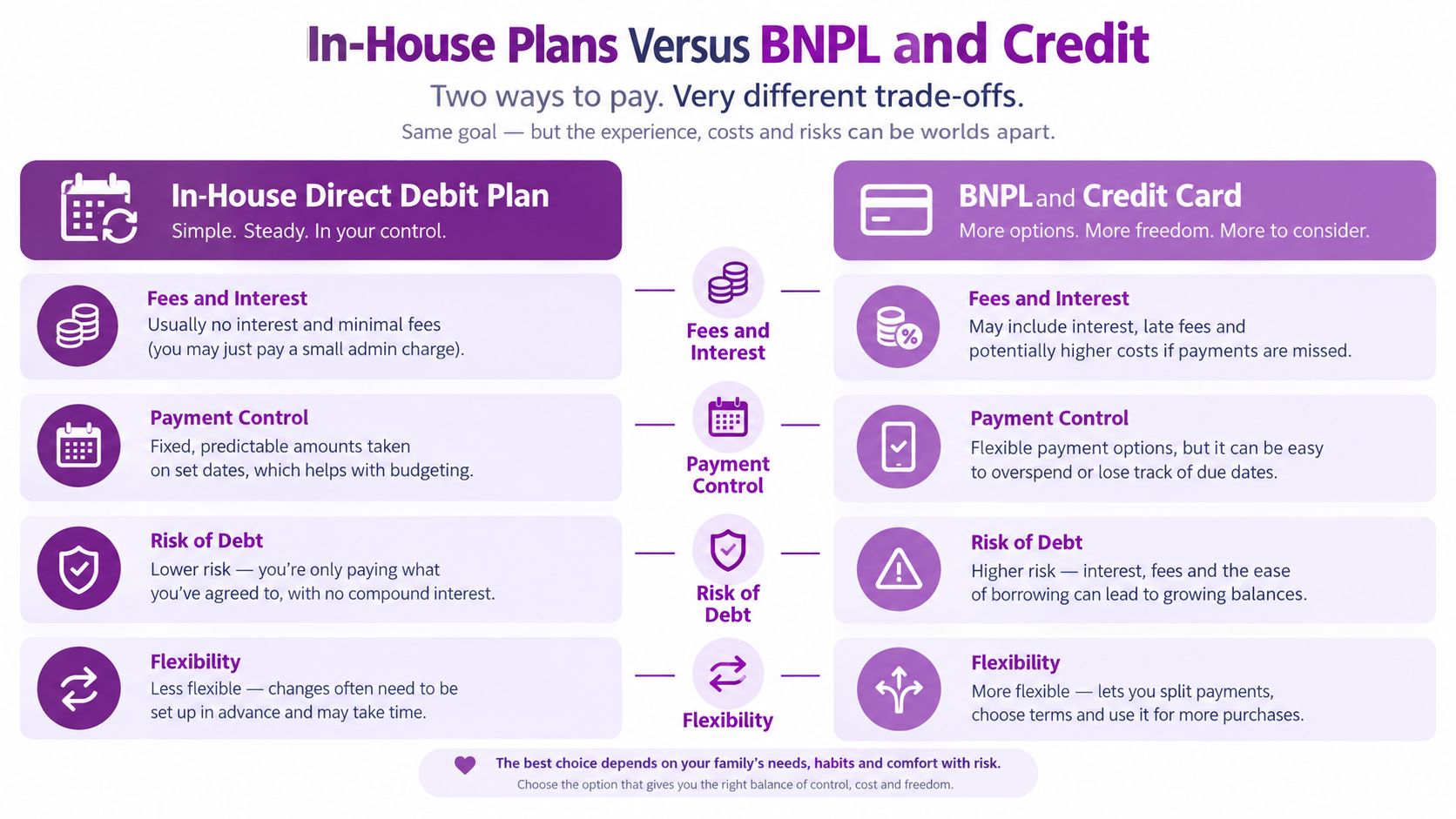
My recommendation is straightforward. Use direct debit for the regular gap fee, keep a credit card only as a backup for an occasional casual day, and avoid using BNPL for every recurring invoice. If a bond top-up is the only short-term problem, a limited buffer may be less disruptive than placing the whole childcare account on rolling credit. That is a cash-flow tactic, not a long-term payment plan.
Setting Up Your Plan at Kids Club ELC
Enrolment day goes more smoothly when you bring the information the centre and Services Australia need. Start with the financial agreement, then confirm the subsidy claim and debit authority separately.
A centre may request an enrolment deposit based on two weeks of gross fees, with the amount deducted from the first invoice. Confirm whether the deposit is refundable or credited, and ask whether you can spread it across an agreed number of fortnights instead of paying it all at enrolment.
For ongoing payments, complete the direct debit authority for a nominated bank account or eligible Visa or Mastercard debit card. Choose weekly or fortnightly collection based on your wage cycle, then write down the debit day. If your pay date shifts, contact the centre before the debit rather than waiting for a failed transaction.
For CCS, prepare your myGov sign-in linked to Centrelink, your child's Customer Reference Number, immunisation history statement, date of birth and activity test assessment if you're claiming more than the base subsidised hours. The centre can then confirm the booking and support the claim process.
Ask how the centre records booked days in Xplor or its equivalent parent app. You should be able to see attendance, statements, casual bookings and relevant adjustments in one place. Once Services Australia confirms the CCS assessment, the provider applies the subsidy to the account rather than sending the money to your bank account.
Bring your bank details, CRN and questions about absences to the enrolment meeting. Fixing the billing rhythm before the first statement is much easier than correcting several missed debits later.
Ask the enrolments or accounts team who can place a one-week hold on a direct debit if your pay day changes. The answer should be specific, including the notice required and whether the hold affects the booking or only the collection date.
Choosing the Right Plan and Next Steps
Choose the plan according to three household signals:
- Predictable income: Salaried two-parent households with two children enrolled full-time generally suit fortnightly direct debit.
- Frequent wage payments: Sole parents and shift workers usually manage weekly direct debit better because the debit stays closer to the pay that funds it.
- Changing attendance: Use casual billing only when your roster swings. It isn't a good substitute for a permanent booking that you already know you'll need.
Check two traps before signing. First, don't choose the cheapest headline fee without reading the bond refund and credit rules. Second, don't accept a debit date that falls before the CCS reduction is expected to appear unless you can comfortably fund the gross amount temporarily.
Your next steps should be practical:
- Book a tour and ask for a sample statement.
- Request the full fee schedule, deposit terms and absence policy.
- Confirm the CCS enrolment through myGov and check the assessment.
- Bring your bank details, child's CRN and supporting documents to enrolment.
- Ask the centre to confirm the billing week, statement date, debit day and contact for payment changes.
Kids Club ELC has centres serving Springvale South, Dandenong North and Ferntree Gully, with enrolment support, infant and toddler care, kindergarten and pre-PREP options. Contact the centre's enrolments team through its website and ask them to match the available payment plan options to your pay cycle and care pattern.
Kids Club Early Learning Centre offers care from six weeks to six years, Reggio Emilia-inspired learning, VIT-registered educators and practical enrolment support for Melbourne families managing changing childcare costs. Visit Kids Club Early Learning Centre to arrange a tour, request the current fee schedule and speak with the enrolments team about a payment plan that fits your family.