
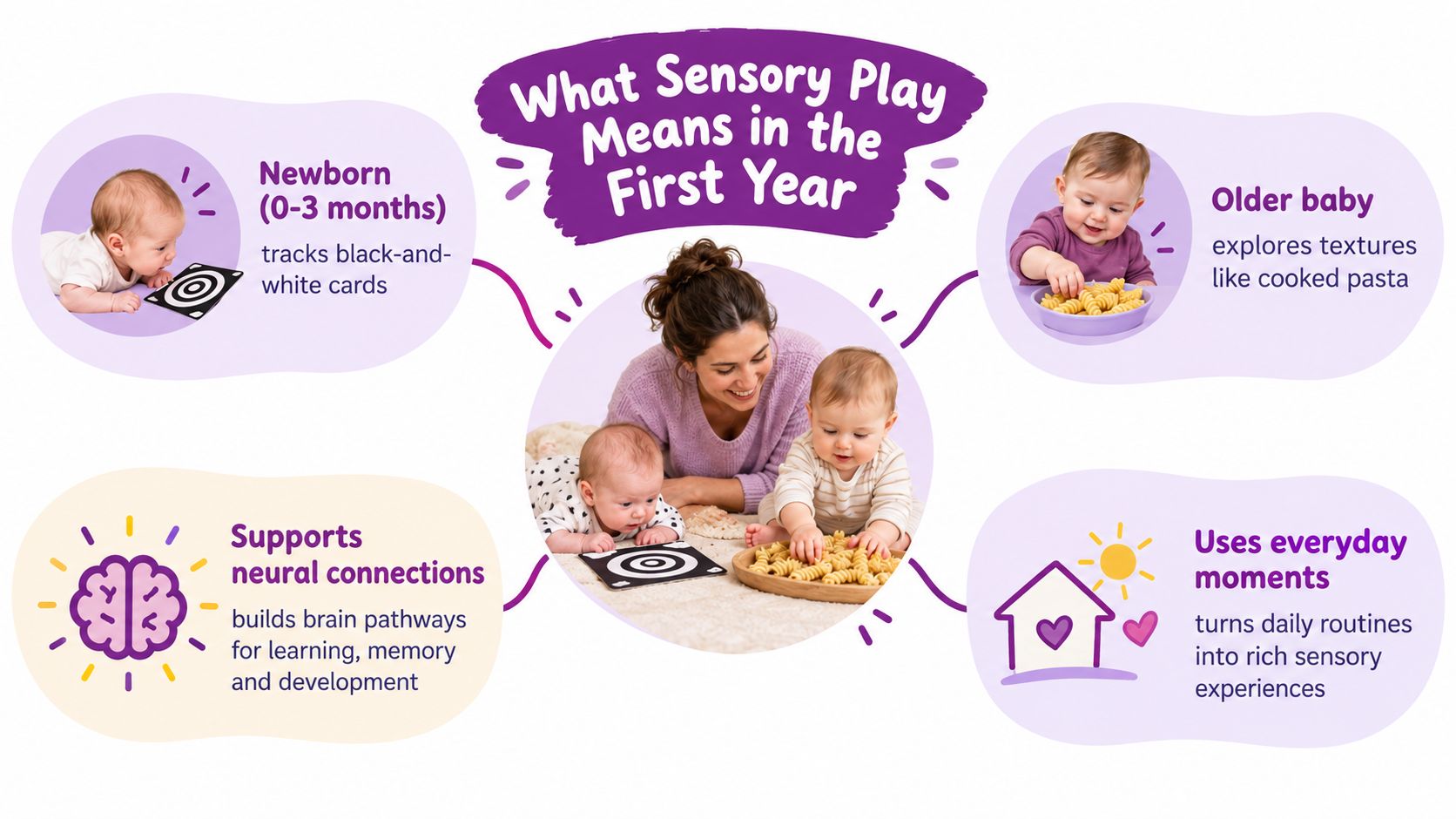
You're on the living-room floor with a towel underneath you, trying to make sense of “sensory play”. Your six-week-old is lying on their back, following a bold black-and-white card with sleepy concentration. Beside you, an older baby is pressing cool cooked pasta between their fingers, then immediately trying to taste it. Neither child needs an elaborate activity station. They need a safe opportunity to notice, move, listen, touch, and respond.
Sensory play for infants is learning through the body. It includes everyday experiences that engage sight, sound, touch, smell, taste, movement, balance, or body awareness. Your face during a nappy change, your voice during a feed, tummy time on a textured mat, and a soft cloth offered during awake time can all count. The important ingredients are age fit, close supervision, a calm pace, and an adult who watches the baby's response.
Australian early childhood guidance places sensory learning at the centre of the earliest months, rather than treating it as something that begins in toddlerhood. This guide translates that approach into practical choices for home, with activities organised around a changing risk profile from the newborn stage through eighteen months.
What Sensory Play Means in the First Year
On the lounge room floor, the same activity can carry different risks at different ages. A newborn may listen to your voice, follow your face, or feel the steady pressure of being held. An older, mobile baby may squeeze a sponge, shake a sealed bottle, or move a scarf across their hands. The material matters, but so do posture, mobility, mouthing, and how closely you can supervise.
Sensory play for infants begins with an experience a baby can safely receive through the senses. The familiar five senses are only part of the picture. Vestibular input comes through movement and balance, while proprioceptive input helps a baby notice where their body is and how it is moving. Rolling, gentle carrying, reaching across the body, and pushing up during supervised tummy time all provide information without requiring a commercial toy.
Australian guidance describes infants as learning through sensory experiences from birth to four months. Early milestone information notes that babies respond to sounds and familiar faces. A lack of response to sounds or play cues is a reason to raise concerns with a health professional, as outlined in Australian birth-to-four-month milestone guidance.
What sensory play involves
A small, clear setup gives you better information than a crowded collection of objects. Screen time, colour-identification tests, and rapid introductions of new textures do not need to lead the experience. Too much novelty can unsettle a tired infant and make it harder to see which sensation has caught their attention.
Begin with one sensory channel and a few safe materials. Offer a soft cloth, pause, and watch. Move it slowly, speak gently, or let your baby look without touching. The adult's role is to create the conditions for exploration while the baby sets the pace.
Practical rule: A calm, alert, interested baby is telling you the experience suits them. It does not need to look impressive.
Everyday care already provides useful opportunities. Talking during a nappy change adds sound and social attention. A soft towel under the hands during tummy time adds touch. For an older baby who can be watched closely, shallow water adds temperature, pressure, movement, and cause and effect. As babies become more mobile, the safe setup needs to change with them.
Why Sensory Play Matters for Early Development
During the first year, babies build understanding by connecting what they feel with what they see, hear, and do. A rattle isn't only a sound. When a baby reaches, grasps, shakes, watches, and hears the result, they're linking movement with consequence. Repeating that kind of experience gives the brain useful information to organise.
Australian early childhood practice recognises children as active learners whose relationships and environments shape learning. Australian research also shows that sensory and physical environments can support social interaction and emotional regulation. A Victorian study involved 10 semi-structured interviews across two early childhood education and care sites in 2022, and reported that children used environmental stimuli to create opportunities for interaction and regulation, while also identifying barriers such as building design and limited staffing. The findings are discussed in Monash University's research record on educator perspectives and sensory environments.
You can watch for development without turning play into an assessment. Notice whether your baby turns towards a familiar voice, follows a slow object with their eyes, reaches towards a texture, brings hands together near the middle of the body, or settles when you reduce the input. These observations help you choose what to offer next.
| Sense channel | What the activity offers | Milestone parents can observe |
|---|---|---|
| Touch | Soft, smooth, warm, cool, wet, or lightly textured surfaces | Reaching, grasping, releasing, or tolerating a new texture |
| Sight | High-contrast images, faces, slow movement, and changing positions | Tracking, focusing, and looking between an object and a caregiver |
| Hearing | Talking, singing, gentle rattles, and pauses for response | Turning towards sound, vocalising, or calming to a familiar voice |
| Movement | Tummy time, carrying, rolling, and supported changes in position | Head control, pushing up, reaching, and increased body awareness |
| Taste and mouth exploration | Safe, age-appropriate feeding experiences once developmentally ready | Bringing safe objects or food to the mouth and exploring texture |
Sensory exploration also connects with fine motor development because babies learn to coordinate looking, reaching, holding, and releasing. For practical ideas that connect these actions with later hand control, see fine motor skill activities for young children. The strongest experiences are usually ordinary, repeated, and shared with a responsive adult.
Setting Up a Safe Sensory Play Space at Home
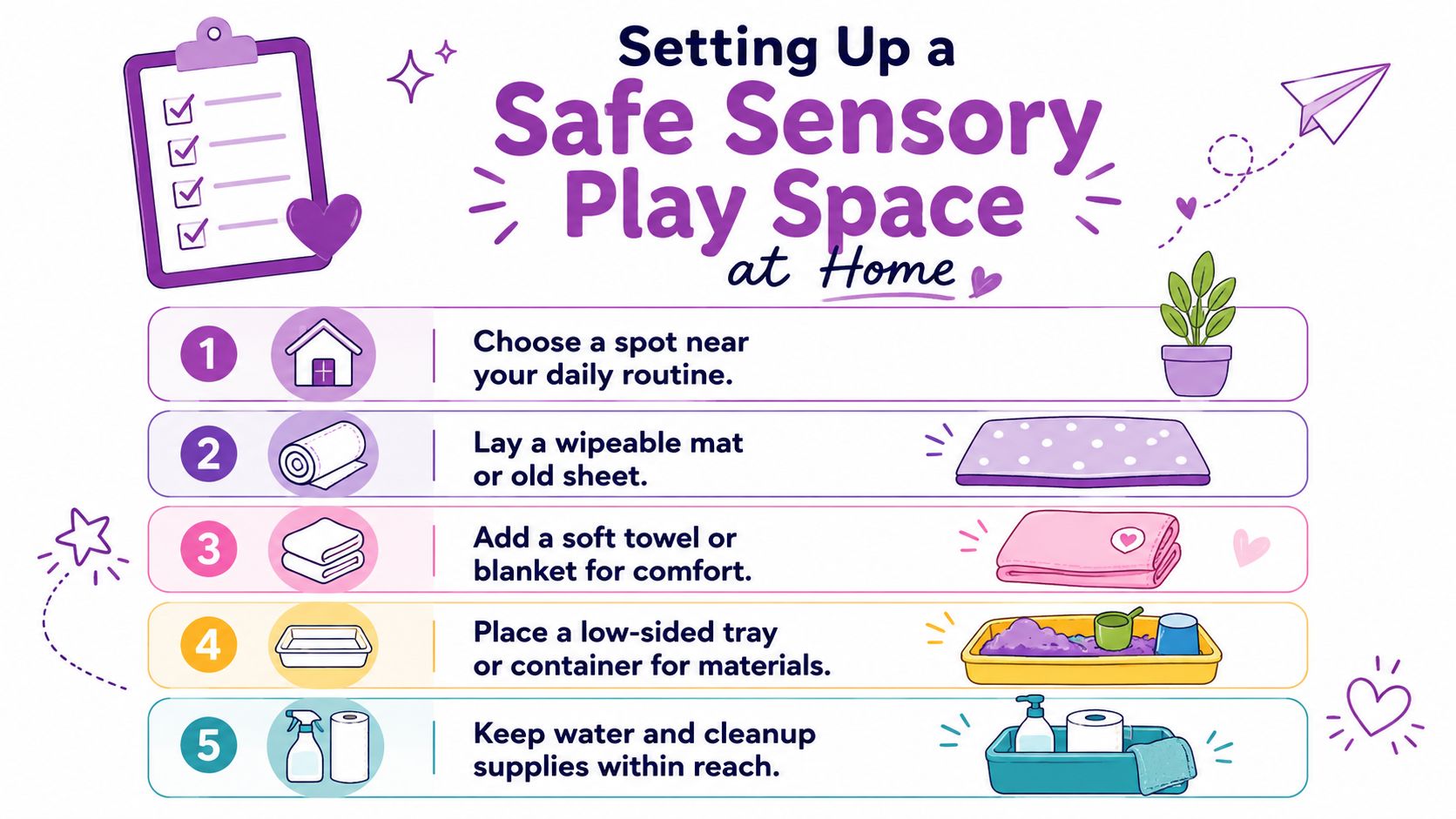
Choose a place you already use. A section of the lounge room floor near the sofa is often more practical than a perfect activity corner that stays untouched. You should be able to sit beside your baby, keep clear sightlines, and reach them immediately without stepping over furniture.
Build the space from the floor up
Start with a stable surface. Use a wipeable mat, an old sheet, or a rug that won't bunch beneath your baby. Smooth nearby hard edges and remove objects that could roll into the play area.
Match the position to the baby. A newborn may lie on their back while watching a card or listening to your voice. As your baby develops stronger head and trunk control, offer supported sitting or awake, supervised tummy time. Never use a play position as a sleep position.
Keep materials visible. Shallow trays, silicone bowls, muffin tins, and low-sided containers help you see what's available. Keep everything within your reach, not just within the baby's reach.
Reduce competing input. Natural daylight or a soft lamp is usually easier to manage than harsh overhead lighting. Turn background music off, or keep it quiet enough that your baby can hear your voice clearly.
Reset before the next use. Sweep the floor, wipe containers, check for damaged seams or loose pieces, and rotate only a small selection. A quick reset protects safety and keeps the invitation uncluttered.
The environment itself teaches your child what's possible. A low surface supports reaching, an open floor supports movement, and clear containers make materials easy to notice. This is consistent with the idea of the environment as the third teacher, where the arrangement of space influences how children explore and connect.
A short visual example can help you assess spacing, positioning, and supervision before you prepare your own area.
Before every session, ask three questions: Can I see the baby's hands and mouth? Can I reach them immediately? Is the setup for awake play only? If any answer is no, simplify the space.
Age-Appropriate Activities from Six Weeks to Eighteen Months
Age bands are useful, but they're not rigid deadlines. Choose the activity that fits your baby's current posture, grasp, mouthing, movement, and ability to remain settled. A younger baby may watch an object while an older baby reaches for it, and the same material can become more complex as skills change.
Begin with looking and listening
From around six to twelve weeks, offer a bold black-and-white card at a comfortable viewing distance, a soft crinkle cloth for supervised grasping, or a short period of awake tummy time on a textured mat. Keep the object still at first, then move it slowly so your baby has time to follow it. Your voice can be the main sensory experience. Speak, pause, and allow space for a look or small sound.
From three to six months, try a warm, damp sponge during a nappy change, a simple rattle that responds when shaken, or oatmeal exploration with your baby securely supported. Keep the invitation small. If your baby reaches for the rattle, let them lead the exchange rather than repeatedly placing it into their hand.
Let older babies act on materials
From six to nine months, a tray with cool cooked pasta can offer a rich touch and grasp experience for a baby who can sit securely with close supervision. A highchair tray with a thin layer of plain yoghurt can support messy exploration, provided the food is appropriate for your baby and you remain close. Crinkling tissue paper can add sound, but it must stay in an adult's hand if it could tear into pieces.
From nine to twelve months, a securely sealed bottle containing dry materials can create a visual and sound experience without loose pieces. Finger painting with boiled, cooled water and cornflour on a taped sheet offers wet and slippery sensations. Chiffon scarves also work well for peekaboo, pulling, and watching an object disappear and return.
From twelve to eighteen months, older infants may explore kinetic sand, frozen berries in a water tray, or a simple cause-and-effect activity using large pom-poms and kitchen tongs. These activities require careful material checks and active supervision because your child's mobility and ability to reach hazards are changing quickly.
| Age band | Primary senses | Starter activity | Watch for |
|---|---|---|---|
| Six to twelve weeks | Sight, hearing, touch | High-contrast card, voice, soft crinkle cloth | Turning away, startling, or losing visual focus |
| Three to six months | Hearing, touch, movement | Damp sponge, simple rattle, supported exploration | Reaching, grasping, mouthing, or becoming tired |
| Six to nine months | Touch, sight, sound | Cooked pasta, plain yoghurt painting, tissue sound | Grabbing, squeezing, tasting, or pulling material apart |
| Nine to twelve months | Sight, touch, movement | Sealed sensory bottle, water-and-cornflour painting, scarf play | Crawling towards materials or attempting to open containers |
| Twelve to eighteen months | Touch, movement, cause and effect | Kinetic sand, frozen berries in water, large pom-poms with tongs | Carrying materials, throwing, mouthing, or losing interest |
Materials to Use and What to Keep Out of Reach
Novelty doesn't make sensory play better. Material choice and supervision matter more than having a large collection of props. Australian guidance recommends age-appropriate materials, easy access, and environments that support exploration at different heights. It also warns against assuming that every sensory material is suitable for every child.
A simple material filter
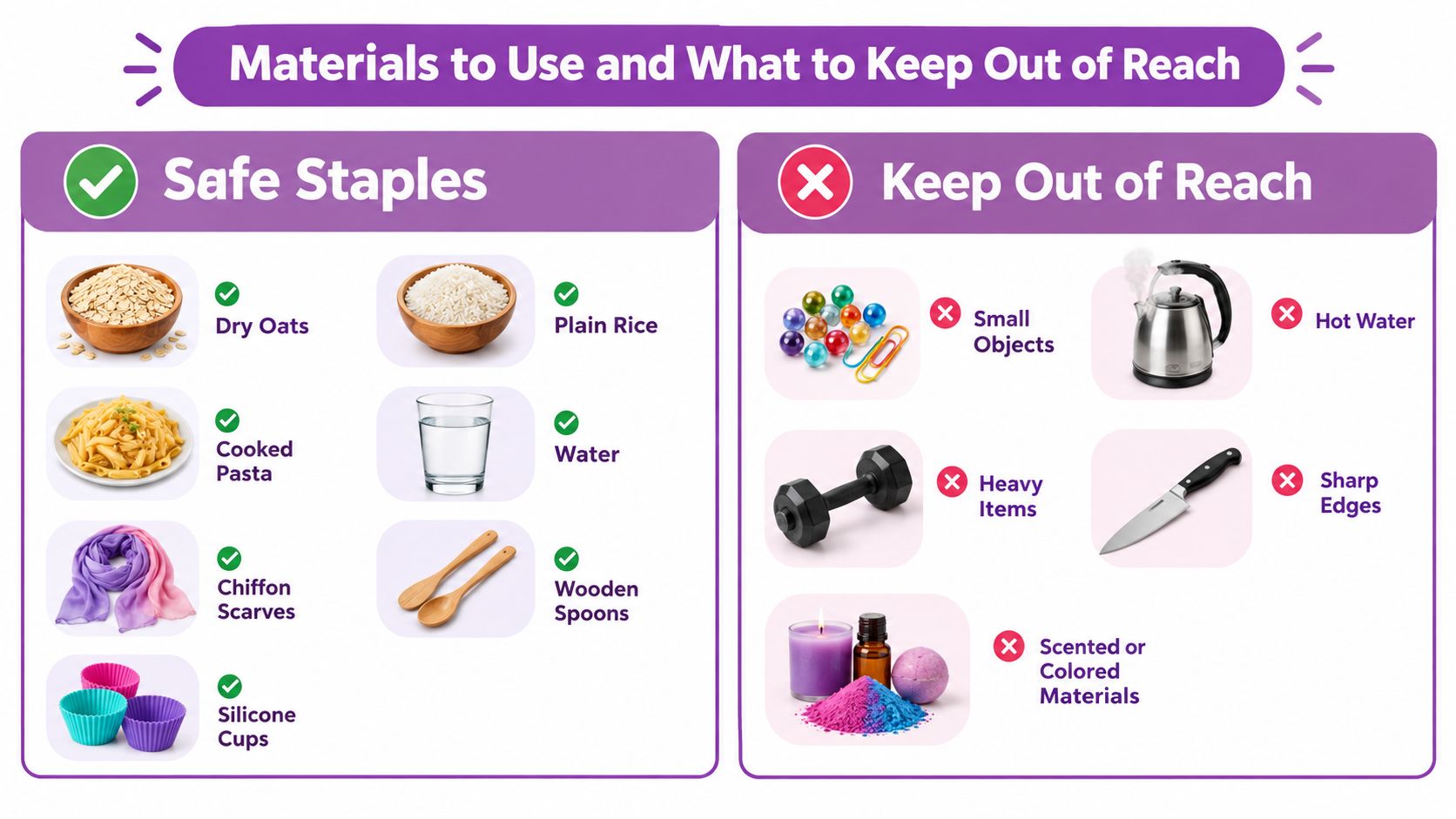
Useful staples can include dry oats, plain rice, cooked and cooled pasta, water, chiffon scarves, wooden spoons, silicone muffin tins, large plastic balls, and household sponges. Inspect every item before use, especially second-hand toys. A damaged seam, loose attachment, cracked container, or detachable piece changes the risk immediately.
Use the toilet-roll tube check as a prompt, not as your only safety test. If an item is small enough to fit through a standard toilet-roll tube, keep it away from an infant. Also consider whether the material swells, tears, leaks, breaks, or becomes smaller when wet.
Keep these items out of reach:
- Loose small parts: Beads, buttons, coins, detachable toy pieces, and similar objects can become choking hazards.
- Magnets and button batteries: These should never be included in an infant sensory setup.
- Raw lentils and beans: They can swell if swallowed, so don't treat dry pantry ingredients as automatically safe.
- Squishy foam toys: Follow Australian consumer safety warnings about squishy toys, as damaged items may release small foam pieces.
- Broken or uninflated balloons: Keep balloons away from babies, particularly if they're damaged or can be pulled apart.
- Essential oils and strong fragrances: A baby doesn't need concentrated scent products for sensory learning.
- Raw dough: Avoid dough made with raw flour or raw egg, particularly where mouthing is likely.
A sensory bin belongs on the floor or another awake-play surface, never in a cot or bassinet. Sleep spaces should remain free of loose sensory objects. Water play requires an adult within arm's reach, with hands ready to support the baby. It's not a setup where you place the tray down and walk away.
For a contained visual activity, you can explore the safety principles behind DIY sensory bottles, but any bottle must be securely sealed, checked repeatedly, and used only during supervised awake time. If your baby's developmental stage makes you uncertain, choose a larger, simpler object instead.
How Often, How Long, and How to Read Your Baby's Cues
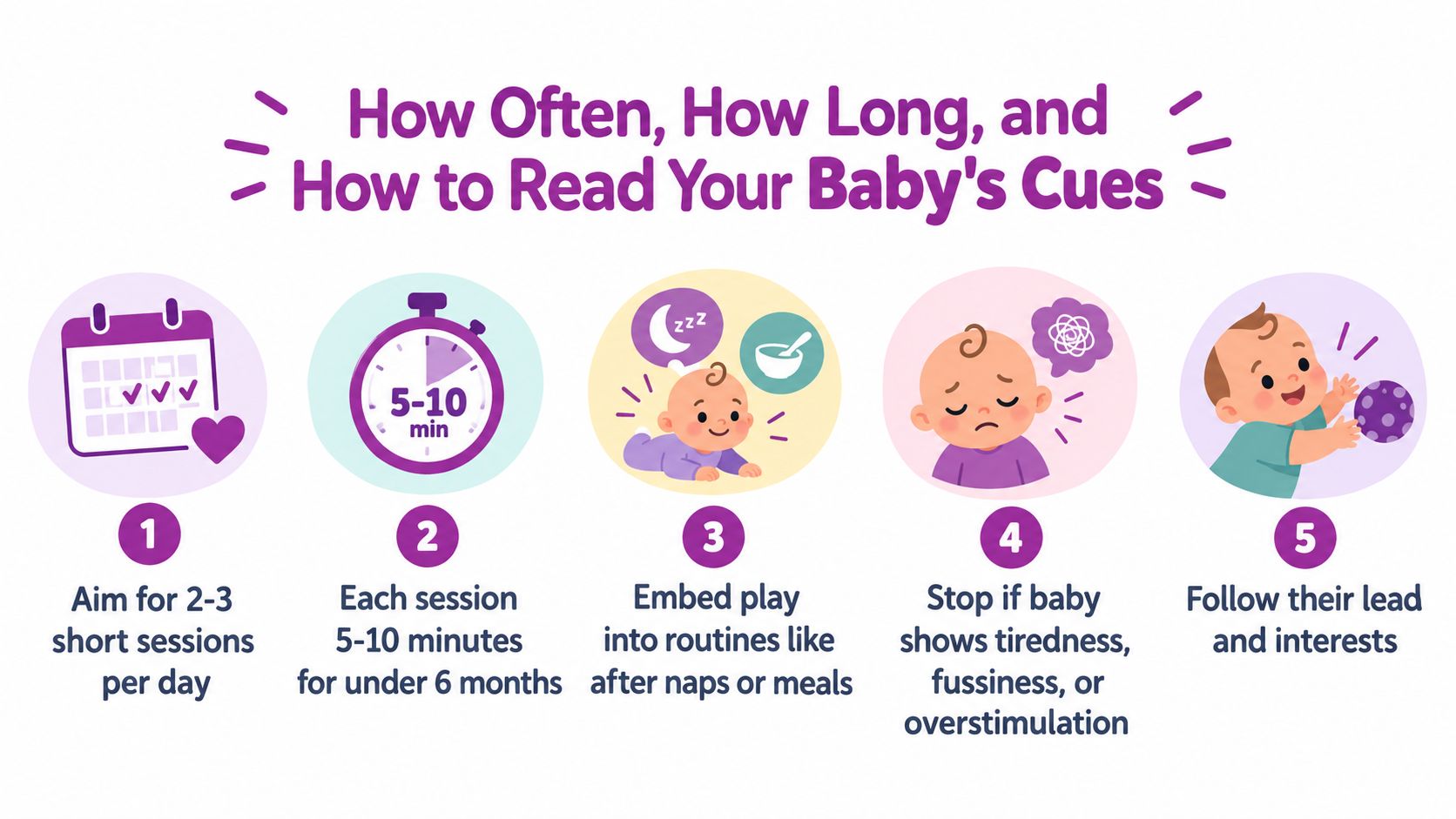
Sensory play works best as a rhythm built around your baby's cues, with session length guided by the baby rather than the clock. Before six months, two or three brief sessions of around five to ten minutes may be enough when your baby is awake and settled. From six months, they may stay engaged longer when rested and fed, but their signals still matter more than the timetable.
Build invitations into routines already happening. Try a voice-and-face game after a nap, a soft cloth during floor time, or a damp sponge during a nappy change. One focused activity, supported by small moments during ordinary care, is easier to manage than preparing new materials throughout the day.
Read the baby, not the timetable
Continue while your baby's body stays relaxed, their gaze remains on the material, their hands reach, or they vocalise gently. Returning to the object after a pause also suggests interest. Stop if they turn away, arch their back, rub their eyes, grizzle, stiffen, or become suddenly still. Falling asleep means awake play has finished.
Early cues can shift quickly with age and development, so read the whole pattern rather than relying on one sign. A younger baby may look away, while an older baby may push the material aside or crawl away.
If your baby seems overloaded, remove the material and reduce stimulation. Dim the light, lower the sound, hold them close, or offer a feed if needed. A short, settled exchange supports learning better than continuing after your baby has had enough.
Watch the pattern: Interest usually looks organised. Overstimulation often looks scattered, tense, or suddenly withdrawn.
Record whether your baby was rested, what they noticed, and what helped them settle. Those observations guide the next invitation more usefully than a rigid schedule.
Documenting Progress and Extending the Experience
A quick note after play can show what your baby is ready to explore next. Once a week, record three details on your phone: a new sound, texture, or movement they explored; the material that prompted it; and the cue that told you to continue or stop.
For example: “Reached for the crinkle cloth, watched it closely, then turned away after a short time.” The following week, offer the same cloth in a quieter space, or pair it with your voice instead of adding another toy. A repeated preference, such as reaching for fabric or settling during water play, gives you a practical starting point.
A photo taken from a similar angle can make gradual changes easier to notice. Your baby may move from watching a material, to reaching, grasping, and transferring it between hands. Treat the photo as a gentle record of how your child is approaching the world, rather than evidence of a deadline.
Extend a familiar experience gradually:
- Add one sense: Talk while your baby touches a cloth, or move a familiar object slowly while they watch.
- Rotate fewer materials: Keep two or three containers available instead of presenting everything at once.
- Invite another person: A sibling or caregiver can mirror your baby's actions, pause, and respond warmly.
- Change the position: Offer the same safe object during back play, supported sitting, or supervised tummy time when developmentally appropriate.
- Reflect weekly: Keep what engages your baby, adjust what overwhelms them, and remove anything that creates a safety concern.
These habits keep the experience responsive: short regular invitations, a baby-led pace, one new material at a time, active supervision, and a quick end-of-week reflection. Development grows through repeated, calm interactions, so you do not need a new activity every day. Follow your baby's changing cues and adjust the level of challenge as their movement, attention, and grasp develop.
Kids Club Early Learning Centre offers programs for children from six weeks to six years, including infant and toddler environments where educators use developmentally aligned sensory experiences with close attention to safety and individual cues. Families in Springvale South, Dandenong North, and Ferntree Gully can visit Kids Club Early Learning Centre to learn how its Reggio Emilia-inspired approach, VIT-registered educators, and practical care options support early learning.