
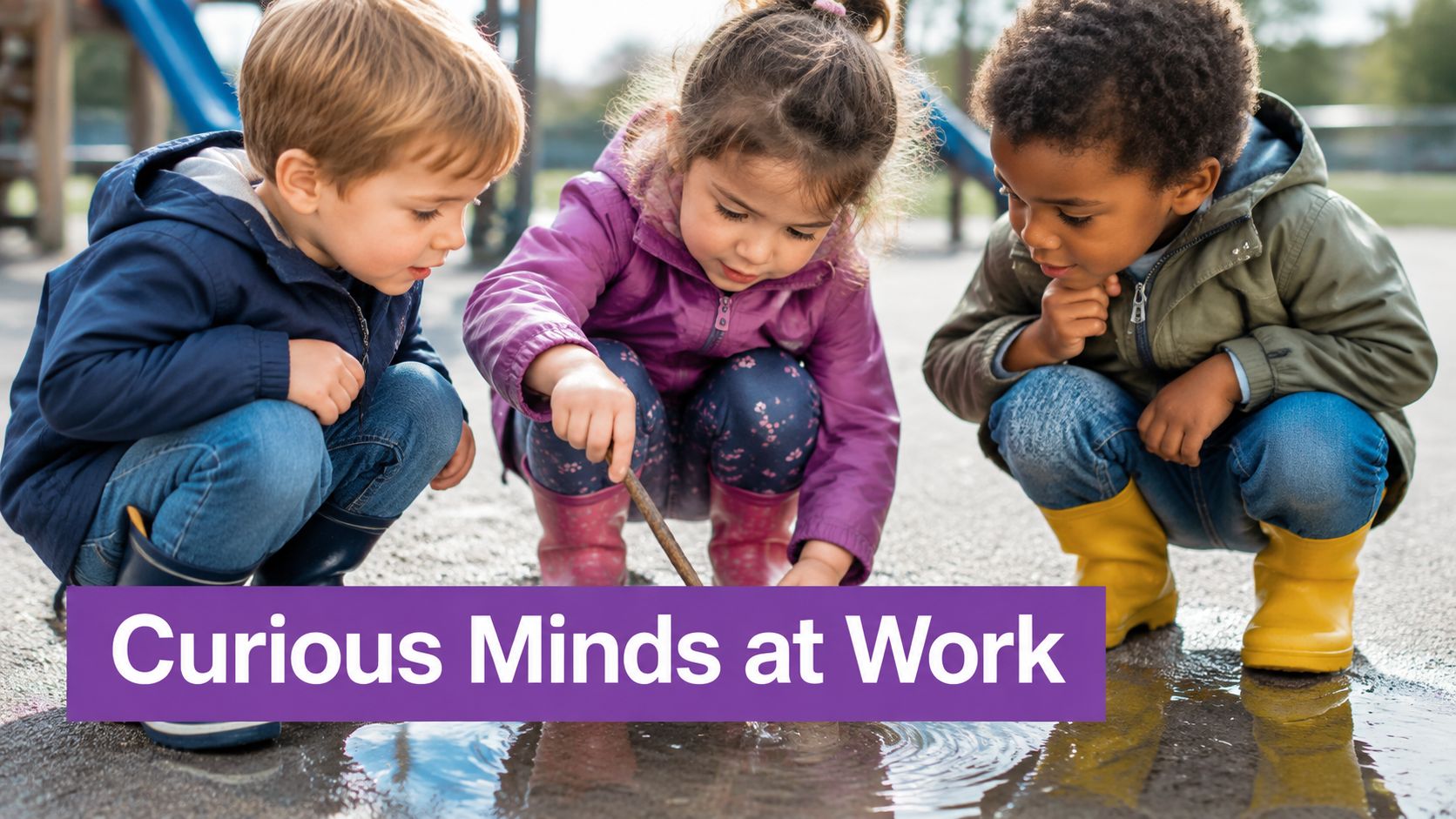
A child crouches beside a puddle in a Melbourne playground, one hand wrapped around a stick and the other holding a plastic cup. They're not waiting for an adult to explain the water. They're asking where it came from, testing whether the stick reaches the bottom, and watching what happens when the cup fills.
For parents choosing long day care or kindergarten, moments like this can raise a practical question: what does inquiry based learning do for a young child? The answer isn't that children look engaged. Done well, inquiry helps children practise asking questions, investigating ideas, explaining their thinking, working with others and returning to a problem when the first attempt doesn't work.
It also needs skilled educators. Inquiry isn't children being left to wander without purpose, and it doesn't replace intentional teaching of early literacy, numeracy or social skills. The quality of the environment, the questions educators ask and the way they document learning all make a difference.
What an Inquiry-Led Morning Actually Looks Like
Three- and four-year-olds are crouched around a puddle after morning rain. One child thinks the water has come from the garden tap. Another points towards the clouds. A third uses a stick to make a narrow channel and watches the water move across the concrete.
The educator doesn't rush to provide the correct explanation. Instead, they listen, repeat the children's theories, offer cups and containers, and ask what the children could do to find out more. The group decides to compare the puddle with water collected from the tap. Their investigation grows from something real, local and interesting to them.
The rhythm of the morning
An inquiry-led morning often has a gentle but purposeful rhythm:
- An invitation to notice: Educators prepare a provocation, meaning an arrangement of materials or an experience designed to spark curiosity. It might be water, seed pods, magnetic tiles, shadows or a collection of leaves.
- Choice within boundaries: Children choose which question or material interests them. Educators may work with a small group while other children pursue different investigations.
- Conversation and testing: Children make predictions, handle materials, compare results and talk through disagreements. The educator adds vocabulary, models safe use and helps children think about what to try next.
- Documentation: Photos, children's words, drawings and educator observations record the process. Documentation means making children's learning and theories visible, not merely displaying finished artwork.
- Reflection: At group time, children revisit what happened, hear other interpretations and consider whether their ideas changed.
The room can look busy. A long day care environment might include several investigations at once, with children moving between collaborative play, routines, meals and rest. That activity differs from a teacher-directed session where every child receives the same materials, follows the same instructions and produces the same result.
Neither approach means educators stop teaching. Inquiry changes the timing and form of teaching. A skilled educator knows when to wait, when to introduce a useful word such as “absorb” or “flow”, and when to offer a new material that helps children investigate further. Families can explore how the learning environment supports this idea through environment as the third teacher.
A Plain-English Definition of Inquiry-Based Learning
Inquiry-based learning starts with a question, observation, problem or possibility rather than an answer delivered first by the teacher. Children investigate through play and hands-on experiences, talk with others, build explanations and revisit their thinking.
Traditional instruction might begin with an adult explaining that some objects float and others sink, followed by an activity designed to demonstrate that fact. Inquiry might begin with children noticing that a wooden block floats while a metal spoon sinks. The educator then helps them ask what makes the objects different and provides materials for testing.
Four elements usually sit at the centre of the approach.
Questions children can own
The question may come directly from a child, or an educator may offer a prompt that leaves room for children's ideas. “Why are there more worms under the log?” invites investigation. “What colour is the worm?” usually has a short answer and little opportunity for extended thinking.
Hands-on investigation
Children need chances to touch, sort, build, measure, observe and change something. A toddler placing shells into groups by size is investigating even if they can't yet explain a method in words. An older child drawing a map of where insects were found is also building a theory.
Sustained dialogue
Educators listen carefully, then extend thinking with comments and questions. They might say, “You noticed the soil is darker here. What could have made that happen?” Children learn from one another as well, especially when they compare different explanations.
Reflection and revisiting
Learning becomes stronger when children return to an experience. They might look at photographs, hear their earlier words, redraw a plan or decide to test a different idea. Reflection helps children notice not only what they discovered, but how they discovered it.
This fits the Australian early years understanding of play-based learning, intentional teaching and children's agency. The Australian Early Years Learning Framework places children's investigating, problem-solving and communicating within learning outcomes. Adult guidance remains essential. Inquiry isn't child-led chaos. It's a carefully prepared environment in which children have meaningful choices and educators provide structure, language, safety and support.
Practical rule: If children have freedom to explore but no educator is listening, extending or helping them reflect, the experience may be open-ended play, but it isn't strong inquiry practice.
Cognitive, Social-Emotional and Language Benefits
The inquiry based learning benefits families notice tend to overlap. A child solving a construction problem is also using language, managing frustration and collaborating with peers. Separating the domains helps explain what's happening beneath the visible play.
Cognitive growth through real problems
A toddler group sorts shells by size and pattern. One child places the largest shells together. Another groups shells with dark markings. The educator doesn't immediately decide which system is correct. They invite the children to compare groups, notice similarities and try a new arrangement.
This kind of experience supports classification, working memory, flexible thinking and early reasoning. Children remember what they tried, hold a rule in mind and change their approach when the rule no longer fits. The Department of Education's national STEM guidance connects inquiry with exploration, reasoning, attention, student agency and resilience through discussion and critique in groups. The guidance on inquiry-based STEM learning also describes children generating questions, making decisions and developing healthier responses to failure.
For school readiness, these habits help children approach unfamiliar tasks, hold onto instructions and explain how they reached a conclusion.
Persistence and social-emotional learning
Three-year-olds are building a bridge with wooden blocks. It collapses, and two children want the same long piece. One suggests a new base. Another proposes taking turns. The educator helps them name the problem and gives them time to negotiate before stepping in with a solution.
Inquiry creates frequent, manageable moments of uncertainty. Children practise waiting, revising a plan, coping with disappointment and listening to another person's idea. The Australian guidance on critical and creative thinking is relevant here because children need both imaginative possibilities and careful evaluation when they investigate.
For school readiness, persistence and emotional regulation support participation in group learning, transitions and cooperative classroom routines.
Language that grows from purpose
A pre-PREP group investigates a worm farm. Children learn and use words such as “moist”, “surface”, “soil”, “shade” and “decay” because the words help them describe something they care about. Later, they present their observations to the group, explain what changed and answer questions from other children.
Language grows through the need to communicate an idea. Children practise sequencing, describing evidence, disagreeing respectfully and speaking with increasing confidence. Queensland's early childhood guidance describes inquiry as children planning investigations, proposing explanations and solutions, and communicating understanding in multiple ways.
For school readiness, oral language gives children tools for understanding stories, contributing to discussions and expressing what they know.
| Benefit domain | What it looks like | Why it matters |
|---|---|---|
| Cognitive development | Sorting, testing, comparing and revising ideas | Supports flexible thinking and problem-solving |
| Social-emotional development | Negotiating roles, persisting after setbacks and managing frustration | Supports participation and self-regulation |
| Language and communication | Describing observations, explaining theories and presenting findings | Supports comprehension, vocabulary and confident communication |
The Little Scientists evaluation provides an educator-focused perspective. It found that inquiry-oriented professional development increased educators' confidence in teaching STEM and made them more aware of children's STEM skills and knowledge. The Australian evaluation of the Little Scientists program also reported communities of STEM inquiry in which children and educators researched together through self-directed, play-based exploration.
What the Australian Evidence Actually Shows
Australian guidance supports inquiry as a meaningful way to develop agency, reasoning, collaboration and communication. It doesn't promise that every child will gain the same outcome, and it doesn't present inquiry as a replacement for all other teaching approaches.
The Department of Education's STEM guidance links inquiry with social interaction, exploration, argumentation, reasoning and resilience. It also connects the approach with stronger attention, student ownership and engagement through group discussion and critique. These recommendations describe the learning process educators should design, rather than offering a universal scorecard for individual children.
Queensland's early childhood resources use similarly practical language. The department describes children planning and carrying out investigations, proposing explanations and solutions, gathering and analysing information, and communicating their understanding. Its guidance on inquiry learning in early childhood connects these experiences with agency, independence, responsibility and higher-level thinking.
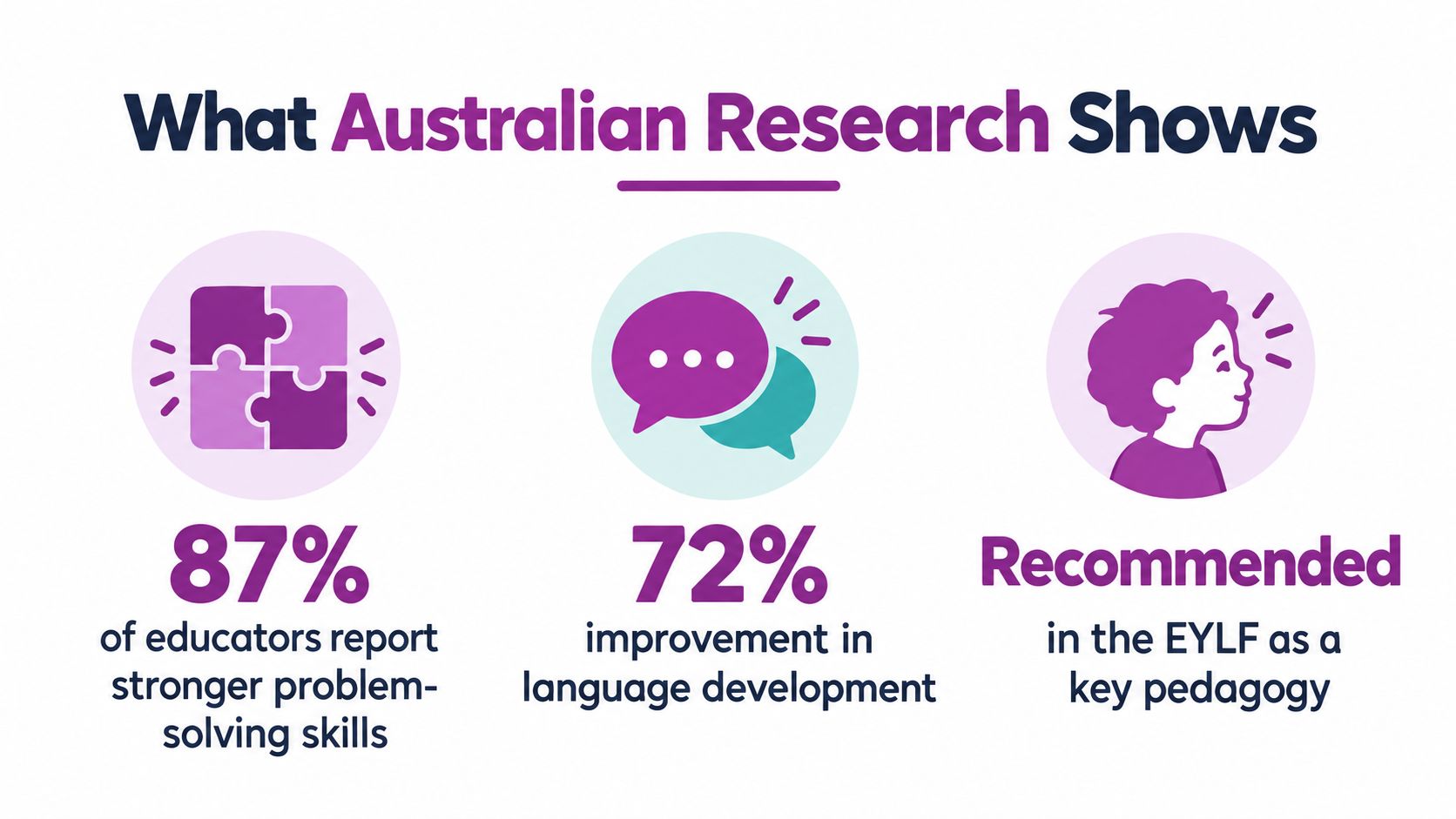
The image above contains percentages that aren't supported by the verified evidence available for this article, so parents shouldn't use those figures as a basis for choosing a centre. Australian early-learning evidence is often framed through broad EYLF outcomes rather than direct causal measures of school readiness. Public evidence also remains limited on which benefits are strongest for children aged three to six, or how inquiry compares with more explicit literacy and numeracy instruction in Australian settings.
That uncertainty doesn't make inquiry a fad. It means implementation matters. The Queensland inquiry learning resource emphasises active information gathering, analysis, decision-making and reflection. Parents should look for those practices, not rely on a label or a colourful wall display.
A genuine program should also include educator scaffolding. Children may generate the question, but adults help them use materials safely, notice evidence, hear new vocabulary and develop the inquiry skills needed to participate successfully.
Reggio Emilia, the EYLF and School Readiness
Reggio Emilia and inquiry-based learning share a view of children as capable thinkers. In a Reggio-inspired setting, an educator doesn't treat a child's question as a distraction from the program. They treat it as information about the child's interests, working theories and next possible learning steps.
The educator becomes a careful observer and researcher alongside the children. Documentation makes this thinking visible through photographs, written observations, children's drawings, transcripts of conversations and displays that show how an idea developed. The aim isn't to decorate the room. It's to help children, educators and families see the learning process.
This connects naturally with the EYLF's emphasis on learning, play, intentional teaching and agency. Australian early childhood practice doesn't require educators to choose between child interest and professional planning. Educators can follow children's questions while deliberately selecting materials, modelling language and creating opportunities to practise particular skills. The Reggio Emilia early learning approach makes this relationship easier for families to recognise in the daily environment.
What readiness can look like
School readiness is broader than knowing letters or counting aloud. Inquiry experiences can contribute to several foundations:
- Early literacy: Children use rich oral language to describe a worm farm, dictate a sign, retell an investigation or invent a story about a construction project.
- Early numeracy: Children sort shells, compare lengths, notice patterns, count materials and discuss which container holds more water.
- Problem-solving: Children test a bridge, revise a ramp or decide how to protect a plant from being damaged.
- Self-regulation: Children plan what to do, wait for materials, manage disagreement, reflect on a setback and return to a task.
- Group participation: Children listen to another explanation, contribute a theory and learn that different people may notice different evidence.
These are foundations, not guarantees. A strong centre will also provide explicit support for phonological awareness, early mathematical ideas, routines and transitions when children need it. Inquiry gives those skills a meaningful context, while educators ensure important learning isn't left to chance.
How This Approach Shows Up at Kids Club ELC
At Kids Club Early Learning Centre, an inquiry-led day can begin with materials that invite more than one possible outcome. Magnetic tiles might lead children to investigate balance and height. Seed pods may prompt questions about where plants come from. Loose parts can become a bridge, a habitat, a shop or a model of something children have seen in the neighbouring community.
The educator observes before deciding what the experience should become. They listen for recurring questions, photograph important moments and record children's theories in learning stories or on room displays. A group might return to the same investigation over several days, adding new materials or changing a plan after seeing what happened.
One investigation, many voices
During a group meeting, children hear one another's explanations. A child who thought all seeds were the same may compare a drawing with a friend's observation. Another child may suggest taking seed pods outside to look for the parent plant. The educator supports the exchange by introducing language, asking follow-up questions and helping children connect ideas.
This rhythm gives children time for small-group dialogue and uninterrupted play. It differs from a program in which every child completes an identical worksheet at the same time, follows a fixed craft model or moves on as soon as the adult has demonstrated the answer.
Learning connected to Melbourne
Local experiences help children see that inquiry belongs in their real lives. Excursions in a neighbouring park can lead to seasonal investigations. Family sharing events can bring cultural knowledge, home languages, photographs or objects into the room. Children may notice changes in weather, plants, birds, buildings or community routines and carry those observations back into play.
For families comparing centres, the important question isn't whether a service uses the word “inquiry”. Look for the daily evidence: children's ideas influence what happens next, educators document thinking rather than only finished products, and investigations connect with the children's interests and community.
Choosing a Childcare That Really Does Inquiry
A centre tour can tell you more than a brochure if you know what to notice. Don't focus only on whether the room looks attractive. Watch how children and educators respond to one another.
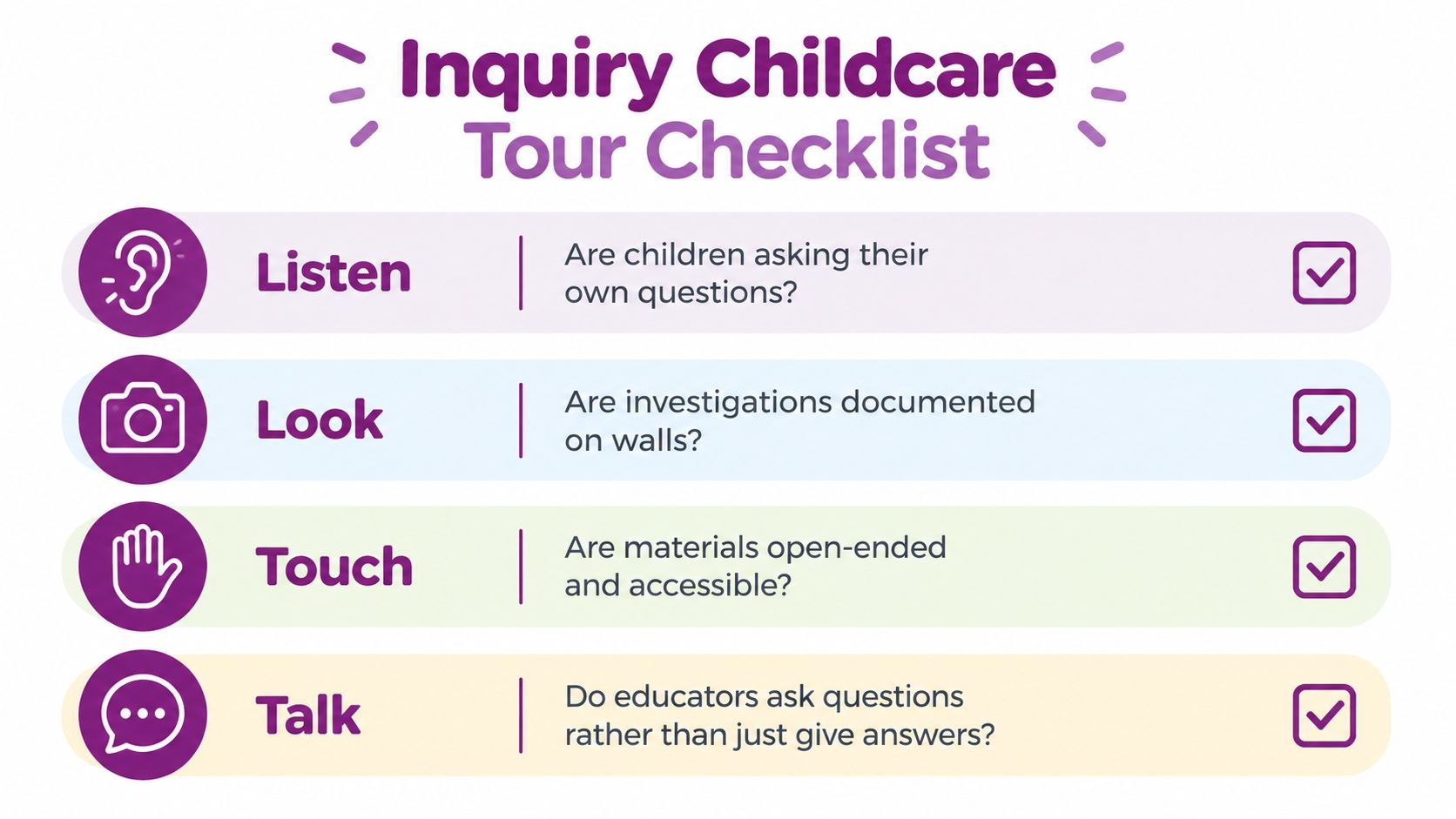
Four things to check
- Listen: Are children asking questions, sharing theories or explaining what they're doing? Can you hear sustained conversation rather than only instructions?
- Look: Are investigations documented with children's words, photographs, drawings and educator observations? Do displays show a process that developed over time?
- Touch: Are materials open-ended and accessible? Can children combine blocks, natural objects, containers, mark-making tools and sensory materials in different ways?
- Talk: Do educators ask children what they notice and think? Do they wait for responses, introduce useful vocabulary and help children revisit an idea?
Ask the educational leader for a recent example. “How did that project begin?” reveals whether children's questions influence the program. “What did educators do when children became stuck?” shows how the centre balances independence with scaffolding. “How do you connect investigations with the EYLF?” helps you hear whether planning is thoughtful or promotional.
You can also ask how families are invited to contribute. A centre might welcome family observations, home experiences, cultural knowledge or materials connected with an investigation. The answer should describe a genuine process, not just a display board.
Look beyond the label: Walls covered with identical worksheets, pre-set craft outcomes and no visible record of children's thinking may indicate a teacher-directed program, even if the centre uses inquiry language.
An inquiry culture won't always look quiet or perfectly tidy. It may look active, unfinished and full of conversation. Visit two or three centres where possible, then compare how educators listen, how children use the environment and whether the room feels organised around learning rather than appearance.
Putting the Benefits Together and Common Questions
Inquiry-based learning can give children a connected set of experiences. They ask a question, use language to share it, work with others, test an idea, cope when it fails and reflect on what to try next. The trade-off is that learning may produce fewer identical take-home products, and the room can be noisier and less predictable than a highly teacher-directed setting.
Is play-based learning the same as inquiry-based learning? Not always. Inquiry can happen through play, but it adds intentional investigation, dialogue, documentation and reflection.
Will it prepare my child for literacy and numeracy? It can build oral language, sorting, patterning, comparison and reasoning in meaningful contexts. Ask how the centre also provides explicit support for early literacy and numeracy.
What does the educator do? They prepare materials, observe, ask thoughtful questions, extend vocabulary, support relationships and decide when more structure is needed.
What if I'm concerned? Ask to see observations and discuss your child's progress with the room educator or educational leader. A strong service should explain what your child is learning, how educators are supporting them and what they'll try next.
Kids Club Early Learning Centre offers Reggio Emilia-inspired, inquiry-focused programs for children from infancy through kindergarten, with educators who document children's questions, interests and developing theories. Visit Kids Club Early Learning Centre to see how the environment, daily investigations and EYLF-aligned learning can support your child in Melbourne.