
You might be reading this after a centre tour where everything looked lovely, but you still left with the same question. What would my child's day feel like here?
That's where many families get stuck. The words child-led, inquiry-based, and Reggio inspired sound warm and thoughtful, but they can also feel slippery if no one shows you what they mean in real moments with real children.
The Reggio Emilia approach to learning makes more sense when you watch a morning unfold. You see how children choose, how educators listen, how materials invite ideas, and how learning gets noticed rather than rushed past. You also start to see an important difference between a service that lives the philosophy each day and one that uses the language as a branding label.
A Morning in a Reggio Emilia Inspired Classroom
It's just after 9am in a Melbourne early learning room. One child heads straight to a clay table and presses small marks into the surface with a stick. Another curls up in the reading nook with a book and then invites a friend to look at the pictures too. Near a wall, a small group notices that the projector is casting light across their hands, and an educator crouches down beside them to ask what they think happens when they move closer.
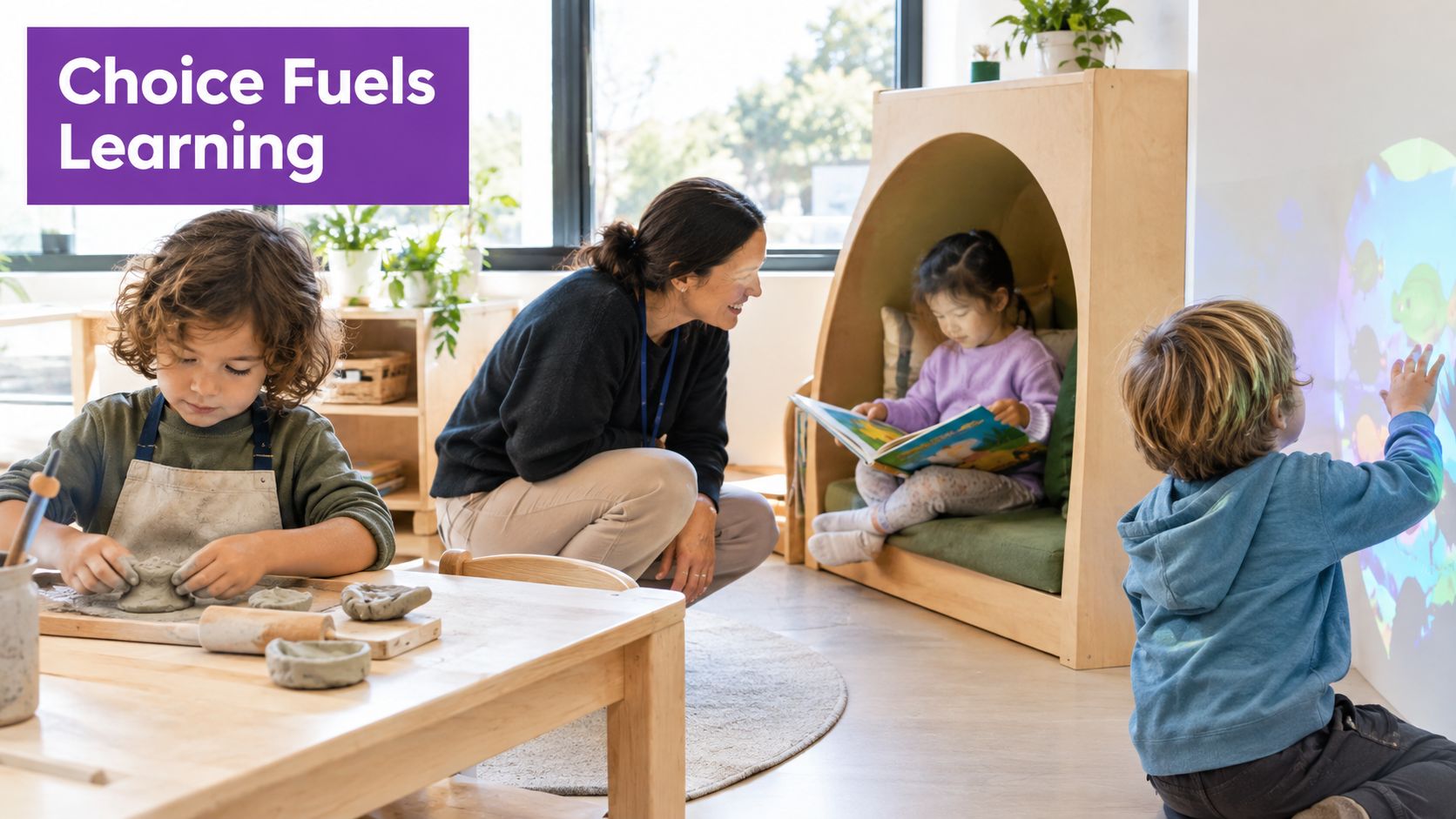
Nothing about the room feels random. The choices are open, but they're intentional. The adult isn't standing at the front delivering a lesson, and the children aren't rotating through timed tasks to finish the same product.
That's a useful first picture of the Reggio Emilia approach to learning. It isn't a packaged curriculum with a script to follow. It's an educational philosophy built on a particular image of the child. Children are seen as capable, curious, social, and full of ideas worth taking seriously.
What parents often notice first
Families usually notice the atmosphere before they notice the theory.
- Children have agency: They aren't all doing one identical activity at one identical time.
- Materials invite action: Clay, light, books, loose parts, paper, and natural objects ask children to test ideas with their hands.
- Conversation matters: Educators listen closely, ask thoughtful questions, and leave room for children to think.
What can be confusing
Some parents worry that choice means chaos, or that child-led learning means adults step back too far. In a strong Reggio-inspired room, that isn't what happens. Children don't drift from activity to activity. Educators prepare the space, notice patterns in children's interests, and help turn small moments into deeper learning.
A good Reggio-inspired morning feels calm, busy, and thoughtful all at once.
That shadow investigation near the projector might become a longer inquiry. The clay marks might become early symbol-making. The shared book might lead to storytelling, drawing, or dramatic play. The morning moves through participation, materials, and relationships, not worksheets.
Where the Reggio Emilia Approach Began
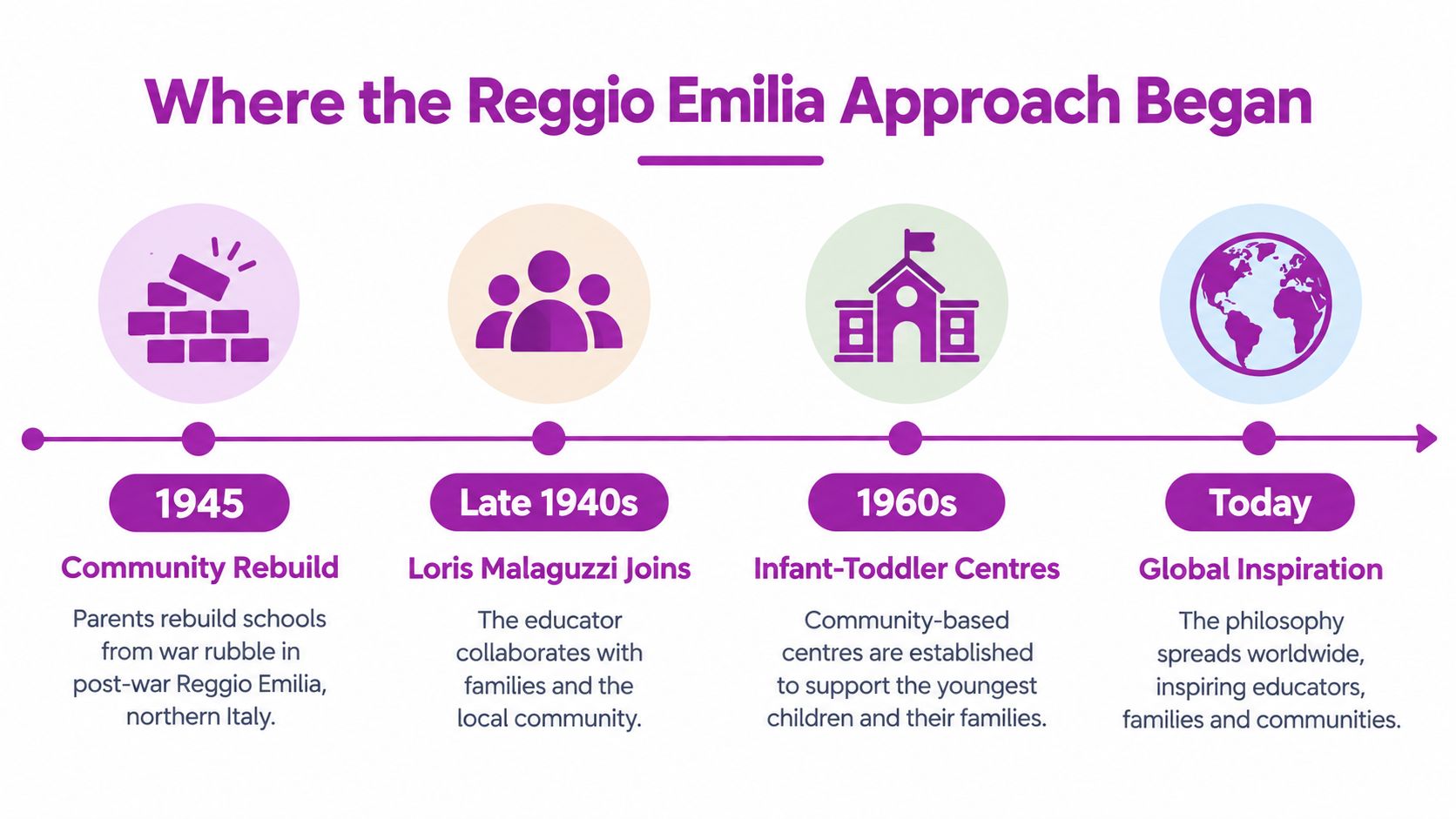
The Reggio Emilia approach began in the aftermath of World War II in northern Italy. Its history matters because the philosophy didn't start as a commercial program. It grew from a community effort to rebuild a different kind of future for children and families.
The national Australian reference organisation, Reggio Emilia Australia Information Exchange, explains that the first school was built amid the ruins of the war. It also notes key municipal milestones that shaped the project, including the first municipal preschool in 1963 and the first infant-toddler centre in 1971, named in honour of Genoffa Cervi. That community-built beginning is a big reason many educators still speak about Reggio Emilia as a democratic project rather than a set of branded teaching materials.
Why the origin story still matters
When parents hear “Reggio”, they sometimes imagine a style of classroom decor. The history points somewhere deeper. The approach asks what kind of learning community children deserve, what voice families should have, and how education can be built with people rather than delivered to them.
That's why the role of the educator is different from a traditional top-down model. The philosophy is often linked with ideas from constructivist thinkers such as Dewey, Vygotsky, and Bruner, but in practice parents usually notice one core belief first. Children are treated as competent communicators from the beginning.
How it took root in Australia
Reggio Emilia has a long Australian history too. REAIE notes that Australian educators have been visiting Reggio Emilia for well over 20 years, and that Reggio-inspired language and pedagogy have entered Australian policy, curriculum documents, and practice through that ongoing exchange.
This is worth knowing because it helps families separate a serious educational conversation from a passing trend. In Australia, the philosophy has been interpreted, debated, and adapted by educators over many years. The strongest services usually show that heritage in how they work with children and families, not just in the words on their website.
Core Principles That Shape Every Reggio Emilia Approach to Learning
The easiest way to understand the principles is to return to that morning classroom. A child studies shadows on the wall. Another shapes clay into something only half explainable. A small group negotiates whose turn it is to hold the torch. Those moments carry the philosophy.
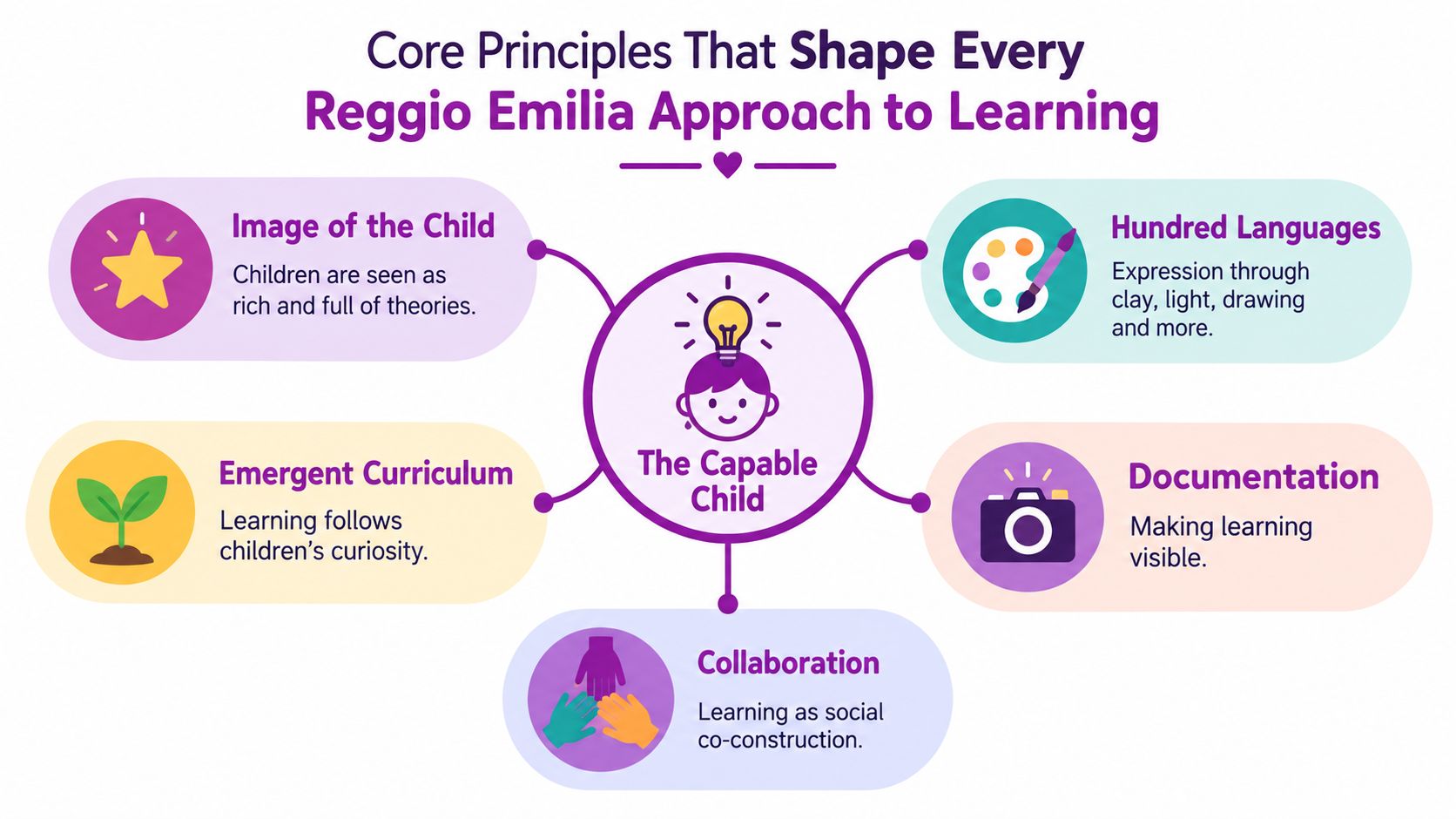
The image of the child
At the centre of the approach is a strong idea. The child is capable.
That doesn't mean children can do everything alone. It means educators begin by assuming children have theories, intentions, preferences, and ways of making meaning. If a child says, “My shadow got bigger because I jumped,” the adult doesn't rush in to correct or close the conversation. They listen for the thinking inside the statement.
The hundred languages
Children don't only express ideas through speech. They draw them, build them, sing them, act them out, sculpt them, and revisit them with movement and sound. In Reggio language, these are the child's many ways of knowing and communicating.
A child who can't yet fully explain a plan in words may show it in clay. Another may revisit a story through music or dramatic play. That's one reason Reggio-inspired programs often include rich creative materials rather than treating art as a once-a-week extra.
For a broader look at how this connects with local practice, Kids Club also shares a guide to inquiry-based learning in early childhood.
Emergent learning with educator guidance
Parents sometimes hear child-led and assume adults follow along. In practice, learning is negotiated. The educator observes what matters to the children, then introduces materials, questions, and experiences that stretch the inquiry further.
That child at the clay table chooses the direction. The educator shapes the conditions for depth.
A short video can help make those ideas feel more concrete.
Documentation and collaboration
Australian research gives this section some important grounding. A 2024 metasynthesis identified 107 potentially relevant studies on Reggio Emilia practices in Australian early years settings, but only 23 articles met the final criteria for inclusion in the analysis, as reported in the Australian Educational Researcher article. That tells us two things at once. Interest is broad, and careful evidence is much narrower.
The same body of work links Reggio-inspired practice to Australia's learning framework for children from birth to five. In everyday terms, the principles that most often show up are inquiry, documentation, collaboration, and child-led exploration.
Practical rule: If a centre talks about Reggio but can't show you how children's ideas shape planning, you're probably hearing philosophy without practice.
The Teacher, the Environment, and the Family
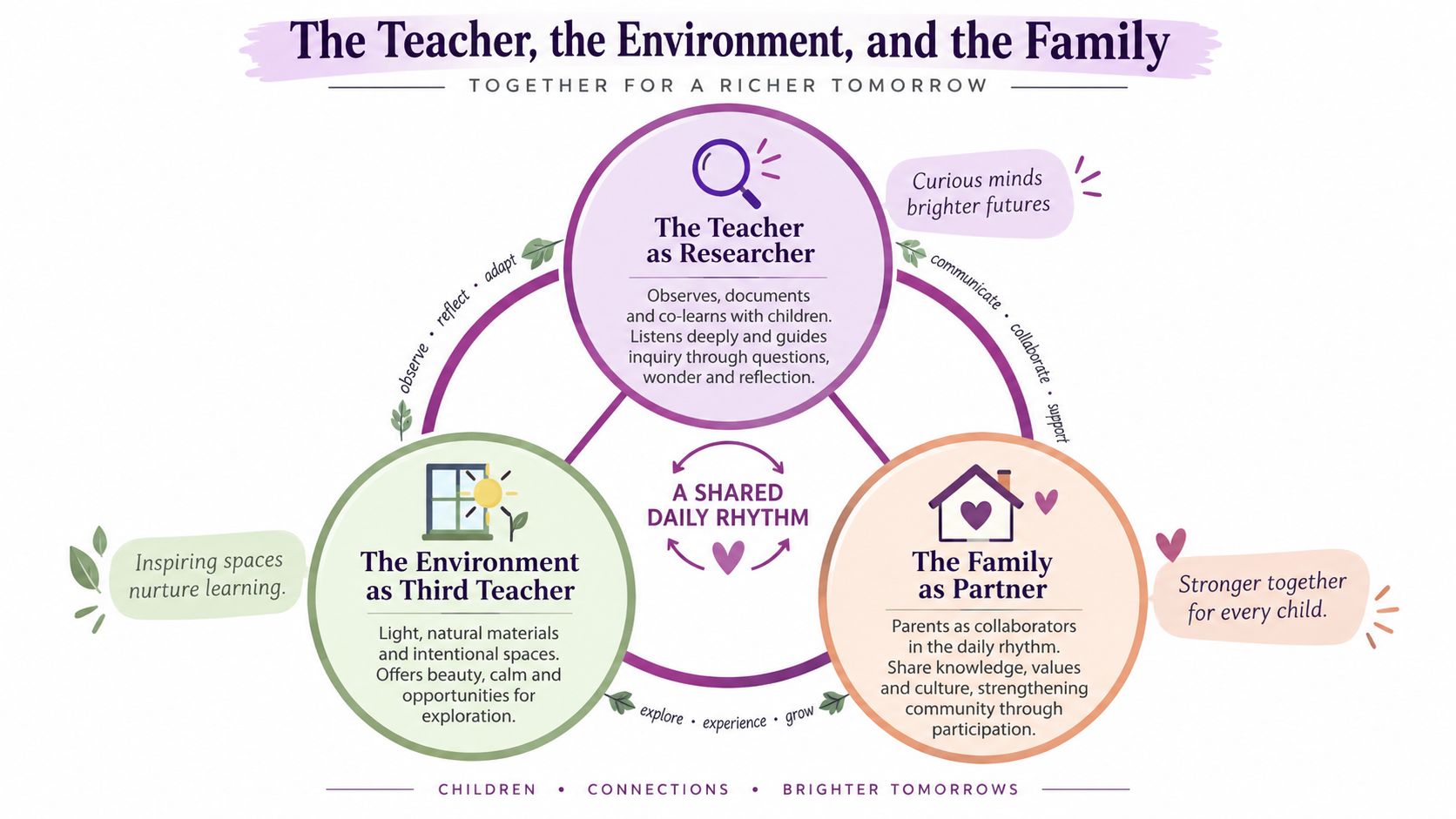
A Reggio-inspired day works because three roles keep interacting. The teacher, the environment, and the family each shape what children can notice, try, and revisit.
The teacher as co-researcher
In this approach, educators listen closely and study what children are doing. They pose questions, add materials, and help children return to an idea over time. They aren't passive. They're highly involved, but their involvement looks different from direct instruction all day.
If children keep revisiting shadows, the educator might bring in torches, mirrors, tracing paper, or outdoor time at different points of the day. The adult is planning constantly, just not always in a visible “whole-group lesson” format.
The environment as third teacher
The space does some of the teaching. Light, order, beauty, accessible shelves, mirrors, natural materials, quiet corners, open floor space, and outdoor investigation areas all influence how children move and think.
Parents often understand this idea quickly when they compare two rooms. In one, most resources are stored out of reach and adults control access to everything. In the other, children can select materials, revisit previous work, and see evidence of their thinking around the room. That second environment invites ownership.
Families exploring this idea further can see how some centres describe the environment as the third teacher in their own practice.
The family as partner
Family partnership in Reggio-inspired settings is more than polite communication at pick-up. Educators learn from families about language, routines, interests, worries, cultural practices, and the questions children are carrying from home.
That changes the curriculum in subtle but real ways.
- Morning conversations matter: A parent mentions their child has been collecting leaves at home, and that interest appears later in the room.
- Documentation builds continuity: Families can see what their child has been wondering about and continue the conversation after hours.
- Shared decision-making deepens trust: Parents don't just receive updates. They help shape the learning relationship.
When these three roles work together, the day feels coherent. The room supports curiosity, the educator extends it, and the family gives it context.
How Documentation Makes Thinking Visible
One of the most misunderstood parts of the Reggio Emilia approach to learning is documentation. Parents often see photos and learning stories on a wall and assume the purpose is display. In strong practice, documentation is a working tool for assessment and planning.
Australian research at a South Australian early learning centre found that documentation is not just record-keeping. It functions as an assessment-and-planning system that makes children's thinking visible, helps educators interpret learning trajectories, and supports curriculum adjustments, as discussed in this Flinders University thesis on pedagogical documentation.pdf).
What the cycle looks like
A useful way to picture it is as a repeated cycle.
Observe carefully
The educator watches without rushing to judge or label. A child shines light through translucent blocks and says the colour “went onto the floor”.Record what happened
That might include notes, photographs, a transcript of the child's words, or the child's own drawing.Interpret with others
Educators discuss what the child may be testing or noticing. Is this about colour, light, movement, cause and effect, or language?Plan the next step
The room changes in response. New materials appear. The group revisits the idea.
Why this matters to families
Documentation gives parents access to the learning that can otherwise be invisible. You may hear your child say they “played with shadows today,” but a thoughtful documentation panel can reveal prediction, comparison, collaboration, and early scientific thinking beneath that simple sentence.
Documentation should help you hear your child's voice, not just admire the educator's display.
It also supports consistency. When multiple educators can see the same records of children's questions and theories, planning becomes more connected and responsive.
What Children Gain from the Reggio Emilia Approach to Learning
Parents usually want to translate philosophy into outcomes that matter at home and at school. They want to know whether this approach supports confidence, communication, self-regulation, and readiness for what comes next.
The strongest answer is that the benefits come from daily habits, not from a single program label.
Confidence and persistence
When children can choose materials, test ideas, and return to long-term projects, they learn that their thinking has value. They also learn that not getting it right immediately isn't failure. It's part of the process.
That matters for school readiness. A child who has practised revisiting an idea, adjusting a plan, and trying another representation is often better prepared for open-ended learning than a child who mostly completes adult-set tasks.
Communication and early literacy
Reggio-inspired environments are language-rich. Children talk with peers, explain theories, hear new vocabulary from educators, revisit stories, dictate ideas, and use symbols in many forms.
Those experiences don't replace explicit literacy foundations. They strengthen the conditions that support them. Children build vocabulary, confidence with expression, listening skills, and an understanding that marks, images, sounds, and words all carry meaning.
Social competence and emotional growth
Inquiry in a group asks a lot of children. They negotiate, wait, disagree, persuade, revisit rules, and learn how their actions affect others. That's social learning in a very practical sense.
A child building with others has to manage frustration differently from a child working alone on a fixed craft task. The educator helps with that process, but the social challenge is real and productive.
What Australian research adds
Australian evidence suggests that culturally responsive Reggio-inspired practice becomes stronger when educators translate the principles to local communities rather than copying an Italian template. A University of South Australia action-research project across six South Australian early learning sites linked this kind of practice with improved children's attendance, participation, confidence, and literacy, along with stronger family-educator interaction and family connection to the site in the University of South Australia report.
That's an important point for families. The approach works best when it's responsive to children's language, culture, and community, not when it is copied as a visual style.
How to Spot a Genuinely Reggio Inspired Centre
This is the question many families wish more articles would answer. A centre can use the words Reggio Emilia on a brochure and still run a fairly conventional program underneath. The difference shows up in what you can observe.
A recent Australian metasynthesis noted that the local evidence base is still relatively thin for parents comparing services, with only 23 qualitative studies over two decades and just one systematic review identified in that body of work through the same Australian Educational Researcher metasynthesis. That makes it even more important for families to ask sharp, practical questions on tours.
What authentic practice tends to look like
- Children's ideas stay visible over time: You can see project work developing across days or weeks, not only one-day activities.
- Documentation includes children's words: The displays show thinking, questions, and process, not just finished products.
- Materials are open-ended: Loose parts, natural objects, clay, light, mark-making tools, and construction resources are easy to find.
- Educators describe observation and planning: They can explain how they notice interests and respond to them.
- Family voice is present: Parents are invited into conversations that influence learning, not only compliance paperwork.
- Work isn't identical: If every child's product looks the same, that usually points to adult-directed craft rather than inquiry.
Questions worth asking on a tour
A simple checklist can help.
| What to ask | What to listen for |
|---|---|
| How do children's interests shape the program? | Examples of projects, observations, and follow-up experiences |
| Can I see recent documentation? | Children's voices, educator reflection, and next steps |
| How do families contribute to learning here? | Specific routines for sharing knowledge, ideas, and context |
You can also compare what you see with how a centre describes its Reggio Emilia early learning centre approach.
If the walls are full of teacher-made displays and every child has produced the same artwork, the service may be using Reggio language without Reggio habits.
Common signs of surface-level adoption
Sometimes the room looks beautiful, but the practice stays shallow.
- Pretty atelier, little inquiry: Art materials are present, but they're used for preset outcomes.
- Busy walls, thin meaning: Photos are displayed, but they don't reveal children's theories or the planning behind them.
- Marketing language without evidence: Staff mention Reggio often, but can't explain how it changes decisions each day.
How Kids Club ELC Brings the Approach to Life
A Reggio-inspired service becomes easier to recognise when you look for how philosophy shows up in ordinary decisions. At Kids Club ELC, the approach is translated into the design of the environment, the role of the educator, and the kinds of experiences children can return to over time.
The rooms are organised to support independence and inquiry. Natural light, accessible materials, and intentionally prepared provocations help children move from quick interest to sustained exploration. That matters because the environment isn't treated as background decor. It shapes what children can notice, choose, combine, and revisit.
What educators do in practice
The role of the teacher is equally important. Kids Club ELC states that VIT-registered teachers lead learning experiences, and that matters in a Reggio-inspired model because the approach depends heavily on educator judgment. There's no fixed script doing the work for them.
In a setting like this, teachers observe closely, document children's thinking, and use those observations to plan emerging experiences. If a group becomes absorbed in movement, rhythm, shadows, mapping, or construction, the educator can deepen that thread rather than pulling everyone back to a disconnected preset activity.
How music and sport fit the philosophy
Families sometimes assume music and sport sit outside inquiry-based learning. They don't have to. In a thoughtful Reggio-inspired program, they can become part of the same child-led investigation.
Music gives children another language for expressing pattern, feeling, memory, and collaboration. A child may represent an idea through rhythm before they can describe it fully in words. Group music-making also asks children to listen, respond, pause, and contribute.
Sport can work the same way when it is guided with intention. Children test balance, space, turn-taking, risk assessment, and negotiation. They learn how rules are made, adapted, and shared. That's not separate from the philosophy. It's another context for problem-solving and relationship-building.
What local families can do next
If you're visiting centres in Melbourne, don't stop at the first impression. Watch a short part of the session if you can. Look for how educators speak with children. Ask to see recent documentation panels. Notice whether the room invites children to make decisions or mostly asks them to follow directions.
If you're comparing options, Kids Club Early Learning Centre is one local provider that describes a Reggio Emilia-inspired approach alongside music, sports, and programs led by VIT-registered teachers for families in areas including Springvale South, Dandenong North, and Ferntree Gully.
The test is simple. Can you see children's ideas shaping the day?
If you'd like to see what this looks like in person, Kids Club Early Learning Centre offers Reggio Emilia-inspired learning environments, VIT-registered teachers, and weekly music and sports experiences woven into everyday early years practice. A visit can help you see the difference between a centre that talks about curiosity and one that builds the day around it.