
Rain taps against the windows, the outdoor plans disappear, and suddenly everyone has a different kind of energy. One child may need to move, another may be ready for a quiet story, while the youngest wants to touch, taste and investigate everything nearby. Australian research links rainy weather with less active and travel time and more media use, so a prepared indoor invitation can help children stay engaged without turning the whole day into passive screen time (Australian research on weather and children's time allocation).
These rainy day activities for kids are organised by developmental stage and energy level, from infant-friendly sensory exploration to preschool construction, dramatic play, cooking, movement and calm transitions. You'll find ideas that use common materials, support literacy, numeracy, fine and gross motor development, and help children express feelings and share ideas. Each activity can also be shortened for a naptime window or expanded into an active burst when the walls feel as though they're closing in.
The aim isn't a perfect craft or a spotless playroom. It's an inviting environment where children can choose materials, test possibilities, revisit an idea and explain what they're thinking. That open-ended approach reflects Reggio Emilia-inspired practice, where children's theories and creative languages matter as much as the finished result.
1. Creative Art and Craft Stations
A rainy afternoon can begin with a sheet of paper, a few washable materials and permission to use them in unexpected ways. Set a low table with paper, chunky crayons, child-safe markers, paint, glue sticks, cardboard, fabric scraps, leaves and clean recyclables. Don't present a model for children to copy. Offer a question instead, such as, “What could you make with these textures?”
Infants can explore one large sheet of paper with a supervised taste-safe mark-making material, or handle fabric, large sponges and textured paper. Toddlers may enjoy transferring paint with a sponge, making lines with thick crayons or gluing large collage pieces. Preschoolers can combine drawing, painting and construction to represent a family, a storm, an invented animal or something they noticed through the window.
Set up an invitation, not a worksheet
Keep materials visible in shallow baskets and invite children to help place them on the table. This supports choice, independence and early sorting. Children also learn that creative work includes caring for the space, so give them a small cloth and let them help wipe the table when they finish.
- For fine-motor practice: Offer playdough, clay, stickers, tongs and thick brushes.
- For emotional expression: Ask children whether their rain feels loud, soft, dark, bright, fast or slow.
- For younger children: Use washable, non-toxic products and avoid small loose pieces that could be swallowed.
- For display: Place finished work at child height and photograph temporary creations before the materials are cleared.
Practical rule: Follow the child's process. If the painting becomes a collage or the cardboard becomes a tunnel, the investigation is working.
2. Indoor Reading Corners and Storytelling Circles
Some children need less stimulation once the rain has interrupted their routine. Create a reading corner with cushions, a rug, a small basket of books and gentle lighting. You don't need a large collection. Choose a few familiar stories, add one new book and include texts that reflect the languages, cultures and family structures children know.
For infants, hold the book close, point to faces and objects, and pause so they can respond with a look, sound or gesture. Toddlers can turn pages, find repeated pictures and join in with predictable phrases. Preschoolers might retell the story with puppets, change the ending or draw a map of where the characters travelled.
Make the story interactive
Use different voices, facial expressions and pauses, but leave space for children to lead. A child who interrupts with a personal connection is practising language and meaning-making, not spoiling the reading. Picture cards can help non-readers choose the next part of a routine, while a homemade puppet theatre can turn a quiet story into shared dramatic play.
After reading, ask open questions rather than testing recall. “What do you think the character might do next?” encourages prediction. “How did the character know someone needed help?” supports social understanding and emotional vocabulary.
Australian families already use indoor play frequently during early childhood. In Victoria, 85% of parents of infants and 73% of parents of children aged three to five reported often playing indoors with their children, according to the Parenting Today in Victoria findings report. A reading corner builds on that familiar routine while giving a rainy day a calm, language-rich centre.
3. Music and Movement Activities
Clear a safe patch of floor and begin with a simple rhythm. Tap knees, clap slowly, stamp softly or shake a container filled with large, securely sealed objects. Toddlers can copy one action, while preschoolers can invent a pattern for everyone else to follow. Infants can watch scarves move, listen to singing and respond with kicks, arm movements or vocal sounds.
Music works well because it can meet different energy levels without needing separate activities. Choose a lively song for jumping, a slower song for swaying and a quiet track for settling. Offer movement scarves to children who don't want to dance in the centre of the room. They can wave, hide, reach and follow the beat from a comfortable spot.

Build predictable musical routines
Use a visual timer or picture card to show when the song will finish. Repetitive songs help children anticipate transitions, and simple percussion supports listening, coordination and turn-taking. Keep loud and quiet instruments available, but establish clear boundaries for where children can move and where instruments rest.
Kids Club Early Learning Centre describes the benefits of music for preschoolers as part of its early learning guidance. At home, you can keep the experience simple. Sing a family song, play music from different cultures, or make a rain orchestra with tapping, patting and gentle shakers.
Use the video below as a movement prompt, then turn the screen off and invite children to create their own rhythm.
A short dance session can be the active burst before a story, sensory tray or rest. Stop if the room becomes crowded or children lose control of their bodies. Indoor movement should feel energetic, not unsafe.
4. Building and Construction Play
Place blocks, cardboard boxes, magnetic tiles, paper tubes and clean recyclable containers on a mat. Then step back. Children may build a bridge, a house, a train station, a nest or something that has no familiar name. The value sits in the testing, adjusting and explaining, not in producing a structure that looks like an adult's example.
Infants can handle large, lightweight blocks while an adult names actions such as “up”, “down”, “in” and “fall”. Toddlers often enjoy filling, emptying and stacking. Preschoolers can work on a shared challenge, such as building a bridge that connects two cushions or a tower that stays upright when a toy animal walks past.
Give builders useful problems
Ask, “What could make the base stronger?” or “How will the people get inside?” Avoid rebuilding the structure for the child. If it collapses, acknowledge the discovery and invite another attempt. This supports early spatial reasoning, persistence, balance and collaborative language.
Transparent tubs help children see their choices, and picture labels make cleanup easier. Save a building plan by photographing it or asking the child to draw it before dismantling. The image gives the child a way to revisit the idea later without needing to preserve a fragile structure all afternoon.
- Low-energy version: Build a small animal shelter on a tray.
- Mixed-age version: Give toddlers large boxes and preschoolers smaller connecting pieces.
- Active version: Add a delivery game where children carry soft parcels to different buildings.
- Safety reminder: Check boxes for staples, sharp edges and loose tape, and keep tall structures away from younger children.
5. Sensory Play and Exploration Tables
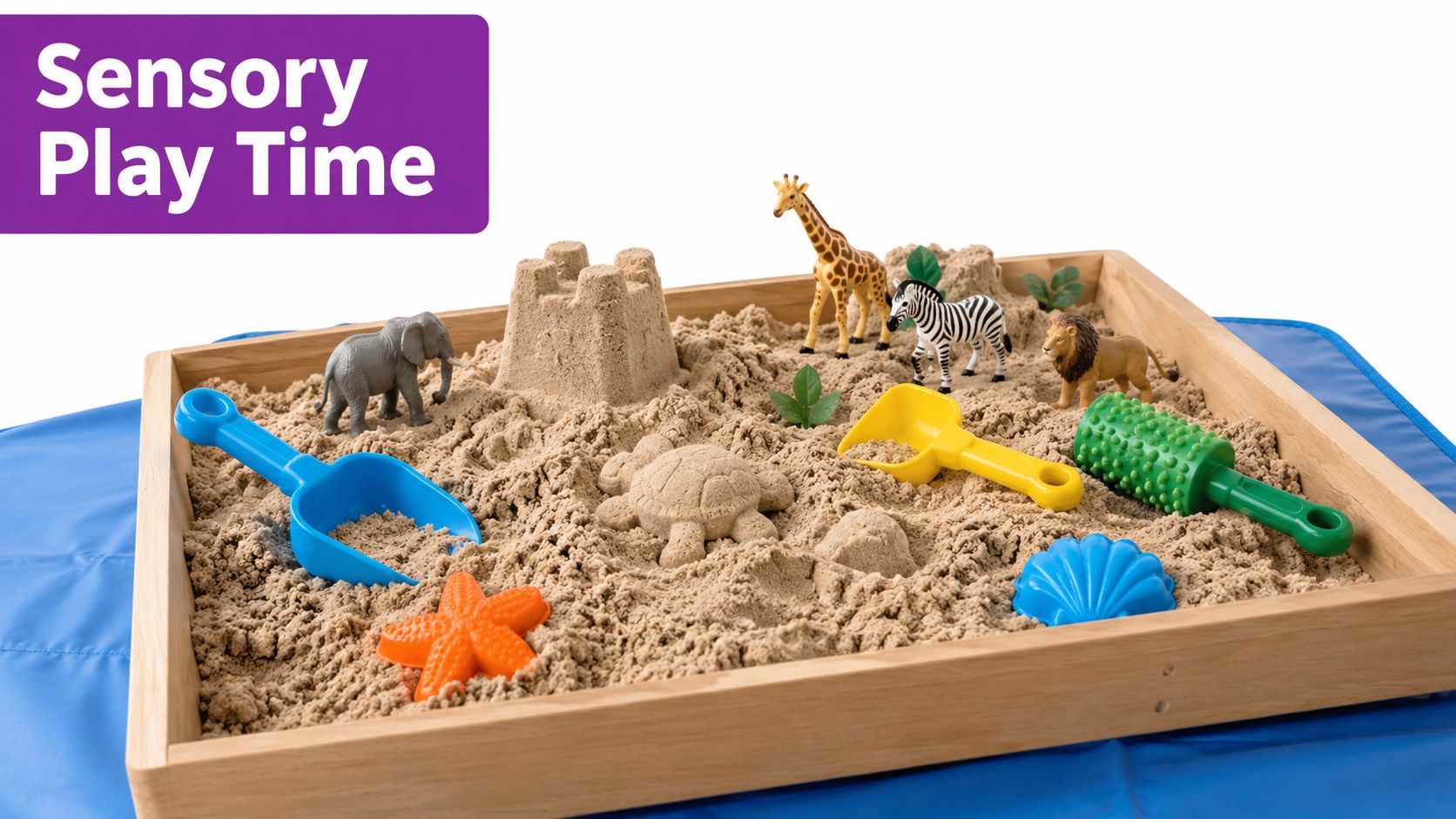
Sensory play is especially useful when children need to slow their bodies and focus their hands. Set up a tray with playdough, water, dry pasta, large natural objects, textured fabric or kinetic sand, depending on the child's age and your supervision capacity. Add scoops, cups, rollers, funnels and large figures so children can investigate without being told exactly what to make.
For a young infant, sensory play may mean touching a damp cloth, listening to water in a sealed container or feeling a large, safe texture while held close. Toddlers can pour, squeeze, scoop and transfer. Preschoolers might make tracks, compare wet and dry materials or create a small scene with animals and blocks.
Keep the experience calm and safe
A waterproof mat and apron protect the floor and reduce adult anxiety about mess. Use child-sized tools, keep the tray within easy reach and stay close, particularly with infants and toddlers. Small items such as dry rice, pasta, beads and tiny figures can create choking hazards. Water beads should not be used around young children.
You can extend the play with a DIY sensory bottle activity, provided the bottle is securely sealed and used with supervision. Watch what each child seeks or avoids. Some children enjoy pressure and resistance, while others prefer smooth, quiet materials. That observation helps you offer a better fit next time.
Change the invitation when interest fades, but don't rush to replace it. A child may return to the same tray several times, adding new ideas each time.
6. Dramatic Play and Role-Playing Scenarios
A cardboard box can become a shop, clinic, bus, animal shelter or family kitchen within minutes. Add fabric, bags, empty food containers, notepads, menus, soft toys and old clothes. Children choose the roles, arrange the space and decide what problem needs solving. That freedom makes dramatic play a strong match for Reggio Emilia-inspired learning.
Infants can watch adults narrate simple pretend actions, such as feeding a toy or putting a doll to bed. Toddlers often repeat familiar routines, while preschoolers create longer storylines with several characters. A child might write a shopping list using marks, count pretend fruit, comfort an injured toy or negotiate who will be the doctor.
Let children's stories lead
Use prompts sparingly. “Who needs help?” or “What should we take with us?” keeps the play moving without taking control. Include props that reflect different family arrangements and community experiences. A shop can include foods familiar to the children, while a clinic can include multilingual signs or a toy stethoscope made from cardboard.
The elements of drama for early learning can help adults notice how children use voice, movement, space and character. You don't need formal drama training. Observe, record a child's words and offer one thoughtful prop when the play reaches a pause.
Children aren't “just pretending” when they run a shop. They're practising language, cooperation, memory, empathy and decision-making in a form they can control.
Keep roles flexible so no child is locked out of the play. If siblings disagree, offer two connected spaces, such as a shop and a delivery service, rather than insisting they play the same character.
7. STEM and Discovery Learning Activities
Rain creates excellent questions. Where does the water go? Which objects stay dry? What makes a paper boat float? Invite children to investigate with a shallow tray, cups, paper, foil, blocks, leaves and safe household objects. You don't need to provide the answer first. Ask children what they notice and what they think might happen.
Infants can watch water drip through a clear container while an adult uses simple descriptive language. Toddlers can sort objects by texture, colour or whether they float. Preschoolers can make a prediction, test it and draw what happened. Mixing colours, comparing full and empty containers, and arranging objects from small to large all introduce early scientific and mathematical thinking.
Document the thinking
Use a clipboard with paper, a magnifying glass and picture cards showing “look”, “guess”, “try” and “talk”. Children can draw observations even if they can't write. Ask, “What changed?” rather than “Was that right?” A failed experiment is useful when it gives the child a reason to change the design.
Try a paper bridge between two books, then add one soft toy at a time. Build a ramp and explore which object travels further. For a nature connection, place leaves or stones in a sorting tray after checking that they're clean, safe and free from sharp edges.
Keep experiments simple and supervised. Avoid hot water, electrical equipment, unknown liquids and objects small enough to swallow. A rainy-day STEM activity should leave children with a new question, not pressure to produce a correct result.
8. Yoga, Mindfulness and Calming Activities
Some rainy days become noisy because children lose access to their usual outdoor movement. Offer a short calming invitation before frustration builds. Place cushions on the floor, dim the lights if appropriate and guide children through animal movements, slow stretches or breathing with a soft toy resting on the stomach.
Infants benefit from a calm adult voice, gentle rocking and pauses for eye contact. Toddlers can copy cat stretches, butterfly legs or a tree pose with support. Preschoolers may follow a short sequence, notice the sounds around them or describe whether their body feels fast, slow, tight or relaxed.
Use short, repeatable cues
“Smell the flower, blow the bubble” gives young children a concrete breathing image. You can also try a quiet bumblebee hum, shoulder squeezes with permission or a listening game where everyone notices one sound. Keep the language practical and non-judgemental. A child doesn't need to be perfectly still for the activity to help.
Five to ten minutes can be enough for younger children, especially after an active game. The adult's behaviour matters as much as the instructions. Speak slowly, model the movement and accept that some children will watch rather than join in.
A calming corner shouldn't become a place for punishment. It's a voluntary space where a child can reset, look at a book, hold a comfort object or breathe with an adult. Follow it with a predictable transition, such as washing hands, having a snack or choosing a quiet puzzle.
9. Cooking and Food Preparation Activities
Food preparation turns a rainy kitchen into a practical learning space. Choose a simple task such as washing fruit, tearing lettuce, mashing banana, mixing a no-bake recipe or making a smoothie. Children can notice smells, textures and colours while practising careful hand movements and learning that food preparation involves planning and cooperation.
Infants can watch from a safe position while an adult names ingredients and actions. Toddlers can pour pre-measured ingredients, stir with support and place soft fruit into a bowl. Preschoolers can count spoonfuls, compare full and empty cups, follow picture instructions and talk about which flavours they prefer.
Make the process the project
Use child-safe tools such as butter knives, soft utensils and stable bowls. Ask children to predict what will happen when ingredients combine. “What will the banana do when we mash it?” invites observation without turning the activity into a lesson with one expected answer.
Choose recipes that suit allergies, family practices and cultural preferences. Check every ingredient, clean surfaces carefully and keep children away from hot appliances, sharp knives and raw ingredients that need adult handling. Handwashing should happen before and after preparation.
Cooking also supports social-emotional learning. Children practise waiting, sharing equipment and coping when a mixture looks different from what they expected. If the result isn't edible, the investigation can still be successful. A playdough recipe offers similar measuring, mixing and sensory learning, but it must be clearly separated from food and labelled so nobody eats it.
10. Movie, Animation and Interactive Screen Time
Screens can have a place in a rainy-day rhythm, but they work best as one part of a varied plan. Choose an age-appropriate animated story, a short nature program or an interactive early learning app, then follow it with conversation or hands-on play. A film about animals could lead to an animal movement game, drawing or a small habitat made from blocks.
Australian screen-use reporting found that around 90% of children spend at least one hour each week on screen-based activities, and most spend 10 or more hours weekly, with ABS reporting also describing a rise in children exceeding 20 hours per week (Australian Bureau of Statistics reporting on children's screen time). That makes an intentional offline alternative valuable, especially when rain already limits movement.
Keep viewing active
Before pressing play, tell children what they'll watch and what they can do afterwards. Pause to ask what a character might be feeling, invite children to spot colours or sounds, or let them act out a scene. Avoid placing a screen on during every unsettled moment, because children also need opportunities to develop their own play ideas.
- For infants: Prioritise face-to-face interaction, songs and books rather than passive viewing.
- For toddlers: Choose short, simple content and sit nearby to talk.
- For preschoolers: Link the program to drawing, construction, music or pretend play.
- For all ages: Keep the viewing area comfortable, set a clear ending and move into an offline activity.
A screen can offer a calm pause after lunch, but it shouldn't replace movement, sensory exploration, conversation or rest.
10 Rainy-Day Activities: Quick Comparison
| Activity | 🔄 Implementation Complexity | ⚡ Resource Requirements | ⭐ Expected Outcomes | 📊 Ideal Use Cases | 💡 Key Advantages / Tips |
|---|---|---|---|---|---|
| Creative Art and Craft Stations | Low–Moderate 🔄 (station setup, cleanup) | Low ⚡ (inexpensive supplies; storage needed) | High ⭐ (fine motor, creativity, emotional expression) | Independent creative time; mixed ages; rainy days | Rotate materials; use washable, non‑toxic supplies; display at child height |
| Indoor Reading Corners & Storytelling Circles | Low 🔄 (curation & cozy setup) | Low–Moderate ⚡ (books, cushions, lighting) | High ⭐ (literacy, vocabulary, calm focus) | Quiet time, small-group story sessions, transitions | Rotate books monthly; use props/puppets; include diverse titles |
| Music and Movement Activities | Moderate 🔄 (planning, space management) | Moderate ⚡ (instruments, playlists, open area) | High ⭐ (gross motor, rhythm, social skills) | High-energy release; group participation; curriculum extension | Use visual timers; include varied genres; scarves/ribbons for engagement |
| Building and Construction Play | Moderate 🔄 (organization, supervision) | Moderate ⚡ (blocks/LEGO, storage solutions) | High ⭐ (spatial reasoning, problem-solving, collaboration) | Collaborative projects; STEM foundations; engineering play | Photograph creations; rotate materials; label storage for independent cleanup |
| Sensory Play & Exploration Tables | Low–Moderate 🔄 (containment, hygiene protocols) | Low ⚡ (cheap materials; regular replacement) | High ⭐ (sensory regulation, fine motor skills) | Infants/toddlers; calming or exploratory stations | Use waterproof mats/aprons; rotate materials monthly; monitor hygiene |
| Dramatic Play & Role-Playing | Low–Moderate 🔄 (theme setup & facilitation) | Moderate ⚡ (props, costumes, themed spaces) | High ⭐ (social-emotional learning, language, empathy) | Role-play scenarios; social negotiation; emotional processing | Rotate themes; include culturally diverse props; train staff to facilitate |
| STEM & Discovery Learning | Moderate–High 🔄 (planning, safety, documentation) | Moderate ⚡ (simple tools, materials, journals) | High ⭐ (critical thinking, scientific/math vocabulary) | Inquiry-based investigations; pre-PREP readiness; small-group experiments | Use natural materials; provide visual instructions; supervise experiments |
| Yoga, Mindfulness & Calming Activities | Low 🔄 (routine building, adult facilitation) | Low ⚡ (mats, calm music, visual guides) | Moderate–High ⭐ (self-regulation, focus, body awareness) | Transitions; calming after high-energy play; short group sessions | Keep sessions short; use animal-named poses; model calm behaviour |
| Cooking & Food Preparation Activities | Moderate 🔄 (safety, planning, allergy management) | Moderate ⚡ (ingredients, child-safe tools, supervision) | High ⭐ (fine motor, measuring/math, positive food relationships) | Small-group nutrition lessons; sensory food exploration | Use picture recipes; check allergies; use child-safe utensils and close supervision |
| Movie, Animation & Interactive Screen Time | Low 🔄 (curation, scheduling, supervision) | Moderate ⚡ (screen, subscriptions, seating) | Moderate ⭐ (educational support; calming) | Occasional calming; staff planning breaks; themed viewing with follow-up | Limit to 20–30 mins; follow guidelines; curate high-quality content and add post-viewing activities |
Make Indoor Play Feel Purposeful
You don't need to complete every activity on a rainy day. Choose one invitation that matches the child in front of you. An infant who is tired may need a warm lap, a cloth book and a simple sensory experience. A toddler with restless hands may benefit from pouring, playdough, sponge transfer or a toy-washing station. A preschooler who wants control may be ready to design a bridge, run a pretend shop or investigate which objects float.
Energy level matters as much as age. Start with an active burst when children are climbing the furniture or arguing over small spaces. Music and movement, a cushion course, animal walks or a delivery game can help children use their bodies safely. Follow that burst with a sensory tray, story corner, construction invitation or mindfulness activity. This rhythm gives children a clear change of pace without expecting them to settle instantly.
Indoor play already forms a familiar part of early childhood for many Australian families, but rain can still make routines difficult. Research involving Australian children found 24.38 fewer minutes of moderate-to-vigorous physical activity on rainy days and 50.01 fewer minutes of light physical activity, showing why a planned movement option matters when outdoor play disappears (Australian research on rain and children's physical activity). You can respond without buying a collection of new toys. Cardboard, fabric, paper, blocks, kitchen tools and safe natural materials often provide enough variety when adults present them with a thoughtful question.
Adjust the same invitation for different children
The same water tray can become a brief, closely supervised sensory experience for an infant, a pouring and transferring task for a toddler, or a floating-and-sinking investigation for a preschooler. The same story can be a lap-time connection for a baby, a repeated phrase game for a toddler, or a puppet retelling for an older child. Open-ended materials allow siblings to participate at different levels without forcing them into identical outcomes.
Stay close during sensory, cooking, construction and movement play. Remove small objects and choking hazards from areas used by infants and toddlers. Check ingredients for allergies, keep hot surfaces and sharp tools out of reach, secure sensory bottles and inspect recycled materials for staples, splinters or torn edges.
Children also need permission to stop. If a child leaves an activity, you can observe what they choose next rather than pulling them back. Their shift may tell you that they need sleep, food, movement, connection or a simpler invitation.
Families looking for developmentally aligned, Reggio Emilia-inspired learning can learn more about Kids Club Early Learning Centre, which supports children from six weeks to six years across Springvale South, Dandenong North and Ferntree Gully. Its programs include personalised care, inquiry-led experiences, weekly professional music and sports curricula, infant and toddler environments, kindergarten and pre-PREP pathways, and support for smooth transitions into school.
Rain doesn't have to produce a perfect schedule. Offer one safe starting point, watch closely, listen to children's ideas and let the play grow from there. A quiet afternoon of making, moving, talking and investigating can give children meaningful learning while helping the whole household find its balance indoors.
Visit Kids Club Early Learning Centre to explore Reggio Emilia-inspired care, kindergarten and pre-PREP programs for children from six weeks to six years. Families in Springvale South, Dandenong North and Ferntree Gully can learn how the centre's music, sports, sensory and inquiry-based experiences support children on rainy days and throughout the year.