
A toddler reaches for a wet leaf, turns it over, and pauses when a tiny insect moves beneath it. Nearby, another child pats the edge of a puddle while a preschooler asks why some leaves are smooth and others feel rough. These moments may look small, but they offer rich starting points for nature based learning activities.
Effective outdoor learning begins with materials children can reach, notice and investigate. The educator's role isn't to provide every answer. It's to watch closely, listen for questions and prepare the next safe opportunity for children to test an idea. This approach suits inquiry-led and Reggio Emilia-inspired practice, where children's interests, relationships and theories shape the program.
The eight experiences below are designed to grow with children from six weeks to three years and beyond. Each includes practical preparation, age adaptations, developmental purposes, safety considerations, seasonal possibilities and ideas for returning to the experience over time. Australian early learning guidance supports this direction. The Early Years Learning Framework's Learning Outcome 2 encourages children to use play to investigate nature, while Quality Area 3 calls for access to built and natural environments for quality experiences, as outlined in this Australian review of nature play and child wellbeing.
At Kids Club Early Learning Centre, local outdoor spaces, family knowledge, music and sports experiences can all deepen these investigations.
1. Forest School and Outdoor Classroom Learning
A forest school experience doesn't require a remote forest. A quiet garden, local park, shaded courtyard or bushland path can become an outdoor classroom when educators return regularly and allow children's observations to guide the experience. Australian guidance recognises settings such as parks, local bushland, beaches and visitor sites as possible locations for bush kinder, rather than limiting nature learning to wilderness areas. You can explore the broader Victorian context through the Victorian Government's bush kinder resources.
Begin with a familiar meeting place. Infants might lie on a weather-appropriate mat and watch leaves move overhead. Toddlers can carry a small basket, follow a short path or investigate bark with an educator. Preschoolers might choose where to explore, negotiate a boundary with peers and return to share what they've found.
Prepare the environment
Before the session, inspect the site, identify hazards, check weather conditions and decide where children can move. Educators need clear supervision arrangements and a shared understanding of when children can take manageable physical risks. Families should know what clothing, footwear, hats and spare clothes are required.
Offer a small number of open-ended prompts:
- For infants: “The leaf is moving. Can you see it?”
- For toddlers: “Where could this stick belong?”
- For preschoolers: “What do you think made this mark in the soil?”
Practical rule: Let the environment provide the first question, then add just enough support to extend children's thinking.
Children can record discoveries through photographs, marks, collected natural objects and educator observations. A leaf found outdoors might later become part of an indoor display, a sorting invitation or a drawing provocation. This connection between outdoor investigation and the learning environment reflects Reggio Emilia-inspired documentation.
Forest school programs are most useful when they become a recurring relationship with place. Visit the same area in different weather, notice changes and share children's theories with families. Australian research identifies imaginative, sensory, creative, discovery, risky and place-responsive forms of nature play, but it also stresses that outdoor access alone isn't enough. Educators need to mediate experiences and help children extend discoveries into language, maths and science through thoughtful conversation, as explained in this Australian research on nature and children's outdoor play.
Kids Club Early Learning Centre can build this rhythm through its nature education centre approach, using local places near Springvale South, Dandenong North and Ferntree Gully.
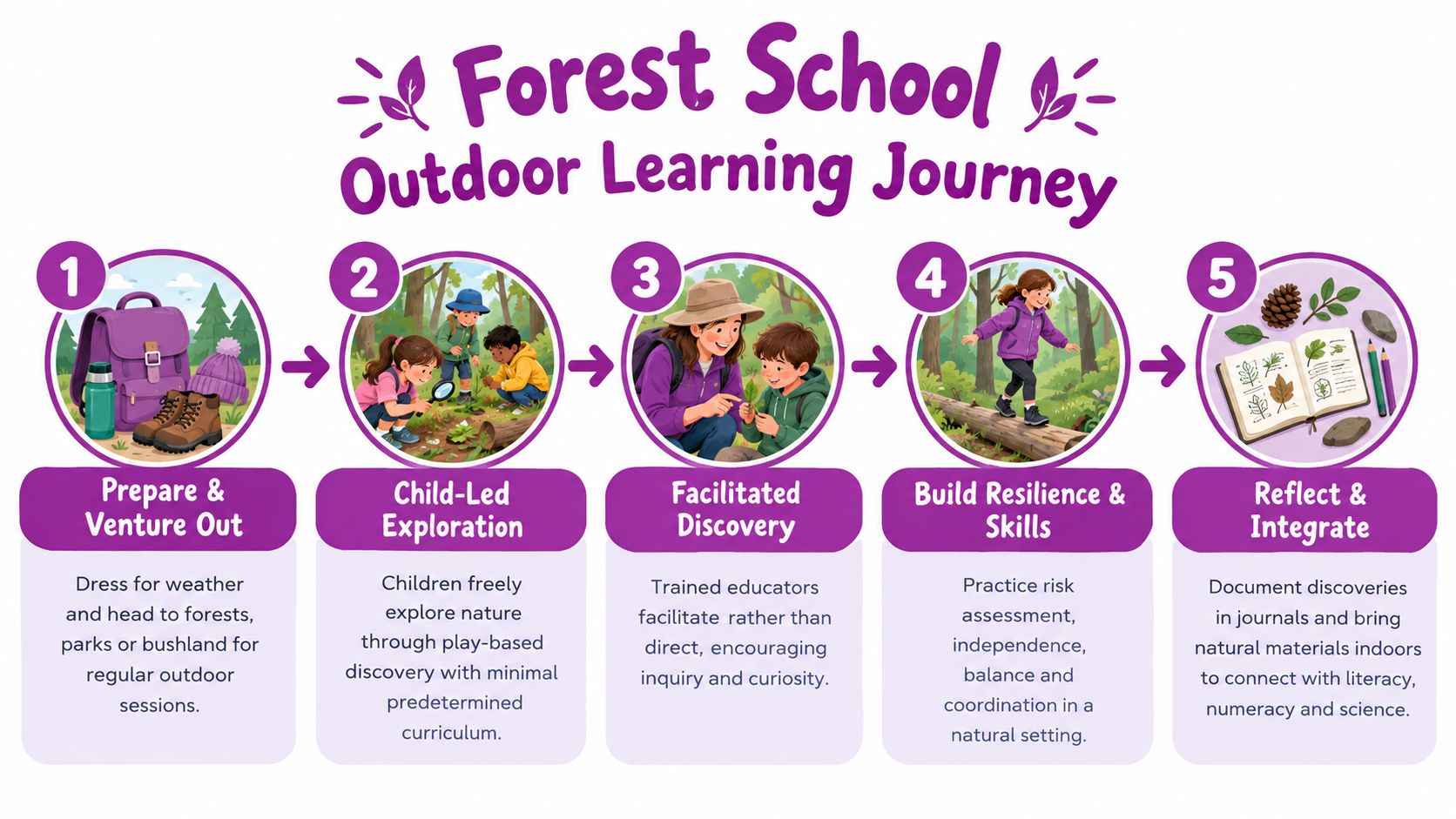
A short video can help families see how an outdoor learning journey may unfold in practice.
2. Gardening and Food Growing Programs
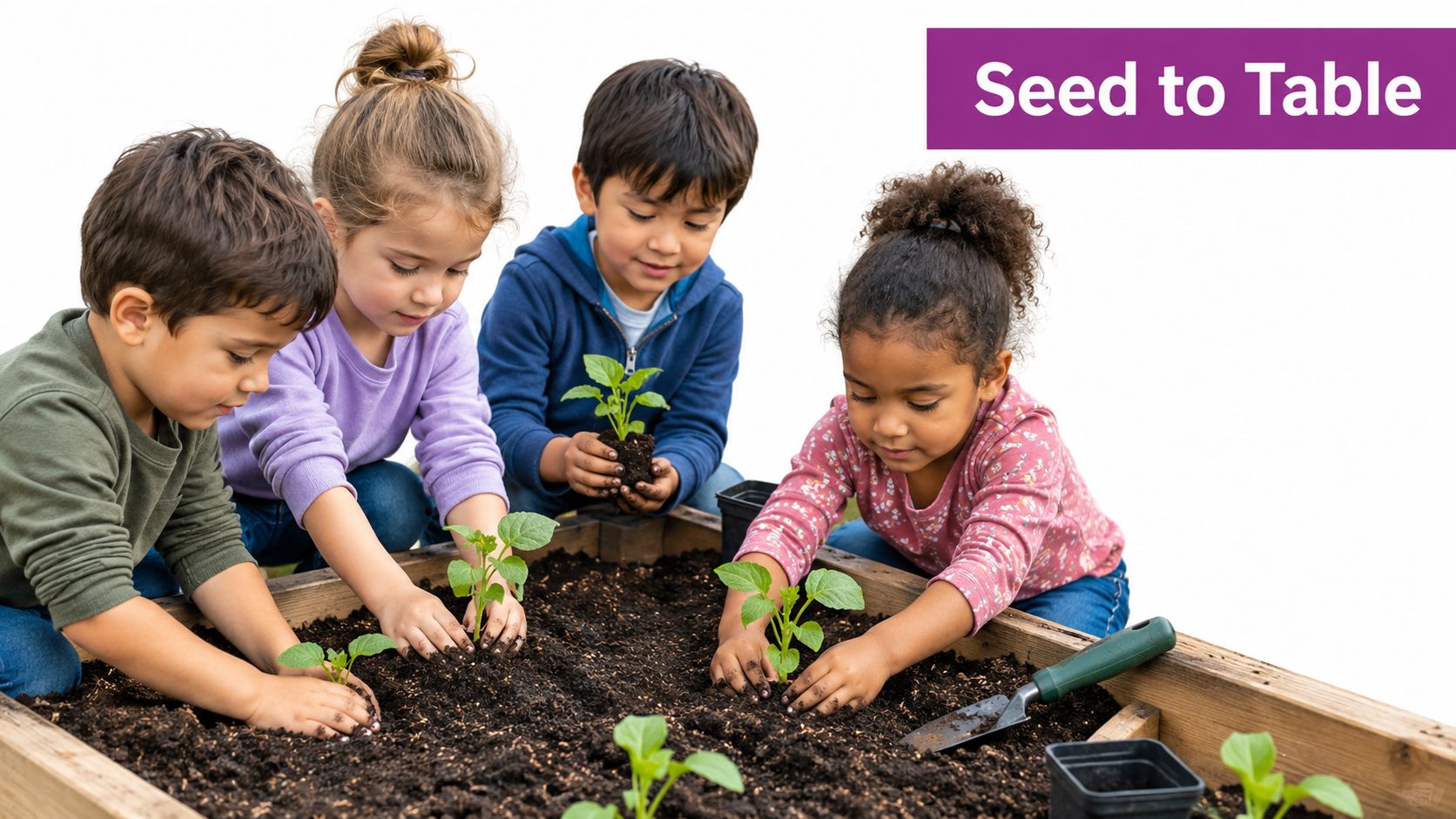
A child presses a seed into soil, covers it gently and checks the pot the next morning. Nothing visible has changed, yet the child is already learning about sequence, patience, care and living systems. Gardening turns an ordinary routine into an extended investigation that can connect science, numeracy, language, food and community.
Start with raised beds, pots or recycled containers placed where children can reach them safely. Choose plants suited to the local conditions and select a mixture of herbs, leafy vegetables and flowers so children can compare smells, textures, colours and growth patterns. The activity doesn't need to begin with a large garden. A few containers can provide a dependable learning focus.
Adapt the experience by age
Infants can experience gardening through close sensory encounters with safe, non-toxic plants. An educator might hold a herb near a baby for smelling, describe the colour of a flower or offer a supervised touch of damp soil. Toddlers can scoop soil, carry a small watering can, place seedlings into prepared holes and notice which plants need water.
Preschoolers can count seeds, compare plant heights, create simple signs, draw changes and help plan what to grow next. Their questions can lead to discussions about roots, sunlight, food preparation and responsibility.
“We planted it yesterday” is the beginning of a conversation, not the end of the learning.
Use photographs and children's words to document the garden's changes. A growth sequence can support early literacy as children dictate captions, recognise familiar names and revisit earlier predictions. Measuring plant height with informal tools also creates meaningful numeracy. The point isn't to turn gardening into a worksheet. It's to let children use mathematical language for a real purpose.
Invite families to contribute recipes, cultural food knowledge or gardening traditions. A seed-to-table experience might involve picking herbs, washing them with support and adding them to a shared meal. Children can see that the garden connects to family life, cooking and community.
Seasonal rotation keeps the experience responsive. In cooler weather, focus on soil, compost and hardy plants. In warmer conditions, investigate shade, water needs and wilting. Always supervise contact with soil, plants, tools and food, and check that the planting area is free from harmful plants or contaminated materials.
3. Nature-Based Sensory and Art Exploration
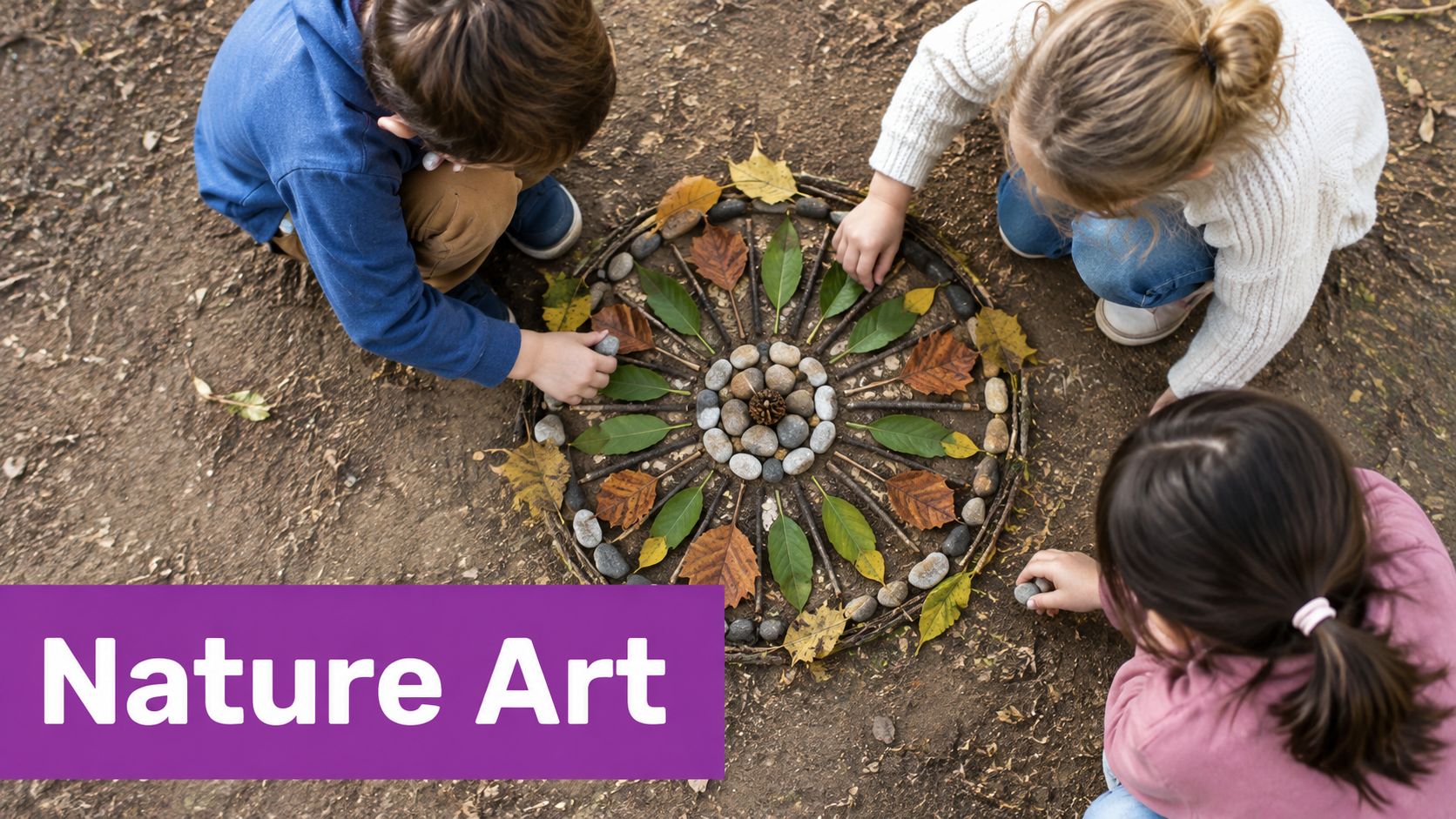
A shallow tray of bark, smooth stones, seed pods, leaves and shells can become a quiet invitation to investigate. Place it near the children, allow time for watching, then follow their ideas. One child may sort by colour, another may rub a leaf across paper, while a toddler transfers stones between containers. The learning develops through choosing, comparing and testing, rather than producing identical artwork.
Open-ended materials give children a starting point, while their actions supply the direction.
For infants, offer a small selection of large, safe natural materials for supervised looking, reaching and touching. Put their experience into words: “This bark feels rough,” or “The stone is cool.” Toddlers can explore wet and dry textures, make marks in mud, and arrange objects into lines or circles. Preschoolers may create patterns, temporary sculptures, mandalas, maps or shared installations, practising communication, planning and cooperation.
Build the invitation around a question
Use baskets, shallow trays, fabric, mirrors or low tables so materials are easy to see and reach. Present a limited selection, then change it with the season. Fallen leaves beside photographs of their tree can prompt matching and vocabulary. Clay near seed pods invites pressing and imprinting. Charcoal beside bark encourages children to compare colour, shape and texture.
Ask questions that keep the decision with the child:
- Notice: “What do you see in this arrangement?”
- Compare: “How are these two stones different?”
- Predict: “What might happen if rain reaches your sculpture?”
- Reflect: “Which material would you use again?”
Sensory exploration can also include music and movement. Children might repeat a pattern while listening to birdsong, move like wind through long grass, or choose sounds for different textures. These links support language, imagination and early representation without turning the experience into a formal lesson.
Collect responsibly. Use fallen objects where possible, take only what the site allows and return materials when appropriate. Avoid unknown berries, sharp fragments and small objects around children who mouth materials. Water, mud and loose parts require close supervision, handwashing routines and clear boundaries.
Photograph an arrangement before wind or rain changes it. Add the children's explanations beside the image in a portfolio or display. Sensory experiences for toddlers can connect outdoor discovery with indoor learning for children who benefit from rich tactile experiences.
4. Nature-Based Movement and Physical Activity
A child pauses beside a fallen log, watches a peer cross it, then chooses whether to try. The log becomes a balance beam, while a gentle slope invites walking uphill and downhill. Stepping stones add another decision: where to place each foot, when to stop and how to adjust. Because the setting changes with weather and seasons, the same route offers fresh motor problems over time.
Start with a safe, clearly marked area and a few open-ended challenges. Keep supervision close, check surfaces, water, plants, weather and access points, and agree on boundaries before children begin. Risk-aware practice leaves room for manageable decisions. Children can judge whether to step, climb, carry or watch, with an adult ready to support them.
Infants may build body awareness during supervised tummy time on an outdoor mat, reaching towards leaves or following movement with their eyes. Toddlers can cross uneven grass, step over a low branch, push a log with an educator or carry objects between two points. Preschoolers may follow a route, climb suitable structures, jump across small gaps or work with peers to design a movement challenge.
Keep the language close to the action:
- Balance: “Your arms are wide. How does that help you stay steady?”
- Direction: “The path curves left around the tree.”
- Force: “What happens when you push the branch gently?”
- Planning: “Where will your foot go next?”
A child who watches several times is gathering information. A child who seeks height or speed is testing a different level of challenge. Offer choices rather than rushing either child, then ask, “Which part felt easy?” or “What could you change next time?” These prompts build body awareness, confidence, communication and problem-solving.
Shorter routes and flexible stopping points suit younger children. Older preschoolers can carry a simple map, count landmarks or help identify a suitable route. Revisit throwing, jumping, stretching, balance and coordination outdoors as part of Kids Club's sports curriculum. Families can join a nature walk, helping children connect movement with shared community life.
Document effort and strategy, not only completion. “You tried a different way to cross” shows that persistence matters. Seasonal conditions extend the invitation: damp grass encourages slower steps, fallen leaves invite jumping, and warm weather calls for shade, water breaks and adjusted timing.
5. Nature Journaling and Scientific Observation
A nature journal can begin with one mark. An infant may look at a photograph taken outdoors. A toddler may make circular scribbles after watching water move. A preschooler may draw a bird, dictate a sentence and add a prediction about what might happen tomorrow. Each form records attention and gives educators a way to revisit children's thinking.
Choose one focus for each session. It might be a single tree, a patch of soil, the weather, a snail trail or the growth of a garden plant. Keeping the focus narrow helps young children notice details without feeling they need to record everything.
Use more than writing
Provide clipboards, thick pencils, crayons, stickers, photographs and natural objects that can be examined safely. Children can point, gesture, draw, dictate, compare and use emerging symbols. An educator might write a child's exact words beside a drawing, then return to that page later and ask whether the idea has changed.
Preschoolers can make a simple seasonal comparison using photographs from the same location. They might notice that a plant has flowers, that the ground is wetter or that fewer insects are visible. These observations develop vocabulary, memory, sequencing and early scientific habits.
Documentation isn't a test of drawing or writing. It's a record of what a child noticed, wondered about and wanted to revisit.
Use prediction prompts carefully. “What do you think we'll see next time?” invites a theory without requiring a correct answer. When children return to the site, compare the new observation with the earlier prediction. This creates a natural reason to use words such as same, different, before, after, more, less, near and far.
Families can contribute by taking a short walk and adding a page at home. A shared journal also helps parents see how outdoor experiences support language and kindergarten readiness. Children practise listening, recalling, representing ideas and talking with others about evidence.
Safety still matters. Keep children within agreed boundaries, don't collect unknown plants or animals and use photographs when a specimen shouldn't be handled. A nature scavenger hunt can offer a structured starting point for observation when educators use simple nature scavenger hunt prompts that suit children's ages and abilities.
6. Outdoor Water Play and Hydrological Exploration
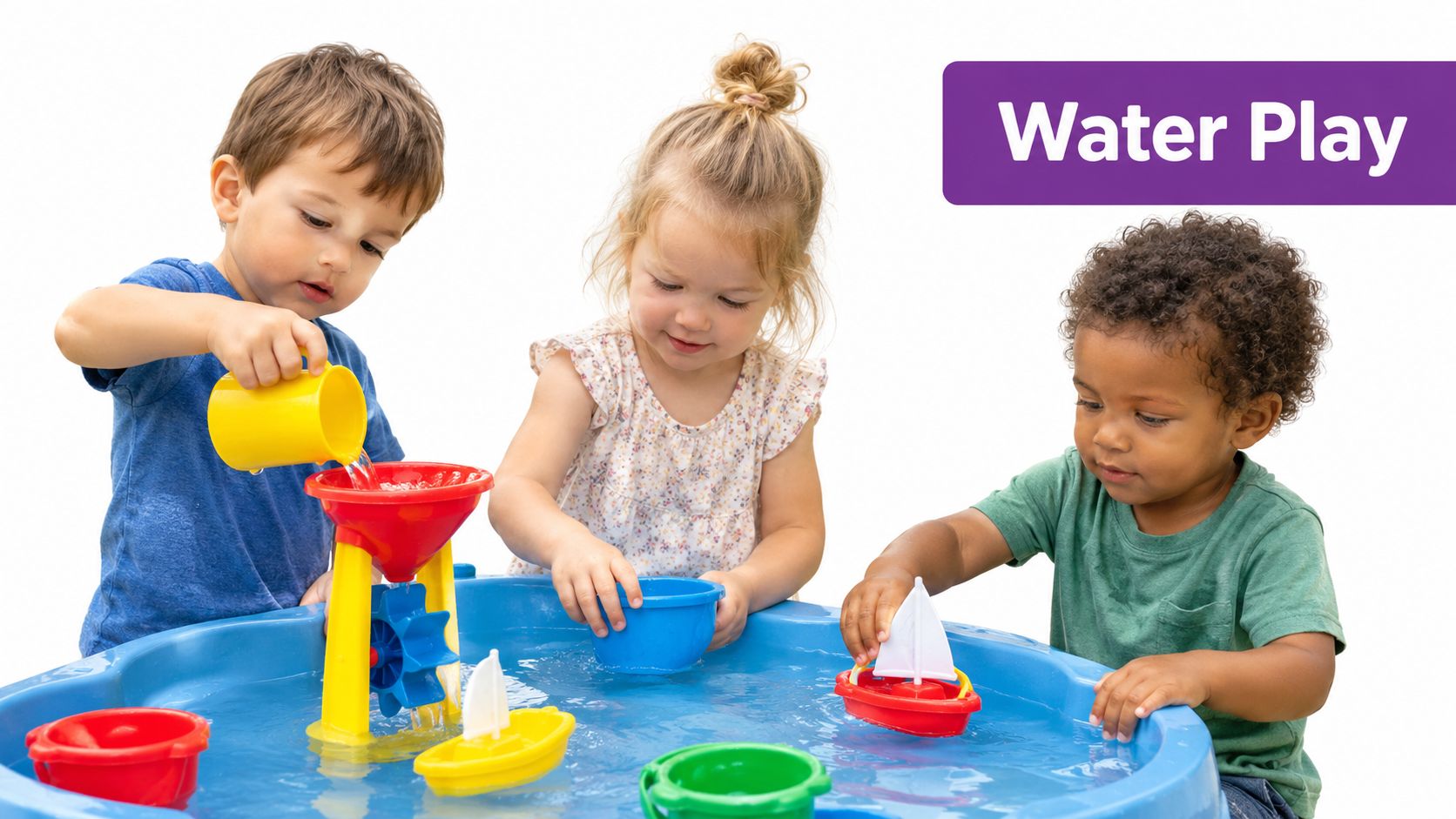
On a warm morning, an educator places a shallow water table near the garden. One child watches a sponge release drops, another fills a cup, and an older child angles a gutter toward a waiting bucket. The same invitation grows with the child, from noticing movement to testing ideas about flow, force and direction.
Water play gives early learners a concrete way to explore changing quantities. Children pour, repeat, adjust containers and observe what happens when water meets stones, pipes or floating objects. Alongside science, they practise words such as full, empty, fast, slow, under, over, around and through.
Adapt the setup as children grow
Keep the materials simple: shallow trays, cups, funnels, scoops, pipes, wheels, sponges and lightweight objects. Infants can watch an adult squeeze a sponge or reach towards a closely supervised tray. Toddlers can fill containers, move water through funnels and test what floats. Preschoolers can arrange gutters, blocks and stones into channels, then explain or predict where the water will travel.
A water station works like a small outdoor laboratory. Children change one part, watch the result and decide what to try next.
Educators can extend the play with a rain collection activity. Children might compare water gathered in different places, watch a water wheel turn or notice how a channel changes after more water is added. These experiences support early maths, problem-solving, collaboration and language without turning play into a worksheet.
Build safety into the routine. Use non-slip surfaces, suitable clothing, handwashing and a clear process for emptying and storing equipment. Young children require constant supervision around water, even in a shallow tray. Test water temperature before use and adjust materials to the season. Ice offers a cold sensory experience, while warmer water may suit cooler conditions when an adult has checked it first.
Rhythm can help children attend to change. Tap as drops fall, sing during pouring or move slowly and quickly to match the water's speed. Later, children may apply the same ideas while watering plants, observing rain or constructing indoor channels.
7. Community Nature Projects and Environmental Stewardship
A small garden bed can become a shared classroom. Children may fill a compost bucket, water a native plant or collect safe natural materials, then see how their actions affect a place used by everyone. The visible result gives care a purpose and helps children build belonging, responsibility and cooperation.
Start with one manageable project. A centre could create a bird-friendly planting area, care for native herbs, add food scraps to a compost system or collect litter with adults in a clearly marked space. Set up child-sized roles before inviting participation, such as carrying light materials, choosing where leaves belong or checking whether a plant needs water.
Age changes the way children take part:
- Infants: Watch adults plant, touch safe leaves and hear repeated words such as care, grow, soil and water.
- Toddlers: Carry lightweight items, pour with help and place leaves or food scraps into the correct container.
- Preschoolers: Help plan the project, suggest roles, make signs and explain why the place needs care.
The same project can support early literacy through labels, messages and conversations. Counting seedlings, comparing plant growth and sorting compost materials bring numeracy into a real task. Carrying, digging with safe tools and watering develop coordination, while shared jobs give children practice with turn-taking and negotiation.
Let the community become part of the project
Families, local council teams, Landcare groups and community gardeners can contribute local knowledge. A visitor might identify a native plant, explain the purpose of mulch or show children how to care for a habitat feature. Children then see environmental stewardship as shared work, with adults and children contributing in different ways.
Use photographs, children's comments and simple displays to make change visible. Return to the documentation and ask:
- Belonging: “Who uses this garden?”
- Responsibility: “What does our plant need today?”
- Problem-solving: “How can we protect this new seedling?”
- Community: “Who could help us care for this place?”
Choose plants suited to the local Melbourne environment and consult relevant experts before planting. Check materials for safety, keep sharp tools with adults, and plan site permissions, hygiene procedures and supervision. Adults should handle waste that may be hazardous.
Return to the project across seasons. Children can notice growth, repair a habitat feature, add compost or decide what needs changing. Music, planting songs and shared rhythms can support group participation, while ongoing questions build kindergarten readiness through planning, communication and flexible problem-solving.
8. Seasonal Nature Study and Phenological Learning
At the entrance, a child pauses beside the same tree they visited last week. A new flower has opened, one leaf has fallen and the ground feels damp after rain. Repeated visits turn a familiar outdoor view into an ongoing investigation.
Choose one tree, garden bed, shaded corner or patch of grass. Keep the viewpoint consistent so children can notice small changes over time.
A repeated observation gives children a stable place from which to ask new questions.
Infants can watch seasonal changes through sensory experiences, photographs and descriptive language. Toddlers can collect fallen leaves with support, compare warm and cool surfaces, notice rain and search for new flowers. Preschoolers can make a seasonal calendar, revisit earlier drawings and take photographs from the same position. The provocation stays the same, while the language, independence and recording method grow with the child.
Use a simple observation rhythm
Rather than treating the activity as a worksheet, build it into the program:
- Return: Visit the selected place regularly.
- Notice: Invite children to look, listen, touch safe surfaces and describe differences.
- Record: Use photographs, drawings, words, gestures and fallen natural materials.
- Compare: Place today's documentation beside earlier observations.
- Extend: Follow a question into art, music, movement, gardening or science.
Introduce vocabulary as children need it. Words such as bud, blossom, damp, dry, shade, shadow, breeze, rough, smooth, fallen and growing help children describe what they observe. Local weather may change in unexpected ways, so children can investigate variation instead of memorising a fixed seasonal pattern.
Family traditions and cultural knowledge can broaden the discussion. Invite families to share ways they recognise seasonal shifts, prepare food, celebrate growth or respond to weather. Ask with care, without assuming every family experiences the year in the same way.
Adjust safety checks as conditions change. Review sun protection, clothing, slippery surfaces, insects, hydration and access to shade. Before going outside, children can help decide what they need, practising independence and self-care.
Create a seasonal display with children's words, photographs, music and natural materials. At each visit, ask, “What do you remember about this place?” and “What's different today?” Over time, children practise memory, sequencing, prediction, descriptive language and flexible thinking. These experiences support kindergarten readiness by giving children regular practice in listening, communicating, investigating and joining shared learning.
Nature-Based Learning Activities: 8-Point Comparison
| Program / Approach | Implementation complexity 🔄 | Resource requirements ⚡ | Expected outcomes 📊 | Ideal use cases 💡 | Key advantages ⭐ |
|---|---|---|---|---|---|
| Forest School and Outdoor Classroom Learning | 🔄 High, trained Forest School educators; risk assessment and transport logistics | ⚡ High, regular natural sites, higher staffing ratios, weather gear | 📊 Strong gains in independence, resilience, gross motor skills, curiosity | 💡 Weekly/daily Reggio-aligned outdoor programs; nature-rich settings | ⭐ Deep experiential learning; sensory-rich; long-term wellbeing |
| Gardening and Food Growing Programs | 🔄 Medium, setup beds, seasonal planning, ongoing maintenance | ⚡ Medium, garden beds/containers, water access, tools, storage | 📊 Builds lifecycle understanding, fine motor skills, numeracy, healthy eating | 💡 Pre-PREP (ages 3–6); seed-to-table activities; family involvement | ⭐ Hands-on sustainability learning; cost-effective; tangible outcomes |
| Nature-Based Sensory and Art Exploration | 🔄 Low–Medium, sourcing/rotating materials; set-up & cleanup | ⚡ Low, loose parts, mud kitchen, storage, basic art supplies | 📊 Enhances fine motor control, creativity, sensory regulation, expression | 💡 Infants/toddlers; indoor/outdoor Reggio provocations | ⭐ Open-ended creativity; low material cost; highly engaging |
| Nature-Based Movement and Physical Activity | 🔄 Medium, staff trained in outdoor supervision and risk management | ⚡ Medium, access to varied terrain, natural play elements, trained staff | 📊 Improves gross motor skills, balance, fitness, risk assessment, confidence | 💡 Complement sports curriculum; progressive movement for ages up to 6 | ⭐ Boosts physical health and confidence; reduces behavior issues |
| Nature Journaling and Scientific Observation | 🔄 Medium, educator time for documentation and reflection | ⚡ Low, journals, cameras, art supplies, storage for samples | 📊 Develops observation, inquiry, literacy, and longitudinal records | 💡 Ages 3–6; Reggio documentation & school-readiness portfolios | ⭐ Supports literacy and assessment; creates tangible learning records |
| Outdoor Water Play and Hydrological Exploration | 🔄 Medium, water management, drainage planning, close supervision | ⚡ Medium, water tables/pumps, drainage, waterproof clothing, materials | 📊 Teaches flow/volume concepts, sensory regulation, cooperative play | 💡 All ages (6 weeks–6 years); science and sensory curriculum links | ⭐ Highly engaging; scalable by age; strong science linkages |
| Community Nature Projects & Stewardship | 🔄 High, coordination with partners, volunteers, ongoing project mgmt | ⚡ Medium, plants, tools, partnerships, volunteer coordination | 📊 Builds stewardship, community connection, civic responsibility | 💡 Mixed-age groups; family/community involvement; long-term projects | ⭐ Authentic purpose-driven learning; strengthens local ties |
| Seasonal Nature Study & Phenological Learning | 🔄 Medium–High, multi-season commitment; consistent site visits | ⚡ Low–Medium, documentation tools, travel to local sites, time | 📊 Deepens cyclical thinking, temporal concepts, long-term observation | 💡 Ages 3–6; multi-season Reggio portfolios and curriculum continuity | ⭐ Strengthens seasonal awareness; supports long-term documentation |
Turn Eight Ideas Into a Living Programme
Nature learning becomes most powerful when educators return to an idea instead of treating it as a one-off excursion. A puddle can support sensory exploration on Monday, water flow on Wednesday and drawing or storytelling later in the week. A garden bed can become a place for touching soil, counting seedlings, discussing care and preparing food.
Start with the youngest child present. Ask what an infant can safely see, hear, touch or track. Then add layers for toddlers and preschoolers without separating the group unnecessarily. The same leaf may be a visual focus for a baby, a sorting object for a toddler and a prompt for descriptive writing or measurement for an older child.
A simple planning rhythm keeps the program intentional:
- Prepare a safe provocation: Arrange a small number of natural materials, tools or movement possibilities.
- Observe children's questions: Watch what they repeat, avoid, combine, carry, name or revisit.
- Document learning: Record children's words, actions, drawings, photographs and working theories.
- Share an extension with families: Invite a related observation, story, recipe or contribution from home.
- Return with greater complexity: Change the materials, introduce a comparison or revisit the same place in new conditions.
This cycle also supports inclusive practice. Some children may want to touch every material. Others may prefer watching from a distance, using a tool, working beside an educator or taking photographs. A nature-based program can offer choice without losing purpose. Educators can adjust pace, noise, texture, physical challenge and social demands while keeping the central inquiry open.
Safety should remain part of planning rather than an afterthought. Victorian bush kinder guidance expects services to consult families, select suitable sites, review policies, conduct risk assessments and create an educational program. Those steps help educators balance freedom with responsibility, particularly for infants, toddlers and children who need additional support.
Australian early learning policy provides a strong foundation for this work. Learning Outcome 2 and Quality Area 3 position children's relationships with natural environments within everyday early childhood practice, as described in the Australian policy review of outdoor learning. For families, that means nature based learning activities aren't fringe enrichment. They can be part of a well-planned early learning program that develops communication, curiosity, movement, relationships, early maths, problem-solving and kindergarten readiness.
When comparing early learning options, ask how outdoor inquiry is embedded in daily practice, how educators manage risk, how children's discoveries are documented and how the program supports infants, toddlers and preschoolers at different developmental stages. Families considering Kids Club Early Learning Centre can explore how its Reggio Emilia-inspired approach, outdoor experiences, music and sports curriculum, and kindergarten programs connect learning with children's everyday interests.
Kids Club Early Learning Centre offers nurturing care for children from six weeks to six years, with nature-focused experiences that use weather, water, stones, plants, movement and change as meaningful learning materials. Visit Kids Club Early Learning Centre to discuss your child's needs, explore the Springvale South, Dandenong North or Ferntree Gully centres, and see how outdoor inquiry can become part of your family's early learning routine.