
You're halfway through peeling a banana when your toddler asks “why?” again. A few minutes later, they're balancing the banana pieces on a plate, offering one to a toy animal, then becoming upset when the pieces fall. That ordinary moment contains far more learning than it first appears.
Your child is using their hands, solving a small problem, practising language, exploring pretend play, managing frustration and sharing an experience with you. Health and human development in early childhood is this whole pattern of growth working together. It includes the body, thinking, emotions, relationships and communication, not just physical health or preparation for school.
What Health and Human Development Really Means
Health gives children the physical and emotional foundations to participate in daily life. Human development describes how children gradually build movement, understanding, independence, communication and relationships. These areas influence one another. A tired child may find it harder to manage emotions, while a secure relationship can give a hesitant child the confidence to try a new physical challenge.
Australia's Australian Early Development Census, or AEDC, offers a shared way to understand development at school entry. It looks at physical health and wellbeing, social competence, emotional maturity, language and cognitive skills, and communication skills and general knowledge. The national AEDC has been conducted every three years since 2009. In 2021, 54.8% of children were developmentally on track across all five domains, compared with 51% in 2009, while 22.0% were vulnerable in at least one domain, down from 23.6% in 2009. These figures come from the Australian Government evidence summary on the early years.
Those figures describe populations, not individual children. They don't predict exactly what your child will do next, and they aren't a pass or fail test. A child can be confident with language yet still need help joining a group. Another may have strong physical skills but need more support with waiting, listening or recovering from disappointment.
Development grows through relationships
Young children learn through repeated, meaningful experiences. A conversation while folding washing, a walk to the park, cooking together or comforting a child after a fall can support development as powerfully as a planned activity. Parents are already their child's first educators. The purpose of a framework is to help you notice the learning that is already happening and respond with intention.
Development also varies between children and is shaped by culture, family routines, temperament, language and opportunity. In a multilingual home, a child may express ideas differently across languages. In a family that values close observation and shared care, learning may look different from a family that encourages early independence. Both can offer rich developmental experiences.
Practical rule: Look for progress, participation and connection, not a perfect performance on a particular day.
The Five Domains That Shape Early Development
Think of the AEDC domains as five connected windows into the same child. They help adults notice strengths without reducing development to one skill or one school-readiness task. The EYLF principles and practices provide another useful way to connect relationships, play and intentional teaching in early learning.
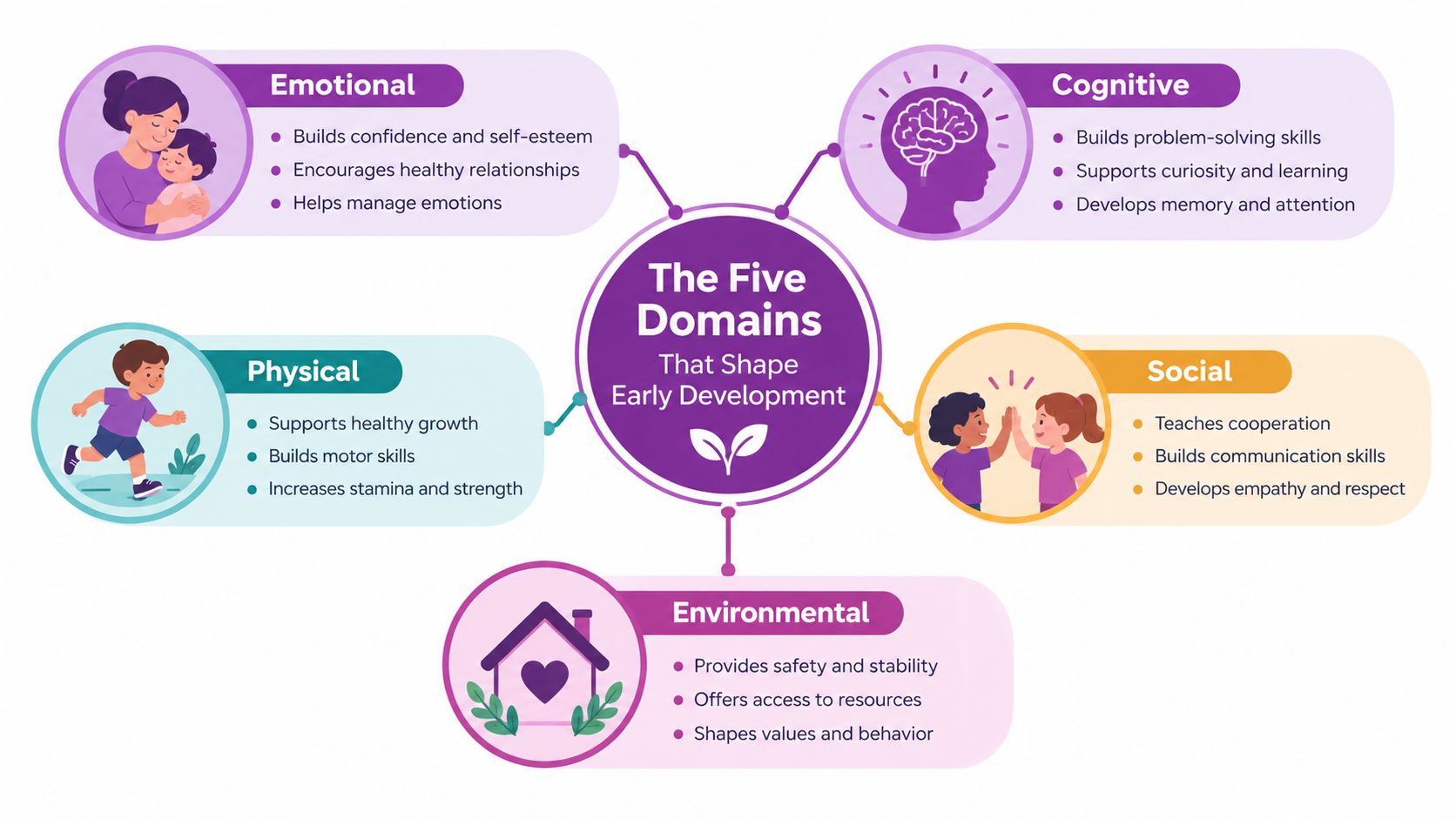
A concept map for everyday family life
| AEDC domain | What you may notice at home |
|---|---|
| Physical health and wellbeing | Moving with increasing control, using hands for tasks, managing personal care and having energy to participate |
| Social competence | Joining play, noticing other people's ideas, taking turns and responding to familiar routines |
| Emotional maturity | Naming or showing feelings, settling with support, concentrating briefly and recovering after frustration |
| Language and cognitive skills | Asking questions, remembering experiences, making plans, sorting objects and trying different solutions |
| Communication skills and general knowledge | Listening, expressing needs, understanding conversations and building knowledge about people, places and everyday life |
Physical health and wellbeing isn't whether a child runs quickly. It includes stamina, coordination, body awareness and the ability to take part in meals, rest, dressing, outdoor play and personal care. A child carrying a small bucket across the garden is strengthening movement while also practising purpose and independence.
Social competence appears when children notice another child's feelings, negotiate over a toy or seek help appropriately. It doesn't mean a child must be constantly outgoing. A quiet child can show strong social understanding by watching carefully, staying near a trusted adult and joining when ready.
Emotional maturity doesn't mean being calm all day. Children are still learning to handle big feelings. Look for the gradual ability to pause, accept comfort, focus on a task and return to play after disappointment.
Language, thinking and communication overlap constantly. Stacking blocks involves hand control, planning, memory, words such as “higher” or “fall”, and persistence when the tower collapses. Reading a familiar book can support vocabulary, attention, imagination and shared connection in one short routine.
Milestones From Birth to Age Six
Milestones are useful observations, not deadlines. Children develop unevenly, and a child may move ahead in one area while taking more time in another. Use the table as a conversation starter, rather than a checklist that creates anxiety.
| Age band | Physical | Social-emotional | Cognitive | Language |
|---|---|---|---|---|
| 0 to 6 months | Moves arms and legs, develops head and body control, reaches and grasps | Responds to familiar faces and voices, settles through responsive care | Watches movement, explores with senses and begins anticipating routines | Makes sounds, smiles socially and responds to voices |
| 6 to 12 months | Sits, reaches, transfers objects and explores movement | Enjoys familiar people, shows preferences and may respond to separation | Searches for partly hidden objects, repeats actions and explores cause and effect | Babbles, uses gestures and responds to familiar words |
| 1 to 2 years | Walks, climbs, carries objects and begins using tools such as a spoon | Shows affection, asserts preferences and plays alongside others | Copies actions, experiments with objects and begins simple pretend play | Uses growing words, gestures and short combinations to communicate |
| 2 to 3 years | Runs, jumps, builds and manages more self-care steps | Begins short shared play, reacts strongly to limits and seeks reassurance | Sorts, matches, remembers routines and uses pretend ideas | Combines words, asks questions and follows familiar directions |
| 3 to 4 years | Uses climbing, drawing and construction skills with more control | Negotiates simple play, shows empathy and practises managing conflict | Notices patterns, solves practical problems and sustains interest in play | Tells simple stories and explains ideas, though unfamiliar listeners may not understand everything |
| 4 to 5 years | Develops balance, coordination and independence with dressing and equipment | Takes part in group routines, manages turn-taking with support and expresses a wider range of feelings | Counts in meaningful situations, plans pretend play and follows several connected ideas | Holds longer conversations, describes events and learns new vocabulary |
| 5 to 6 years | Refines movement, hand control and school routines | Builds friendships, manages group expectations and seeks help when needed | Follows sequences, makes predictions and adjusts plans | Explains thinking, listens to stories and communicates with increasing clarity |
Knowing when to talk with someone
Variation is normal. A child may be cautious in a new setting, use fewer words when tired or prefer watching before joining. Give them time, observe across different situations and consider what they can do with a trusted adult.
A conversation with a general practitioner, maternal and child health nurse, speech pathologist or paediatric service is sensible if a concern persists, skills appear to go backwards, or your child has difficulty participating in everyday routines. For example, you might seek guidance if a two-year-old rarely communicates interest in pretend play, or if a four-year-old's speech remains hard for familiar adults to understand. These examples don't diagnose a child. They describe reasons to ask for a professional view rather than waiting alone.
The transition to school is also broader than recognising letters or writing a name. Teachers in Melbourne's south-east will notice how a child separates, communicates needs, manages belongings, joins group experiences, follows routines, recovers from setbacks and approaches unfamiliar tasks. Families can find practical age-related ideas in this guide to supporting five-year-olds.
How High-Quality Childcare and Reggio Emilia Approaches Support Development
A childcare service supports health and human development through the experiences children repeat each day. The name of a philosophy matters less than the quality of relationships, supervision and learning opportunities behind it. Ask a practical question: what will educators do with my child, and how will they know it is helping?
Look for educators who greet children warmly, listen carefully and respond to individual interests. Check whether the room invites movement, conversation, investigation and calm recovery after frustration. Ask how observations are recorded, how families contribute, how home languages are respected and how experiences are adjusted when a child needs extra support.
For families in Melbourne's south-east, the five AEDC domains offer a useful lens: physical health and wellbeing, social competence, emotional maturity, language and cognitive skills, and communication and general knowledge. In Springvale South, Dandenong North and Ferntree Gully, families may encounter services that combine predictable routines with project-based investigation inspired by Reggio Emilia, as described in the Reggio Emilia-inspired approach at Kids Club ELC.
A child who becomes fascinated by leaves might collect, sort, draw and compare them. Educators could then invite children to represent their discoveries with clay or construction. One interest becomes a pathway across the AEDC domains: children use new vocabulary, practise fine-motor control, negotiate with peers, manage attention and explain their ideas. The adult follows the child's question while still providing thoughtful guidance.
When touring a centre, ask: “Can you show me how an observed interest becomes a learning experience, and how you share that process with families?”
The table is a guide, not a quality score. Traditional childcare may include excellent intentional teaching, while a Reggio Emilia-inspired approach still depends on skilled educators, safe practice and strong relationships.
| Feature | Routine-focused childcare | Reggio Emilia-inspired approach at Kids Club ELC |
|---|---|---|
| Planning | Educators may plan around routines, developmental goals and group interests | Educators often extend investigations from children's questions and observations |
| Role of the child | Children join planned experiences and receive opportunities to choose | Children make choices, represent ideas and contribute to shared projects |
| Environment | Rooms provide suitable resources for care, play and learning | Materials, light, displays and open-ended resources form part of the learning environment |
| Documentation | Educators record routines, observations and progress for families | Documentation can show children's theories, conversations and project development |
| School readiness | May include direct preparation for routines, literacy, numeracy and group participation | Develops these capabilities through inquiry, collaboration, communication and purposeful play |
This short visual introduction explains inquiry-led early learning before you visit a service.
Qualifications, stable relationships, safe supervision and family partnerships matter across philosophies. Ask about educator-to-child ratios, staff continuity, inclusion planning, outdoor experiences, sleep routines and responses to distress. Choose the setting that suits your child's needs and gives your family clear, open communication.
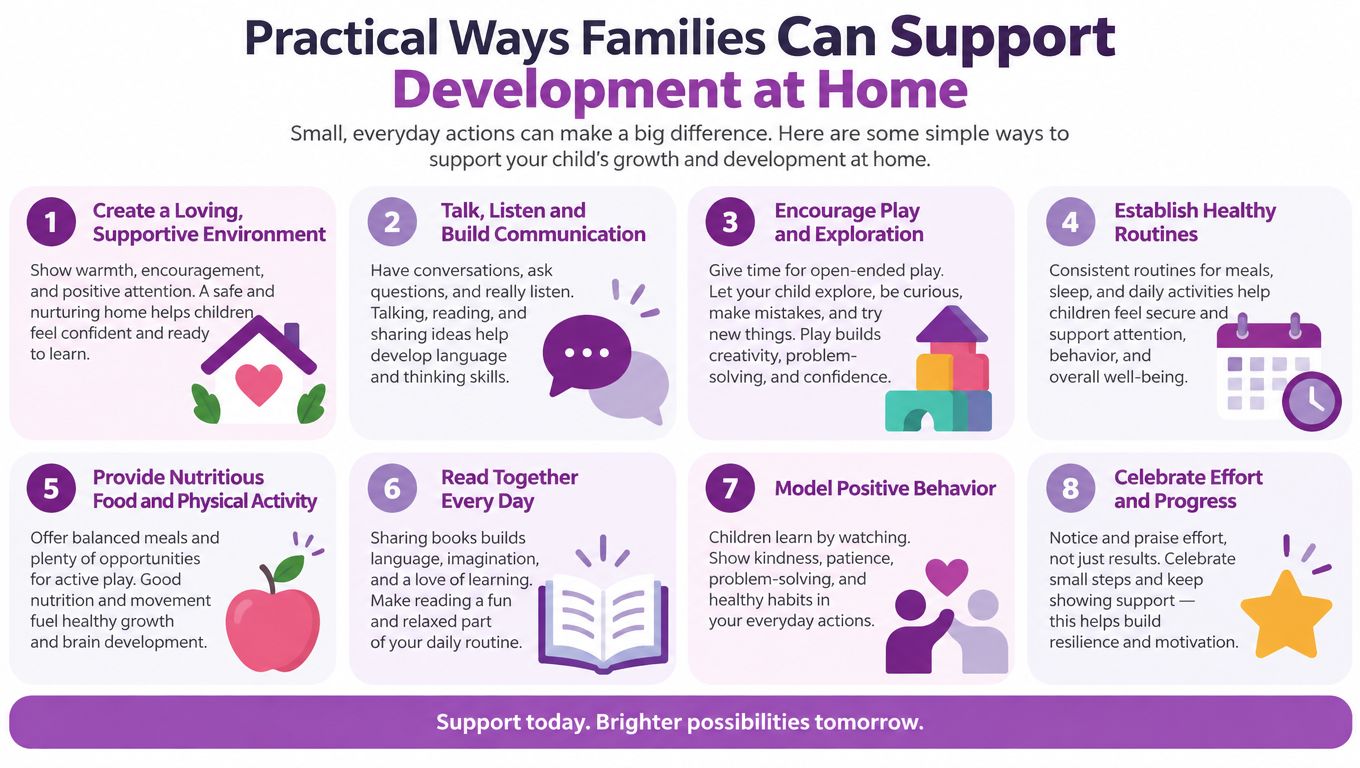
Practical Ways Families Can Support Development at Home
You don't need a separate lesson plan for every developmental area. Small routines become powerful when you slow down, let your child participate and talk about what you're doing.
Build learning into ordinary routines
- Talk during care: Describe the steps while washing hands, packing a bag or preparing food. Pause so your child can respond with a sound, gesture, word or sentence. This supports communication and language.
- Read responsively: Choose a book your child enjoys. Ask what they notice, repeat interesting words and invite them to turn pages or retell a familiar part. You don't have to finish every page.
- Offer open-ended materials: Cardboard boxes, fabric, blocks, paper, leaves and safe kitchen utensils can become houses, shops, roads or instruments. Open-ended play gives children room to plan and change their minds.
- Count real objects: Count socks while sorting washing, compare which container holds more pasta or group toy animals by colour. The point is the thinking, not a worksheet.
- Make room for movement: Walk, climb, dance, carry, balance and play with a ball. Follow your child's confidence and provide safe challenges rather than demanding a particular performance.
- Name emotions without fixing them immediately: Say, “You wanted the blue cup and you're upset.” Once your child feels understood, offer a choice such as trying again or choosing another cup.
- Share responsibility: Let your child pour water, place napkins, put shoes away or choose between two outfits. Independence grows through manageable participation.
- Invite connection: At a shared meal, ask each person to notice one thing about the day. If conversation is difficult, use songs, family stories or a favourite object as a starting point.
A library visit in Springvale South, Dandenong North or Ferntree Gully can provide books and community connection. Playgroups, parks and maternal and child health nurses can make support more practical for families with limited time, transport or confidence. If your home language isn't English, keep using the language in which you can offer the richest conversation. Strong connection matters more than forcing one language during every interaction.
Common Questions Parents Ask About Early Development
How do I know whether my child is on track?
Watch patterns across settings rather than judging one difficult morning. Notice how your child communicates, plays, moves, connects and responds to support. If a concern continues or affects everyday participation, write down examples and discuss them with your maternal and child health nurse or GP.
Will learning two languages delay my child?
Bilingual or multilingual children may distribute their words and ideas across languages. Count the child's communication across their languages, not only the English words you hear. Share examples with educators and seek a speech pathologist who understands multilingual development if you remain concerned.
What should I do after an educator raises a concern?
Ask for specific observations. Find out when the behaviour occurs, what happens before it, what helps and whether the educator has noticed strengths in the same area. Agree on one or two shared strategies, then review them together rather than leaving the conversation as a general worry.
Do screens affect sleep and language?
The effect depends on what the child watches, when they watch and whether an adult joins the experience. Protect sleep routines, keep screens from replacing conversation and movement, and talk about what your child sees. Shared books, songs and face-to-face play give children more opportunities to practise communication.
Will childcare harm attachment if I return to work?
Children can form secure relationships with parents and responsive educators. Consistent care, predictable arrivals and departures, and warm communication help children understand that adults return and their needs will be met. If separation is difficult, ask the service for a gradual orientation plan.
Families can also speak with the Maternal and Child Health Line, an NDIS early childhood partner or a paediatric service in Melbourne's south-east. Early guidance isn't an admission that you've done something wrong. It gives adults more options.
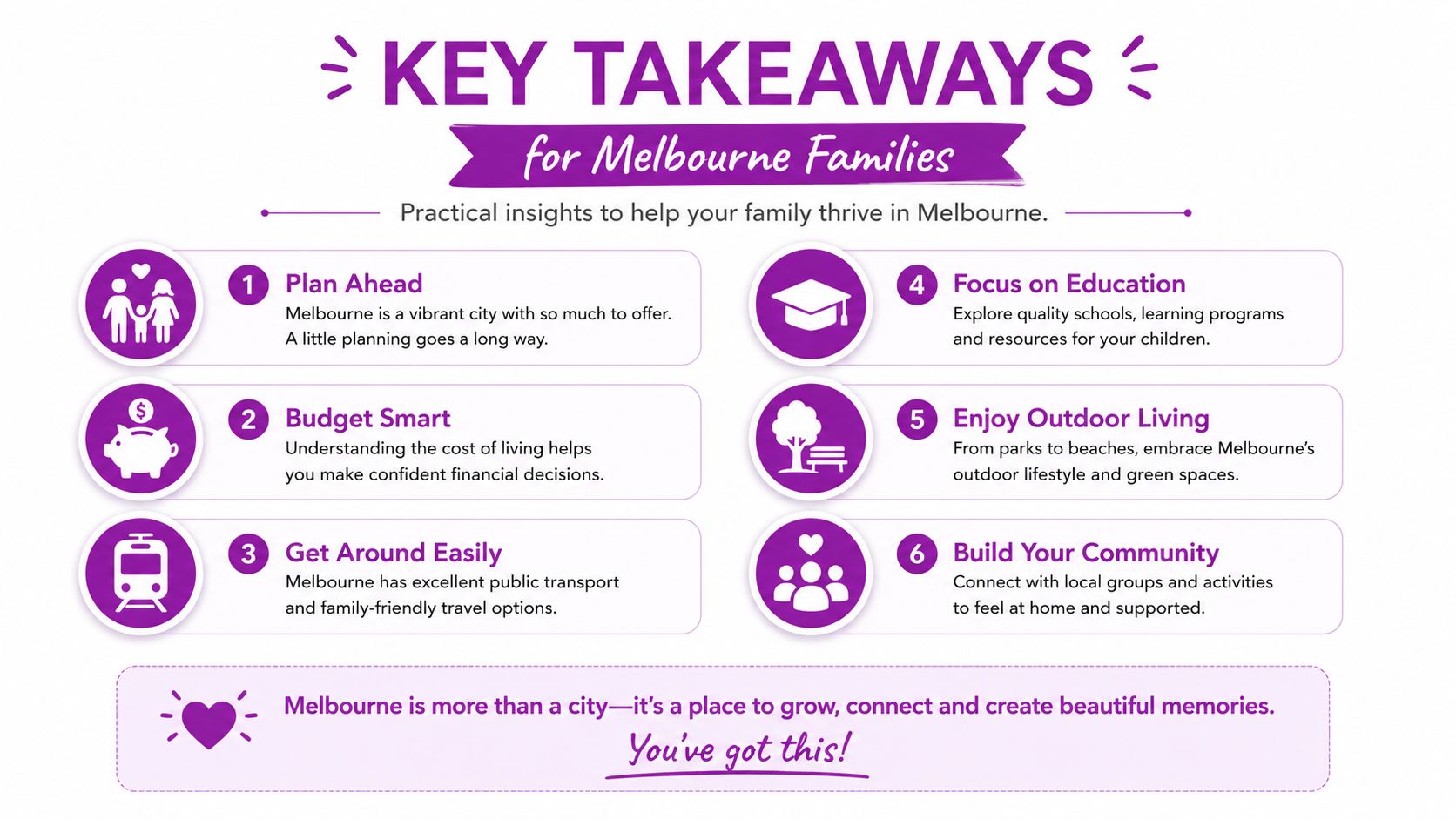
Key Takeaways for Melbourne Families
Health and human development is easier to support when you focus on the whole child. The AEDC domains give families a practical map, but your child's relationships, culture, interests and daily experiences give that map meaning.
This week, you could:
- Notice all five domains: Write down one strength in movement, social connection, emotional regulation, thinking and communication.
- Tour with purpose: Ask an early learning service about documentation, project work, educator-to-child ratios, family communication and support for individual needs.
- Protect a daily connection: Set aside time for shared reading, conversation or open-ended play, even when the routine is busy.
- Use local support: Attend maternal and child health consultations, visit a library, join a playgroup or explore a nearby park.
- Trust your observations: You know your child's patterns. If something feels different or difficult, ask a GP, nurse or paediatric professional for guidance.
The national picture shows why this attention matters. In the 2024 AEDC, 52.9% of children were on track across all five domains, while 23.5% were developmentally vulnerable in at least one domain. The 2024 AEDC data and reports help explain why early support should be thoughtful, local and inclusive.
If you're comparing childcare, kindergarten or pre-PREP options, download a milestone checklist, prepare your questions and book a visit. A calm conversation now can help you choose support that respects your child's strengths and builds confidence for the next step.
Kids Club Early Learning Centre offers nurturing programs for children from six weeks to six years, with VIT-registered educators, Reggio Emilia-inspired learning, kindergarten and pre-PREP options across Melbourne's south-east. Visit Kids Club Early Learning Centre to explore the programs and arrange a centre visit.