
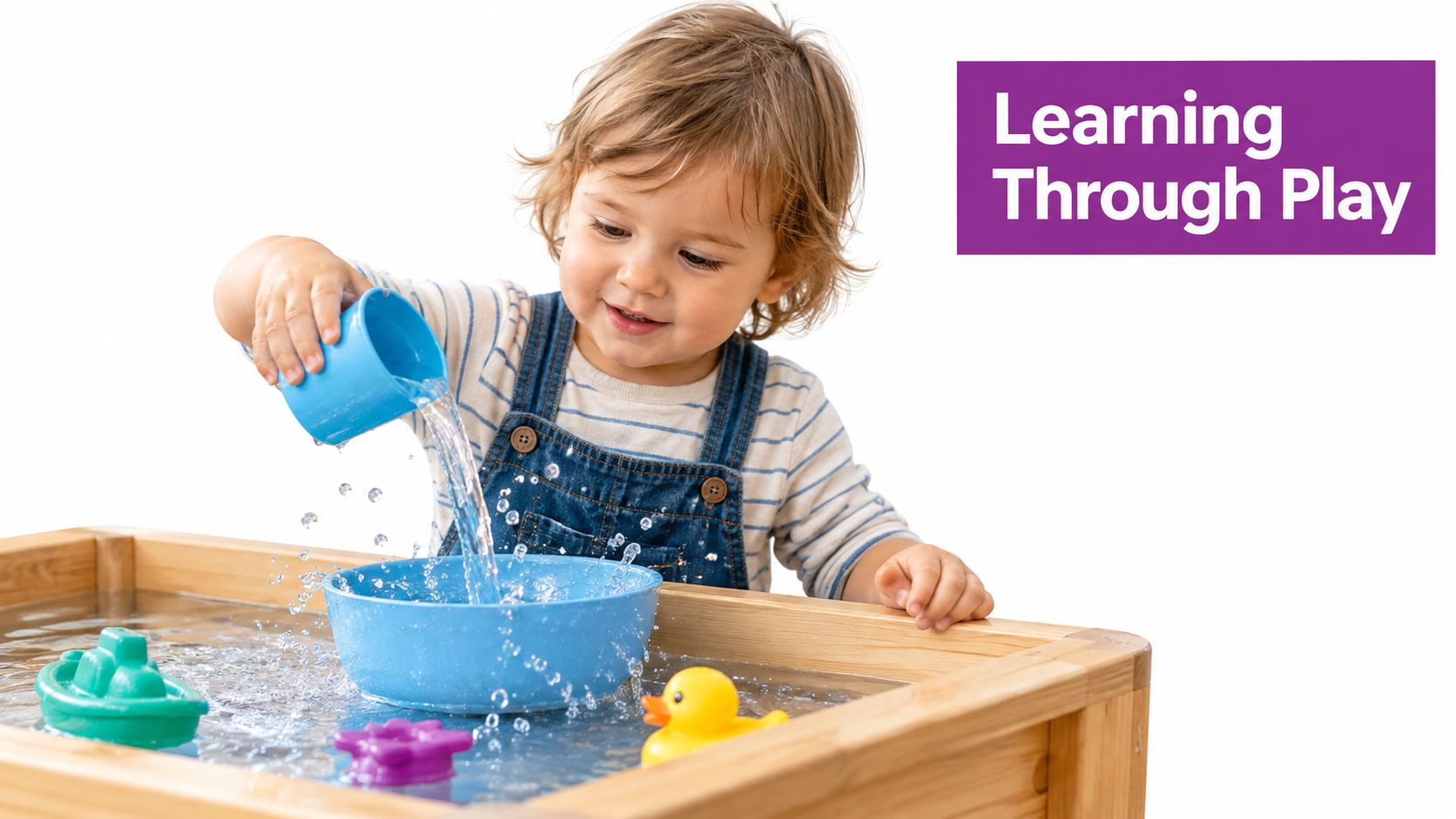
Your toddler's just tipped the same cup of water for the tenth time, watched it spill, filled it again, and now she's trying to catch it in her other hand. It's tempting to step in with the answer, or with a towel. Stay close for another minute, though, because that messy, repetitive experiment is exactly where discovery learning begins, and understanding what an adult does next makes all the difference.
What Discovery Learning Looks Like at Home
She pours, pauses, and frowns when the water disappears through her fingers. She tries a cup instead. She drops in a leaf, presses it down, and watches it pop back up. No one has explained floating, volume, or cause and effect, yet she's testing all three with complete concentration.
That's the heart of discovery learning. Your child builds understanding by exploring, asking questions with her actions, and testing an idea rather than passively receiving an answer from you. The learning sticks differently because she's the one who noticed the puzzle in the first place.
Where Play Ends and Discovery Begins
Left entirely alone, that same water play may stay at splashing. Add a curious adult nearby and it changes. You might say, "You filled the small cup really quickly. What happens with the big one?" You've offered no answer, but you've handed her a new question and words to think with.
That gentle involvement is the difference between unstructured play and intentional discovery learning. In the second version, an educator or parent observes what interests your child, chooses what to offer next, and uses conversation to stretch the thinking a little further.
Your child leads the investigation. You help her notice what her investigation is telling her.
Think of a baby shaking a rattle, then shaking a soft toy and looking puzzled by the silence. Or a four-year-old who insists a heavy rock will float because a big boat does. Each moment holds a small theory. Your role isn't to correct it straight away. It's to keep the testing going, safely and with interest, so your child revises the theory herself.
What to Look For in That Moment
- A question in action: Repeated pouring, dropping, stacking, or opening and closing shows your child is checking whether the result stays the same.
- A change of strategy: Swapping cups, turning a puzzle piece, or asking a friend to hold something signals problem-solving, not random play.
- Talk that explains: Even simple words like "gone," "more," or "too heavy" show your child connecting language to what she's discovered.
You don't need special equipment at home. Containers, cardboard, cushions for climbing, and objects from the garden all work. What matters is your child's freedom to try, your patience while she repeats, and a well-timed question that opens the next idea.
The Evidence Behind Discovery Learning
At a centre tour in Melbourne's east, a father watches his daughter spend ten minutes balancing stones on an upturned crate. "She's clearly busy," he admits, "but is she learning anything that counts?" That question sits behind most enrolment conversations, and Australian families can answer it with local evidence rather than reassurance alone.
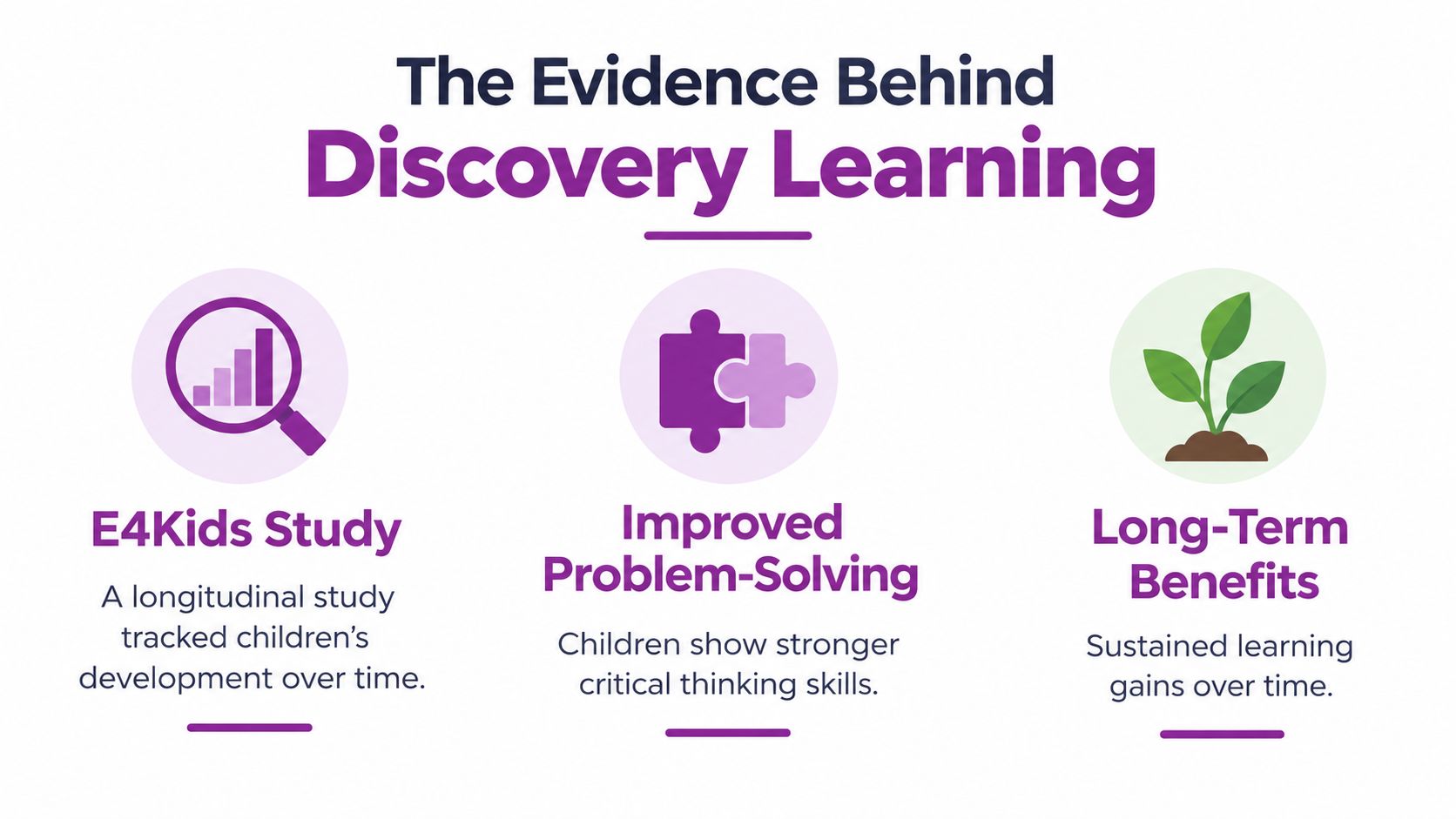
Australia's longitudinal E4Kids study intensively examined approximately 2,600 children in Victoria and Queensland between 2009 and 2014. The E4Kids linked analysis then tracked those children into school and found that emotional aspects of the early childhood environment predicted outcomes in mathematics, science, English, effort, behaviour, grades and NAPLAN performance from Year 1 through Year 7.
Why Relationships Sit Underneath the Exploring
Read that finding slowly, because it explains what educators do while your child plays. Inquiry doesn't happen in a cold or hurried room. Children take intellectual risks, guessing, testing, and being wrong in front of peers, when educators know them well and respond warmly. The relational climate around the play is what carries the learning, and skilled educators build that climate deliberately.
Australia's Early Years Learning Framework gives this approach its formal shape. It treats play as both a context and a process through which children ask questions, solve problems, test ideas, and develop critical thinking. The framework also names enquiry, experimentation, hypothesising, researching, investigating, and problem-solving as processes children build through these experiences.
Those habits feed into critical and creative thinking as children grow. A child who has practised predicting what a ramp does to a ball is rehearsing the same mental move she'll use later in science and maths, just with concrete materials instead of symbols on a page.
Attendance Alone Is Not Enough
Here is the part that should shape how you choose a service. Around 96% of Australian children access at least one year of early childhood education before school, yet approximately one in five still enters school developmentally vulnerable, according to the same submission. Participation, in other words, is widespread. Quality is where children diverge.
Practical rule: Don't ask only whether a program offers play. Ask what the adults do during that play, and what happens next because of what they noticed.
The quality and nature of everyday experiences remain decisive. For Victorian families, that means favouring programs where responsive relationships sit alongside purposeful exploration, careful observation, and educator-guided inquiry.
A quick way to test quality on a tour is to listen. You'll hear educators wondering aloud, children explaining their thinking, and questions that stay open long enough for a child to answer with actions, words, or a drawing.
Discovery Learning vs Direct Instruction vs Free Play
These three approaches often get tangled together, which is why discovery learning attracts both unfair criticism and exaggerated praise. Separating them helps you see what you're choosing. Each one has a place, but they ask very different things of your child and of the educator.
Direct instruction puts the adult in front. The educator demonstrates, explains the correct method, and children practise it. That clarity suits specific skills, such as how to hold scissors safely or how to form a letter. Used for everything, though, it gives young children few chances to reason for themselves.
Unstructured free play sits at the other end. Children choose freely and adults mainly supervise. It's valuable for imagination, friendship, and letting off steam, and every good program protects time for it. Without adult involvement, however, children may repeat what they already know rather than build new understanding.
Comparing Three Approaches to Early Learning
| Approach | Who Leads | Educator Role | Child Gains |
|---|---|---|---|
| Free play | Child | Supervises for safety | Independence, social play, imagination |
| Discovery learning | Child, with educator guidance | Observes, questions, provides materials, documents | Deeper understanding, reasoning, persistence |
| Direct instruction | Educator | Demonstrates and explains | Specific skills, clear correct methods |
The Middle Ground Works Hardest
Discovery learning occupies the space between those poles. Your child directs the exploration, while the educator steers it. She decides which materials appear on the table, when to model a technique, when to stay silent, and when a question could lead to the next step.
Australian evidence suggests that open-ended discovery can deepen understanding, while modelling may produce more immediate learning, and the strongest approach combines both, as summarised in the Evidence for Learning play-based learning guidance. In a Melbourne study across 16 early learning centres described in that guidance, children appeared to learn more during modelled play, while open-ended and purposefully framed experiences produced deeper understanding and enabled children to lead peers.
Child-led doesn't mean adult-free. It means the adult's work is mostly invisible until you know where to look.
Watch for that balance in practice. An educator might briefly show children how a pulley lifts a bucket, then step back while they test what else it can lift. She'll note who's predicting, who's copying a peer, and who needs a lighter load or a harder challenge tomorrow.
So when a centre describes itself as play-based, ask which kind of play dominates the day. You're listening for intentional guidance woven through child-led exploration, with short bursts of direct teaching where a skill needs demonstrating.
Discovery Learning Activities for Infants to Preschoolers
Age changes what discovery looks like, but the educator's underlying rhythm stays surprisingly consistent. Once you can spot that rhythm, a shelf of everyday objects stops looking random and starts looking planned.
The Victorian Department of Education's evidence paper on integrated teaching and play reports that effective play-based learning involves people, materials, and the environment. It recommends a repeating cycle where educators observe an interest, offer manipulable materials, ask open questions, allow children to test and revise explanations, and record learning evidence for planning.
Infants Explore With Their Senses
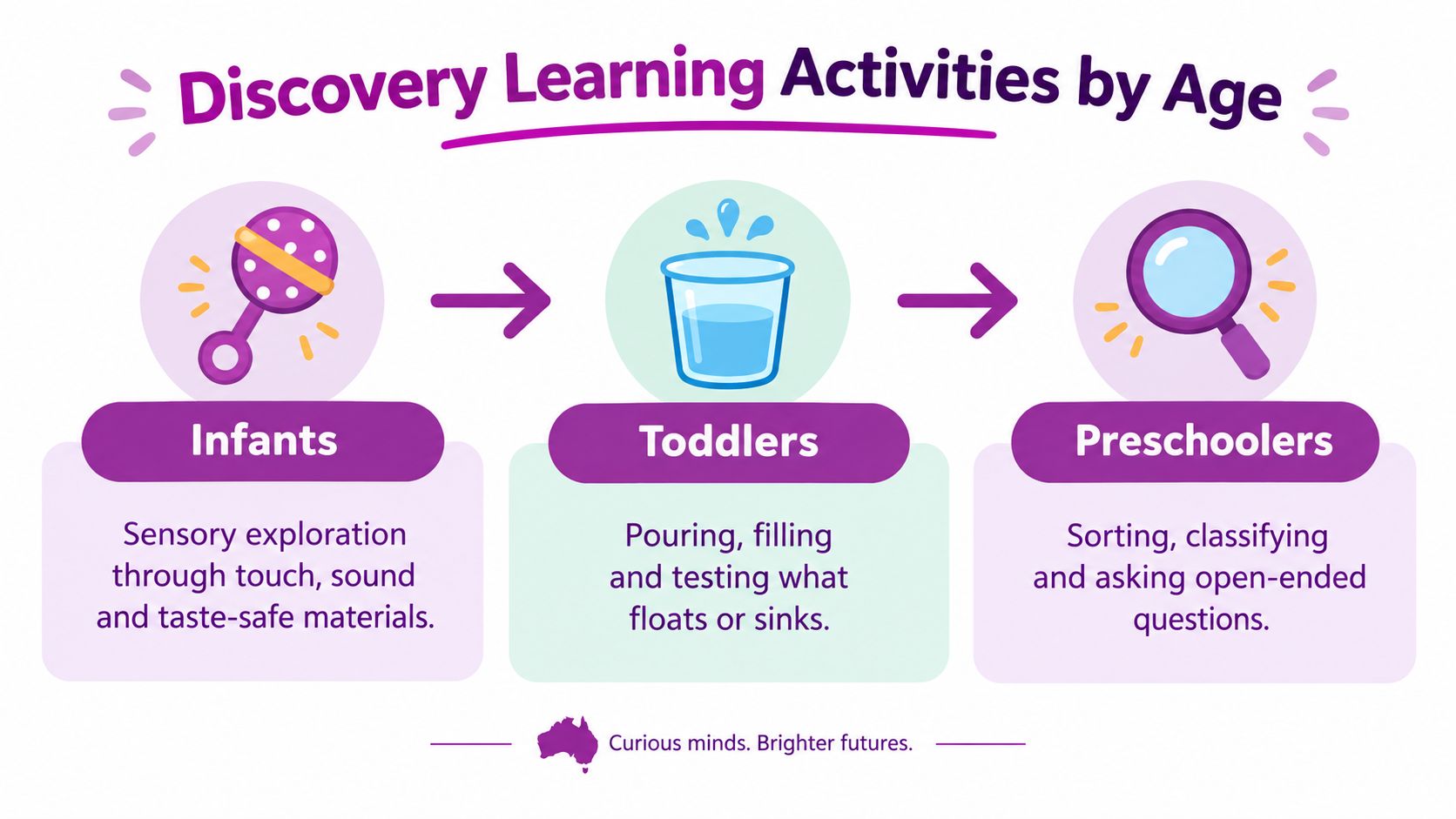
For babies, discovery is physical and concrete. Comparing textures, sounds, movement, and object permanence matches their emerging communication and motor skills. An educator places a scarf partly over a ball, watches whether your baby searches for it, and adjusts the challenge next time.
Try this at home with safe, clean household items that feel and sound different. Narrate, follow your baby's gaze, and stop when she turns away. Her attention, not your plan, sets the length of the investigation.
Toddlers Test How Things Behave
Toddlers want to know what materials do. An educator might set out water, funnels, tubes, and containers, then document children's predictions about flow. Along the way she introduces vocabulary such as "full," "empty," "faster," and "slower," attaching words to experiences children are already having.
Materials that can be used many ways, explored through loose parts play, suit this age beautifully. Lids, boxes, fabric, and natural objects invite sorting, transporting, filling, and tipping. Your toddler isn't making a mess for its own sake. She's gathering data.
Preschoolers Explain and Represent
- Predict first: Educators ask what children think will happen before the test begins, making the result meaningful.
- Explain the reasoning: Children describe why they think the tower fell or the plant leaned toward the window.
- Represent findings: Drawing, building, or dictating a sentence lets children record discoveries and revisit them later.
- Collaborate: Testing an idea with peers exposes children to different theories and practises negotiation.
Notice how the cognitive demand rises while the joy stays. Your preschooler still explores with her hands, but now she's also arguing a case, listening to a counter-idea, and changing her mind based on evidence. Those are school skills, learned through materials that make sense to a four-year-old.
How Discovery Learning Became Intentional Practice in Victoria
Victorian parents sometimes wonder whether discovery learning is a current fashion that will pass. It isn't a recent invention here. It grew through documented professional work that treated inquiry as something educators could plan, assess, and improve together.
The Victorian Curriculum and Assessment Authority created the Inquiry to Implementation project to support the Victorian Early Years Learning and Development Framework for children from birth to eight years, as recorded in the Monash University review of the Inquiry to Implementation project. That independent review examined practice across nine multidisciplinary Victorian networks and identified four dominant themes across all networks, plus seven additional themes in particular networks.
What Educators Actually Changed
The review documented shifts in assessment practice, professional relationships, and practitioner learning, alongside promising practices, successes, and barriers. That detail matters because it shows inquiry being tested across multiple professional communities, not confined to one centre or one charismatic teacher's style.
In this model, educators observe children's interests and formulate questions with them. They document what's happening, revisit investigations over days or weeks, and use collaboration with colleagues to extend children's thinking further. A passing fascination with shadows becomes a planned inquiry with torches, drawings, and increasingly precise language.
A credible discovery program can show its workings. If nobody can explain what was observed, planned, and revisited, the discovery label is doing more work than the teaching.
Why the Birth to Eight Span Matters
Because the Victorian framework stretches from birth to eight years, inquiry deliberately crosses the move from early childhood settings into school. Your child isn't expected to stop investigating when she reaches Prep and start learning in an entirely different way. Kindergarten and school-readiness programs can build on the same habits of questioning and evidence-testing.
For families, that history offers a useful benchmark. Strong discovery learning should show educator planning, reflective assessment, and sustained inquiry sitting alongside children's curiosity, collaboration, and creative problem-solving. If a service can walk you through that chain for a real project, you're seeing intentional practice rather than a slogan.
How Kids Club ELC Brings Discovery Learning to Life
At Kids Club Early Learning Centre, discovery learning takes shape through a Reggio Emilia-inspired approach that encourages inquiry, creativity, and collaboration. Children investigate open-ended materials, follow genuine questions, and revisit ideas with educators who treat their theories seriously.
Who Guides the Discoveries
Experienced, VIT-registered teachers lead the learning experiences, planning environments and provocations from what they observe in each group of children. Weekly professional music and sports curricula run at no extra cost, adding rhythm, movement, and physical problem-solving to the week's exploring.
The physical setting carries part of the teaching load too, an idea explored in the environment as the third teacher. Purpose-built spaces include dedicated environments for infants and toddlers from six weeks to three years, plus engaging rooms for children aged three to six. That separation lets babies explore at floor level safely while older children tackle construction, dramatic play, and longer projects.
This short video shows the kinds of spaces and experiences children move through during a typical day.
From First Exploration to School Readiness
Government-funded three-year-old kindergarten and the four-year-old pre-PREP program build foundations in literacy, numeracy, social-emotional learning, and curiosity-driven exploration. Numeracy might grow from comparing how many blocks balance a scale, while literacy grows as children dictate captions for photographs of their investigations.
Transitions stay smooth because the pedagogy doesn't change abruptly between rooms. Your child meets familiar rhythms of observing, questioning, testing, and representing, with the challenge level rising as she grows. Families across Springvale South, Dandenong North, and Ferntree Gully can expect that same approach, adapted by educators who know their local community.
Questions to Ask When Choosing a Discovery-Based Childcare
Many parents leave a tour feeling warmly reassured but still unsure what their child learned that week. You're not alone in that gap, and naming it on a tour is entirely reasonable.
A study of 48 parents of preschool children found that 77.8% agreed they understood how play supports learning, yet 33.8% agreed and 28.4% strongly agreed that they wanted to know more, as reported in Children Australia research on parent understanding of play-based learning. Reassurance alone doesn't close that gap. Specific questions do.
Questions That Reveal Real Practice
- How do you observe and document learning: Ask who records observations, how often, and how those records change what happens next week.
- When do educators step in: A thoughtful answer describes watching first, then deciding whether a question, a material, or a brief demonstration will help most.
- What does progress look like here: Listen for examples of children revising ideas, persisting longer, explaining reasoning, or using richer vocabulary.
- How will you tell me: Ask how learning is shared with families and whether you can contribute observations from home.
Evidence You Can Comfortably Request
Ask to see learning stories that connect a moment of play to an outcome, written in language you can follow. Photographs become far more useful when they carry educator interpretation explaining what your child was testing and what she understood. A photo of block play alone tells you little. A note about her third attempt to bridge a gap tells you a great deal.
If a centre welcomes these questions and reaches for real documentation, that's a strong sign. Vague answers about children learning through play, with nothing to show you, deserve a gentle follow-up.
Also ask how experiences connect to Victorian kindergarten learning outcomes and how educators support the move into school. Strong services answer plainly, show examples, and invite your knowledge of your child into the planning. Take this list on every tour, including ours, and compare the quality of the answers you receive.
Frequently Asked Questions About Discovery Learning
How Do I Know It Is Preparing My Child for School
Look for growth in the foundations school demands. Discovery experiences build literacy through talk and representing ideas, numeracy through comparing and measuring, plus self-regulation and communication through collaborative problem-solving. Ask for learning stories linked to Victorian kindergarten outcomes so you can watch that progress accumulate, rather than trusting a general promise.
Is It Just Unstructured Play With a Fancy Name
No, and you're right to test the claim. Credible discovery learning includes intentional educator guidance, planning, and assessment wrapped around child-led exploration. If educators can't show you observations, planned provocations, or revisited investigations, you're probably looking at unstructured play wearing a label it hasn't earned.
What if My Child Prefers Being Told What to Do
Some children feel safer with clear instructions, and good educators respect that starting point. They'll offer more modelling and smaller choices at first, then gradually widen the space for independent decisions. Discovery learning adapts to temperament, so your cautious child builds confidence at a pace she can manage.
If you'd like to see guided discovery in action, from sensory play for babies to inquiry projects in our funded kindergarten and pre-PREP rooms, book a tour and bring your hardest questions with you. Our educators will happily show you real documentation of children testing ideas and explain exactly what we'd plan next for your child. Start by visiting Kids Club Early Learning Centre to find your nearest centre in Springvale South, Dandenong North, or Ferntree Gully and arrange a time that suits your family.