
At 6.30pm, the toddler is tired, dinner is going cold, and the floor has disappeared under wooden blocks, dress-ups, board books and one lonely shoe. You're trying to start the bedtime routine while searching for the other shoe, clearing a path to the cot and negotiating over which books are allowed upstairs. The room isn't dirty. It's asking too much of everyone.
Good toddler room organisation isn't about creating a picture-perfect playroom. It solves practical problems: fewer blocked pathways, safer access to materials, easier transitions, less visual noise and a reset you can manage when you're exhausted. It also changes how children use the room, because the placement of furniture and resources affects whether they can move, choose, settle and help restore the space.
The answer isn't a premium storage haul or a decorating weekend followed by a slow return to chaos. Treat the room as a working environment. Zone it by activity, choose storage that's accessible but anchored, rotate toys instead of displaying everything, and use short routines that keep the system functional.
The End-of-Day Toy Avalanche and What Good Organisation Really Solves
The toy avalanche usually starts innocently. A toddler pulls one basket from a shelf, tips it out, finds a puzzle piece, moves to the cars, opens a drawer and drags a blanket into the middle of the room. By dinner, every activity has merged into one sprawling mess. At bedtime, you're not tidying a room. You're trying to recover enough floor space to move safely through it.
A parent might spend the evening hunting for pyjamas, rescuing books from the dress-up box and returning blocks to a container that's already too full to close. The next morning, the same room creates fresh friction. A shoe is buried, the favourite cup is missing and the toddler becomes upset before the day has properly started.
Practical rule: Organise for the moments when your child is tired, rushed or overstimulated, not for the five minutes after you finish styling the shelves.
A useful room gives each activity a home and each pathway a purpose. The child can see a small selection of resources, reach suitable materials without climbing, and return to a familiar quiet spot when the room feels too busy. You can supervise movement, move through the room with a laundry basket or support a transition without stepping over obstacles.
That doesn't mean every toy needs a matching container. It means the room should answer four questions quickly:
- Where does this activity happen?
- What can my toddler access independently?
- What must stay out of reach or secured?
- What needs to be cleared before sleep, meals or care routines?
The best system is forgiving. If putting away a set of animals takes a complicated sorting ritual, it won't survive a difficult afternoon. A broad category, a picture label and a low, stable container are more useful than a beautifully colour-coded arrangement that demands adult perfection.
Start with the room's behaviour, not its appearance. Notice where your child repeatedly gets stuck, where toys collect, where adults lose sight of play and where transitions become arguments. Those observations will tell you more than a basket catalogue ever will.
How to Audit the Room Before You Buy a Single Basket
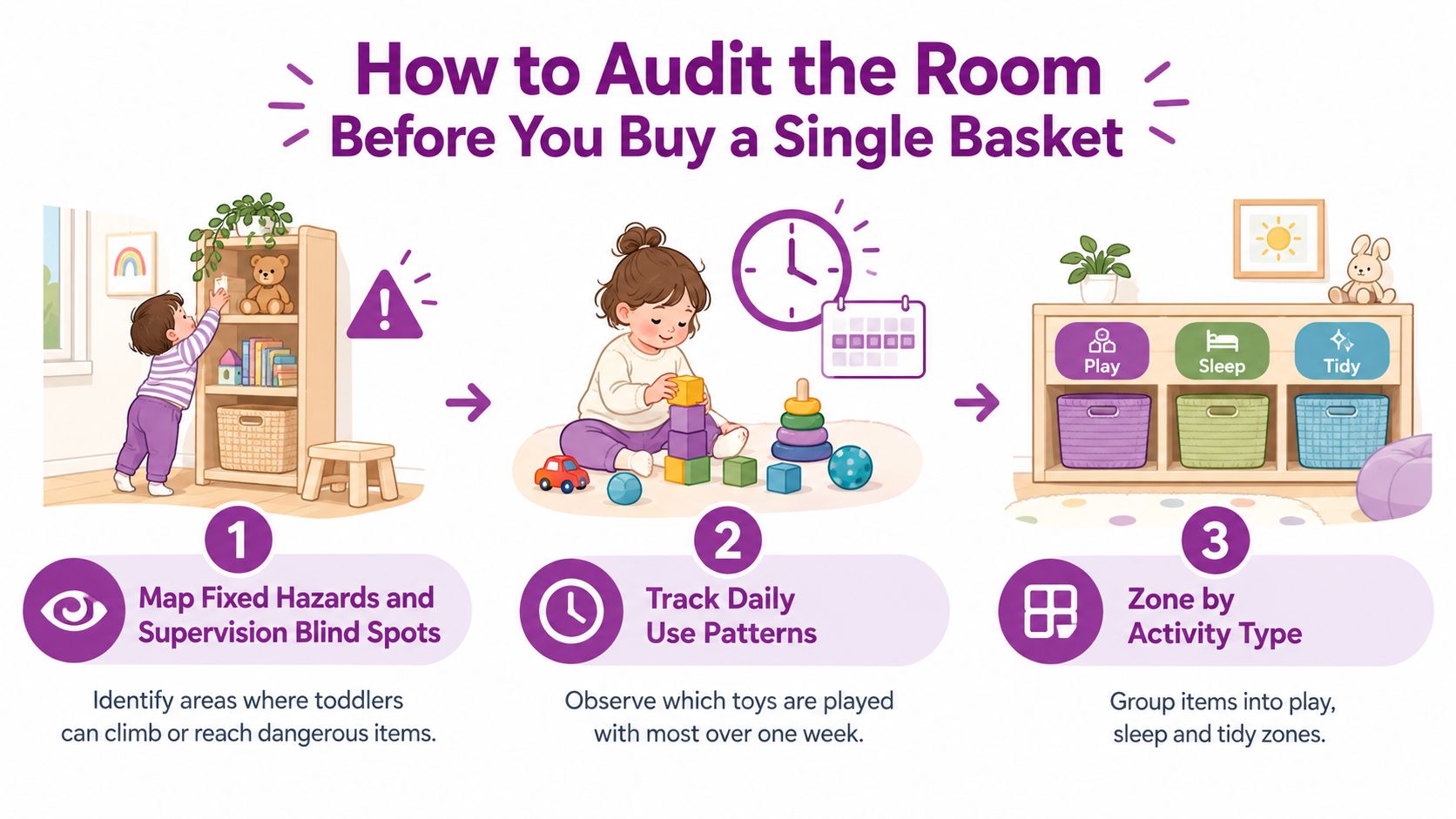
Shopping first is how families end up with storage that occupies the floor, blocks the window and still leaves the important toys scattered. Audit the room while it's being used, then buy only what fixes a real problem.
Start with hazards and blind spots
Use a sheet of paper and draw the room as it is. Mark the door, windows, cot or bed, change table, built-in cupboards, power points, heaters, stairs and any furniture that can't move. Then mark corners, dark spaces, narrow gaps and areas where a toddler could climb, pull, hide or reach something restricted.
Victorian premises guidance requires services to identify risks, put controls in place and plan supervision deliberately. It also recognises movable shelving with children's equipment as compatible with play areas when it doesn't obstruct usable space. That gives families a useful principle: flexible furniture is helpful, but only when it leaves clear access and doesn't create a new hazard. Read the Victorian premises guidance for long day care and kindergarten before copying a childcare layout into your home.
Track how the room actually works
Watch one ordinary morning, one afternoon and one bedtime. Don't judge the mess. Record what happens.
- Traffic: Which routes does your toddler use repeatedly?
- Friction: Where do toys, clothing or books pile up?
- Supervision: Which areas disappear from your view when you're changing, feeding or packing?
- Access: Which resources does your child reach for, and which ones cause dumping?
- Transitions: What needs to be close to the door, cot or change area?
Write down three to five friction points. You may discover that the problem isn't a lack of storage. It might be that the book basket sits beside the noisy construction toys, or that the clothes drawer is too far from the change area.
Draw zones, then test the plan
Sketch broad activity areas over the floor plan before buying furniture. Leave an uninterrupted route through the room, keep care routines accessible and place the quietest areas away from the most active play.
Finally, walk through the layout from a toddler's height. Can you see across the room? Can your child move between areas without crossing a care space? Does a shelf narrow the exit? Could a low piece of furniture become a step towards a window?
Risk assessment isn't a one-off decorating exercise. Recheck the room after adding furniture, changing routines or introducing equipment. Toddlers develop quickly, and a harmless-looking arrangement can become a climbing invitation.
Four Zones That Cover Almost Every Toddler Room
A toddler room doesn't need a separate room for every interest. It needs a few recognisable zones that reduce competition between activities. Keep the sleep area visually calm, reserve an open rectangle for movement, place books somewhere protected from high-energy play and group self-care materials around the routines that use them.
The 3.25 square metres of unencumbered indoor space per child required in Australian early-childhood settings is a useful planning benchmark, even for families arranging a home room. Victorian requirements define this as clear usable space, so fixed fittings and obstructions do not count towards the allowance. For 12 children, a compliant service room would need at least 39 square metres before furniture, sleep arrangements, storage and circulation are considered, according to the Victorian regulatory requirements fact sheet. At home, the lesson is clear: do not fill every spare metre with equipment.
Sleep zone
Make the cot or toddler bed the visual calm point. Keep the wall nearby simple, reduce loose items and avoid storing exciting toys beside the sleep space. A small selection of sleep books or a familiar comfort item is enough.
Active play zone
Toddlers need an unbroken section of floor for crawling, carrying, dancing, building and recovering from a tumble. A corner packed with furniture won't provide the same freedom as a clear rectangle. Keep portable equipment movable, and don't place a seated care area across the main movement route.
Reading and retreat zone
Use a small basket of books, a floor cushion or firm soft seating, and a rug where appropriate. Put this zone away from the loudest play resources. A reading area beside a full vehicle shelf is technically organised, but it won't feel quiet for long.
Self-care zone
Keep clothes, nappies, wipes and daily care items close to the change table or dressing area, with adult-only supplies secured. Picture labels can help toddlers identify what belongs in a drawer, but independence never overrides safe storage.
The environment as the third teacher guidance from Kids Club Early Learning Centre reflects this broader idea, where the room supports movement, choice and learning rather than acting as a backdrop.
| Zone | Purpose | What belongs here | Keep out | Supervision note |
|---|---|---|---|---|
| Sleep | Rest and predictable settling | Cot or bed, limited sleep books, comfort item | Noisy toys, loose climbing equipment | Keep the area easy to scan |
| Active play | Movement and gross-motor exploration | Open floor, portable movement resources, blocks | Sharp-edged furniture and cluttered baskets | Preserve a clear route across the room |
| Reading and retreat | Focus, connection and regulation | Small book rotation, cushion, soft furnishings | High-stimulation toy displays | Keep it visible, not hidden behind shelves |
| Self-care | Dressing and daily routines | Clothes, care items, visual cues | Restricted products and climbable storage | Keep adult tasks close and secure |
Storage That Is Accessible but Actually Safe
“Make everything reachable” is incomplete advice. A toddler who can reach a shelf may also pull it, climb it, sit on it or use it to reach a window. Independence needs a safe structure around it.
Australian safety guidance now places clear emphasis on anchoring covered furniture. From 4 May 2025, Australia's mandatory information standard includes warnings and anchoring advice for covered furniture such as bookcases, wardrobes, chests of drawers and entertainment units. The RMIT furniture safety research project also points families towards low-set furniture with a broad, stable base, heavy items stored low, drawer locks and anchoring to walls or floors.
Use the accessible but anchored model
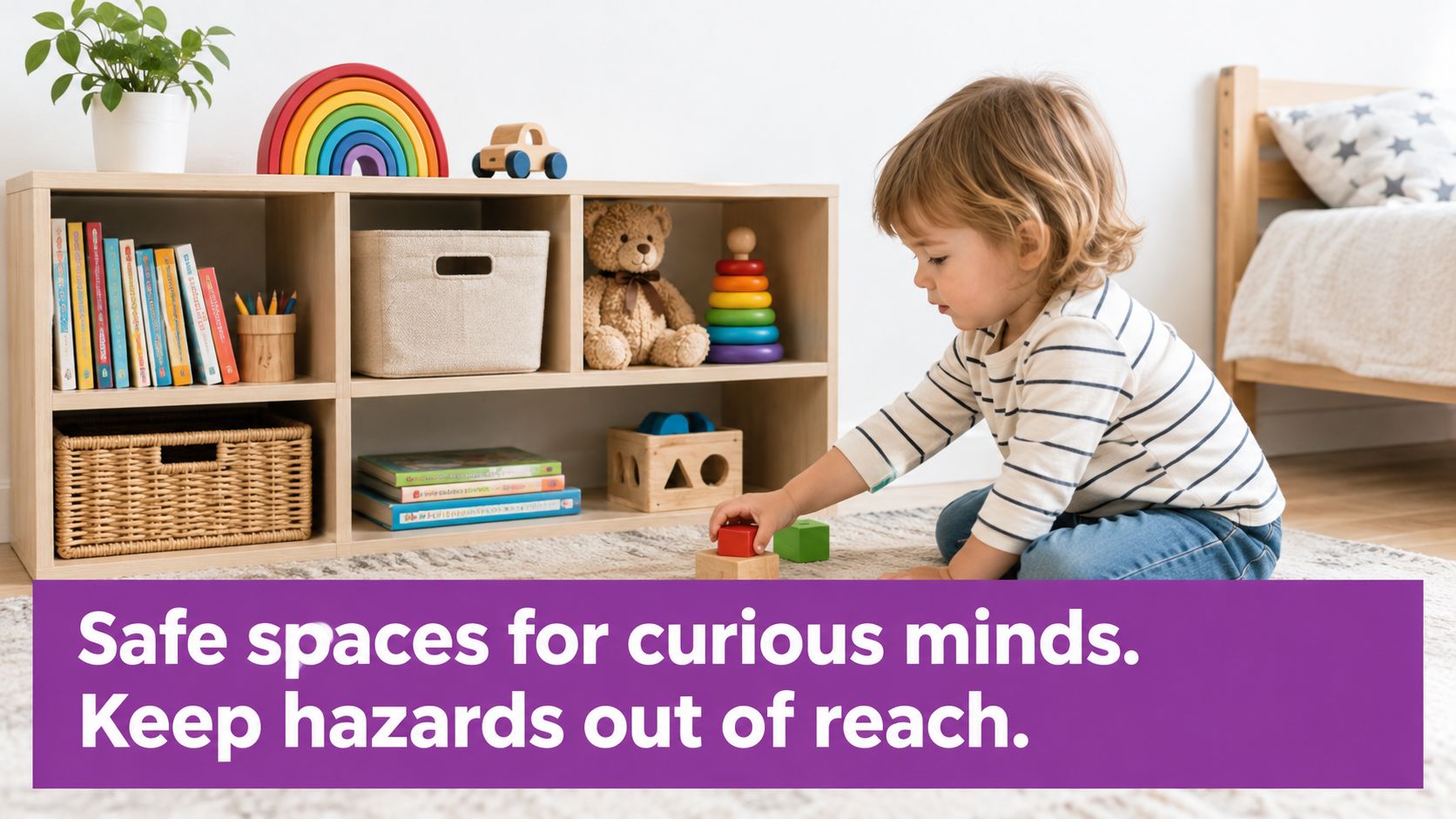
Choose low, stable shelving with a broad base, then secure it according to the manufacturer's instructions. Keep lightweight, suitable materials at toddler height. Put heavier objects low, and don't display attractive toys on top of furniture. A child should never need to climb to reach the item you want them to use.
For each shelf or drawer unit, run this check:
- Stability: Can it tip when pulled from the front?
- Anchoring: Is it secured to an appropriate wall or floor point?
- Load: Are heavy items stored low?
- Drawers: Could multiple drawers open and create a ladder?
- Reach: Are restricted items outside your toddler's access?
- Path: Does the unit narrow a movement route or block supervision?
Anchor shelves before filling them. The exact installation method depends on the wall structure and the product, so use the supplied hardware or seek qualified advice rather than improvising with unsuitable fixings.
If a toddler could stand on it, sit on it or pull it over, it doesn't belong at the edge of a play zone.
Open baskets still have a place. They support choice when they're stable, light enough to handle safely and limited to materials suited to the child's stage. The mistake is treating every low basket, cube unit and open shelf as automatically safe. Storage should invite reaching, not climbing.
Check wardrobes, chests of drawers and entertainment units first. These are often treated as background furniture even though toddlers may pull on handles, open drawers or climb onto low surfaces. Reassess the arrangement when your child begins cruising, climbing or moving from a cot to a bed. The safe layout for a younger baby won't necessarily remain safe for a mobile toddler.
A Toy Rotation System That Survives Real Life
Toy rotation fails when it becomes another demanding household project. Use a simple system that reduces choices without requiring a perfect inventory.
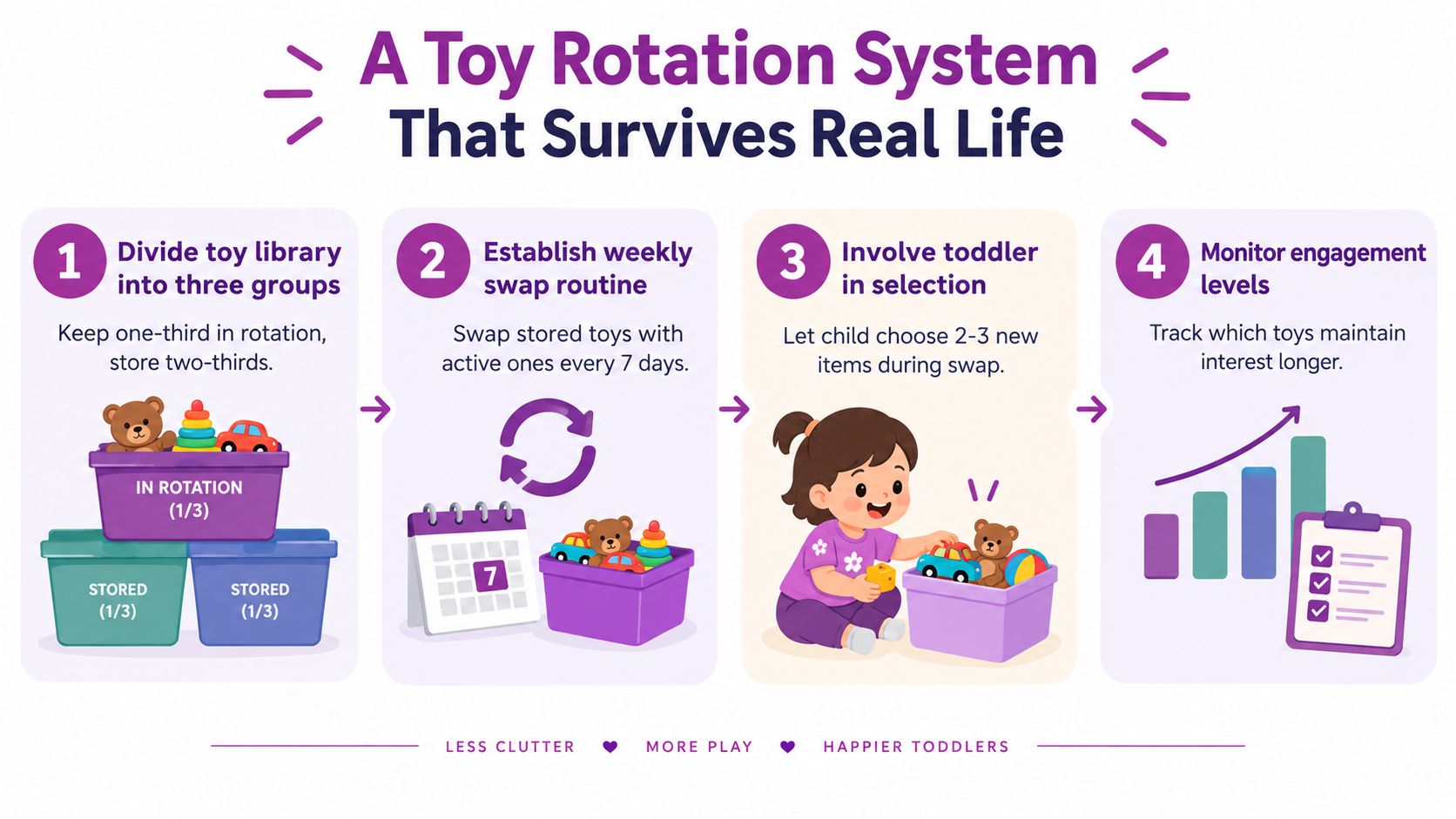
Start by dividing the toy library into four broad groups. Keep one group available, store the other three in a dry, adult-managed place, and include a small curiosity shelf with only a few new or less familiar items. Rotate once a week if that fits your household. If weekly swaps are unrealistic, use a consistent rhythm linked to an existing task, such as changing bedding.
Choose by function, not by brand:
- Movement: Balls, tunnels or portable gross-motor equipment.
- Construction: Blocks, stacking materials and simple loose parts.
- Pretend play: Animals, vehicles, dolls or dress-up pieces.
- Fine-motor and focus: Puzzles, posting toys, drawing materials or books.
A picture label on each container helps toddlers identify where materials belong, especially before they can read. Keep the stored bins somewhere adults can reach but children can't turn them into a climbing route. Return a group to storage before bringing out its replacement.
Use four questions when deciding what stays out:
- Is it safe for the current stage?
- Does the child choose it without repeated prompting?
- Does it serve the purpose of the zone?
- Does it support the kind of play your child is currently practising?
If something hasn't been touched for a month, store it separately rather than letting it occupy prime space. That doesn't mean it must be discarded. It may become useful again later, suit a different child or work better in a supervised activity.
For the toddler who empties every bin, reduce the number of items in each container and use open trays for one activity at a time. For siblings, give each child a small personal area while keeping shared resources grouped by activity. If you never rotate because the week gets away from you, swap only one group. A partial system is still better than a room where every resource competes for attention.
The Australian research on movement environments doesn't support one universal winning layout. Research involving 68 toddlers aged 1.0 to 2.9 years across 11 childcare services found associations between environmental characteristics and sedentary behaviour, while a separate outdoor redesign added natural elements, inclines, levels and an arched bridge and reported more varied physical activity after the change. The practical takeaway is to observe your own room: can children move between zones, and do they spend time sitting, standing, moving and negotiating space?
Ideas for open-ended materials and flexible play can also be found in the loose parts play approach used by Kids Club Early Learning Centre, but keep the amount manageable and the storage anchored.
Designing for Sensory Load, Regulation and Neurodivergent Kids
A room can be tidy and still feel loud. Bright displays, hard surfaces, toy shelves packed with colour and overlapping sounds create competition for attention. That affects neurodivergent children particularly, but a tired toddler can also need less visual and auditory demand.
Recent Australian research on infant and toddler classrooms reports that low couches and cushioned areas produce less noise than hard furniture. A 2025 UNSW discussion of preschool design for neurodivergent children highlights grouping activities with similar sensory qualities, using clear visual cues and creating small retreats. The useful home application is not to create a clinical room. It's to stop making every part of the room compete at once.
Separate sensory qualities
Place messy or tactile play together, keep active movement away from reading, and use rugs or soft furnishings where safe to reduce echo. Don't display every toy. Closed storage for some materials can create visual quiet while low, open access remains available for a carefully chosen selection.
Create a small retreat with a cushion, two books and perhaps a soft toy. It should remain visible to an adult, easy to leave and free from loose clutter. It isn't a punishment space. It's a predictable place to pause.
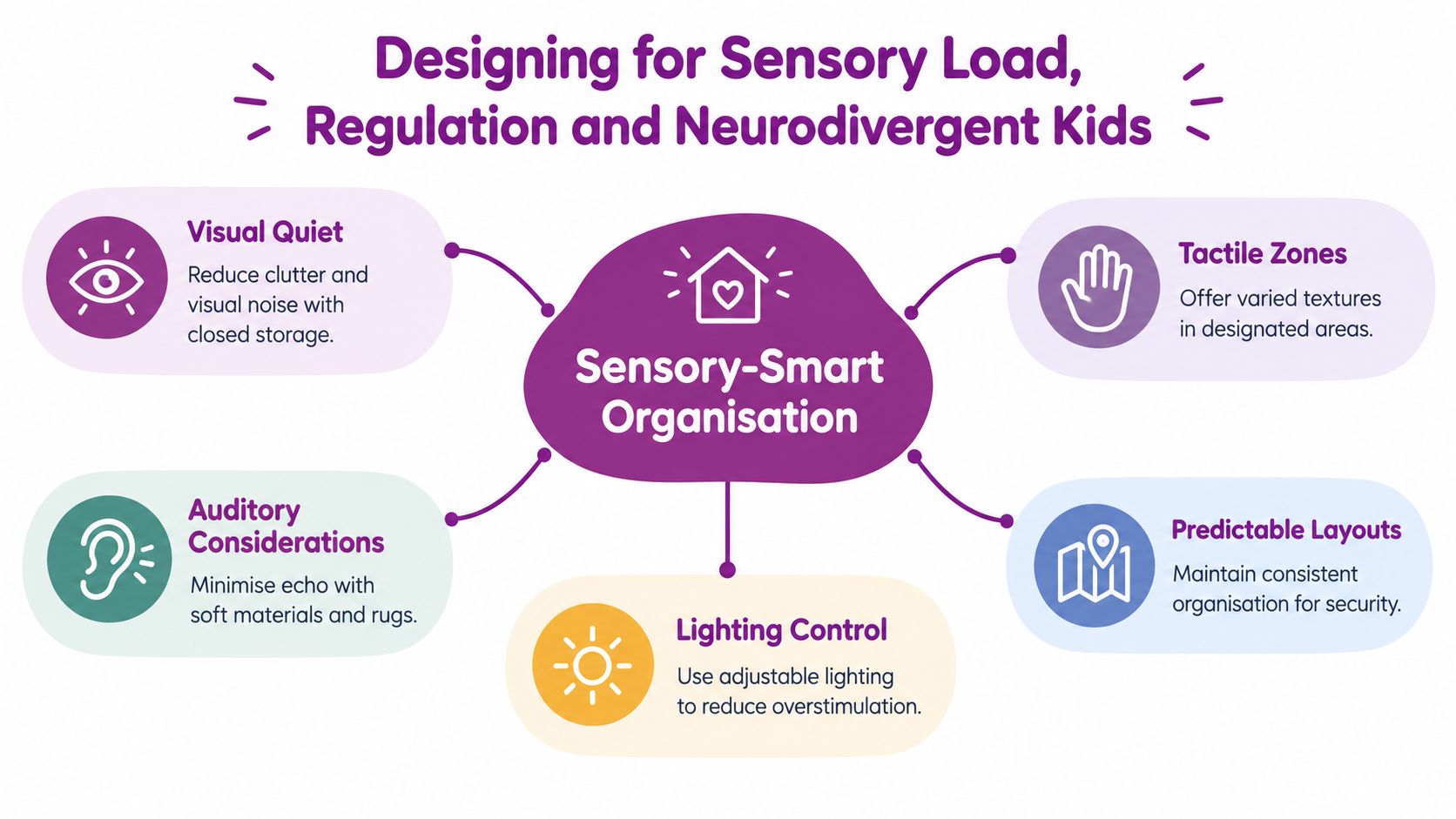
Warm, adjustable lighting can help you reduce glare and intensity during wind-down periods. Lower the number of posters, keep wall colours calmer around sleep and reading areas, and use picture or colour cues to show what happens in each zone. Consistency matters more than decoration.
The sensory support guidance for toddlers from Kids Club Early Learning Centre reflects the value of environments that respond to children's sensory needs. For a child who seeks movement and another who becomes overwhelmed by noise, one open play area may not be enough. Give both children a clear option without labelling either response as difficult.
Daily and Weekly Routines That Keep the Room Sorted
A room stays organised through small resets, not heroic cleaning sessions.
Nightly reset, five minutes: Clear the sleep, self-care and retreat zones first. Return books, remove loose clothing, restore the cot area and leave one clear route through the room.
Weekly reset, fifteen minutes: Return every toy to its activity zone, check that shelves remain stable, remove broken or unsuitable materials and reduce anything that has overflowed its container.
Monthly rotation review: Bring out one stored group, put one active group away and note what your toddler actually used. Keep the system flexible when interests change.
Use one simple family rule: before starting a new activity, your toddler helps return two items. Make it a shared ritual, not a test of obedience. Perfect rooms aren't the goal. Predictable, safe rooms are, and even a partial system will save more time than another storage product.
Kids Club Early Learning Centre offers dedicated infant and toddler environments with clear pathways, low shelves, accessible resources, cosy areas and open floor space for movement and choice. If you're looking for care in Melbourne's Springvale South, Dandenong North or Ferntree Gully, visit Kids Club Early Learning Centre to explore the rooms and enrolment options.