
A kitchen bench, a bowl of water, a cork and a spoon can keep a three-year-old busy for longer than an expensive kit. When a child asks why one object sinks and another stays on the surface, they're already testing an idea with their hands. That question can lead to a prediction, a fair test, a surprise and a new question.
These STEM activities for preschool children aged three to five use ordinary materials and small, manageable setups. Each one centres on an observable question a young child can answer through action. You'll find ways to adjust the experience for younger and older preschoolers, plus a safety note built into every activity.
The adult's role isn't to provide the answer too quickly. It's to notice what children are trying, add useful words, and help them test their thinking. Australian evidence supports this inquiry-led approach. The ELSA pilot used play-based digital applications alongside educator-guided experiences, with the Experience, Represent, Apply approach keeping the learning purpose ahead of the device. The same principle works with water, blocks, plants and recycled materials.
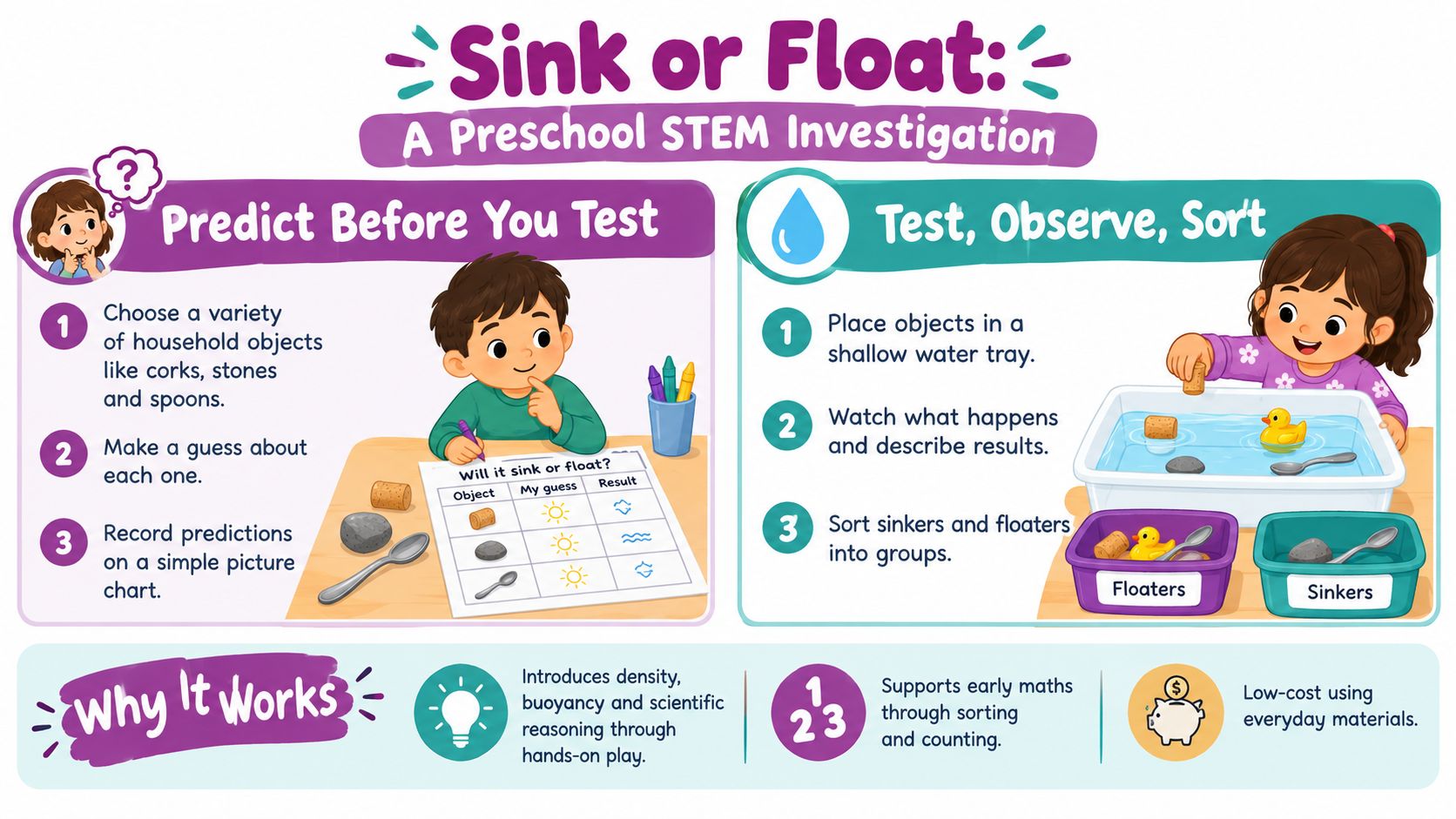
1. Sink or Float Water Investigation
Observable question: Will this object sink or float?
Fill a shallow tub with water and place a cork, spoon, rock, bottle cap and sponge beside it. Ask children to hold each object, make a prediction and place it in the water. The result matters, but the conversation matters just as much. A child might notice that a heavy-looking sponge floats while a light-looking rock sinks.
Use picture cards showing a splash at the bottom and an object on the surface. Children can place each card beside their prediction before testing. Afterward, invite them to sort the objects into two groups and explain whether their prediction changed.
Practical rule: Ask “What do you think will happen?” before asking “Why?” Young children often need the experience before they can explain their reasoning.
For three-year-olds, offer a small selection of large objects and focus on the words in, under, on top, wet and dry. Four- and five-year-olds can compare objects made from different materials, test a larger collection, or investigate whether changing shape affects the result. A ball of modelling clay that sinks can be reshaped into a boat, giving children a chance to test a new design.
Keep the water shallow and supervise continuously. Use objects too large to swallow, avoid sharp edges and wipe up spills promptly. Rotate the materials so the investigation doesn't become a memory game. The useful learning comes from making a new prediction and checking it.
2. Block Tower Engineering Challenge
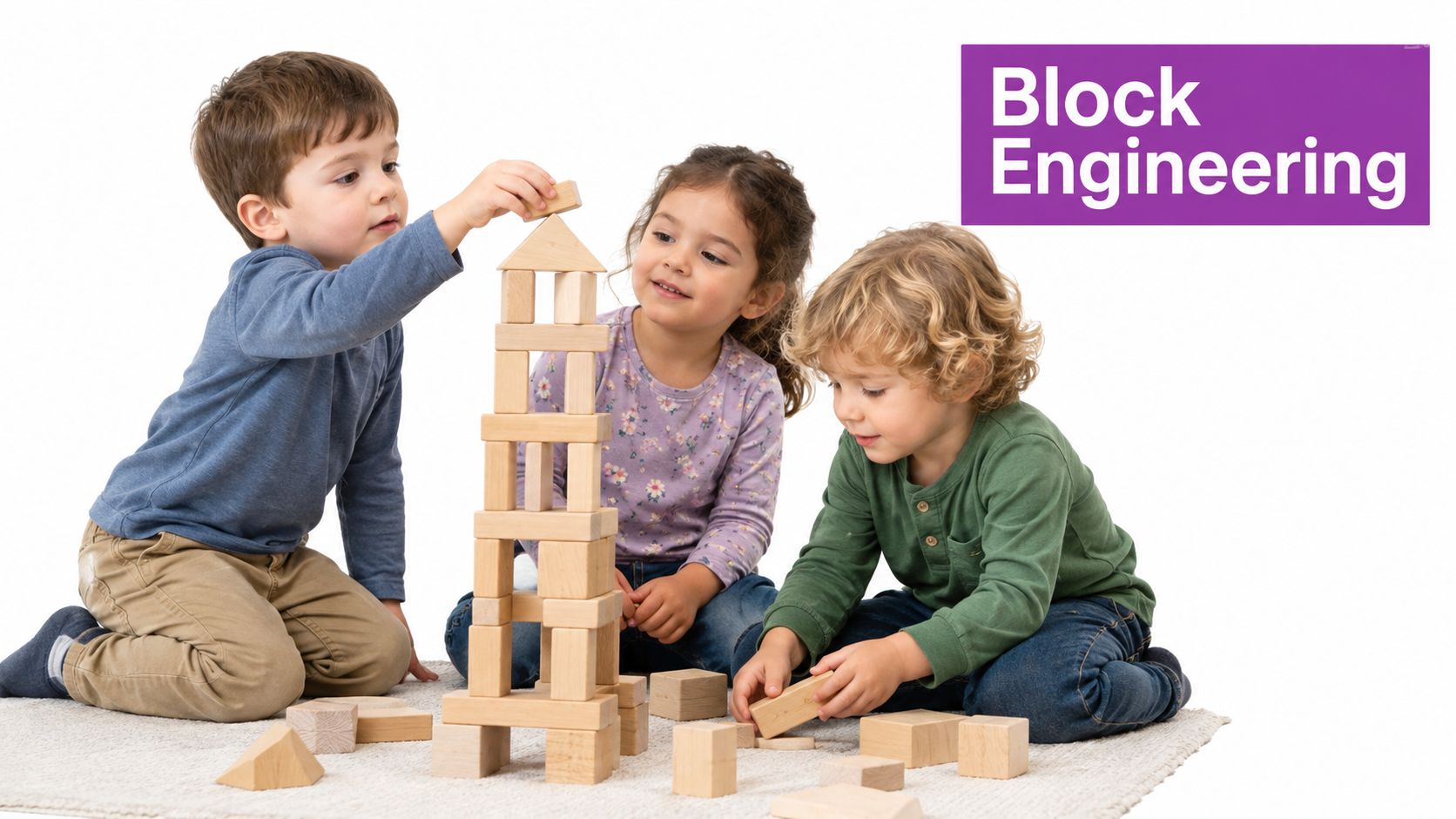
Observable question: Which base will keep the tower standing?
Put wooden or foam blocks on a clear floor space. Begin with a simple challenge, such as building a tower for a toy animal or making a bridge that a small car can pass under. Don't demonstrate the “correct” structure first. Let children choose a wide base, a narrow base, tall blocks or short blocks and discover what happens.
Children can gently test each structure by placing a toy on top or tapping the floor nearby. A collapse isn't a failed activity. It gives the group something visible to discuss: which block moved first, where the structure leaned and what could change next time.
For three-year-olds, focus on stacking, balancing and enclosing space. Offer large blocks and let them build beside a peer. Four-year-olds can compare two bases and predict which will support more weight. Five-year-olds can draw a plan, build a bridge with a gap, or redesign a structure after a stability test.
A small set of photo prompts can inspire ideas without turning the play into copying. You can also extend the experience with loose parts play at Kids Club ELC, where children combine open-ended materials and make decisions about construction.
A strong STEM prompt describes the problem, not the solution. “How could we make it stand longer?” gives children room to think.
Watch for pinched fingers, falling blocks and children carrying heavy pieces. Use foam blocks with younger children or in tight spaces. Keep structures low enough that a falling tower won't reach a child's face, and ask children to build on the floor rather than a high table.
3. Ramp and Marble Races
Observable question: Which ramp will send the object further?
Lean cardboard, a short plank or a piece of guttering against a stack of books. Start with one ramp and one large ball or toy car. Mark the start and finish areas with masking tape so children release each object from the same place. Then change one feature, such as the height, surface or object.
Three-year-olds can choose between a low ramp and a high ramp, then use words such as fast, slow, far and near. Four-year-olds can compare two surfaces, such as cardboard and fabric. Five-year-olds can help design a fair test by keeping the object and starting point the same while changing only the ramp height.
Pair children so one releases the object and the other watches where it stops. A simple drawing, tally mark or photograph can record the result. If the car veers sideways, ask whether the ramp is straight or whether one wheel is catching. That moves the experience beyond racing and towards problem-solving.
Start with one variable. If the height, object and surface all change together, children can see that the result changed but can't easily work out why.
Choose large balls or cars rather than small marbles for children who still mouth objects. Small marbles require close adult supervision and secure storage. Position the ramp away from walkways, keep children behind the release line and stop the activity if objects roll towards other children.
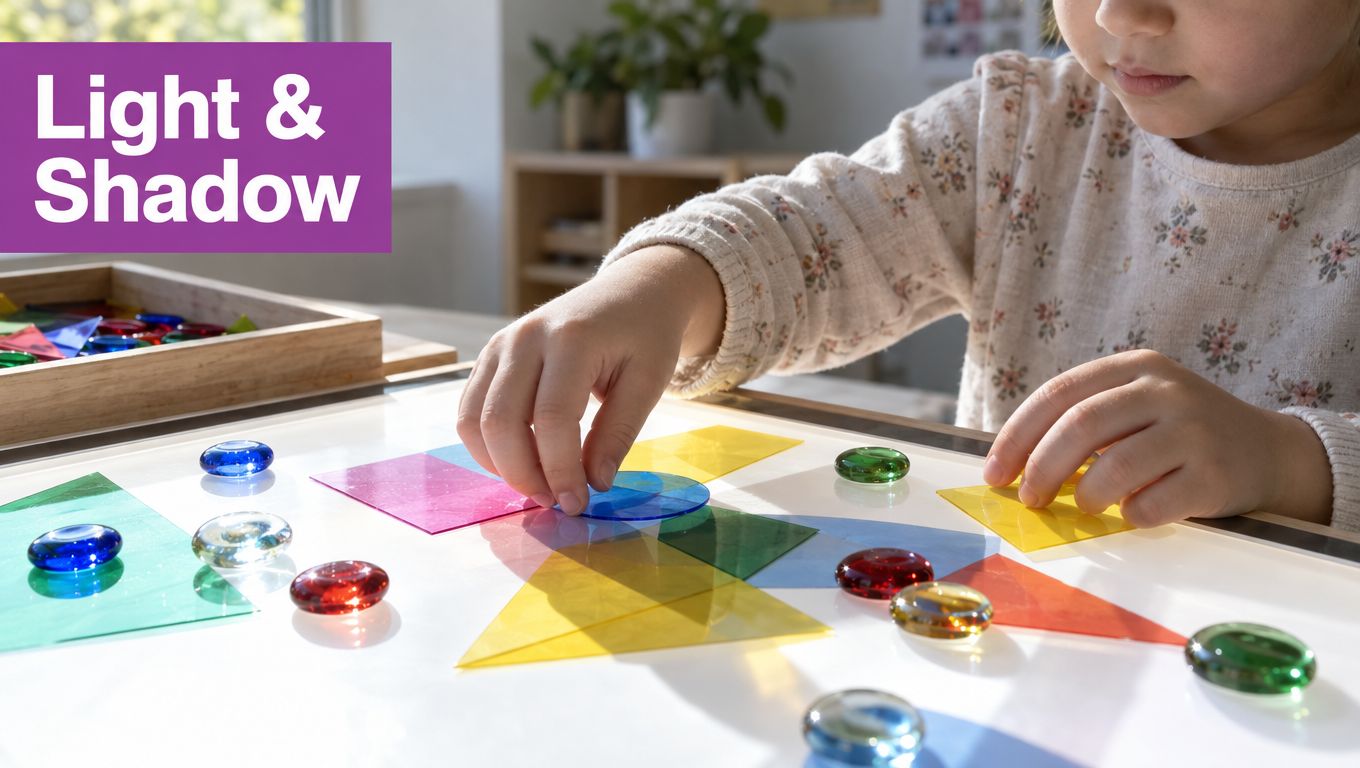
4. Light Table Shadow and Colour Exploration
Observable question: What happens when light meets this material?
Place transparent, translucent and opaque materials on an LED light table or a safe backlit surface. Coloured acetate, clear plastic shapes, leaves, fabric, cardboard and natural objects create different effects. Children can move each item, layer colours and watch shadows change as the distance from the light changes.
For three-year-olds, offer two or three materials and use simple language: light through, light blocked, bright, dark and shadow. Four-year-olds can sort objects by how much light passes through them. Five-year-olds can create a repeating colour pattern, predict the colour made by overlapping two translucent pieces, or use a torch to investigate shadows away from the light table.
A light table suits a Reggio Emilia-inspired environment because children can make a visible record of their thinking. Photograph a pattern, transcribe a child's explanation or place the drawing beside the materials used. The documentation should show the child's decisions, not just a neat finished arrangement.
A DIY sensory bottle activity at Kids Club ELC can extend colour, movement and observation beyond the light table. Keep the question open. “How can you make the shadow longer?” usually creates more investigation than “Can you make a shadow?”
Use an LED light table that stays cool. Check that the surface and torch are in good condition, keep cords secured and supervise children with transparent plastic pieces. Don't use glass, hot lamps or materials with sharp edges. Children should never look directly into a bright torch.
5. Seed Planting and Plant Growth Journal
Observable question: What will this seed need to grow?
Plant beans, cress or sunflower seeds in clear cups, small pots or a garden bed. Invite children to handle the seeds, add soil and decide where the containers should sit. A clear cup makes roots easier to notice, while a garden bed adds responsibility and a connection to outdoor care.
Three-year-olds can help scoop soil, place a seed and water with a small can. Use words such as seed, root, stem, tall, short and dry. Four-year-olds can draw what they see after each observation. Five-year-olds can compare plants in different positions, measure growth with blocks or a ruler and discuss why one plant may look different from another.
Pre-soaking some seeds can make early changes easier to notice, but don't hide the waiting. Children need time to understand that living things change gradually. If a seed doesn't grow, treat that as useful evidence. Ask whether it had enough water, light or suitable soil, then plant another batch rather than presenting the first attempt as a failure.
Use a simple journal with drawings, stickers, photographs or children's dictated words. A child might draw a brown seed on one page and a green shoot on the next. This links science with language, early measurement and care.
Keep soil, seeds and fertilisers away from mouths, and check for plant allergies before planting. Wash hands after handling soil. Adults should control access to fertilisers and avoid toxic plants. Watering needs supervision too, because wet floors quickly become slippery.
6. Kitchen Chemistry Fizzing, Melting and Mixing
Observable question: What changes when these materials meet?
Set up small trays with bicarbonate of soda, vinegar, ice, salt, water and child-safe containers. Let children look at the materials before mixing anything. They can describe the powder, liquid and ice, then predict what might happen when two materials are combined.
For three-year-olds, keep the investigation visual and sensory. Mix a small amount of bicarbonate of soda and vinegar in a tray, then talk about the bubbles and sound. Four-year-olds can compare plain ice with ice sprinkled with salt. Five-year-olds can help make playdough, notice how ingredients change when mixed and compare the material before and after cooking or chilling.
Use sensory vocabulary rather than rushing to scientific labels. Children can say fizz, cold, smooth, sticky, runny or hard. Adults can introduce terms such as solid, liquid, change and reaction when they fit the child's observation.
Food ingredients don't automatically make an activity safe. Check allergies and dietary requirements, keep materials out of mouths and use separate utensils from food preparation. Small amounts reduce waste and mess. A tray under each container makes clean-up easier.
The Science Week activity ideas from Kids Club ELC can help educators connect simple experiments with broader inquiry. Keep vinegar away from eyes, protect clothing, clean spills quickly and supervise every mixture. Never combine household cleaning products. For children with sensory sensitivities, offer tongs, spoons or visual observation instead of requiring direct touch.
7. Magnet Exploration What Sticks and Why
Observable question: Will this object stick to the magnet?
Give children a large, child-safe magnet and a tray of objects made from metal, plastic, wood, fabric and natural materials. Include a metal spoon, cardboard piece, wooden peg, fabric scrap and a large plastic lid. Before each test, ask children to predict what the magnet will do.
Three-year-olds can test a few objects one at a time and sort them into sticks and doesn't stick groups. Four-year-olds can look for patterns in the materials. Five-year-olds can investigate whether a magnet can attract an object through paper, a thin fabric layer or a clear container. Keep the focus on what children observe rather than suggesting that every shiny object will be attracted.
A magnetic treasure hunt works well after the first round. Hide large magnetic objects around the room and give children picture clues. Pair children so one holds the magnet and the other records the result with a drawing or places an object in the correct group.
“Do you think it will stick? What makes you think that?” gives children a reason to inspect the object before they test it.
Use only large magnets designed for children. Small or loose high-powered magnets are dangerous if swallowed and must not be part of preschool play. Supervise closely, check magnets for damage and store them in a locked or inaccessible container after the activity. Keep magnets away from devices and medical equipment that may be affected by magnetic fields. Adults should check every object for sharp edges before adding it to the tray.
8. Bee-Bot Floor Robot Coding
Observable question: Which instructions will take the robot to the picture?
Place a Bee-Bot on a floor grid with picture cards showing a house, tree, animal or colour. Invite children to choose a target and plan the route before pressing any buttons. A short route using forward, left and right commands is enough to begin. Children can then check whether the robot arrived where they expected.
Three-year-olds can act as the robot. An adult or peer gives one instruction at a time, and the child moves across a large grid. This unplugged version builds directional language without requiring equipment. Four-year-olds can programme a two- or three-step route. Five-year-olds can plan a longer route, predict the result and debug when the robot turns the wrong way.
Pair children with different roles. One child gives the instructions, another presses the buttons and both check the outcome. Ask, “What happened?” and “What would you change?” rather than correcting the sequence immediately. A child who notices that the robot moved too far has already found the basis of debugging.
Use picture symbols and arrows for children who aren't reading yet. Connect the route to a story, such as helping the robot deliver food to an animal. This gives the commands a purpose and invites language, collaboration and imaginative play.
Keep the robot on a clear, flat surface. Check batteries and cords, keep small accessories away from mouths and supervise turn-taking. Don't allow children to stand on the grid while the robot is moving. Store the equipment safely after use, especially where younger siblings may access buttons or loose pieces.
8 Preschool STEM Activities Comparison
| Activity | Implementation Complexity 🔄 | Resource & Cost ⚡ | Expected Outcomes ⭐ | Ideal Use Cases 💡 | Key Advantages 📊 |
|---|---|---|---|---|---|
| Sink or Float Water Investigation | Low, simple setup; open‑ended testing | Very low; household items and water tray; ongoing supervision required | ⭐⭐⭐⭐, buoyancy, prediction, observation, early maths | Short provocations, repeatable inquiry stations, small groups | Immediate visual results; sensory engagement; low cost |
| Block Tower Engineering Challenge | Moderate, open‑ended build and teacher scaffolding | Low–medium; blocks, storage and floor space needed | ⭐⭐⭐⭐⭐, spatial reasoning, fine motor, collaboration | Free play, engineering challenges, photo documentation | Strong school‑readiness links; clear cause–effect feedback |
| Ramp and Marble Races | Moderate, build/stabilise ramps and introduce variables | Low; recycled ramps, supports; needs stabilising aids | ⭐⭐⭐⭐, motion, slope, friction, measuring distance | Physics explorations, team challenges, comparative tests | Concrete demonstration of force and speed; adjustable variables |
| Light Table Shadow and Colour Exploration | Moderate, electrical safety checks and material prep | Medium–high; LED table preferred or DIY light source | ⭐⭐⭐⭐, light/shadow, colour mixing, focused sensory play | Art–science integration, quiet sensory stations, indoor use | Highly engaging visual play; links science and art |
| Seed Planting and Plant Growth Journal | Low–Moderate, planting plus ongoing care and recording | Low; seeds, soil, clear cups or garden bed; space for plants | ⭐⭐⭐⭐, life cycles, measurement, responsibility | Long‑term projects, garden programmes, sustainability lessons | Visible growth over time; fosters care and routine |
| Kitchen Chemistry: Fizzing, Melting, and Mixing | Low, simple recipes; needs hygiene and allergy checks | Very low; common kitchen ingredients; requires cleanup | ⭐⭐⭐⭐, states of matter, cause‑and‑effect, sensory vocabulary | Short experiments, cooking links, sensory science demos | Highly engaging reactions using familiar materials |
| Magnet Exploration: What Sticks and Why? | Low, straightforward testing and sorting | Low; magnets and assorted objects; strict safety storage | ⭐⭐⭐⭐, classification, attraction, early engineering concepts | Sorting activities, science tables, magnetic building extensions | Immediate results; inexpensive; teaches classification |
| Bee‑Bot Floor Robot Coding | Moderate, device setup, mats, stepwise scaffolding | Medium–high; commercial robots and mats; flat floor space | ⭐⭐⭐⭐, sequencing, debugging, directional language | Screen‑free coding lessons, paired planning activities | Concrete introduction to computational thinking; collaborative play |
Start With One Activity and Build From There
Choose one activity this week and set it up with materials you already have. Leave it available long enough for children to return, change their approach and test a new idea. A water tray might begin with sink-or-float predictions, then lead to boat design. A block area might move from stacking to bridge building. The best follow-up often comes from the child's question rather than the adult's plan.
Watch for evidence of thinking, not just a finished product. A child who says, “It fell because this one is wobbly,” is connecting an event with a possible cause. A child who tries a wider base after a collapse is revising a design. A child who uses words such as heavier, further, under, same, different or next is communicating observations and comparisons.
Australian research points to a practical challenge for early childhood settings. A survey of 425 early-childhood educators found stronger confidence in mathematics than in science, technology and engineering knowledge, even though educators generally viewed STEM as suitable for young children and felt confident supporting inquiry-based learning. The Australian educator research supports professional learning that is short, repeatable and connected to everyday practice.
For educators, a useful routine is simple:
- Notice: Record what the child did, said or changed.
- Ask: Use one open question rather than a string of quiz questions.
- Test: Offer time and materials for another attempt.
- Connect: Link the experience to language, maths, movement, art or care for living things.
Families can use the same routine at home. You don't need a dedicated science area, a screen or a specialist kit. A recycled box, a measuring cup, a plant pot or a few blocks can support serious thinking when children have time to investigate.
The activities also need to work for different children. Offer visual cards, larger materials, movement-based choices, partner roles and home-language questions. The Australian evidence on accessible and culturally responsive STEM highlights the value of ordinary materials and professional learning that helps educators broaden participation. Children don't need to fit a builder or inventor stereotype to take part. They can observe, sort, listen, move, draw, explain, care and try again.
Families looking for structured early learning can explore Kids Club Early Learning Centre's programs in Springvale South, Dandenong North and Ferntree Gully, or visit kidsclubelc.vic.edu.au to check local enrolment options. Its Reggio Emilia-inspired approach gives children opportunities to investigate, create and collaborate, while educators can document the questions and ideas that emerge through play.
Start with the bowl of water, the blocks or the seed cup. Ask one honest question, give children room to answer with their hands and stay close enough to notice what changes. That is how STEM becomes part of the preschool day, not a special event added to it.
Kids Club Early Learning Centre offers inquiry-focused programs for children from six weeks to six years across Springvale South, Dandenong North and Ferntree Gully, including kindergarten and pre-PREP experiences that support curiosity and problem-solving. If you're looking for a local setting where children can explore hands-on STEM through play, visit Kids Club Early Learning Centre to learn more and enquire about enrolment.