

You're halfway along Springvale Road when the school sends a message about an early finish. Your toddler's centre closes at the usual time, your next work call starts before you can reach home, and the Monash is already slowing near Mulgrave. You're not looking for another broad promise about “family-friendly” support. You need the care hours, workplace arrangements and backup plan to work on the same Tuesday.
That's the practical meaning of working parent support. It's a coordination problem involving childcare, kindergarten, parental leave, subsidies, flexible work and your own wellbeing. A useful plan should fit the route between Springvale South, Dandenong North, Ferntree Gully, Boronia, Mulgrave and Dingley Village, not just explain which government department handles each benefit.
A Tuesday Morning in Melbourne's South-East
At 7.05 am, a parent in Springvale South is packing a school bag, warming a toddler's breakfast and checking whether a partner can handle drop-off. The older child needs to be at school, the toddler needs to arrive at an early-learning centre, and the parent has a work call that can't easily move. A small delay at the school crossing becomes a missed call, a rushed handover and a message to a manager asking for understanding.
The afternoon creates the same pressure in reverse. A commute from the city or across the Monash corridor can turn a standard pickup into a race. If the child is unsettled after a room transition, the parent may need extra time at collection. If the school finishes before the centre's closing window, the family needs a clear before- or after-school arrangement rather than a last-minute favour.
Practical rule: Build your care plan around the time you must leave work, not only the centre's advertised opening time.
The strongest support plan joins five pieces. Childcare options cover the hours before and after school. Kindergarten funding supports the preschool years. Child Care Subsidy helps families assess the cost of booked care. Workplace rights and formal flexibility shape when work can happen. Wellbeing and community support give parents somewhere to turn when sleep, illness or the mental load becomes too much.
The order matters because your day matters. You need to choose a setting before you can confirm subsidy details, match attendance to work before you request flexibility, and establish backup care before an ordinary illness disrupts the week.
What Working Parent Support Actually Covers in Australia
Working parent support is a combination of help you claim and help you arrange.
The claimable side includes Australian Government Parental Leave Pay, Child Care Subsidy and government-funded kindergarten. These programmes can reduce the financial pressure around a child's early years, but they don't automatically create a workable commute or guarantee a place on the days you need.
The arranged side includes your centre's attendance pattern, your employer's response to a flexible-work request, a partner's roster, and a backup carer. Those pieces determine whether a family can manage an ordinary week without relying on emergency decisions.
Australia's employment pattern explains why this coordination matters. In 2025, 73% of Australia's 2.2 million couple families with children aged 0–14 had two employed parents, compared with 60% in 2005. Over the same period, the share of couple families with children with only one employed parent fell from 33% to 22%, as reported in Workplace Gender Equality Agency parental-leave information. Employment-compatible care is therefore part of how many households organise income and caregiving, not a niche extra.
The five practical pillars
Parental leave gives families time around a birth or placement and creates a bridge towards returning to work. Leave arrangements still need to connect with a childcare start date.
Child Care Subsidy helps eligible families with approved care costs. The result depends on family circumstances, activity, booked hours and the service's fees.
Funded kindergarten supports learning before school. Families still need to check how the kindergarten timetable fits their workday and whether a long day care setting or sessional programme suits them.
Flexible work rights give eligible employees a pathway to request arrangements such as altered start times or different work locations. A written arrangement is easier to manage than repeated informal negotiations.
Mental-health and community supports include a trusted GP, parent groups, playgroups and respite options. These supports matter because coordination becomes harder when a parent is exhausted or isolated.
For families in Springvale South, Dandenong North, Ferntree Gully, Mulgrave, Boronia and Dingley Village, the useful question is not “Which benefit applies?” It's “Who handles each handover, on which day, and what happens when the routine fails?”
Childcare and Kindergarten Options Close to Home
The right setting depends on your child's age, your working hours and how much timetable certainty you need. A family leaving Springvale South before the school run may need a different arrangement from a parent in Ferntree Gully who works fixed kindergarten days.
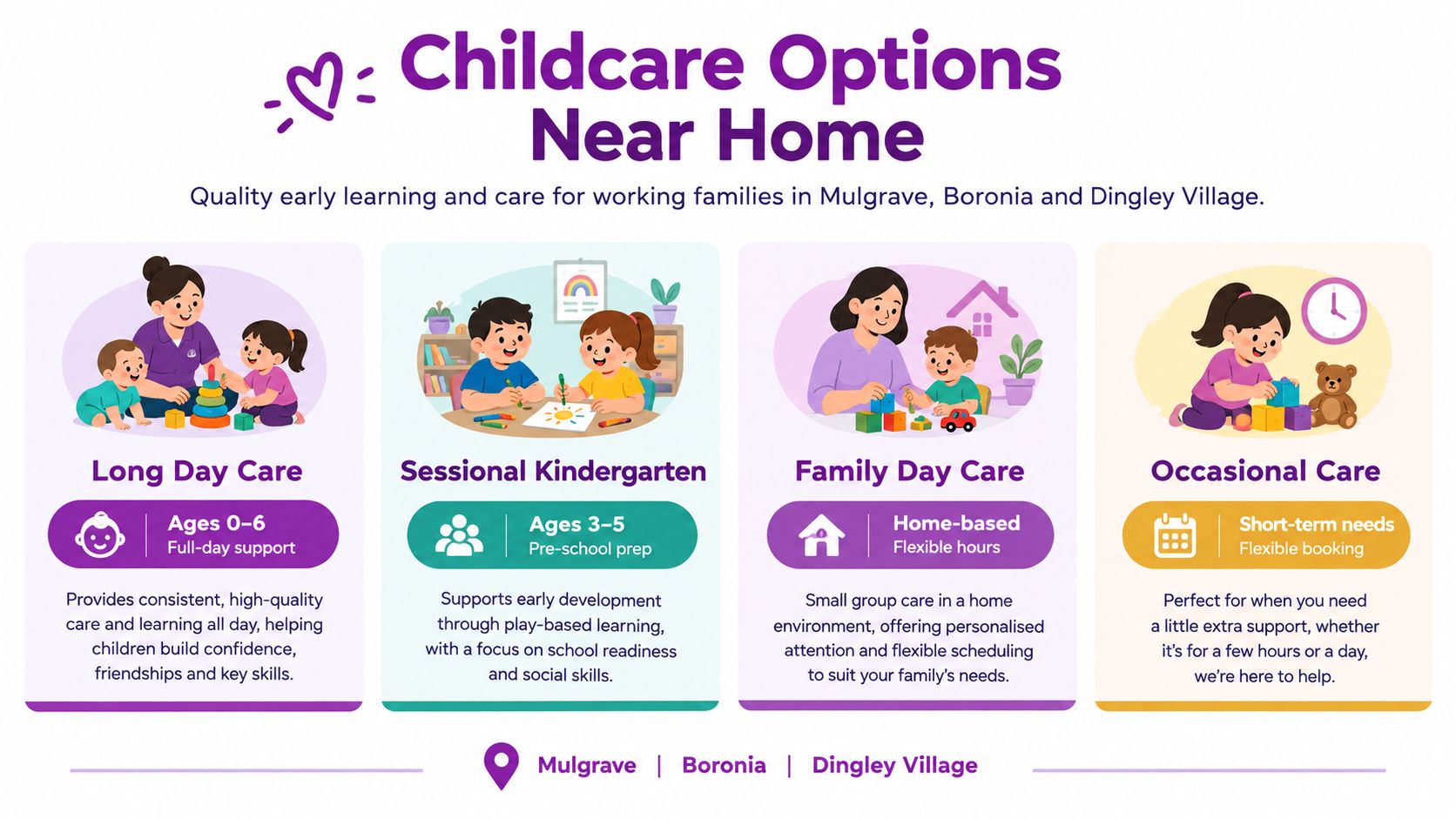
Long day care usually offers the most practical structure for parents working full days. Children can attend from infancy through the preschool years, with dedicated infant and toddler rooms and older rooms for kindergarten and school-readiness learning. A Reggio Emilia-inspired programme may suit families who value inquiry, creativity and collaboration, while the longer operating day can reduce the number of handovers.
Kindergarten inside a long day care centre combines the kindergarten programme with extended care. That can be useful when a parent works beyond a short session or when a child needs care before and after the educational programme. A standalone sessional kindergarten may offer a focused preschool timetable, but parents must arrange separate care around the session if their workday continues.
Family day care provides a home-based environment and may suit children who respond well to a smaller group. Ask about operating hours, educator availability, backup arrangements and how the service handles planned absences.
Occasional care can help with short-term needs, appointments or an irregular week. It usually isn't a complete solution for a fixed full-time roster, so treat it as one part of a wider plan.
| Option | Typical ages | Hours | Best fit for |
|---|---|---|---|
| Long day care | Infancy to preschool | Full-day weekday care | Parents with regular workdays and commuting commitments |
| Sessional kindergarten | Preschool years | Set sessions | Families who can arrange care around a shorter timetable |
| Family day care | Infancy to preschool | Varies by educator | Families seeking a home-based setting or smaller group |
| Occasional care | Varies by service | Short or irregular bookings | Appointments, temporary gaps and changing needs |
Ask each centre how three-year-old funded kindergarten and four-year-old pre-PREP fit around attendance days. Also compare fees, subsidy treatment, meals, public-holiday arrangements, room transitions and the time needed to reach work. Families comparing nearby settings can use this guide to childcare services near me as a starting point.
A short video can help you think about the difference between care settings before you tour a service.
When you visit, watch the handover rather than only the room displays. Notice whether educators explain settling, meals, sleep and daily communication clearly. Those small details often determine whether care removes pressure from your day or adds another coordination task.
How to Enrol Step by Step Without Missing a Subsidy
Enrolment works best when you begin with the date you need care, especially if parental leave is ending. A centre may have a suitable room but not a place on your preferred days, so separate “when can my child start?” from “which programme do we like?”
A practical enrolment sequence
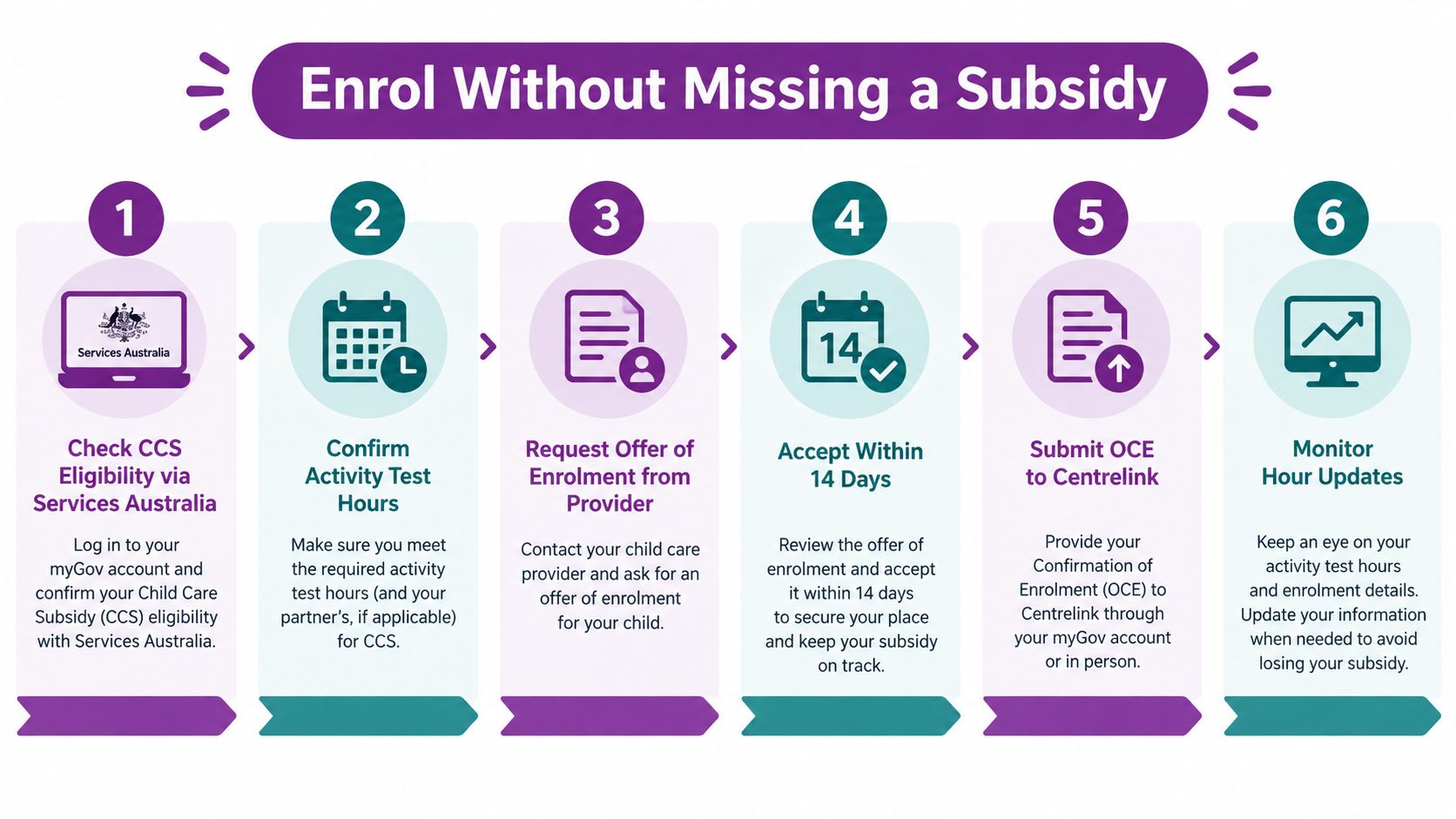
Check eligibility through Services Australia. Review your family details and start an estimate before accepting an arrangement.
Confirm activity-test hours. Consider work, study, leave and other recognised activities for each parent. Your likely entitlement affects the number of subsidised care hours available.
Ask the provider for a fee and attendance breakdown. Check the hourly fee, booked hours, enrolment charges, meals, late fees and what happens when your child is absent.
Tour the service. Ask to see the infant, toddler and kindergarten spaces if your child may transition during the enrolment period.
Align the start date with your return to work. A gradual start can give your child time to settle before your first full week back.
Keep the records current. Update family income, work activity, contact details and care arrangements when circumstances change.
Documents to prepare
Have your child's immunisation history, birth certificate details, Centrelink Customer Reference Number and emergency contacts ready. The provider may also ask for authorised collection details, medical information and parent contact information.
Parents often lose time by assuming the centre can correct every Services Australia detail. A reputable service can support the administration, but you still need to check the submitted information. Confirm that the family income estimate is current and ask how the service records absences and attendance.
For a simple pre-enrolment estimate, use this Child Care Subsidy estimator. Treat the result as a planning guide, not a guaranteed invoice amount. Your centre should explain the actual fee statement and the attendance pattern before you commit.
Write down the questions you'll ask at the tour:
- Start date: Can the place begin when parental leave ends?
- Attendance: Are the required days available every week?
- Settling: Can a parent attend orientation visits?
- Transitions: How are moves from infant to toddler or kindergarten rooms managed?
- Communication: Who receives daily updates and illness notices?
- Costs: Which charges sit outside the ordinary daily fee?
This preparation prevents a common problem: choosing a service first and discovering later that its hours or available days don't match the return-to-work plan.
Workplace Rights and Flexible Work that Actually Helps
Australian working parents may rely on National Employment Standards covering paid parental leave, unpaid parental leave, requests for flexible work and protections connected with returning to work. Your eligibility and specific entitlement depend on your circumstances, so use your employer's policy and Fair Work guidance for the details.
The conversation with a manager becomes easier when you turn “I need flexibility” into a work plan:
- Could I start earlier on two days so I can collect from care on time?
- Can I work from home for a defined portion of the week where the role allows it?
- Can we set a review date after my child settles into care?
- What happens if the centre calls about illness?
- Can my return begin with fewer care days and increase as my child manages longer attendance?
Formal flexibility means the arrangement is clear. It might involve set start and finish times, agreed flexitime, a different work location or compressed hours where appropriate. Informal flexibility means answering emails after bedtime, swapping shifts at short notice or completing family tasks during work and catching up later.
A national survey of 4,268 employed parents found that formal flexibility, including flexitime and flexiplace, was associated with lower fatigue and burnout, while informal workarounds were associated with poorer health outcomes, according to the research on work flexibility and parent health. The lesson is straightforward: flexibility should reduce uncertainty, not move paid work into every spare moment.
Share the return-to-work load
Parental leave is often treated as the mother's transition, but fathers and secondary carers also need a clear plan. Ask about Dad and Partner Pay, secondary-carer leave and whether both parents can use staggered arrangements under workplace policy.
A staged return can pair a parent's work increase with a child's gradual increase in care days. This may be useful during the infant-to-toddler transition, when sleep, food and room routines are changing.
Ask for this in writing: days, hours, work location, collection responsibilities, review date and the process for unexpected care disruptions.
Mental Health, Community Supports, and Respite
A subsidy can help with fees, but it can't settle a baby, find a backup carer or remove the mental load of remembering every bag, form and pickup. Working parent support must include the parent's capacity to keep coordinating the week.
Look for a GP who understands perinatal mental health if pregnancy, birth or the early months are affecting your mood, sleep or sense of control. Parent groups and playgroups run through councils and community organisations in Greater Dandenong and Knox can help families build local connections, particularly when relatives live elsewhere. Ask your council, Maternal and Child Health service or community health provider about current groups and respite pathways.
The line between a difficult week and a need for professional support isn't always obvious. Contact a health professional when low mood, anxiety, anger, hopelessness or exhaustion persists, interferes with daily life or makes caring feel unsafe. If there's immediate danger, contact emergency services.
Childcare can either reduce or increase this pressure. A predictable routine, a consistent key educator and clear two-way communication help parents know what happened during the day without sending a string of messages. Ask how the centre shares sleep, meals, learning, incidents and room-transition information.
Wellbeing check: If your care arrangement leaves you constantly apologising at work, rushing every handover and losing sleep over the next day, it needs reviewing even if the fees look manageable.
The wider labour-market picture shows why this matters. Around two million Australian parents with children under 15 were outside the labour force or working part time in 2022–23, and more than half identified caring for children as their main barrier to returning to work, as reported by ABC News in its coverage of before- and after-school care. A care plan that protects rest and predictability can support employment without treating exhaustion as the price of returning.
Building Your Weekly Support Plan Across Mulgrave, Boronia, and Dingley Village
The families who cope most reliably don't leave every handover to memory. They design a repeatable week, then make exceptions visible.
Start with fixed childcare days that match recurring work commitments. If a Mulgrave parent has office meetings on set days, those days should be protected in the booking pattern. Add a contingency arrangement, such as a mutually agreed backup day or carer, rather than assuming a neighbour will always be available.

Plan from the commute backwards
A Boronia parent starting early at a Bayswater warehouse may need care that opens early enough to allow the drive, not merely a service with a convenient suburb name. A Dingley Village parent finishing late at a Moorabbin hospital may need a centre closing window that leaves room for collection, parking and the trip home.
For a school-aged child, write down the gap between school finishing and the parent arriving. Before- and after-school care may solve one part of that gap, but school holidays and pupil-free days need their own response. Ask whether the provider can support older siblings while a younger child attends long day care.
Cost needs to sit beside time. In the June quarter of 2025, 1,423,900 Australian children used Child Care Subsidy-approved care, with average attendance of 26.7 hours per week and an average hourly fee of $13.40, according to Australian Government Child Care Subsidy data. The Productivity Commission reported a median 2025 weekly cost of $711 for 50 hours of centre-based care in the same source. Use official estimates and your actual roster to test whether an extra day supports household income after fees, travel and unpaid time.
Families comparing local arrangements can review childcare in Boronia alongside their commute and booking needs.
A weekly template to copy
| Question | Monday to Friday plan |
|---|---|
| Who drops off? | Name the parent or carer and the time |
| Who collects? | Record the person and latest realistic arrival |
| What work is fixed? | List shifts, meetings and travel windows |
| What is the backup? | Name the person and their availability |
| What changes in illness? | Record the employer and centre contact steps |
| What must go in the bag? | Note medication, bottles, comfort items and school materials |
Put the template in a shared notes app or on the fridge. Review it when a roster changes, a child moves rooms or school hours shift.
Frequently Asked Questions for Melbourne Working Parents
How do absences affect Child Care Subsidy payments?
Ask your provider how booked absences, public holidays and longer periods away are recorded. Your statement should show attendance and charges clearly, so compare it with your booking pattern and contact Services Australia if the subsidy outcome doesn't match your circumstances.
When can my child start three-year-old kindergarten?
Eligibility and programme timing depend on Victorian rules and the child's age cut-off. Ask the centre or your local kindergarten service which year your child can start, how funded sessions operate and whether the programme sits inside a long day care day.
Can both parents claim separate activity hours?
Each parent's recognised activity and family circumstances can affect the assessment. Check the current Services Australia rules rather than assuming one parent's work pattern automatically covers the household.
What if the centre's fee exceeds the subsidy hourly cap?
The subsidy may not cover the full hourly fee. Ask for the service's hourly charge, the applicable cap and the estimated out-of-pocket amount, then compare the total with the travel time and the work hours the booking makes possible.
Bring these questions to your tour, then ask for a written fee estimate and attendance plan. A clear answer is more useful than choosing care based only on the advertised daily rate.
Kids Club Early Learning Centre offers weekday long-day care from 6.30 am to 6.30 pm at centres in Springvale South, Dandenong North and Ferntree Gully, with infant and toddler rooms, funded three-year-old kindergarten, four-year-old pre-PREP and practical enrolment support for working families. Visit Kids Club Early Learning Centre to discuss your required days, return-to-work date and the routine that will fit your family.