
Social-emotional learning is already part of school readiness in Victoria, not an optional extra added after literacy and numeracy. More than 90% of four-year-old children participate in kindergarten, and Victorian kindergarten programs explicitly support social and emotional development alongside communication and motor skills, including respect, independence, expressing feelings and resolving conflict according to the Victorian Child Protection Manual. The most effective social emotional learning activities for kindergarten therefore look less like formal lessons and more like purposeful moments woven through play, transitions, relationships and creative exploration.
The eight activities below connect each practice to a distinct school-readiness capability and a Reggio Emilia principle. They're suitable for children aged three to six, with simple options for educators and parents. The aim isn't to make every child respond in the same way. It's to give children varied, respectful ways to understand feelings, participate with others, recover from difficulty and communicate what they need.
1. Emotion Recognition and Naming
A child who can point to “frustrated”, “worried” or “excited” has a useful starting point for asking for help. Emotion recognition and naming develops the school-readiness capability of emotional literacy, helping children notice what's happening inside themselves and respond to other people with greater empathy.
This activity fits the Reggio Emilia principle of the environment as the third teacher. A low shelf with emotion cards, a mirror, family photographs and drawing materials can keep feelings visible throughout the day. Children don't have to wait for a teacher-led discussion to explore emotional language.
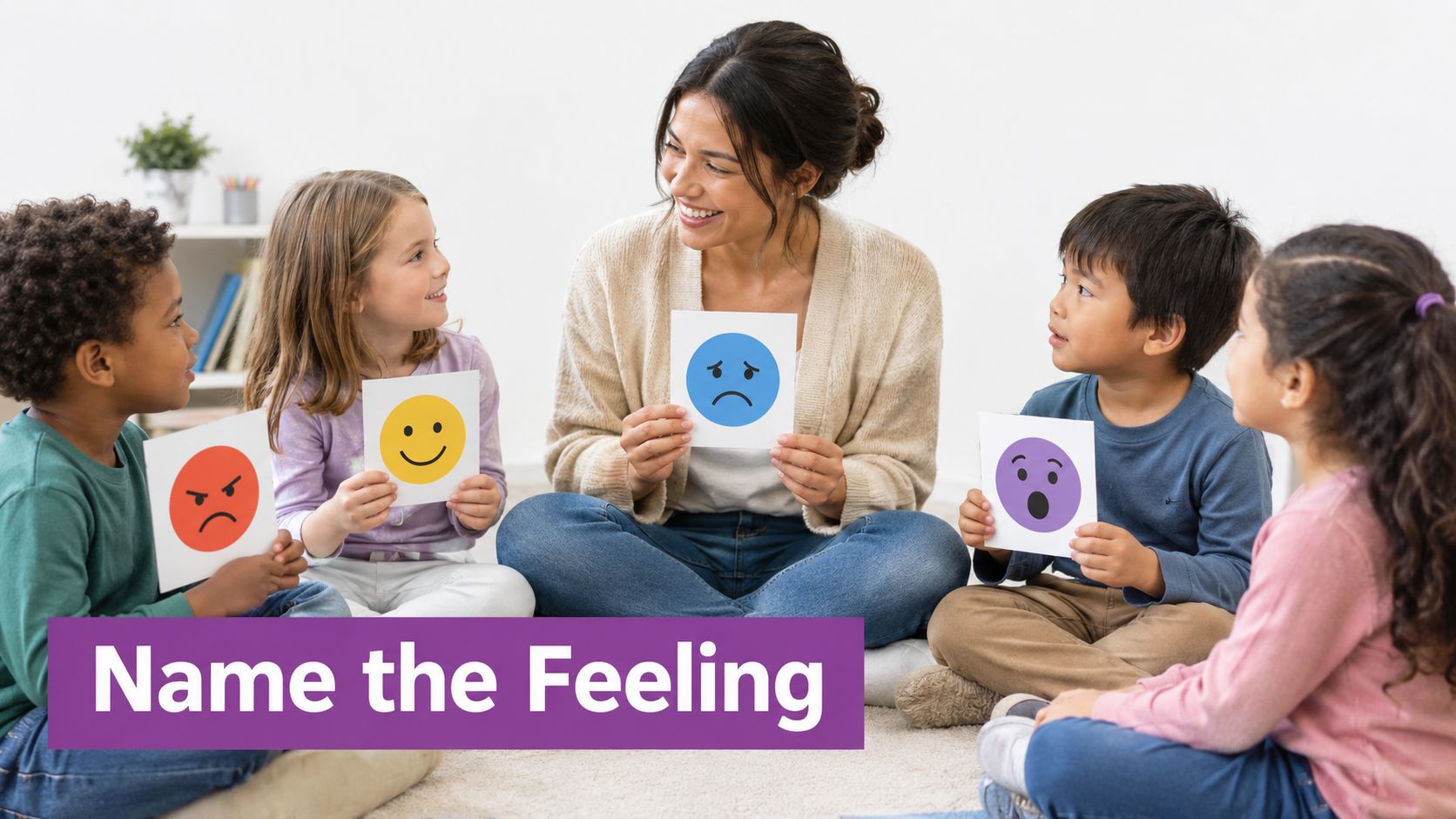
Begin with familiar feelings such as happy, sad, angry and scared. Once children use those words confidently, add feelings such as disappointed, proud, calm and nervous. During a morning meeting, children might choose a card, make a matching facial expression or show their feeling through movement. A child who doesn't want to speak can point, draw, gesture or use the mirror instead.
Practical rule: Name the feeling without assigning blame. “You're feeling frustrated because the block tower fell” is more useful than “You're being difficult.”
Adults should model the language in genuine moments: “I feel frustrated when the paint spills, so I'm going to take a breath and clean it up.” Use the same vocabulary during conflicts, transitions and story discussions. A feelings display can also include words from children's home languages, helping families see their culture and communication style reflected in the room.
For an Australian context, personal and social capability in early learning offers a useful lens for connecting emotional language with everyday relationships. Don't demand eye contact, verbal explanations or a particular facial expression. Some children will recognise feelings through colour, movement, symbols or photographs before they can describe them in words.
2. Mindfulness and Breathing Exercises
A busy kindergarten day needs small, repeatable pauses. Mindfulness and breathing exercises build the school-readiness capability of attention and self-regulation by helping children notice their bodies, shift focus and prepare for what comes next.
The Reggio Emilia connection is the hundred languages of children. Mindfulness doesn't need to mean sitting with closed eyes. Children can listen to a bell, follow a slow movement sequence, notice the feel of a leaf or watch bubbles rise. These alternatives respect children who find stillness uncomfortable, who process sensory information differently or who aren't yet ready for long verbal instructions.
Try “sleeping dragon breathing”. Children place a hand on their belly, breathe in gently through the nose and breathe out as though a dragon is resting. You can also use a pretend flower, inviting children to smell the flower slowly and blow a soft breeze across its petals. At home, try the same routine before putting shoes on, entering the car or beginning a meal.
Keep the practice inviting rather than compulsory. Some children may breathe, stretch, watch or move around the edge of the group. An educator can model the routine without insisting that every child copies it.
Make calm a familiar routine
Practise when children are already settled, not only when someone is upset. A short breathing cue before outdoor play, after lunch or before group time gives children a familiar pathway to follow during a harder moment. Nature walks can become moving mindfulness sessions, with children listening for sounds, noticing textures and watching how their bodies move.
For guided inspiration, educators and families can explore the child-friendly practices available through Smiling Mind. Use visual cards, a soft chime or a bubble wand to make the routine concrete. The purpose isn't perfect stillness. It's helping children discover which sensory and movement experiences support their own readiness to participate.
3. Cooperative Games and Team Building
Cooperative games build the school-readiness capability of working with a group. Children practise listening, waiting, sharing space, adjusting their actions and encouraging peers when the goal belongs to everyone rather than to a winner.
The Reggio Emilia principle of learning through relationships guides this work. Children develop ideas together while educators observe how they assign roles, respond to different abilities and adjust play so everyone can participate. The process matters as much as the finished structure.
Try a named activity called Bridge Builders. Give small groups blocks, cardboard tubes or recycled boxes and ask them to make a bridge for toy animals. Keep the instruction simple: “Build a bridge that reaches from this basket to that basket.” At home, children can connect two cushions or build a road between two rooms with blocks. Their choices reveal planning, communication and flexible thinking.
A parachute game needs little preparation. Invite children to hold the edges, lift together, lower slowly and guide a soft ball across the fabric. Ask them to move it toward a named colour or keep it from falling without rushing. For ideas about using role-play, movement and voice to support shared participation, educators can explore the elements of drama.
Keep the challenge genuinely collaborative
Explain the shared goal in one sentence, then demonstrate. Avoid giving one child permanent control of the materials or praising only the fastest response. A child who cannot hold the parachute comfortably might choose the movement, watch for the ball or give the group a signal instead.
Afterward, ask one concrete question:
- Notice the process: “How did we know when to lift together?”
- Invite children's ideas: “What could we change next time?”
- Recognise cooperation: “Who helped the group keep going?”
- Include quiet voices: “Did anyone notice a helpful idea from a friend?”
A cooperative relay can avoid racing. Children might carry one object together, pass a beanbag around a circle or complete a movement pattern as a team. If competition takes over, pause and redesign the task. Shared success gives children practice in belonging, contribution and problem-solving without comparing speed, volume or coordination.
4. Emotion Regulation Strategies
Emotion regulation is the school-readiness capability that helps children recover from disappointment, sensory overload, waiting and change. It doesn't mean expecting children to stay calm all the time. It means teaching them practical ways to recognise rising stress and seek support before they're overwhelmed.
The Reggio Emilia principle here is the environment as an active partner in learning. A calm corner, regulation station or quiet nook communicates that bodies and feelings deserve care. Place a cushion, visual breathing prompt, soft fabric, headphones, books and a few safe sensory tools within reach. Children should know how each item works and when they can use it.
Teach the strategies during relaxed play. A teacher might say, “Let's test the quiet space. What does your body notice here?” Children can compare stretching, wall pushes, slow music, drawing, heavy work or sitting with an adult. Families can create a smaller version at home using a cushion, a favourite book and a card showing two or three choices.
The building resilience in children guide can support conversations about coping and recovery, but the specific strategy must remain individual. A child who seeks movement may regulate through jumping or carrying equipment. Another may need reduced noise and fewer words.
Regulation tools are invitations, not punishments. A calm corner shouldn't become a place where children are sent away for having feelings.
Use visual steps such as “stop, notice, choose, return”. Give transition warnings before pack-up, outdoor play or group changes. During dysregulation, reduce language and focus on safety. Save the reflection for later, when the child can participate. A personal toolkit can include the child's preferred strategies, but don't assume a weighted item, noise-blocking headphones or a particular sensory tool is suitable for every child. Seek family input and follow professional guidance where needed.
5. Social Stories and Scripting
New routines can demand several school-readiness capabilities at once. A child may need to understand what will happen, separate from a parent, join a group, ask for help and cope with uncertainty. Social stories and simple scripts make these expectations more predictable without requiring children to learn through trial and error alone.
This activity connects with the Reggio Emilia principle of documentation as a way of making learning visible. A short book with photographs of the actual room, educators and routines creates a record children can revisit. It also gives adults a way to listen for children's questions and revise the environment when a routine remains confusing.
Create a story called “Going to the garden”. Use one idea per page: “I put my hat on. I walk with the group. I can ask an educator for help. I can look at the plants. When it's time to go inside, I walk back with my friends.” Keep the wording concrete and avoid promises that adults can't guarantee.
Write with children and families
Ask the child what they already know and what feels uncertain. Include photographs of the child's locker, bag hook or favourite play area where appropriate. Families can add the words used at home for comfort, toileting, food, greetings or asking for help. If a child uses an augmentative communication system, include the relevant symbols or gestures.
Read the story before the event and return to it afterward. A child starting a new room might need a sequence about meeting educators, storing belongings and choosing an activity. Another child may need a script for joining a game: “I can watch first. I can ask, ‘Can I play?’ I can choose another activity if the answer is no.”
Don't use social stories to demand compliance or describe a child as a problem. Offer several acceptable ways to participate, including watching, standing nearby, holding an object or taking a break. If the actual experience differs from the story, acknowledge it and update the script together.
6. Gratitude and Kindness Practices
Gratitude and kindness practices develop the school-readiness capability of belonging. Children notice how their actions affect others, learn to appreciate contributions and experience themselves as capable members of a community.
The Reggio Emilia principle is family participation and community connection. Kindness becomes richer when children can draw on their own family traditions, languages and experiences of caring for people, animals, places and Country. Avoid presenting one universal version of gratitude. Some families show appreciation through words, while others use food, care, making, ceremony or practical help.
Try a brief end-of-day appreciation ritual. Invite children to name, draw or demonstrate something that helped them feel connected. “I noticed you held the door for the group” is more meaningful than general praise. Children can create thank-you artwork for a family member, a community helper or someone who cares for the garden.
A kindness board can document acts of care without turning them into a competition. Add photographs, children's words or drawings when someone shares materials, welcomes a friend, tends a plant or helps restore a play space. Don't require children to perform kindness for public recognition. Some children may prefer a private thank-you, a note or a quiet act of service.
Keep gratitude authentic
Adults need to model specific appreciation: “Thank you for moving your blocks so your friend could pass” explains what the child did and why it mattered. Children can help water plants, prepare a shared snack, collect materials or make a comfort basket for the reading area.
At home, replace a repeated request for “one thing you're grateful for” with a flexible prompt: “Who helped you today?” “What felt good in your body?” or “What would you like to care for tomorrow?” Children who communicate nonverbally can choose a photograph, object or symbol. The practice should strengthen connection, not pressure children to describe positive feelings when they're tired or upset.
7. Conflict Resolution and Problem-Solving
A disagreement over a truck, role or building space is a live lesson in the school-readiness capability of solving problems with others. Children need repeated opportunities to express a need, hear another perspective, generate options and repair a relationship.
This activity reflects the Reggio Emilia principle of child agency. Adults remain responsible for safety and provide structure, but they don't need to impose a solution every time children disagree. A peace table, floor mat or clearly marked conversation space can offer a consistent place to pause and talk.
Teach the process when the group is calm. Use simple visual steps:
- Stop safely.
- Say what happened.
- Listen to the other person.
- Name what each person needs.
- Think of more than one solution.
- Choose one and check whether it works.
When conflict occurs, get close without taking sides. “You both wanted the same truck. I'll help keep hands safe. Alex, you can speak first, then Sam.” Validate feelings while separating them from unsafe actions. Children may need a break, an interpreter, visual symbols or an adult to restate the words.
Try this language: “You're both angry, and you both want a turn. What are two ways we could solve that?”
A solution might involve taking turns, finding a second resource, changing the game or building something together. Don't force an apology before the child understands what happened. Repair can include returning an object, rebuilding a knocked-down structure, checking on a friend or agreeing to a new plan.
Follow up later: “Did the solution work?” If it didn't, treat that as useful information rather than failure. The kindness and gratitude classroom process poster can inspire visual sequencing, but create conflict-resolution visuals that match the language and needs of your own group.
8. Arts-Based Expression and Emotional Processing
Children often communicate feelings through colour, rhythm, movement, dramatic play and construction before they can explain them in a detailed conversation. Arts-based expression supports the school-readiness capability of communicating ideas in multiple ways, while giving children a safe distance from difficult experiences.
The Reggio Emilia principle is the hundred languages, including the many ways children represent their thinking. Set out paint, clay, fabric, instruments, costumes, loose parts and drawing tools without deciding what the final product should mean. A child may show anger through heavy brush strokes, a repeated drumbeat or a dramatic character. Another may choose quiet colours or movement.
Use open prompts such as “Show me what calm sounds like” or “What could your body do when it feels excited?” Don't ask children to explain every mark, and don't interpret a dark painting as evidence of a particular emotion. Say, “Tell me about this if you'd like,” then accept “I don't know” or silence as a valid response.
A Melbourne kindergarten might place blue and yellow paint beside a mirror and invite children to explore how colours, faces and body shapes can represent feelings. At home, play music with contrasting tempos and let children move, freeze, sway or create their own dance. Dramatic play can rehearse welcoming a new friend, visiting a doctor or asking to join a game.
Document the meaning children choose
Photograph children's work with permission and record their own words rather than an adult interpretation. Display several different representations of the same feeling to show that there isn't one correct way to express it. Invite families to contribute songs, stories, instruments or creative traditions from home.
For educators wanting to connect dramatic play with communication and social understanding, elements of drama in early learning provides a relevant starting point. Keep the invitation open-ended. The purpose isn't a polished performance. It's giving children a way to explore, rehearse, regulate and communicate through materials and movement.
Kindergarten SEL Activities: 8-Point Comparison
| Activity | Complexity (🔄) | Resources & Training (⚡) | Expected Outcomes (📊 · ⭐) | Ideal Use Cases | Key Advantages & Tips (⭐💡) |
|---|---|---|---|---|---|
| Emotion Recognition and Naming (Feelings Vocabulary) | Low, routine-based, repetitive practice 🔄 | Minimal materials (cards, books); moderate teacher modelling skills ⚡ | Improves emotional vocabulary and basic self-regulation 📊 · ⭐⭐⭐⭐⭐ | Daily circle time, transitions, whole-group instruction | ⭐Foundational SEL skill; reduces behaviour issues. 💡Start with primary emotions; model language consistently. |
| Mindfulness and Breathing Exercises | Medium, consistent short practices needed 🔄 | Minimal props (bells, visuals); requires teacher training for guidance ⚡ | Reduced anxiety, improved attention and calmness over time 📊 · ⭐⭐⭐⭐ | Transitions, calming moments, group or individual practice | ⭐Teaches self-soothing and attention skills. 💡Make playful metaphors, start 1–2 minutes and build daily. |
| Cooperative Games and Team Building | Medium, planning and facilitation for inclusion 🔄 | Space and simple props; teacher facilitation skills ⚡ | Stronger peer relationships, communication, cooperation 📊 · ⭐⭐⭐⭐ | Outdoor play, mixed-age groups, community-building sessions | ⭐Highly engaging; reduces social isolation. 💡Set clear rules, debrief collaboration, modify for sensory needs. |
| Emotion Regulation Strategies (Coping Skills) | High, individualised supports and scaffolding 🔄 | Calm corner materials, sensory tools, staff training and time ⚡ | Greater independence, fewer disruptions, improved regulation 📊 · ⭐⭐⭐⭐⭐ | Children with intense emotions or neurodivergent learners; quiet spaces | ⭐Empowers agency; supports neurodiversity. 💡Teach in calm moments; create personal regulation toolkits and visuals. |
| Social Stories and Scripting | Medium–High, time-intensive individualisation 🔄 | Low-cost materials (photos, paper/digital); requires knowledge of child ⚡ | Reduced transition anxiety; clearer expectations and routines 📊 · ⭐⭐⭐⭐ | Preparing for new experiences, anxious or autistic children, transitions | ⭐Highly effective for anxiety and predictability. 💡Use real photos, simple language, co-create with families, repeat regularly. |
| Gratitude and Kindness Practices | Low, simple rituals but needs authentic modelling 🔄 | Minimal materials; ongoing practice integrated into routines ⚡ | Increased prosocial behaviour, sense of belonging and optimism 📊 · ⭐⭐⭐⭐ | Morning/closing circles, community projects, family engagement | ⭐Builds community and empathy. 💡Model genuineness, be specific, celebrate acts publicly. |
| Conflict Resolution and Problem-Solving | High, requires facilitation, neutrality, time 🔄 | Visual supports (peace table), staff training in restorative facilitation ⚡ | Long-term problem-solving, restored relationships, autonomy 📊 · ⭐⭐⭐⭐⭐ | Peer conflicts, multi-age environments, restorative practices | ⭐Teaches lifelong communication and perspective-taking. 💡Teach skills in calm times, use visual steps, follow up on outcomes. |
| Arts-Based Expression and Emotional Processing | Medium, facilitation and space for materials 🔄 | Art/music materials, space, teacher comfort with arts integration ⚡ | Access to non-verbal emotional expression and symbolic processing 📊 · ⭐⭐⭐⭐ | Children who struggle with verbalising feelings; curriculum integration | ⭐Multiple modes of expression; integrates creativity and SEL. 💡Allow open-ended exploration, avoid forced interpretation, document work. |
Turn Small Moments Into Lasting Skills
Social-emotional learning works best when adults stop treating it as a separate program and start noticing the opportunities already present. A child choosing an emotion card is practising language. Two children carrying a parachute are practising coordination and cooperation. A child stepping into a quiet space is learning to recognise a need and choose support. A group repairing a disagreement is building the relational skills that make classroom learning possible.
The Victorian kindergarten system already places social and emotional development at the centre of school readiness. The Victorian Child Protection Manual explains that kindergarten programs support children to show care and respect, express feelings appropriately, develop independence, seek help and resolve conflict constructively. These capabilities belong in everyday play, not only in a scheduled lesson.
National data also shows why sustained attention matters. In 2021, 9.6% of Australian children were assessed as developmentally vulnerable in the social competence domain, while Australian research locations recorded 13.9% vulnerable in that domain, according to the Australian Early Development Census research publication. The Australian Government conducts the census every three years to understand children's development as they begin school. That makes observation and responsive planning important parts of the work, especially when children communicate differently or need additional support.
Start with one activity that matches an immediate need. If children are struggling to identify feelings, begin with emotion cards and mirrors. If transitions are difficult, introduce a breathing cue and a visual sequence. If play repeatedly breaks down, use a cooperative challenge or peace table. Repeat the practice often enough for children to recognise it, then observe what changes.
Document children's actual words, gestures, choices and preferred strategies. Share those observations with families and ask what helps at home. Adapt the environment rather than expecting every child to use the same approach. One child may need movement, another may need visual communication, and another may need a trusted adult nearby before joining the group.
A Reggio Emilia-inspired setting such as Kids Club Early Learning Centre can create natural opportunities for this work through inquiry, creative projects, music, sport, guided conversations and family partnership. Its programs for young children include experiences that support cooperation, communication, emotional understanding and preparation for the next stage of learning. The strongest results come when educators and families use consistent language while still respecting each child's agency, culture, temperament and developmental pathway.
Choose one small routine today. Name the feeling, make space for the child's response and record what helped. Over time, those ordinary moments can build a connected progression from recognising emotions to regulating them, collaborating with others, repairing relationships and expressing ideas with confidence.
Kids Club Early Learning Centre offers Reggio Emilia-inspired learning, family partnership, music and sports experiences, and kindergarten programs that support social-emotional development from infancy through the preschool years. If you're looking for a Melbourne setting where children can build emotional literacy, cooperation and school-readiness skills through everyday play, visit Kids Club Early Learning Centre to explore the programs and locations.