
The Child Care Subsidy is paid directly to approved providers and supports over 1.4 million children, so many families pay a lower fee at the gate rather than claiming the money back months later. For Melbourne families, it can form the foundation of a childcare budget, especially after the 3 Day Guarantee began on 5 January 2026.
A parent in Springvale South might be checking a centre's daily fee while also working out school drop-offs, changing shifts and household bills. The displayed fee can look daunting, but the amount your family pays depends on your income, recognised activity, the service's hourly fee and the subsidy cap.
Understanding How the Childcare Subsidy Works for Families
A family comparing long day care fees may see one daily price on the centre's website and a different amount on the account. CCS helps explain that difference. It is applied to approved childcare fees before the family pays, with the Australian Government sending the subsidy to the approved service. The family then pays the remaining gap.
That arrangement makes CCS different from a traditional rebate. Parents generally do not pay the full fee and wait months for a repayment. Instead, the subsidy forms part of the fee calculation from the beginning, so it belongs in the household budget alongside rent, groceries and transport.
Australia introduced CCS in July 2018, replacing the Child Care Benefit and Child Care Rebate with one national subsidy system. The Productivity Commission's report on child care, education and training records the subsidy's reach in the most recent full-year data available in that source set.

Treat CCS as part of the household budget
Suppose a Melbourne family books several days of long day care for a toddler. The centre's listed fee is only the starting point. The final account also depends on the approved fee, the family's CCS percentage, the number of subsidised hours available and any amount charged above the hourly cap.
The out-of-pocket fee is therefore the figure parents need for planning. Ask the centre to show how that gap may look during an ordinary week, after a change in work hours and when a child moves into another age group. A clear fee statement can make those changes easier to anticipate.
Practical rule: Ask for an estimate of your actual family gap, not only the centre's full daily fee.
Government reporting for the December quarter 2025 recorded that approved care was used by 48.8% of children aged 0 to 5 and 34.8% of children aged 0 to 12, according to the Australian Government's childcare subsidy data. The figures underline CCS's role as a regular budgeting tool, rather than an occasional payment parents remember only at tax time.
The same source notes that policy changes from July 2023 increased support for families with one child in 30 hours of care across all income categories. For parents comparing kindergarten, long day care and flexible attendance, the practical question is how CCS fits their booking pattern and the centre's fee structure. That is why a subsidy estimate should sit beside the weekly household budget, not apart from it.
Key Eligibility Rules and Payment Calculations
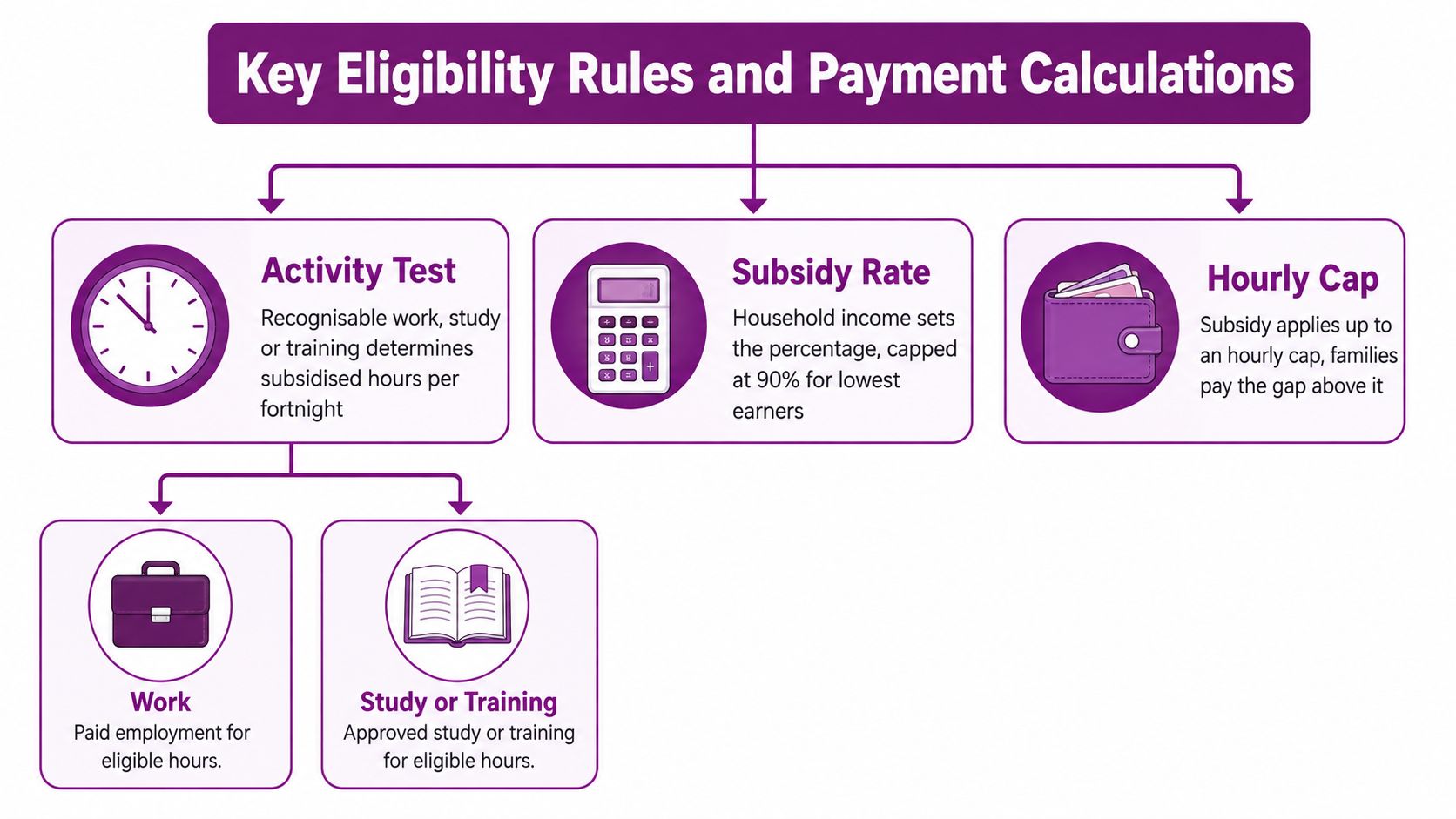
CCS calculations look complicated because several rules operate at once. You can make them easier to understand by checking four things in order: your family's income, recognised activity, the service's hourly fee and whether a higher rate applies for a younger sibling.
Start with recognised activity
The activity test looks at recognised work, study, training and related participation. Under the standard settings, parents undertaking more than 48 hours of recognised activity per fortnight can receive up to 100 hours of subsidised care per child. Activity between 16 and 48 hours provides 72 hours, activity between 8 and 16 hours provides 36 hours, and less than 8 hours generally provides no subsidised hours unless a safety-net rule applies. These settings are outlined in the Family Assistance Guide activity test rules.
For a parent returning to work, the important detail is that the activity test affects subsidised hours, not just the percentage of the fee covered. Keep records of changing shifts, study timetables and training commitments, then update your details when your circumstances change.
A low-income safety net can provide 24 hours per fortnight for families with combined annual adjusted taxable income at or below $85,279, even when they don't meet the activity test. This can matter during a return-to-work transition, irregular employment or a period of interrupted caregiving.
Apply your income percentage
Your household income sets the CCS percentage. In the 2026–27 settings, families earning up to $88,520 can receive 90%, while households above $538,520 receive 0%. Between those points, the percentage tapers by 1% for every $5,000 of income, as explained by the Australian Government's Child Care Subsidy guidance.
The percentage applies to the lower of the service's hourly fee or the relevant cap. It doesn't mean the government pays that percentage of every amount charged by a centre.
Check the hourly cap
For centre-based day care, the 2026–27 hourly cap is $15.19 for children below school age and $13.30 for school-age children. If the centre charges more than the applicable cap, CCS is calculated only up to the cap, leaving the difference for the family to pay.
For second and younger children, the rate can be higher. The additional-child settings start at 95% above $146,437, then step down through 80% and 50% before returning to the standard CCS rate at $370,727 or more. These bands make it important to consider each child's age, care pattern and household income together.
Understand the 3 Day Guarantee
Since 5 January 2026, all CCS-eligible families can access at least 72 hours of subsidised care per fortnight, regardless of activity level. Families with more than 48 hours of recognised participation, certain exemptions or Aboriginal and Torres Strait Islander children can access 100 hours.
The reform helps parents with casual work, study changes or a return to employment, but it doesn't guarantee a place at a particular centre or remove the need to plan attendance. The Starting Blocks explanation of the 3 Day Guarantee is useful for checking how the new baseline applies to your family.
Real-World CCS Examples and Government Data Insights
A family comparing two childcare centres may see similar daily bookings but very different final bills. The difference often comes from how the centre's hourly fee sits against the CCS cap, not only from the family's subsidy percentage. This makes CCS more than a fee rebate. It is a foundation for planning the weekly childcare budget.
Government figures show the scale of this system. The June quarter 2026 childcare subsidy release reported:
- 1,393,620 children from 989,100 families used CCS-approved care.
- Those children attended 15,438 approved services.
- Average attendance was 26.8 hours per week, and the average hourly fee was $13.90.
- The Australian Government paid $3.88 billion in subsidies during the quarter.
These figures describe the wider system, not your personal bill. They do show why families should check both the advertised fee and the portion eligible for CCS. The January 2026 3-Day Guarantee also makes subsidised care a more useful baseline for family budgeting, particularly when work or study patterns change.
A simple Melbourne fee comparison
Consider one child below school age attending a centre-based service. The family's CCS percentage depends on household circumstances, while the hourly cap limits the fee used in the calculation.
| Service fee per hour | Amount used for CCS calculation | Fee above the cap |
|---|---|---|
| $14.50 | $14.50 | None |
| $15.19 | $15.19 | None |
| $18.00 | $15.19 | $2.81 |
The table uses the $15.19 hourly cap for children below school age in the 2026–27 settings. With an 80% CCS percentage, the subsidy on an $18 fee is calculated using $15.19, not the full charge. The family pays its normal share of the capped amount, plus the $2.81 charged above the cap.
That gap can affect the weekly budget quickly. A centre charging above the cap may have a higher out-of-pocket cost than one with a similar session length and a fee closer to the cap. Compare the estimated family gap for the hours you book, rather than relying on the headline fee.
Families can use a childcare subsidy estimator to model likely costs. Ask each centre to confirm its current fees, session length and inclusions. The estimate does not replace Centrelink's assessment, especially if income, activity or sibling circumstances change, but it gives you a practical starting point for enrolment decisions.
How to Apply and Manage Your Childcare Subsidy
Apply for CCS through your myGov account linked to Centrelink. The application records your family details, children, income information and activity circumstances, then Centrelink assesses the entitlement. Once approved, the subsidy is paid to the approved service and appears through your childcare account and fee statements.
The current process is designed to reduce repeated administration. Families generally apply for a 12-month period, rather than submitting a new application every few months. You should still review your circumstances during the year because a change in taxable income, work, study or care arrangements can affect the result.
Complete the application before care begins
A late application can create an avoidable cost. Families will usually need to wait 28 days after applying before CCS starts, so don't assume the subsidy will automatically cover care from the first booked day.
Before your child begins, check that:
- Your child is linked correctly: Confirm the child and carer details in myGov.
- Your service is approved: Ask the centre whether it can claim CCS for the booked care.
- Your enrolment is confirmed: Make sure the service submits the enrolment and you approve it in your account.
- Your income estimate is sensible: An inaccurate estimate can lead to a later adjustment.
- Your activity details are current: Include work, study, training and other recognised participation.
Keep your circumstances updated
A casual worker's hours can move from one fortnight to the next. A student may change subjects, or a parent may begin paid work after a period at home. These changes can alter the number of subsidised hours available, even when the child attends the same centre.
Record your activity in fortnightly terms and review it when your roster or course changes. If you share care between services, check how your total booked hours fit within the available entitlement rather than assessing each service in isolation.
Before signing an enrolment form: Ask the centre to show the full fee, the expected CCS contribution and the estimated gap for your ordinary attendance pattern.
Your provider can explain its statement, but Centrelink remains the place to confirm your formal entitlement. Keep copies of notifications and review statements promptly if the amount looks different from your estimate.
Choosing the Right Early Learning Centre for Your Budget
A lower advertised fee isn't automatically the lower-cost choice. The full comparison includes the hourly gap above the cap, session length, travel, attendance flexibility, educator qualifications, learning program and whether the centre supports your child's next step into kindergarten.

Kids Club Early Learning Centre is a family-owned provider with centres in Springvale South, Dandenong North and Ferntree Gully. Its programs cater for children from six weeks to six years, with dedicated environments for infants and toddlers, VIT-registered teachers and a Reggio Emilia-inspired approach built around inquiry, creativity and collaboration.
When comparing a centre, ask for a written fee statement rather than relying on a verbal daily figure. You'll want to know how the service handles meals, additional activities, kindergarten programs, absences and changes to booked sessions.
Look beyond the daily price
A suitable centre should fit your family's routine as well as your budget. Consider:
- Location: A centre near home or work may reduce daily travel pressure.
- Room transitions: Ask how children move from infant care into toddler and preschool rooms.
- Learning continuity: Check whether the program supports language, social development, independence and school readiness.
- Enrichment: Ask whether music, sport or other experiences are included or charged separately.
- Kindergarten pathways: Confirm how funded kindergarten and pre-PREP options fit within the service's timetable.
Kids Club offers weekly professional music and sports curricula at no extra cost, along with government-funded three-year-old kindergarten and a four-year-old pre-PREP program. Families can review the provider's childcare fees information alongside their own CCS estimate, then ask for a centre-specific calculation.
A visit also tells you what a spreadsheet can't. Notice how educators speak to children, whether rooms feel calm and purposeful, how the outdoor areas are used and whether staff answer questions clearly. The right decision combines affordability with confidence in the daily experience your child will receive.
Watch the centre's approach in practice before making a decision.
Common Misconceptions and Next Steps for Parents
A low income doesn't automatically mean maximum subsidised hours, because activity rules still shape entitlements, although the 3 Day Guarantee now provides a broader baseline. Casual or part-time work doesn't automatically mean no subsidy either, and families should check their recognised activity rather than rely on older advice. The guarantee also doesn't create places where a centre has limited availability.
Review your activity hours, apply through myGov before care begins and ask a local provider for a written fee estimate. Families comparing childcare services near you can then model the actual gap before committing.
Kids Club Early Learning Centre offers flexible early learning from six weeks to six years, Reggio Emilia-inspired programs, qualified educators and government-funded kindergarten pathways across Springvale South, Dandenong North and Ferntree Gully. Visit Kids Club Early Learning Centre to discuss your care needs, understand the fee structure and plan how CCS may fit your family budget.