
A parent in Springvale South might be comparing three different kinder options while checking a work roster, organising school drop-off for an older child and wondering whether “Free Kinder” really means no bill at all. The answer depends on where the program runs, how many hours your child attends and whether you also need long day care.
Government funded kindergarten is the starting point for that decision. It helps eligible Victorian children access a teacher-led, play-based learning program, but it doesn't automatically cover every hour your child spends at a centre. The practical questions are just as important as the policy headline: will the program fit your working week, can your chosen service offer a place, and how will kindergarten funding interact with the Child Care Subsidy?
This guide explains the difference between three-year-old and four-year-old kindergarten, how funding works in sessional kinder and long day care, what enrolment usually involves, and what families should ask before accepting a place. If you're still working out what age preschool is in Australia, keep this guide beside your notes from centre tours and conversations with educators.
Starting the Conversation About Funded Kindergarten
The first useful step is to separate the kindergarten program from the hours of care around it. A three-year-old may attend a funded teacher-led program during part of the week, then need additional care before, after or between those sessions. A four-year-old may receive a larger funded program but still need full-day care while parents work.
That distinction matters in Melbourne's growth corridors, including Springvale South, Dandenong North and Ferntree Gully. Families often aren't choosing between “free” and “paid” care. They're choosing between a sessional kindergarten with separate care arrangements, an integrated long day care centre, or a combination that suits work, study, siblings and travel.
Practical rule: Ask a centre to explain your child's complete weekly schedule, not just the funded kindergarten hours.
Funding can reduce the cost of the kindergarten component, but it doesn't remove every possible charge. In long day care, families may still pay for care outside the funded program, depending on attendance and their Child Care Subsidy circumstances. Sessional services may have a different fee structure, and extras such as excursions or optional services can also be handled differently.
Before you compare centres, write down the answers to four questions:
- What does my child need developmentally? Consider confidence with separation, communication, self-help skills and interest in group experiences.
- How much care do we need? A short session may suit one family, while another needs a child to remain at the centre for most of the working day.
- Which program is available? A nearby centre may have a waitlist, limited days or a different session pattern.
- What will we pay after funding and subsidies? Request a written fee explanation rather than relying on the phrase “Free Kinder”.
A good educator won't expect you to understand every government term immediately. Take your questions to the service, ask how the program runs in a normal week, and use the answers to judge whether the arrangement is realistic for your family.
What Government Funded Kindergarten Really Is
Government funded kindergarten is an early childhood education program supported by the Victorian Government and delivered by an approved early learning service. A qualified early childhood teacher leads the kindergarten program, while educators support children through routines, relationships, play and care across the day.
Victoria introduced free kindergarten programs for three- and four-year-old children at participating services from 2023, and the state uses the same per-child funding rates for funded three-year-old and four-year-old enrolments in 15-hour-per-week programs. The government's longer-term plan is that, by 2029, every Victorian child will have access to two years of play-based learning through a funded kindergarten program. These policy details are set out in the Victorian Government's kindergarten funding information.
The program is different from ordinary childcare
Childcare provides care, supervision, routines, meals and learning experiences across the day. Kindergarten is the teacher-led educational program within that broader early learning setting. In a long day care centre, both can happen in the same room or centre, but they aren't the same thing.
Families should also distinguish kindergarten from Pre-Prep. Victoria is transitioning towards Pre-Prep as a separate expansion of funded preschool hours, with the timing and hours varying as the reform is introduced. It isn't another name for every current kindergarten place, so ask the service which program your child is enrolling in and how it relates to the year before school.
Funded kindergarten can operate in:
- Sessional kindergartens, where children attend set education sessions and families organise other care separately.
- Long day care centres, where the funded kindergarten program sits within a longer day of education and care.
- Community-run services, including cooperative models with their own enrolment and operating arrangements.
The Victorian framework is designed around play-based learning and children's development across communication, wellbeing, identity, learning and community participation. In practice, a teacher might plan experiences that support storytelling, group discussion, block construction, counting, problem-solving and emotional regulation, while educators respond to each child's interests and needs.
Where Child Care Subsidy fits
The Child Care Subsidy is separate from kindergarten funding. It is a means-tested Australian Government payment that can reduce eligible long day care fees. Kindergarten funding supports the kindergarten program, while CCS may reduce the cost of additional approved care.
That distinction is the key to reading a fee statement. If the service tells you your child has a funded kindergarten place, you should still ask how the centre calculates fees for the rest of the day, whether CCS applies, and which charges aren't covered by either arrangement.
Comparing Three-Year-Old and Four-Year-Old Kindergarten
Three-year-old and four-year-old kindergarten are connected, but they aren't identical experiences. The younger program usually gives children time to build confidence in a group, practise communication and develop the social skills needed for more sustained participation. The older program generally places greater emphasis on the transition to school, while still using play as the main vehicle for learning.
Victoria's funding architecture sets three-year-old kindergarten at between 5 and 15 hours per week, with services funded pro rata for the hours they deliver. The state funding guide gives example 15-hour rates of $2,500 per child in a sessional service and $2,000 per child in long day care, while the example 5-hour rates are $833.33 and $666.67 respectively. These are funding amounts to services, not a promise that every family's total weekly bill will equal zero. The Victorian kindergarten funding guide explains the structure.
Four-year-old kindergarten has a minimum 15-hour requirement, or 600 hours per year, for full funding. Victoria is also moving towards Pre-Prep, with funded hours rising from 15 to up to 25 hours per week from 2026 in some areas, and towards 30 hours by 2036, according to the same government guide. Availability and implementation can vary, so families should ask their local service what applies to their child.
| Feature | Three-Year-Old Kindergarten | Four-Year-Old Kindergarten |
|---|---|---|
| Main purpose | Builds confidence, relationships, language and learning through play | Strengthens learning dispositions and supports the move towards school |
| Funded hours | Between 5 and 15 hours per week, funded pro rata | Minimum 15 hours per week for full funding |
| Delivery | Sessional kinder, long day care or community service | Sessional kinder, long day care or community service |
| Family care question | Often needs extra childcare for working hours | May fit more easily into a longer care day, but extra care can still be needed |
| Key decision | Is the child ready for group learning and what schedule is available? | Does the program, timing and care arrangement support the year before school? |
Age eligibility and enrolment timing can affect which year your child enters. Don't rely on a centre advertisement alone. Ask the service to confirm the relevant cut-off, the program name, the available hours and whether the place is funded for your child's circumstances.
How Funding and Free Kinder Work in Practice
The phrase Free Kinder is easiest to understand as funding attached to a participating kindergarten program, not as a guarantee that a child's entire day will cost nothing. In a sessional kindergarten, that funding may remove the main program fee. In long day care, it usually acts as a fee offset while the family continues paying for care outside the funded kindergarten component.
For three-year-old programs, funding can apply across the delivered hours within the 5 to 15-hour weekly range. Four-year-old programs require the minimum funded attendance described above for full funding. The service receives the funding and applies it according to the program's approved arrangements, so ask how that appears on your statement.
Session-based care and long day care are different
A sessional kindergarten may offer a defined education session, with families arranging other care around it. That can work well when a parent is available for drop-off and collection or has another childcare arrangement.
Long day care is designed for families who need a longer booking. Your child may participate in the funded kindergarten program during part of the day, then remain at the centre for meals, rest, indoor play, outdoor learning and other care. The additional hours aren't automatically covered by Free Kinder.
| Cost item | Sessional kinder | Long day care |
|---|---|---|
| Funded kindergarten program | May remove the main kindergarten tuition fee at a participating service | Applied as an offset against the eligible kindergarten component |
| Care outside funded hours | Usually arranged separately by the family | Charged as long day care according to the centre's fee schedule |
| Child Care Subsidy | Generally not the mechanism used for the sessional kindergarten program | May reduce eligible long day care fees for an approved booking |
| Meals and routine care | Depends on the service | Usually part of the long day care fee structure, but confirm inclusions |
| Excursions and special charges | Check the service's policy | Check whether optional or additional charges apply |
| Late collection | May be charged under the service policy | May be charged under the service policy |
The most useful conversation is a written example based on your actual booking. Ask the centre to show the funded hours, the paid care hours, the expected CCS treatment and any likely extras separately. Families can also use a Child Care Subsidy estimator as a starting point, then confirm the result through Services Australia and the centre.
Victoria's long day care guidance states that Free Kinder is a fee offset, and most families will still pay some fees across the week. The state also says that, from 1 April 2026, funding begins from the first day of the month after enrolment is entered into Arrival, with monthly payments scheduled between the 4th and 7th of each month. Check the Victorian long day care Free Kinder guidance for current administrative details.
Enrolling Your Child Step by Step
Start with the centres that make your weekly life possible. A place close to home may be easier than a more distant service with a preferred session pattern, especially when school drop-off, traffic and work start times all compete for attention.
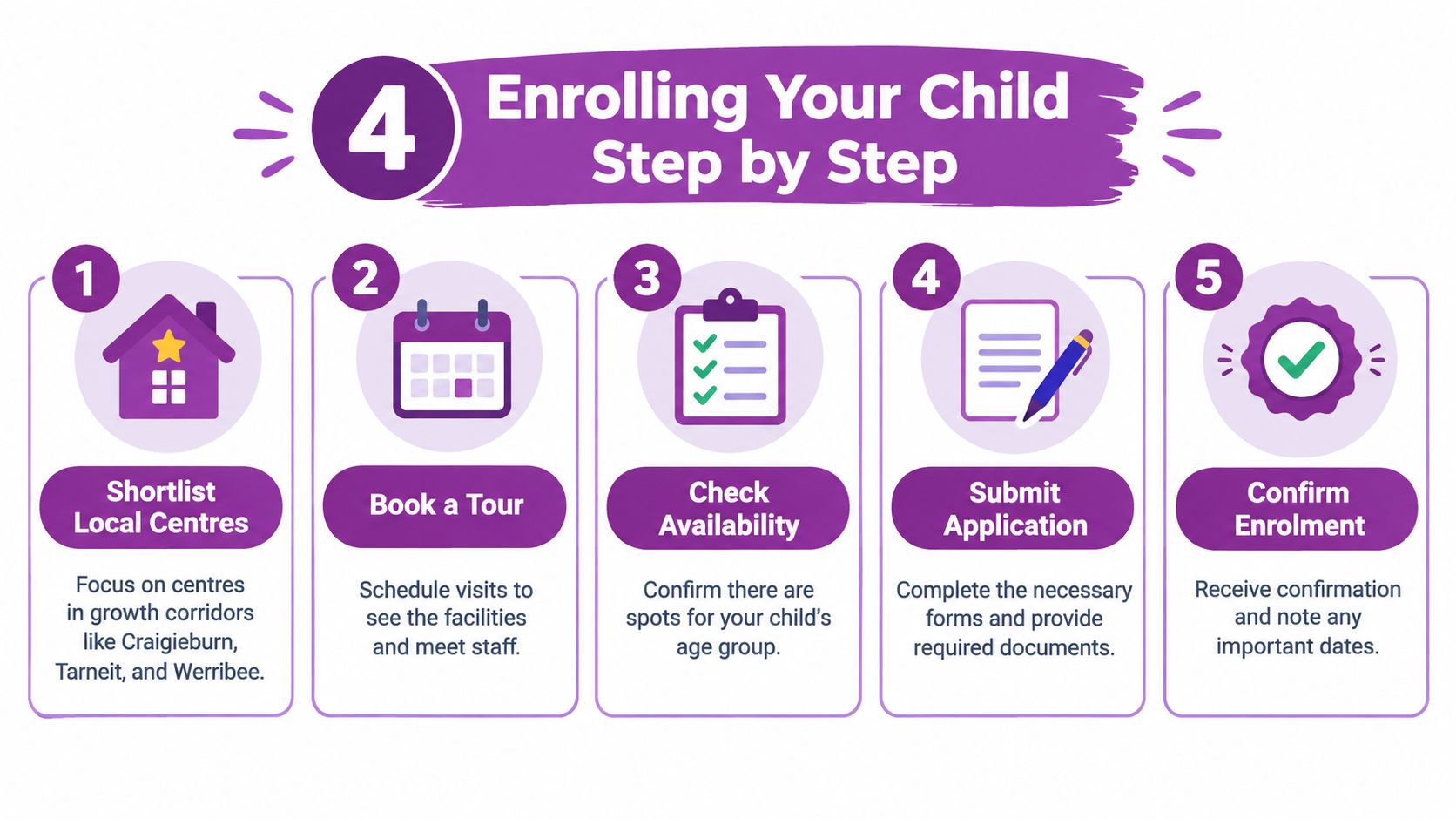
A practical enrolment pathway
- Shortlist local services. Include sessional kinders and long day care centres in your suburb or travel route. Compare program hours, age groups, teacher arrangements, meals, rest routines and availability.
- Book a tour. Visit while children are engaged in the daily program. Notice how educators speak to children, how rooms are organised and whether staff can explain funding without rushing you.
- Check availability. Ask whether a place exists for your child's age group, which days are offered and whether the service has a waitlist. Ask how round-one and round-two offers are handled locally, because processes can differ between councils and services.
- Submit the application. The service may request identification, your child's birth certificate, immunisation information, contact details and documents confirming eligibility or address. Keep copies of everything you send.
- Confirm the placement. Read the offer carefully, return acceptance documents by the deadline and record orientation dates, start dates, fees and cancellation conditions.
Prepare the paperwork and the child
Complete your Child Care Subsidy assessment before care begins if your child will attend long day care. Then ask the chosen service to confirm the kindergarten funding arrangements, the funded hours, the attendance requirements and the way the offset will appear on your account.
For your child, preparation can be simple. Talk about the centre positively, practise opening lunch containers and shoes, read books about starting kinder, and arrange orientation visits if offered. Tell educators about sleep, comfort, communication, allergies, cultural practices and separation worries. Those details help the team create a calmer first day.
Why Funded Kindergarten Builds School Readiness
The value of kindergarten isn't limited to the amount deducted from a family account. A strong program gives children repeated opportunities to practise the behaviours and skills that make group learning manageable, including listening, waiting, negotiating, remembering instructions and asking for help.
A child may show the progress at home before a parent sees it in a formal “school readiness” task. They might tell a longer story, attempt to write their name, sort objects by shape, persist with a puzzle or recover more calmly after frustration. These everyday changes reflect growing language, self-regulation, confidence and curiosity.
Play is purposeful learning
Play-based learning doesn't mean children are left without guidance. Qualified teachers observe children, identify what they are ready to learn and design experiences that extend their thinking. A pretend shop can involve oral language, turn-taking, counting and problem-solving. A construction project can involve planning, collaboration, spatial reasoning and persistence.
The Victorian Early Years Learning and Development Framework supports this broad view of development. It recognises that children learn through relationships, communication, wellbeing, identity and connection with their community. Two years of consistent participation can give children more time to become comfortable with group routines and learning relationships before school.
Families looking for simple ways to continue this work at home can use these school readiness activities as conversation starters rather than turning home learning into formal lessons.
A useful measure: Look for a program that helps your child become an engaged, confident learner, not one that pushes worksheets before your child is ready.
The teacher's role matters. Ask how educators observe learning, share progress with families and support children who need extra help with communication, regulation, transitions or participation. Those answers tell you more about quality than a colourful brochure.
How It Connects With Kids Club ELC Programs
At Kids Club Early Learning Centre, families in Springvale South, Dandenong North and Ferntree Gully can ask how a government funded kindergarten program fits within a longer early learning day. The centres offer a government-funded three-year-old kindergarten program and a four-year-old Pre-Prep kindergarten program, with qualified educators supporting children through the broader care routine.
For a working parent, the day may begin with arrival, breakfast or a settling routine. The teacher-led kindergarten experiences can include group discussions, music, language, creative work, outdoor exploration and intentional play. Later, the child may continue with lunch, rest, small-group experiences and afternoon care, depending on the booked hours.
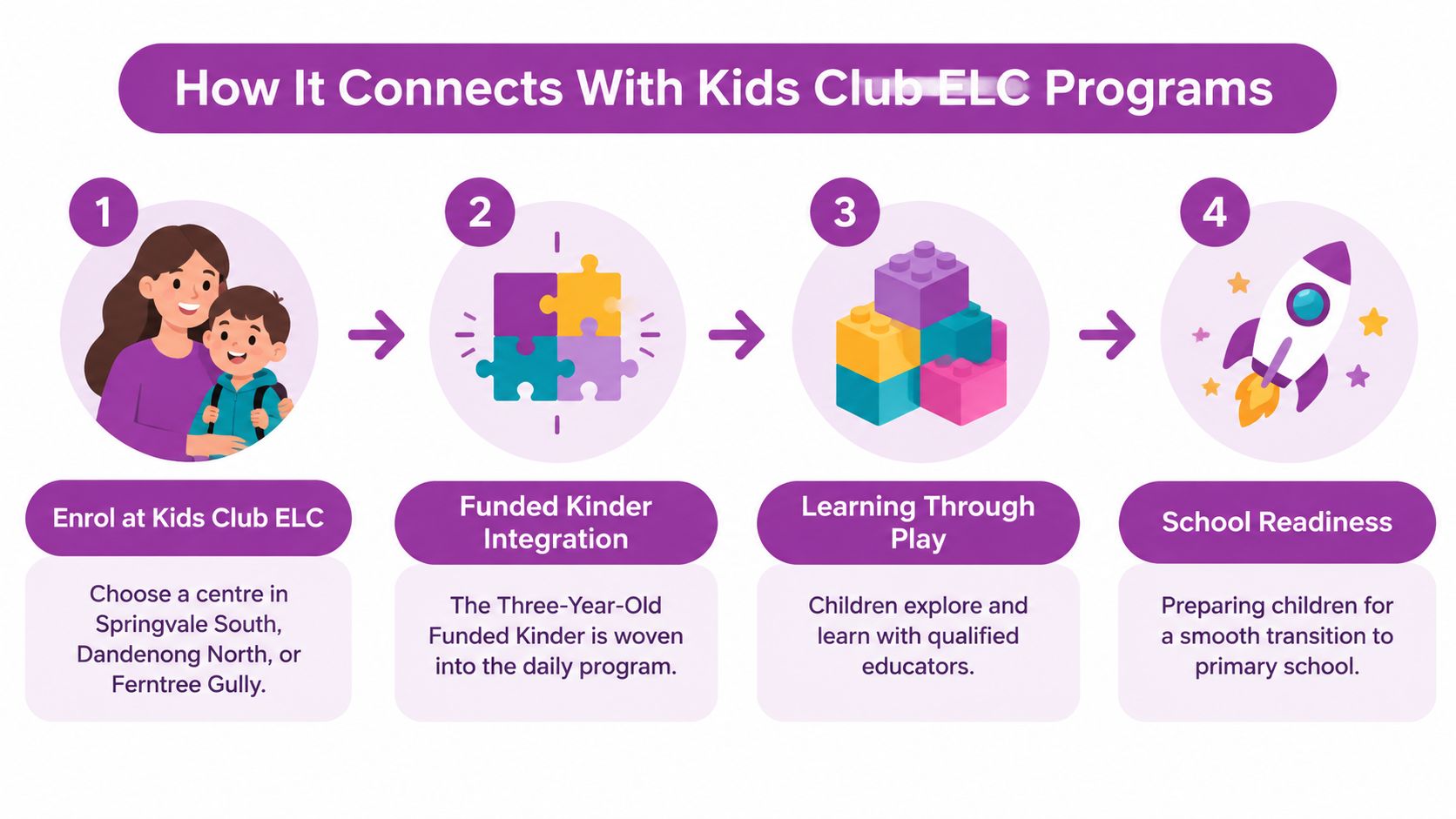
The same physical centre can therefore feel like kindergarten during the teacher-led learning period and long day care during the rest of the day. That isn't a contradiction. The funded program is one part of an integrated early childhood experience, while educators continue to provide care, supervision and learning across the full booking.
Families should ask how the centre records funded attendance, applies the fee offset and explains any remaining gap. It's also worth asking how the service uses the Victorian Early Years Learning and Development Framework, how VIT-registered teachers communicate with families, and how enrichment such as music, language and outdoor learning connects with children's interests.
A tour can make the arrangement much clearer than a phone conversation. Ask to see the room your child would use, meet the teaching team where possible, and request a sample day that reflects your intended arrival and collection times.
Questions Melbourne Parents Ask Most
Does Free Kinder mean I'll pay nothing? Not necessarily. In a sessional setting, the main kindergarten fee may be removed. In long day care, the funding is generally an offset, and families may still pay for additional care hours and other applicable charges.
Can my child complete kindergarten in long day care? Yes, participating long day care centres can deliver funded kindergarten within a longer day of care. Ask whether the service offers the required program hours, which teacher leads it and how the remaining hours are charged.
Can Child Care Subsidy reduce the rest of the bill? CCS is separate from kindergarten funding and may apply to eligible long day care hours. Your family's circumstances and approved care details affect the result, so confirm it with Services Australia and the centre.
What if my four-year-old misses a cut-off? Don't assume your child must start immediately or wait automatically. Ask the service or your local council about the relevant eligibility date, available program and how the timing affects the year before school.
Does a funded kindergarten place guarantee a school place? No. Kindergarten enrolment and school enrolment are separate processes. Contact the school about its own application requirements and deadlines.
How do I compare two local centres? Compare the actual weekly schedule, teacher arrangements, transitions, communication, fees after funding and CCS, and the centre's ability to cover your workday. A centre that offers fewer funded hours but a workable full-day arrangement may suit your family better than a session that creates difficult gaps.
What if our address or family arrangements recently changed? Call the service directly. Shared custody, a new address, updated immunisation records or a change in work hours can affect the documents and arrangements you need to discuss.
Ask for a written fee example before accepting a place. The clearest answer is the one that shows your child's funded hours, additional care hours and expected out-of-pocket costs in the same weekly picture.
Kids Club Early Learning Centre offers government-funded three-year-old kindergarten and four-year-old Pre-Prep alongside long day care in Springvale South, Dandenong North and Ferntree Gully. Visit Kids Club Early Learning Centre to discuss your child's program, funded hours, care needs and enrolment options with the team.