

You're at the door with bottles, a spare sleep sack, and a baby who fed at 6:10, not at the time on the card. Work doesn't start at the same hour every day, a grandparent covers one morning, and you need the room to bend without the day falling apart.
A workable infant daycare schedule is a few fixed handovers, with feeds and sleep moving to the baby in front of you. The flexibility families ask for, and the flexibility a room can staff, are not the same thing. I would rather show you both than hand you a pretty timetable that collapses when three babies need settling at once.
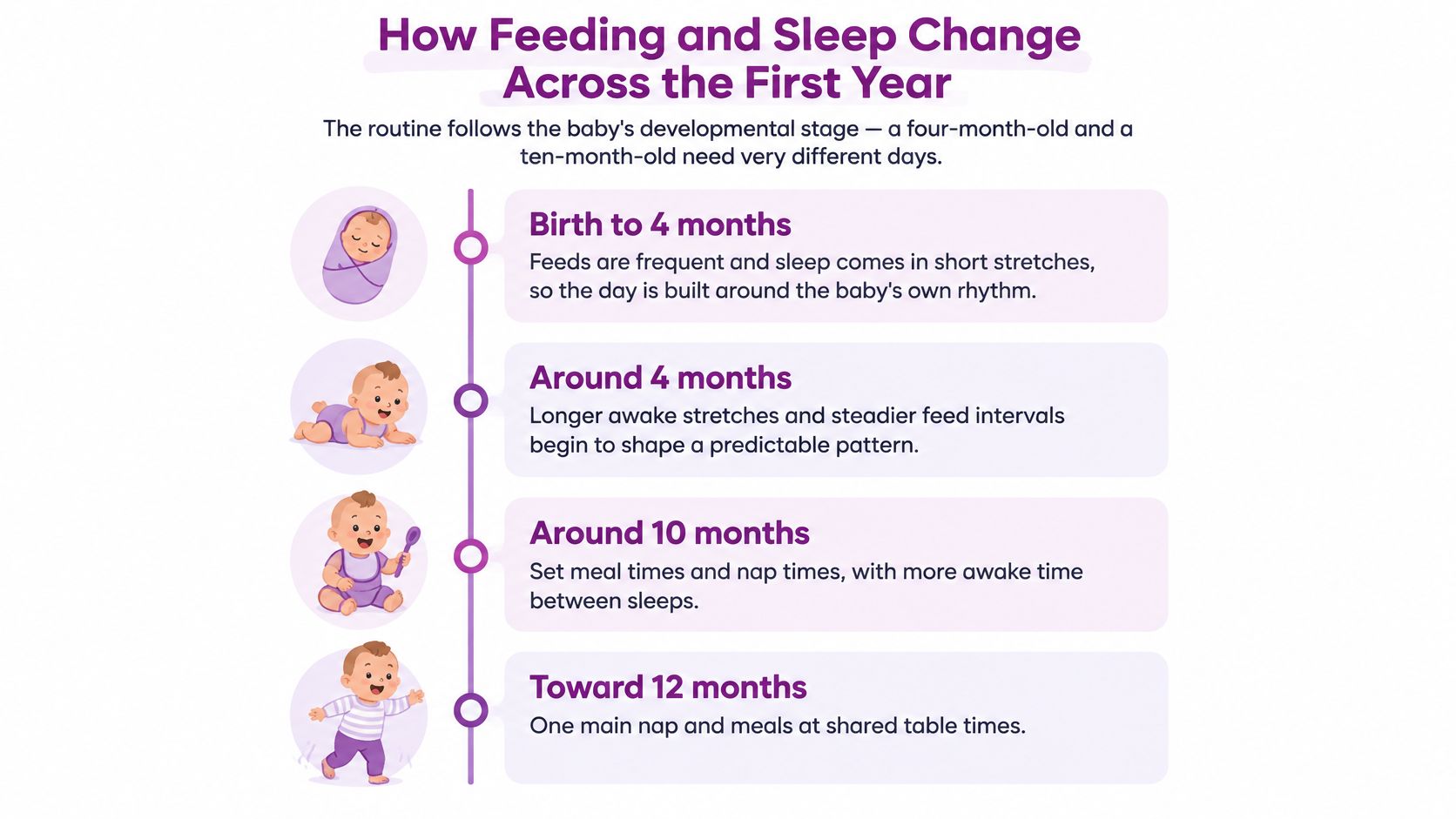
How Feeding and Sleep Change Across the First Year
A four-month-old and a ten-month-old should not share one nap clock. The routine follows the baby's stage. Feeds get fewer, naps join up, and the stretch of awake time grows. Treat the ranges below as a map, not a score. A baby can sit between two bands for weeks.
| Age | Feeds per 24 hours | Daytime naps | Typical awake window |
|---|---|---|---|
| 0 to 3 months | 8 to 12 | 4 to 5 | 45 to 90 minutes |
| 4 to 6 months | 5 to 7 milk feeds | 3 to 4 | 90 minutes to 2.5 hours |
| 6 to 9 months | 4 to 6 milk feeds plus solids | 2 to 3 | 2 to 3 hours |
| 9 to 12 months | 3 to 4 milk feeds plus solids | 2 | 3 to 4 hours |
Birth to six months
Newborns, from birth to three months, often take 8 to 12 feeds in 24 hours and 4 to 5 short daytime naps, with about 45 to 90 minutes awake between sleeps. Say your baby is eight weeks old and fed at 7:00. The next feed is likely around 9:00 to 10:00, and a nap may last only 30 to 45 minutes. A two-hour play block at this age usually ends with a baby who is too tired to settle.
From four to six months, milk feeds often ease to 5 to 7 in 24 hours, naps join into 3 to 4, and awake time stretches toward 90 minutes to 2.5 hours. A morning rest and a midday rest start to look recognisable. That still isn't a group timetable. One baby may be ready at 9:15. Another, awake since 6:40, may need the cot at 8:40.
Six months to the first birthday
From six to nine months, solids sit beside 4 to 6 milk feeds, with 2 to 3 daytime naps and awake windows of 2 to 3 hours. Milk still does the nutritional work. A spoon at morning tea doesn't replace the bottle or breastfeed before it.
From nine to twelve months, many babies move to 3 to 4 milk feeds plus solids, two daytime naps, and awake windows of about 3 to 4 hours. Meals can start to line up with shared table times. Sleep still shouldn't be cut short so a baby "fits" outdoor play.
Practical rule: Match your baby to the nearest band, then ask how the room will shift feeds and naps when the baby moves into the next one.
Compare last week's pattern with the row, not with a neighbour's child. If naps are already dropping from three toward two, say so before the first day. The room day has to be built around that shift, not the other way around.
A Typical Flexible Day for Infants in Daycare
Fixed points hold the day together. Everything between them moves with hunger and tiredness. Arrival and departure stay put. Feeds, sleep and play do not.
| Time | Block | What happens | Timing |
|---|---|---|---|
| 7:30 am | Arrival handover | Parent shares last feed, sleep time and nappy notes | Fixed |
| 8:00 am | Morning feed | Milk intake recorded; solids offered if the baby is around six months or older | Moves with hunger cues |
| 9:00 am | Floor play and tummy time | Short sessions on mats with reading, rattles and sensory play | Flexible |
| 10:00 am | Morning sleep | Familiar settling cues; shorter or longer depending on the baby | Moves with tiredness cues |
| 12:30 pm to 2:30 pm | Afternoon sleep | Second rest window; shorter or longer depending on the baby | Moves with tiredness cues |
| 3:00 pm | Afternoon feed | Top-up feed and cuddles before outdoor time | Flexible |
| 4:00 pm | Outdoor or sensory play | Walks, music and water play in short bursts | Flexible |
| 5:00 pm | Departure handover | Parent receives a written report of feeds, sleep and nappies | Fixed |
The anchors that stay put
Arrival handover is the first anchor. You say when the last feed finished, when the baby last slept, and what the nappy was like. That note sets the first two hours. Without it, educators guess, and a guess at 8:00 am is still wrong at lunch.
Two rest windows come next, one late morning and one early afternoon. The window is offered. The length is not prescribed. Settling uses the same cues the baby already knows, such as a sleep sack, a short rock, or a familiar phrase, rather than a new routine invented for the group.
Floor play sits in short bursts, including tummy time on a mat with a book or a rattle. Departure handover closes the day with a written record of feeds, sleep and nappies, so the evening at home starts from facts, not from a rushed chat in the doorway.
What is allowed to move
The 8:00 am feed is a planning slot, not a siren. A baby who is still full from a 7:15 bottle waits. A baby who woke hungry at 6:00 doesn't sit through songs first. The same logic covers the afternoon top-up, outdoor time and sensory play. Short bursts beat one long block, because an overtired baby won't enjoy water play any more than a hungry one will.
A three-day week and a five-day week use the same shape. What changes is when you walk in and when you collect. A baby who arrives at 9:30 skips the early floor play and may take the morning nap sooner. The handover still happens, and the record still covers every block the baby was here for.
You can tell the day is working when settling doesn't drag on, each feed is written down as it happens, and the baby is alert in play rather than grizzly between sleeps.
If those three signs slip for several days in a row, the times need a look, not a stricter clock.
Staffing Ratios That Shape Feeds and Sleep Times
Staffing is a hard limit, not a preference. A room can't offer every baby a private feed at the same minute, because the people holding those babies are also the people counted in the ratio.

Under the National Quality Framework educator-to-child ratios, children from birth to 24 months need a minimum of 1:4 in every jurisdiction. Victoria also applies 1:4 for children over 24 months and under 36 months, where most other jurisdictions use 1:5. Ratios must be met whenever children are being educated and cared for. Educators counted in the ratio must be physically present and directly engaged. In a mixed-age group, the calculation uses the youngest child.
What eight babies actually require
Say the room has eight infants. The 1:4 minimum means at least two educators directly engaged with those children. If one steps out to warm a bottle or walk a toddler to another room, the arrangement left behind still has to keep supervision and the ratio intact. Hoping the second educator "keeps an eye" while also settling three babies isn't a plan. It's a gap.
That is why feeds and settling are staggered. Nappy changes, outdoor moves and bottle preparation are high-attention tasks. Stacking them at 10:00 means somebody waits, and the baby who waits is often the one who then won't sleep. A coverage plan names who stays in the room during breaks. A headcount happens at every transition, including the walk to the veranda and the walk back.
A centre that quotes a lower ratio in the baby room has more room to stagger those tasks. The legal floor doesn't move just because a family would prefer all naps at noon.
Ask two questions before you enrol.
- Who stays in the room when an educator leaves to prepare a bottle or take a break?
- How are feeds ordered when several babies are hungry in the same half hour, and who decides that order?
If the answers are vague, the timetable on the wall is decoration. The actual schedule is whoever can be spared.
How the Day Follows Your Baby
A family arrives with a home routine that works. Bottle at seven, nap at nine, a second sleep after lunch. They want that clock copied into the cot room, and a centre cannot promise identical times. What it can promise is a familiar response inside a staffed group day, with sleep recorded and talked through rather than pinned to one nap bell. Closing the gap between the home clock and the room starts with what you hand over in writing.
Before the first day, hand over four things.
- Feeding intervals and hunger signs. Note how long a feed usually lasts and what "hungry" looks like for this baby: rooting, a particular cry, hands at the mouth.
- Sleep cues and the home settling method. Yawning, a stare into the middle distance, or rubbing an ear all mean different things. Name the method that works, whether that is a pat, a rock, or being put down awake.
- Comfort objects. A sleep sack or a muslin from home does more than a new toy on day one.
- Medical needs, allergies and diet. The tour booking form asks for the child's date of birth, a tentative start date, and any special needs such as allergies or dietary requirements. Put the same detail in the handover, not only on the form.
A Sax Institute evidence check on sleep and settling links consistent sleep routines with longer sleep, shorter time to fall asleep, earlier bedtimes and fewer night awakenings. It does not crown one order, such as feed then play then sleep, as the right sequence for every baby. Anchors stay predictable: arrival check-in, feeds, rest opportunities, nappy checks, floor play and the departure handover. The clock times of sleep and milk shift with cues.
Why one nap bell fails babies
ACECQA guidance on sleep and rest requires services to weigh each child's age, developmental stage, individual needs, family preferences and cultural practices, to record sleep, and to tell the family. A fixed sleep block for the whole room sits uneasily with that obligation. Two babies the same age can need very different amounts of daytime sleep, so a timetable built for the group will wake some children early and hold others awake past their window.
Waking a settled infant so the room can start lunch is a staffing convenience, not responsiveness. If your baby sleeps earlier or longer than the usual window, the useful move is to record the time and trial that shift for a week. Wake the baby for an agreed feed or a medical need. Not to match the group clock.
Record planned times and actual intake on separate lines. A late nap that wrecks the next settle, or a missed feed that shows up as distress in play, only becomes obvious when the two columns sit side by side.
Breastfeeds, expressed milk, formula, solids and safe-sleep checks belong on the same daily note. Planned opportunities and what happened are different facts, and both matter. A gradual start with the same caregivers lets the baby meet familiar faces before the week gets long. Care routines sit next to learning, including the experiences set out in the centre's scope and sequence, and a baby who is due a feed does not wait for a group experience to finish.
Confirm the first review at handover, with a date. A vague "we'll see how it goes" is how small mismatches run for months.
Days per Week, Subsidies and Fitting Work Hours
A three-day subsidy may help with costs, but it does not set the days or hours a centre can offer. Plan around your work pattern and your baby's needs, then check that the required sessions are available.
National figures can help put a weekly plan in context. In the December quarter of 2021, 47.7% of Australian children aged 0 to 5 used approved childcare, and centre-based day-care users averaged 31.3 hours a week, about three days, according to the December quarter 2021 early childhood report. The September quarter 2020 report recorded a centre-based average of 30.7 hours. These figures cover children aged 0 to 5, not infants alone, and predate 2026. Treat them as context, not a recommended schedule.
Subsidy hours are not a place in the room
From 5 January 2026, eligible families can access at least 72 hours of subsidised care per fortnight under the Child Care Subsidy 3 Day Guarantee, regardless of how much a parent works or studies, as set out by Village Education's guide to the 3 Day Guarantee. The guarantee does not reserve a place, remove the gap fee or ensure that a centre can offer your preferred days and start times. Centre-based services may not offer non-standard hours or care before 7 a.m., so check opening times against your actual work hours.
The Kids Club Early Learning Centre enrolment form asks for a tentative start date and the days required, with Monday to Friday as the options. List the days you need, then ask whether the available sessions can accommodate your working hours. Subsidised hours and a staffed infant place are separate considerations. Use the Child Care Subsidy estimator to check how the subsidy might apply before treating eligible hours as confirmed care.
| Pattern | What it looks like | Continuity |
|---|---|---|
| Regular attendance | The same weekdays each week | Familiar educators can follow the baby's cues and care notes across the week |
| Alternating schedule | Different days from week to week | Clear handovers help educators pick up the latest feeding and settling information |
| Shorter settling-in | Fewer or shorter sessions before longer days | Care notes carry forward, while the baby may need time to settle after a gap |
Regular days make it easier to build familiarity. Alternating days can fit rotating shifts, but each handover needs to make the latest care information clear. A shorter settling-in block gives a baby time to become familiar with the room before longer sessions begin. After a gap, allow for the possibility that settling may take time again.
Book a Tour and Trial the Schedule Before You Commit
Don't lock a full week from a brochure. Book a tour, watch a feed and a settle, and trial a shorter session before you commit to every day you think you need.
Kids Club Early Learning Centre runs infant and toddler programs for children from 6 weeks to 3 years, across three centres in Springvale South, Dandenong North and Ferntree Gully. The Ferntree Gully baby room is staffed at 1:3, which is tighter than the legal 1:4 floor and gives more room to stagger bottles and sleeps.
On the tour, ask three questions and write the answers down.
- How is the infant day structured across feeds, sleep and play, and which parts are allowed to move?
- What happens when a baby sleeps earlier or later than the rest of the room, and who decides not to wake them?
- How does settling-in work for the first weeks, including who the baby will see on those days?
A shorter trial, even a couple of hours, shows you the handover in action. At the end of the first fortnight, check three things in writing: feeds and sleep recorded at each block, the baby settling with familiar educators, and the times still making sense as the baby changes. Bring the handover notes to the tour, and leave with a review date, not a promise to "play it by ear".
You can compare programs and locations on our childcare services page, then book the visit for a day you can stay long enough to see a feed and a rest, not only the foyer.
Kids Club Early Learning Centre offers nurturing infant and toddler care from six weeks, with days built around each baby's feeds and sleep rather than one room clock, across Springvale South, Dandenong North and Ferntree Gully. If you're weighing days, settling-in and a timetable that can be staffed, bring your baby's current pattern and talk it through on a tour. Visit Kids Club Early Learning Centre to book a time and agree the first review before you commit to the week.