
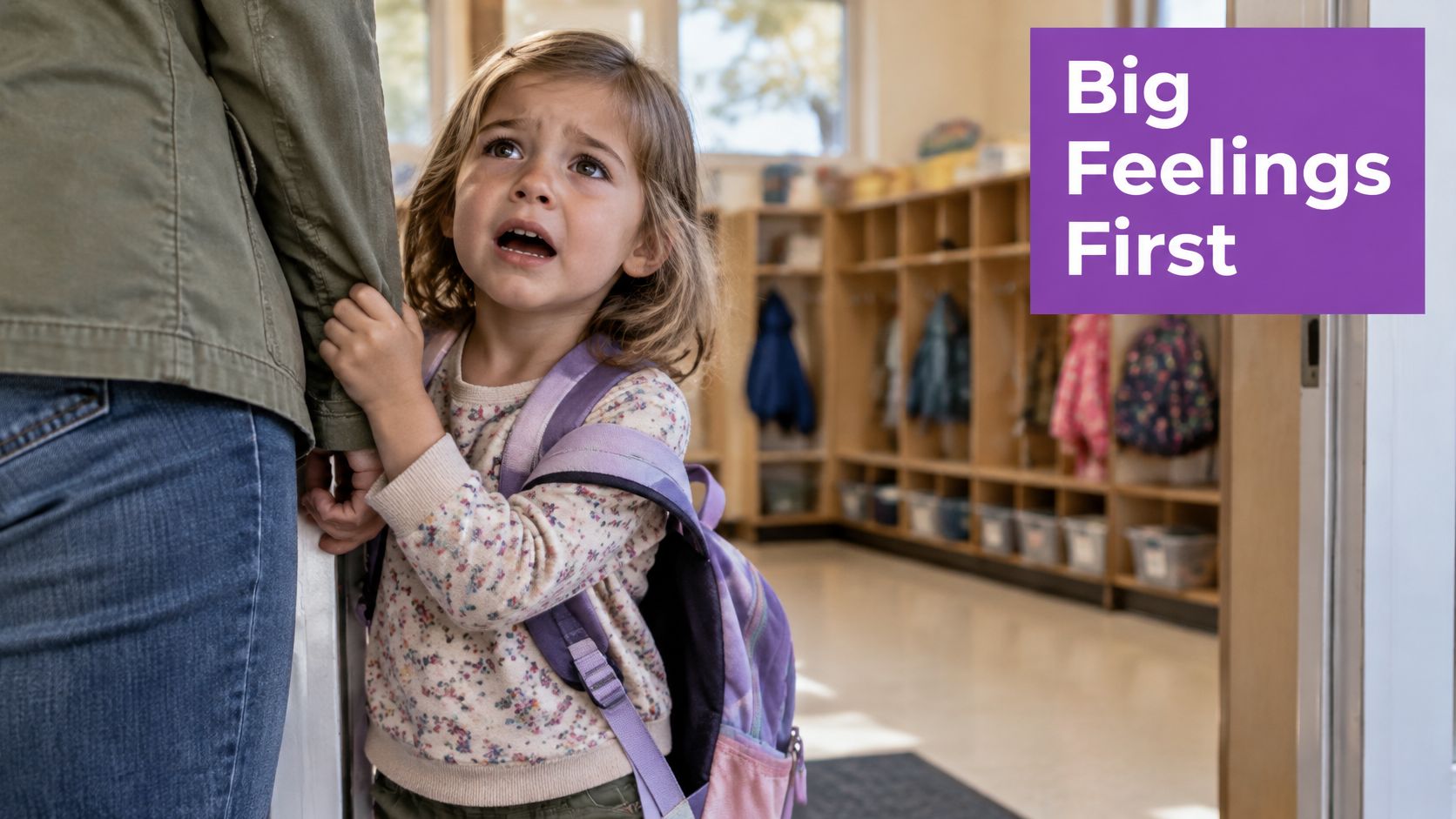
Your child sings the alphabet on the drive to kindergarten, then grips your jacket when it's time to say goodbye. At that moment, being ready for school feels less about knowing letters and more about feeling safe enough to step inside.
Why the Kindergarten Door Still Matters
Say a four-year-old arrives knowing the names of every dinosaur in their backpack, but freezes at the classroom door. An educator crouches beside them, acknowledges that goodbye feels hard, and offers a familiar job: carrying the watering can to the garden. The child doesn't need a worksheet. They need a relationship, a predictable routine and a manageable way to join the day.
A school readiness program for preschoolers should make room for that kind of learning. It's preparation for participating in an unfamiliar social world, not a crash course in behaving like a primary school student.
A broader picture of readiness
In 2021, approximately 55% of children were developmentally on track across all five domains when they began full-time school, leaving almost 45% not on track across every domain, according to the Australian Early Development Census national trends report. The report also associates preschool attendance with stronger developmental outcomes, particularly in language and cognitive skills, and communication and general knowledge.
Those findings don't turn an uncertain goodbye into a warning sign. They remind adults to look beyond the skills that are easiest to recite or display on paper.
Readiness includes having enough physical confidence to explore, enough language to express a need, and growing capacity to manage feelings. It also includes joining other children, accepting help and staying curious when something doesn't work immediately.
A useful starting point: Ask what helps a child participate, rather than what the child can perform on demand.
At the door, progress might mean accepting an educator's hand. On the mat, it might mean contributing an idea. In the sandpit, it might mean asking for a shovel instead of snatching one.
None of those moments requires a pass-or-fail judgement. They give families and educators practical information about the experiences, relationships and support a child needs before Prep.
Five Domains a Readiness Program Builds
Five school-readiness domains and what programs practise
| Domain | On track | What the program practises |
|---|---|---|
| Physical health and wellbeing | 78% | Outdoor play, coordination, toileting and opening lunch containers |
| Social competence | 74% | Joining group play, turn-taking and cooperating with peers |
| Emotional maturity | 75% | Naming feelings, waiting, and settling after frustration |
| Language and cognitive skills | 82% | Stories, mark-making, counting and patterns inside play |
| Communication and general knowledge | 76% | Asking for help, retelling ideas and talking about the world |
The individual-domain percentages above, alongside an overall figure of 53% on track across all five domains, are reported in the Australian family school-readiness study published in Early Childhood Education Journal; they describe national school-entry outcomes, not targets for an individual kindergarten class. The study also describes parents' practical concern with children managing the unfamiliar physical and social world of school.
That distinction matters. A child might confidently explain how a volcano works but struggle to manage a lunch container or enter a game already underway. Strength in one area doesn't mean support elsewhere is unnecessary.
What the domains look like up close
Physical health and wellbeing includes the everyday demands of participation. Climbing, balancing and manipulating playdough offer opportunities to practise coordination, while accessible toilets and patient guidance allow children to attempt self-care without being rushed.
For social competence, watch what happens when a child approaches a busy block corner. An educator might help them notice an available role, such as delivering blocks for the bridge, rather than telling everyone to share.
Emotional maturity becomes visible when the bridge falls. The useful question isn't whether the child ever becomes upset, but what support helps them recover and try again.
- Language and cognitive skills: A pretend café gives children reasons to make marks on an order pad, count cups, notice patterns and listen to a customer's request.
- Communication and general knowledge: A child explains why the garden needs watering, asks where a missing tool belongs, or tells an adult that something hurts.
These areas overlap during ordinary play. Exploring personal and social capability can help families recognise how relationships, emotional understanding and everyday participation fit together.
Observation without ranking
An educator's record should describe something useful: the child asked to join a game after an adult helped them find the words. That tells a family much more than a broad label such as confident or shy.
Families can contribute equally specific information. Perhaps their child manages the bathroom independently at home but finds an unfamiliar toilet noisy or confusing. The response should address the setting and the task, not assume the child lacks the skill.
The domains are a way to organise support, not rank children. They help educators notice quieter needs alongside obvious strengths, while keeping the whole child in view.
Daily Practices That Grow Skills Through Play
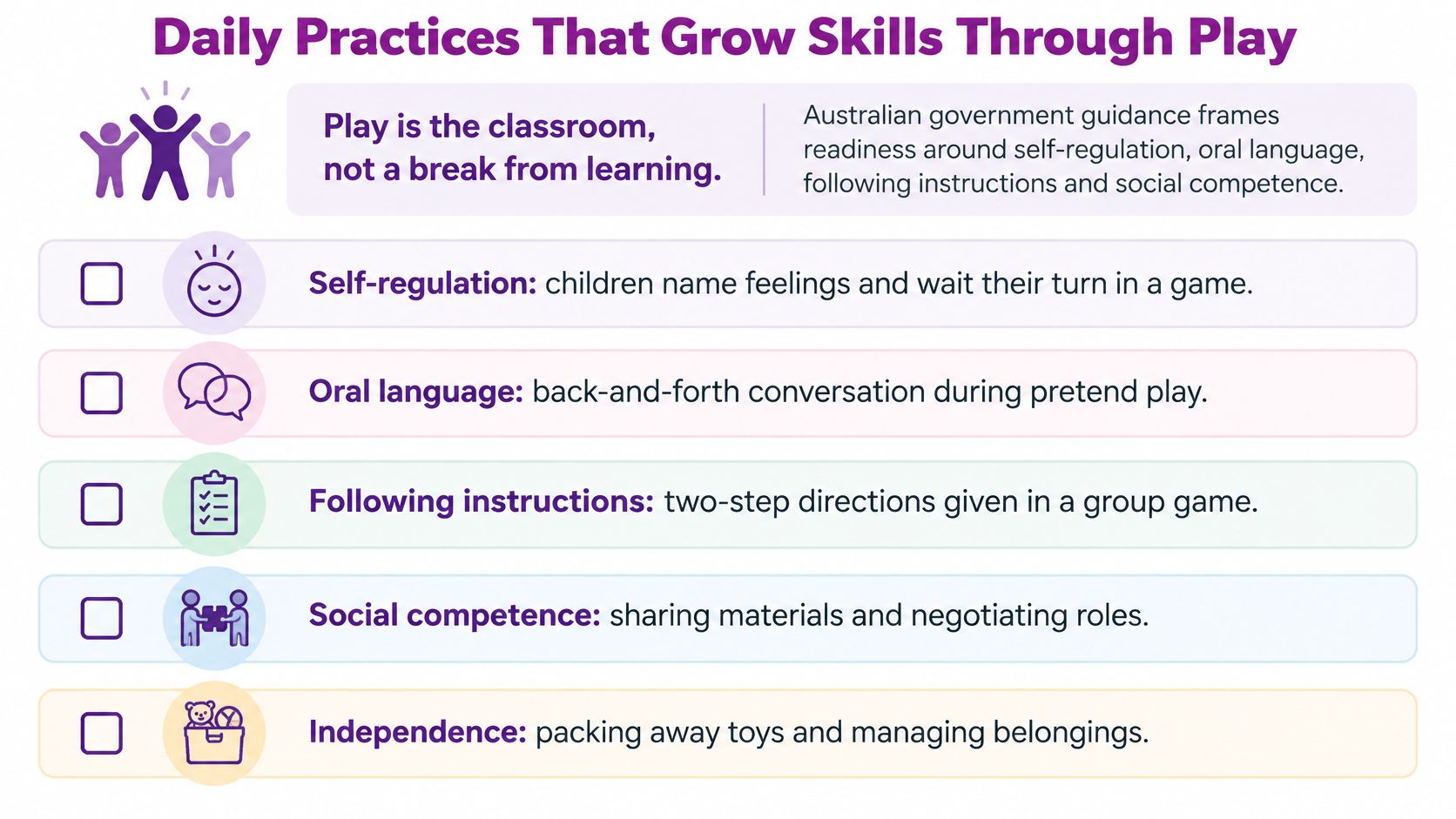
At the water trough, children have a problem: everyone wants the hose. An educator could settle the dispute immediately, or help the group work out a sequence, explain their ideas and tolerate a short wait. The second approach keeps the play moving while making the learning intentional.
In an Australian Government discussion of school readiness, readiness includes self-regulation, oral language, following instructions, social competence, emotional maturity and an approach to learning. Alphabet recall alone doesn't capture those capabilities.
Small routines with a clear purpose
Intentional play-based learning in early childhood doesn't mean leaving learning to chance. Educators can build purposeful practice into experiences children already want to join.
- Make the day visible. A picture schedule shows that outdoor play comes before lunch. A child can check what happens next instead of depending entirely on spoken reminders.
- Practise taking turns. In a simple matching game, the educator models how to watch another player and stay involved while waiting.
- Invite story retelling. After a picture book, children use puppets to recreate the problem in their own words. The educator prompts without demanding a memorised version.
- Name feelings in context. When a tower collapses, an adult acknowledges disappointment and helps the child choose between rebuilding, seeking help or taking a pause.
- Solve shared problems. At the trough, children propose who holds the hose and how others can fill their buckets. The educator supports negotiation rather than supplying every answer.
- Prepare for transitions. Before pack-up, children receive a clear warning and a concrete finishing task, such as parking the trucks beside the shed.
The adult's role changes with the child's needs. Sometimes it means modelling the words; sometimes it means staying nearby long enough for the child to attempt the next step.
Record what actually changes
Useful observations capture behaviour: a child follows a request to collect their hat and meet at the gate, stays with a difficult puzzle, seeks help, or enters peer play. A portfolio can include educator notes, drawings, photographs of constructions, the child's explanation and family input.
Play is the learning environment. The educator's planning makes the practice deliberate.
Replacing these opportunities with long adult-led lessons can leave less room for initiative and conversation. Explicit guidance still belongs, but it should help children do something meaningful.
On a visit, ask an educator to show where children practise waiting, talking and helping themselves during an ordinary session. Their examples should be recognisable in the room, not confined to a program brochure.
A Two-Year Path Before Prep
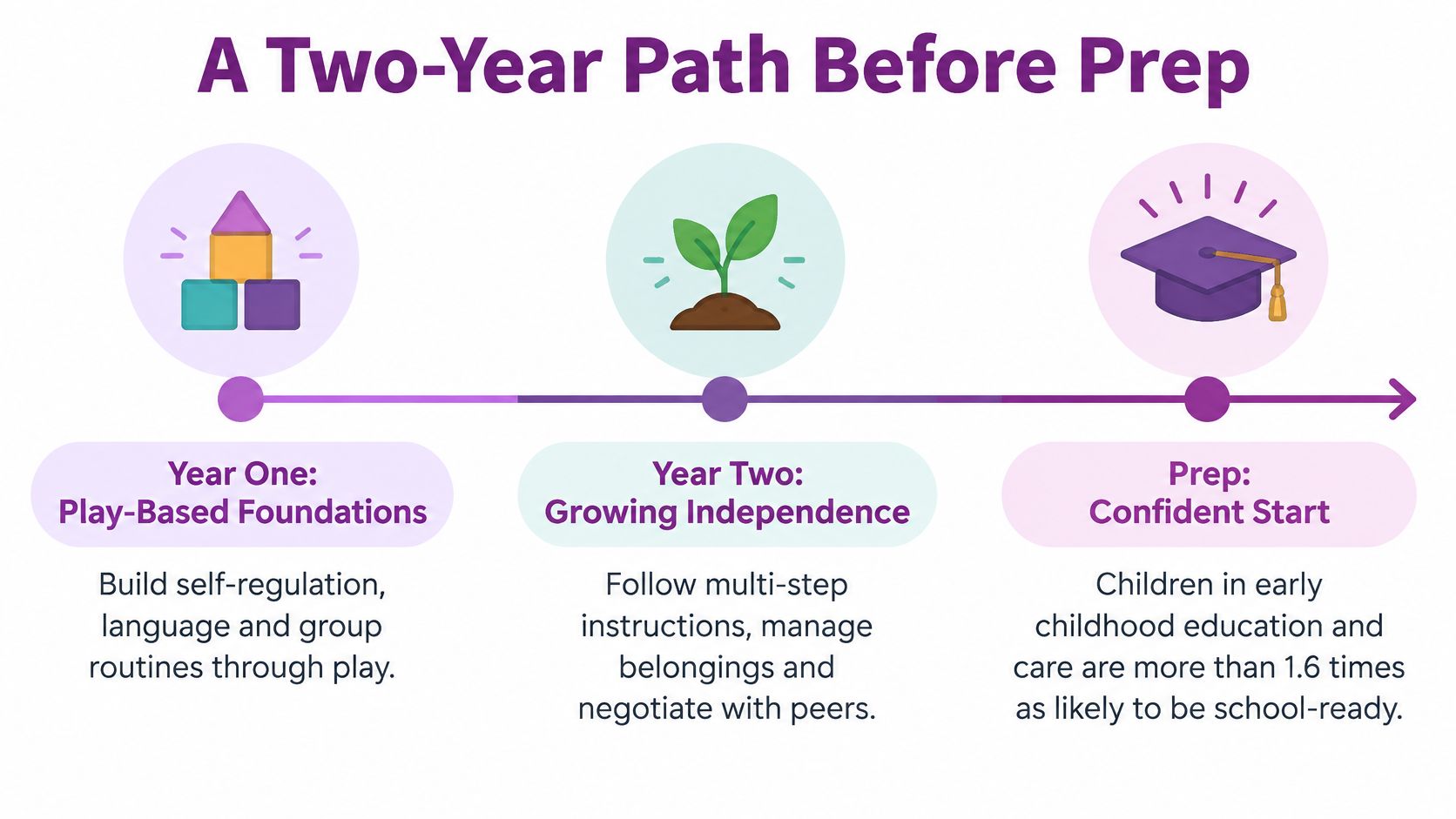
Children attending early childhood education and care were more than 1.6 times as likely to be school ready, defined as on track across all AEDC domains, while high-quality preschool attendance for two to three years was associated with children being nearly eight months ahead in literacy compared with children who hadn't attended preschool, according to the Australian Government's incoming ministerial brief. These are group findings, not promises about an individual child's progress.
The practical case is for sustained opportunities, rather than a hurried academic burst before school. Children need time to become familiar with people, revisit challenges and use developing skills in different situations.
How a readiness program changes across two kindergarten years
| Year | Main focus | What increases |
|---|---|---|
| Three-year-old kindergarten | Communication, independence, self-regulation, motor coordination and curiosity through play | Short routines, sensory exploration and help-seeking |
| Four-year-old year before school | Collaborative inquiry, phonological awareness, mark-making, oral narrative, counting and patterns | Longer projects, sustained attention and transition notes for school |
Build complexity without rushing childhood
In the earlier year, a gardening experience might involve touching soil, carrying a small watering can and asking for another turn. An educator provides familiar language and manageable responsibilities.
Later, children might plan what to plant, draw signs, compare growth and dictate an account of what happened. The subject stays engaging, but the expectations become richer: remembering a plan, listening to competing ideas and returning to an unfinished investigation.
An explanation of three-year-old kindergarten can help families consider the earlier year as a foundation in its own right, rather than merely waiting for the year before school.
Ask what becomes more demanding
Educators can begin with baseline observations, review progress each term and adjust the level of support. Transition information should explain what helps the child participate, not just list completed activities.
For example, a child may produce a detailed spoken story while needing an adult to write it down. Another may draw an elaborate plan but need support to explain it to a group. Both can take part in a shared project without completing identical work.
- Look for greater depth: Children revisit questions, test ideas and explain their thinking.
- Look for purposeful literacy: Names, signs, rhymes and stories serve a real activity.
- Question extra sitting time: A longer mat session isn't, by itself, evidence of a more advanced program.
Schoolification means importing formal school expectations into preschool without enough regard for development. A thoughtful progression adds challenge while preserving movement, choice and the satisfaction of finding something out.
What Readiness Looks Like on an Ordinary Day
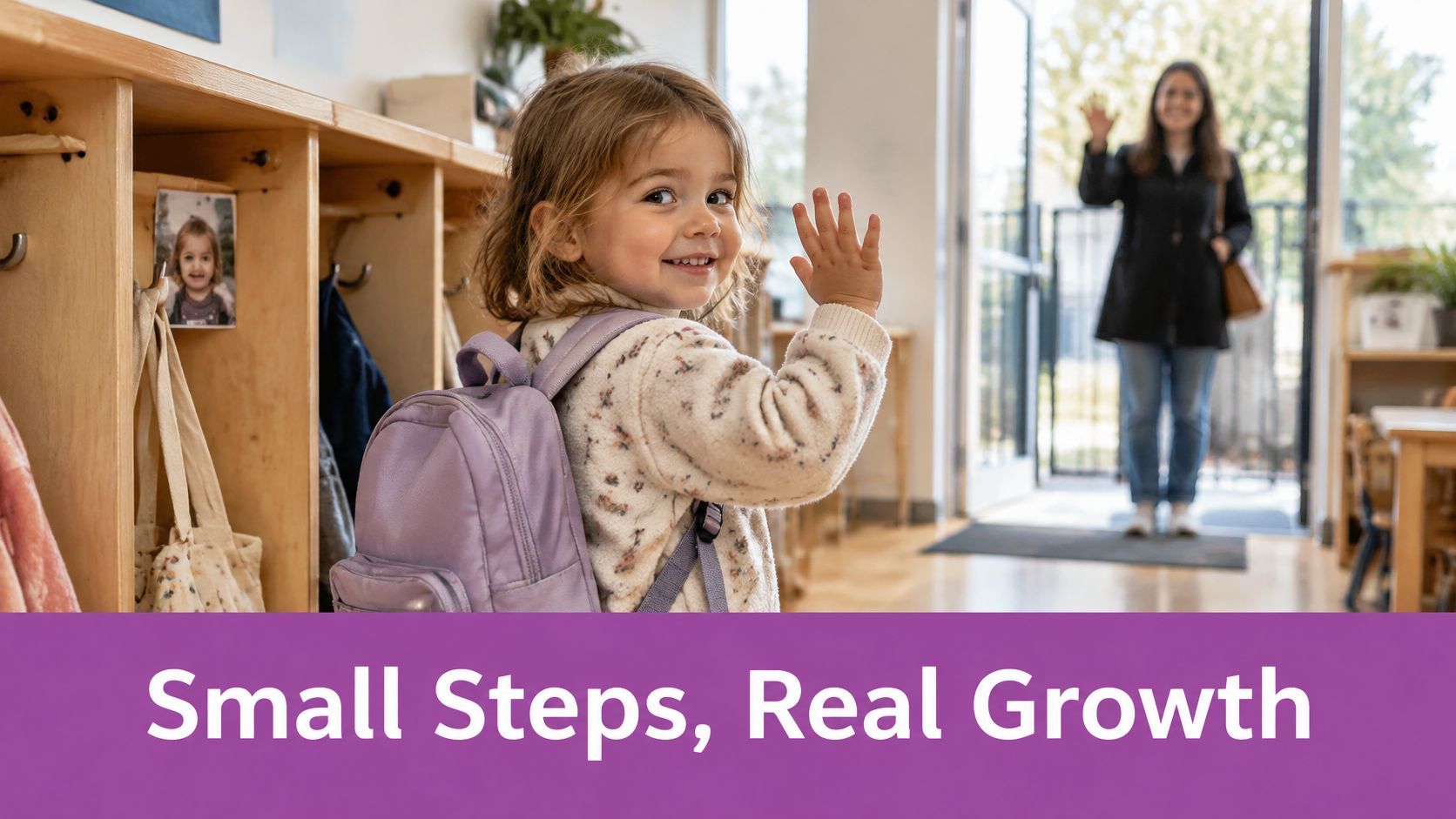
At arrival, a child hangs their bag beneath their photo and takes out their drink bottle. Their parent follows a familiar goodbye ritual, then leaves while an educator helps the child choose where to begin. The wave may still be wobbly. Participation doesn't have to look effortless.
At home, a useful echo is letting the child manage an everyday object without immediately taking over. Place a lunch container within reach, let them attempt the catches, then show the difficult movement if they need help.
On the mat
During group time, the child watches a talking stone move between classmates. When it reaches them, they retell the part of a story where the dog escaped through the gate. They leave out the ending, and the educator accepts the contribution before inviting another child to add an idea.
The important detail is that the child has something to communicate and space to communicate it. A polished performance isn't necessary.
- Try a connected home task: Ask your child to put on their shoes, then collect their drink bottle. If they lose track, help them return to the request rather than treating it as a test.
- Leave room for their account: At dinner, ask what happened during an activity and follow their answer with a genuine question. Don't turn the conversation into a quiz.
In the outdoor space
Later, children disagree over a bike. One stamps a foot; the other grips the handlebars. With an educator nearby, they name their frustration and agree to use a timer so each knows when a turn will finish.
At the park, a parent can support the same kind of transition by explaining what will happen before leaving. A final slide followed by collecting belongings gives the child a concrete sequence to follow, while still allowing disappointment.
Notice the recovery, not just the upset. What helps your child return to the activity or move on?
An educator might record that the child accepted the timer after adult support and returned the bike when prompted. That observation identifies both progress and the help still needed.
A child who reads familiar words may still find these moments difficult. Families can share what works at home, such as a visual reminder or a quieter goodbye, so adults aren't working at cross-purposes.
Choose an ordinary routine to watch over the coming week. Notice what your child attempts independently, how they communicate and what helps after frustration, without adding a new set of lessons to family life.
When a Child Needs a Different Start
A child covers their ears during group time and moves away from the mat. The immediate question shouldn't be how to make them sit like everyone else. It should be what makes the experience uncomfortable, and how they can participate differently.
Readiness includes preparing the environment for the child. That may mean a quieter arrival, visual communication, a predictable place to sit, sensory adjustments or a different way to contribute.
In 2024, Victoria funded 4,945 children to access Early Start Kindergarten or Access to Early Learning and supported 1,257 kindergarten services through Kindergarten Inclusion Support, according to the Victorian Department of Education's departmental objectives reporting. These supports underline why a single pathway won't suit every family.
Begin with an inclusion conversation
Children with disability, developmental delay, trauma, limited English or a different communication style should be planned with, not around. A child's way of communicating or responding to a busy room shouldn't automatically be treated as a behaviour to eliminate.
- Bring concrete observations. Describe what happens before a difficult moment, what your child does and what helps. Include strengths, interests and successful situations.
- Connect the adults. With your consent, kindergarten staff, receiving school staff and relevant practitioners can share useful strategies instead of starting again separately.
- Seek relevant input. Discuss whether allied-health advice would help clarify communication, movement, sensory or participation needs. An inclusion conversation isn't a diagnosis.
- Rehearse the unfamiliar. Plan visits, photographs of important spaces or visual routines that make the school day easier to anticipate.
For a child learning English, participation may be easier to recognise through gesture, play and communication in their home language. Families should be invited to explain those abilities rather than having them overlooked.
Make the plan specific
Preschool attendance alone doesn't remove every barrier. Consistent access, quality interactions, culturally safe practice and coordination all affect how useful the experience is for a particular child.
A workable transition plan names the adult responsible for coordinating information and describes the adjustments to be tried. It also includes a way to check whether those adjustments help.
For example, moving from a crowded doorway to a quieter entry point is a practical change. Writing that the child needs to become more confident doesn't tell anyone what to do.
Families should leave the conversation knowing who will act, what will change and how progress will be discussed. The aim isn't to make every child look ready in the same way, but to create a realistic route into belonging and learning.
Choose a Program and Book a Visit
After a tour, it's easy to remember the bright room and forget what happened inside it. Before deciding, write down a moment when an educator helped children think, communicate or manage something for themselves.
A useful comparison starts with the teaching you could observe. Did an adult give children time to respond? Was a disagreement handled with guidance? Could a child find their belongings without waiting for someone to do everything?
Compare the experience, not the display
Use these questions to organise your impressions:
- Purposeful play: Could educators explain what children were practising during an activity, beyond saying they were having fun?
- Developmental progression: Was there a clear difference between the earlier kindergarten year and the year before school?
- Useful communication: Could staff describe how observations become information families can use?
- An inclusive response: Could the team explain how it would approach your child's particular participation needs?
A display of matching worksheets tells you little about those questions. A child's construction plan, their explanation and an educator's note about how they revised it can offer a much clearer picture.
A local option to explore
At Kids Club Early Learning Centre, we offer government-funded three-year-old kindergarten alongside kindergarten programs for children moving towards school, using a Reggio Emilia approach centred on inquiry, creativity and collaboration. Our weekly professional music and sports curricula are included at no additional cost, offering further opportunities to practise listening, coordinated movement and participating with others.
Our centres are in Springvale South, Dandenong North and Ferntree Gully. For families comparing options across Melbourne's south-east and eastern suburbs, a visit allows you to consider the environment as well as the practical journey.
During the visit, watch a transition if possible, ask how progress is shared with families and describe something your child finds difficult. Listen for a practical response rather than a guarantee that every child will be ready on the same timetable.
Our tour booking form asks for your child's date of birth and a tentative start date, so have those details in mind. Afterwards, compare what you observed with your child's developmental needs, not with the size of a take-home worksheet folder.
At Kids Club Early Learning Centre, we offer kindergarten learning through inquiry, creativity and collaboration to support children's growing independence, language and participation. Visit Kids Club Early Learning Centre to book a tour at Springvale South, Dandenong North or Ferntree Gully, and bring your questions about what a school readiness program could look like for your child.