
You're collecting your child after care, and they're keen to show you a crooked block tower. The educator mentions persistence and cooperation, while you're wondering whether they're learning enough, whether another day would help, and what you should notice at home.
That tower can tell you something useful, but not because it's tall or tidy. The learning might be in how your child changed the base after it fell, asked a friend for a block, or stayed with a frustrating task. Early learning outcomes become meaningful when educators connect everyday moments with growing capabilities, rather than reporting which activities children completed.
What Early Learning Outcomes Mean for Your Child
Early learning outcomes describe developing knowledge, skills and dispositions, such as communicating an idea, seeking help or trying another approach. They're not test scores, and a finished painting isn't an outcome by itself. What your child explored, decided and expressed while painting matters more.
Parents often encounter related terms that mean different things:
- Milestones describe skills commonly emerging during a developmental period, such as beginning to walk or combining words.
- Learning outcomes describe broad aims for learning, including wellbeing, identity and communication.
- School readiness describes the capabilities children bring to starting school, including participating, managing routines and communicating needs.
A toddler pointing towards a water jug might be developing intentional communication. A preschooler explaining why a boat sank might be developing reasoning and expressive language. Both are learning, although their actions look quite different.
Practical rule: Ask what your child did, what it reveals about their learning, and what the educator will offer next.
A useful conversation goes beyond whether your child had a good day. It helps you understand how their confidence, independence and understanding are changing.
Developmental Milestones by Age From Birth to Five
Typical milestones by age band and developmental domain
| Age band | Physical | Social and emotional | Language and communication | Thinking and early numeracy |
|---|---|---|---|---|
| Birth to 12 months | Develops head control, reaching and rolling | Responds to familiar faces and comfort | Coos, babbles and responds to familiar voices | Tracks movement and explores objects with hands and mouth |
| 1 to 2 years | Develops walking and picking up small objects | Shows affection and plays alongside others | Uses emerging words and follows familiar, simple instructions | Stacks objects and searches for hidden toys |
| 2 to 3 years | Practises running, kicking and using a spoon | Expresses frustration and begins sharing with support | Combines words into short phrases | Matches objects and explores sorting |
| 3 to 4 years | Explores pedalling and drawing circular shapes | Practises turn-taking and separating with support | Uses longer sentences and shares simple accounts | Explores counting, colours and shapes |
| 4 to 5 years | Practises hopping, scissors and dressing | Cooperates in shared play and uses emerging calming strategies | Retells familiar stories and notices print and sounds | Compares quantities, sizes and arrangements |
These are broad examples to discuss, not a diagnostic checklist or a promise that every skill appears within its listed band. The table groups familiar developmental changes so you can recognise learning in play without turning childhood into a series of deadlines.
A child may explain elaborate pretend stories while still finding scissors difficult. Another may climb confidently but need substantial help entering a group game. An uneven profile doesn't, by itself, tell you whether a child needs additional support.
How to read the table without scoring your child
- Look for a pattern. Notice what happens across familiar routines and different days. Being tired, unwell or uncomfortable can change what a child shows you.
- Compare with their earlier self. Perhaps your child previously pulled you towards the fridge but now points and names what they want. That change is more informative than a comparison with a cousin.
- Notice independent use. A skill used spontaneously in play shows something different from a skill demonstrated after repeated adult prompting. Record both, including the help offered.
Choose a small selection of skills from your child's band and watch for them during ordinary play. For example, notice how they request help, handle a spoon and solve a problem with blocks. Write down the situation rather than marking each skill as achieved.
A useful observation sounds like: your child tried turning the puzzle piece, then asked for help. It doesn't need to sound like a school report.
For children who hear more than one language, consider communication across all their languages, including gestures and understanding. An English-only picture can miss capabilities expressed at home, so share examples with the educator rather than assuming limited English means limited language.
If your child loses a skill, or you're concerned about hearing, movement, interaction or communication, speak with your maternal and child health nurse or GP. You don't need to wait for a portfolio review to raise a concern.
The Five Developmental Domains and How They Connect
Development is like a woven rope: the strands support one another. A child's ability to take part in learning involves more than recognising letters or counting objects.
The Australian Early Development Census, or AEDC, considers these domains:
- Physical health and wellbeing, including physical readiness for everyday participation.
- Social competence, including getting along with others and approaching shared activities.
- Emotional maturity, including responding to feelings and managing behaviour.
- Language and cognitive skills, including foundations for literacy and numeracy.
- Communication skills and general knowledge, including expressing ideas and understanding the surrounding world.

Consider a child who becomes overwhelmed when waiting for a turn. Their difficulty managing frustration can make joining a group game harder, which also reduces opportunities to negotiate and talk with peers. An educator might help them name the feeling, practise waiting alongside a trusted adult, and re-enter the game.
That's why personal and social capability belongs within learning, not outside it as a behaviour issue to resolve before teaching begins.
What the national picture tells parents
At school entry, 52.9% of Australian children were developmentally on track across all five domains in 2024, while 23.5% were developmentally vulnerable in at least one domain, according to the Australian Government's AEDC reporting.
These are population-level benchmarks, not predictions about your child's future or a verdict on your parenting. They help communities understand where support is needed; they don't explain why an individual child finds something difficult.
When watching play, look beyond the most obvious skill. A shared obstacle course might involve balance, following a friend's suggestion and recovering from disappointment. Ask which capability your child is practising, and what else that practice helps them do.
How the EYLF, VEYLDF and NQF Set the Outcomes
Early childhood frameworks compared
| Framework | Scope and who applies it | Outcomes or standards it sets |
|---|---|---|
| Early Years Learning Framework (EYLF) | National learning framework used in approved early childhood education and care settings | Learning outcomes covering identity, connection, wellbeing, learning and communication |
| Victorian Early Years Learning and Development Framework (VEYLDF) | Victorian guidance for professionals supporting children's learning and development | Aligned learning outcomes, with Victorian practice guidance |
| National Quality Framework (NQF) | National regulatory and quality framework for approved education and care services | Requirements and quality standards covering programs, relationships, staffing, environments and service management |
The acronyms can make a straightforward idea feel complicated. The EYLF and VEYLDF guide what educators support children to learn; the NQF addresses the conditions and practices of the service. They're related, but they aren't interchangeable.
Learning aims and service quality
The EYLF describes children developing a strong sense of identity, connecting with and contributing to their world, experiencing wellbeing, becoming confident and involved learners, and communicating effectively. These are broad outcomes, not subjects taught in isolated lessons.
For example, a child choosing materials for a pretend veterinary clinic might express preferences, collaborate with friends, investigate animal care and make appointment signs. An educator can plan deliberately for these capabilities without turning the play into a worksheet exercise.
The VEYLDF uses aligned outcomes within Victorian practice guidance. For families, the useful question isn't which acronym appears most often in a newsletter. It's whether educators can explain how their planning responds to your child's interests, strengths, culture and support needs.
The NQF works differently. It includes regulation and quality assessment, with the National Quality Standard addressing aspects of service operation and educational practice. A service's rating is therefore different from an assessment of your child.
Ask for the connection: How does this learning aim influence what educators actually say, offer and change during the day?
A well-presented room doesn't answer that question. Watch whether an educator notices a child's idea, adds useful language, offers an appropriate challenge and allows time for the child to respond.
Outcomes describe the direction of learning. Quality standards help families examine whether the service provides supportive conditions for it. Neither should be treated as a guarantee that every child will develop in the same way.
How Educators Track Progress Without Formal Testing
Young children can show their understanding while building, talking, moving and managing routines. Educators use those situations to gather evidence without requiring children to perform on command.
Assessment methods and what they show
| Method | What it shows | How often it is used |
|---|---|---|
| Learning story | A meaningful learning moment, the child's interests and possible next steps | After a significant observation |
| Portfolio | Drawings, photographs, comments and other evidence showing change | Collected over time and reviewed at transitions |
| Anecdotal observation | Brief, dated notes about actions, words or interactions | During everyday experiences, then reviewed for patterns |
| Developmental checklist | Skills considered against developmental expectations | At planned reviews or when a concern needs closer attention |
| AEDC at school entry | Population patterns across developmental domains | During national census cycles, not as an individual diagnostic test |
There isn't a universal documentation timetable for every method. Ask how your child's service chooses what to record and how educators use it, rather than judging quality by the number of photographs uploaded.
What a useful record contains
A strong entry identifies the situation, the observable capability and the next teaching decision. A photograph of a block bridge alone tells you very little. A note explaining that your child widened the supports after the bridge collapsed shows problem-solving; a plan to offer different lengths of timber gives that observation a purpose.
Useful portfolios include more than art samples. Look for examples of sustained attention, narrative language, cooperative play, motor independence and managing routines, consistent with the broader developmental picture discussed by the Australian Institute of Health and Welfare.
An educator's scope and sequence can help explain how experiences build on earlier learning. It should leave room for individual responses, not require every child to produce an identical result.
Questions for a progress meeting
- Language: What have you noticed about how my child communicates, and in which situations?
- Independence: Which observation shows something they can now manage with less help?
- Next steps: What will you offer next, and what could we try naturally at home?
Bring your own examples too. A child who says little in a busy room may tell detailed stories at home, and educators need that context.
The AEDC has a different purpose from these personal records. Its school-entry categories describe population patterns and aren't an individual diagnosis. If observations suggest a developmental concern, the next step is a specific conversation and, where appropriate, referral, not adding more checklist entries.
Why Quality Matters More Than Attendance Days
It's tempting to assume that more days in care automatically produce stronger early learning outcomes. Attendance creates opportunities, but it doesn't tell you what happens between arrival and collection.
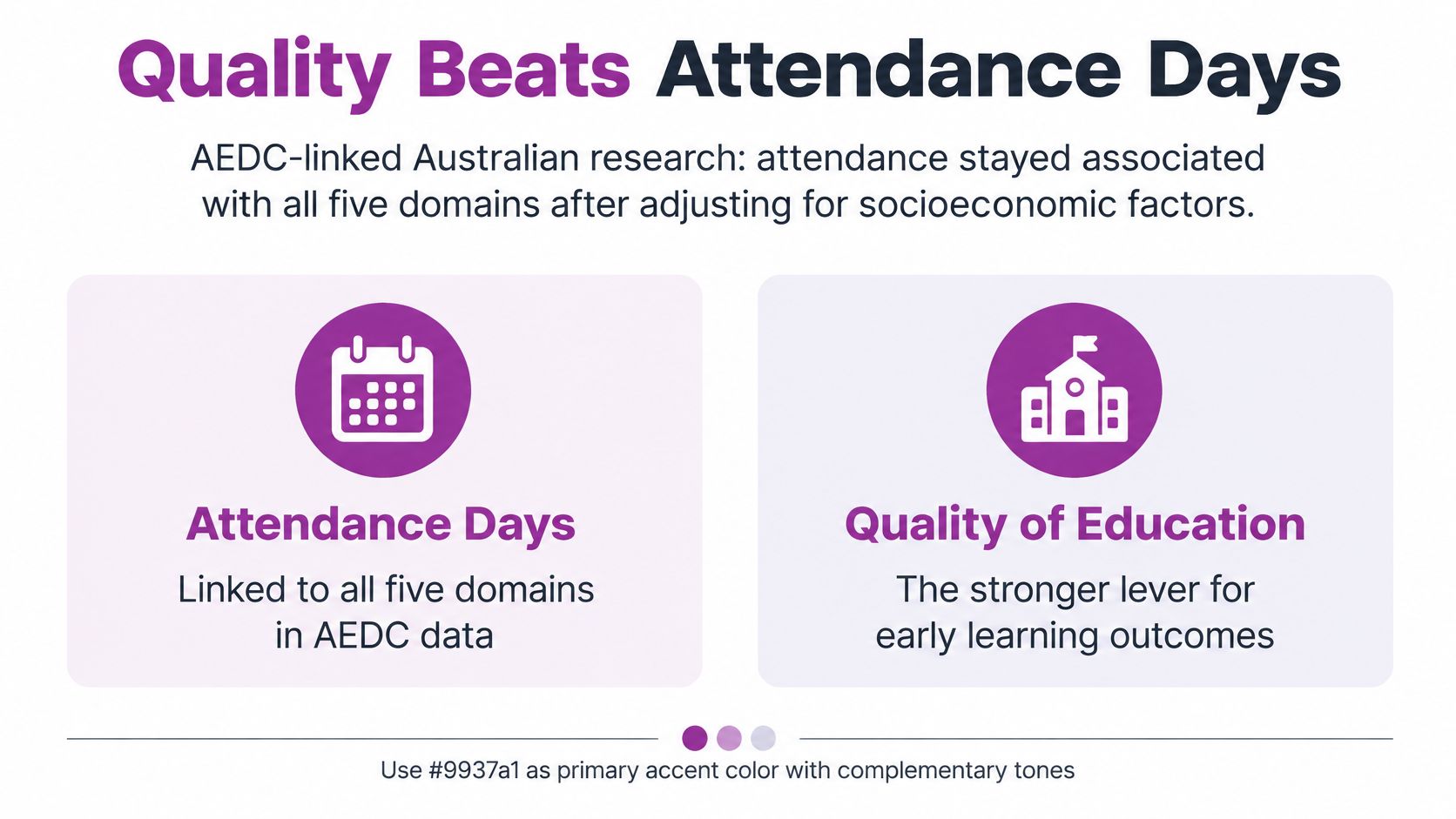
An Australian study using AEDC-linked data found that participation remained associated with all five developmental domains after demographic and location adjustments, yet attendance explained only 0.2%–2% of outcome variation; it also identified an Exceeding NQS rating as the threshold associated with reduced developmental vulnerability.
That's an association, not proof that a rating causes a particular outcome. It also doesn't mean attendance is unimportant or that the remaining differences can all be attributed to service quality.
What to watch instead of counting days
- Responsive relationships: Does the educator recognise when a child needs comfort, space or help joining in?
- Intentional teaching: When a ramp doesn't work, does the educator invite the child to investigate rather than immediately fixing it?
- Language and mathematical thinking in play: Listen for conversations about reasons, positions, quantities and possibilities, not just instructions.
- Educator continuity: Find out who knows your child well and how information is shared when staffing changes.
- Observation that changes planning: Ask for an example of something educators changed because of what they noticed.
A rating is useful information, but a visit helps you understand daily practice. At Kids Club, our Dandenong North centre has an Exceeding National Quality Standard rating; ratings for other locations should be checked individually rather than assumed.
Family circumstances, health, language experiences and life outside the service also influence development. No centre controls every influence, and no attendance pattern guarantees school readiness.
Choose days that work for your child and family, then examine the learning within them. The more useful question is: What interactions happen while my child is here, and how do educators know they're helping?
Supporting Outcomes at Home Through Everyday Routines
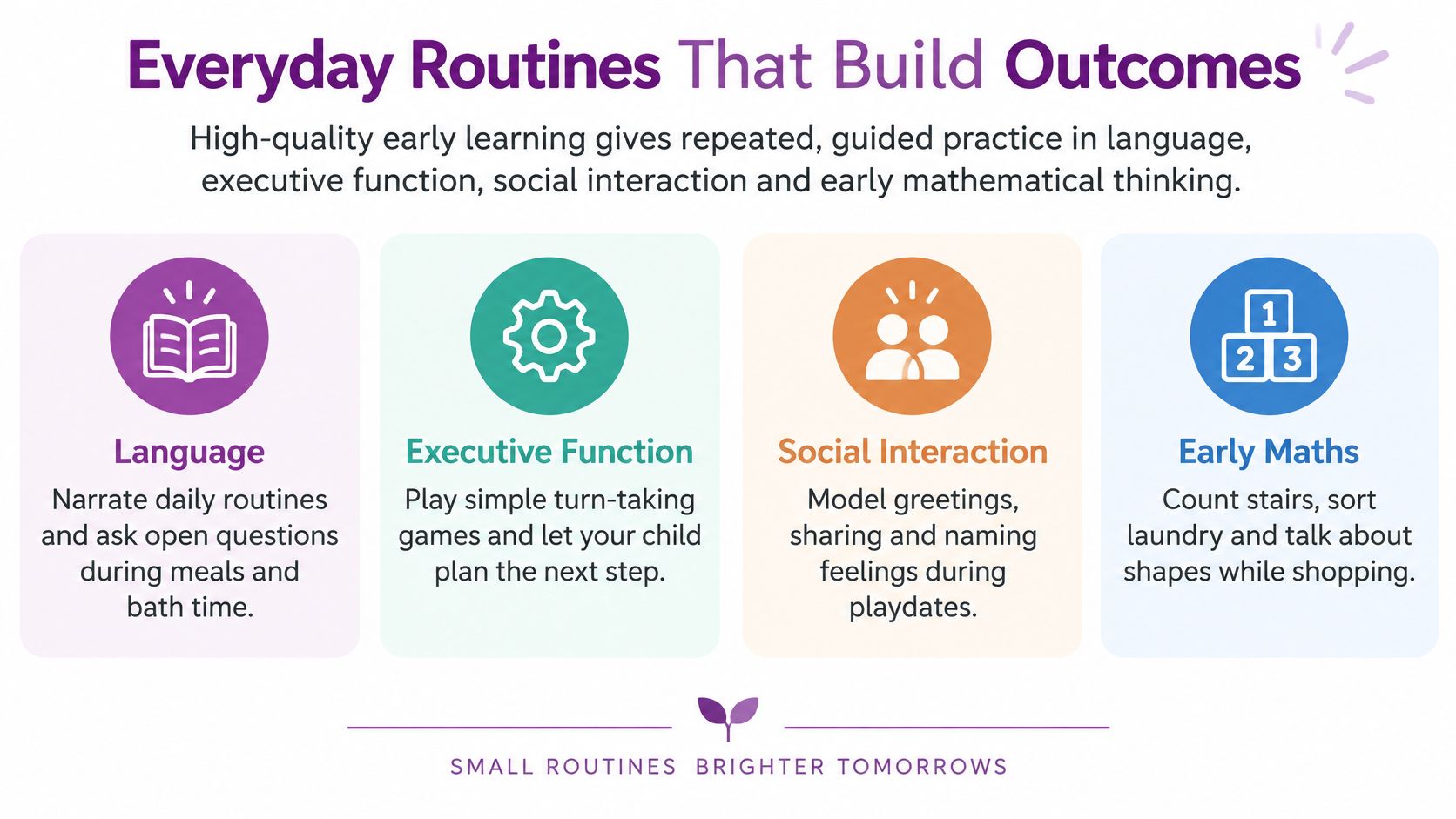
High-quality early learning offers repeated, guided practice in language, managing attention and actions, social interaction and mathematical thinking, helping children participate in later learning. The Australian Institute of Health and Welfare's early education evidence summary also identifies literacy and numeracy skills at ages four to five as predictors of later primary-school achievement, not guarantees for an individual child.
Make ordinary moments useful
Read together without turning it into a quiz. Follow your child's interest in a picture, pause for their contribution and ask what they think might happen next. For a baby, responding to a sound or gaze is already a shared communication experience.
Count and compare for a reason. Set out cups, share fruit pieces or find a lid that fits. Words such as more, fewer, beside and underneath help children connect mathematical ideas with things they can see and handle.
Leave room for self-care. Let your child attempt a sleeve, pour from a small jug or pack familiar belongings before stepping in. Practical activities for developing fine motor skills can support these attempts without needing formal handwriting practice.
Name feelings and offer manageable choices. Acknowledge disappointment before offering an action: they can sit beside you or move somewhere quieter. This supports emotional understanding without expecting a distressed child to explain everything immediately.
Keep shared play manageable. A familiar playmate and a simple activity can make practising negotiation easier. Stay close enough to model asking for a turn, while allowing children to attempt their own solutions.
Keep brief, dated notes. Record a new phrase, an independent action or a problem your child solved. Share the context with the educator, including whether your child needed help or used another language.
These aren't homework tasks. Choose opportunities that fit naturally into meals, getting dressed, shopping and play, and stop when the interaction becomes a battle.
Home should offer connection and practice, not another classroom timetable.
Use a planned progress conversation to consider patterns with your educator rather than checking achievement every evening. Raise new concerns promptly, but leave plenty of ordinary family time undocumented.
Kids Club Practice and How to Check It Yourself
At our Springvale South, Dandenong North and Ferntree Gully centres, we use the Reggio Emilia approach, with learning through inquiry, creativity and collaboration. Our centres have experienced, dedicated, VIT-registered teachers and educators.
Consider a typical inquiry experience: a child finds that water runs through some materials but collects in others. An educator might invite a prediction, introduce words such as absorb and drip, and help children compare their ideas. This is an example of how inquiry can work, not a claim about a particular session.
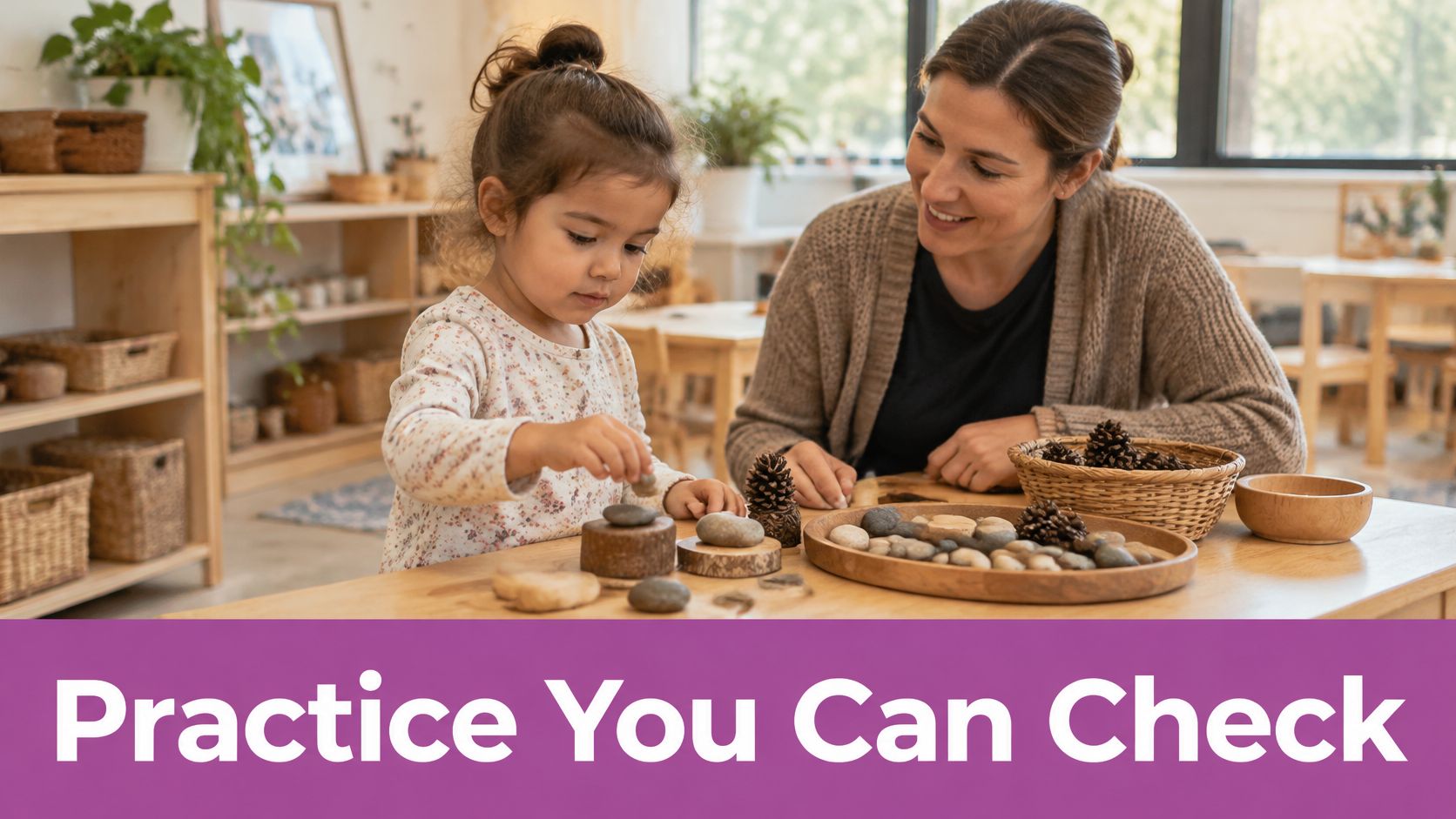
Our infant and toddler programs and dedicated spaces for children aged three to six provide different contexts for developing connection, communication and involved learning. Professional music and sports curricula are included each week at no additional cost. Ask how participation is adapted to your child's confidence and capabilities, rather than assuming the activity name tells you the outcome.
Bring a purpose to your visit
Choose something to notice. Use the age-band guide to identify capabilities relevant to your child, such as requesting help or joining play.
Request a documentation example. Ask to see a de-identified learning story or portfolio entry and have the educator explain the observation, interpretation and next step. Confirm the centre's current documentation practices directly.
Look at teaching and continuity. Find out who would work closely with your child, how educators share information and what the centre's current quality rating means.
Watch whose ideas matter. Notice whether children can ask questions, revisit investigations and influence what happens, alongside appropriate routines and adult guidance.
Bring your home observations. Explain your child's interests, languages, comfort strategies and current challenges. Listen for a specific response rather than a general promise of school readiness.
These descriptions communicate our educational approach, not a guaranteed individual result. Confirm room arrangements, available places, fees, funded kindergarten eligibility and booking details with your chosen centre.
Kids Club Early Learning Centre offers nurturing care and inquiry-led learning, with opportunities to develop communication, wellbeing, independence and confidence through play. Visit Kids Club Early Learning Centre to arrange a tour, bring your observations from home and ask how educators would recognise and support your child's next steps.