
Your toddler points at a bowl of pasta and babbles, then looks at you expectantly. You answer, describing the curly pasta and asking whether they'd like more. It might feel like ordinary dinner-table chatter, but your child is practising something important: using sounds, gestures and shared attention to communicate meaning.
When parents ask what is literacy development, they're often wondering when letters and reading should begin. The reassuring answer is that you don't need to wait for a workbook. You can support literacy through the conversations and play already happening in your home.
What Literacy Development Means in the Early Years
Literacy development is the gradual, cumulative process through which children learn to use language to communicate, understand ideas and eventually read and write.
It begins from birth, through listening, watching faces, responding to voices and joining exchanges with other people. Later, children bring those experiences into songs, pretend play, stories, drawing and their first attempts at writing. The Australian Institute of Health and Welfare's literacy overview describes literacy as a continuous process that begins before formal schooling and extends across language, communication, reading and writing.
Think of building a house. Oral language and listening are the foundations and walls, while reading and writing are the roof built above them. A child needs opportunities to understand spoken ideas, ask questions and make connections, rather than merely recognise the shapes of letters.
More than an alphabet checklist
Some common assumptions can make parents feel unnecessarily pressured:
- Literacy isn't only learning letters. Explaining why a toy needs fixing also involves organising and communicating ideas.
- Literacy isn't only taught at school. A family conversation about an outing gives a child useful practice describing events.
- Literacy isn't a fixed ability. Children develop skills through opportunities, responsive teaching and support suited to their needs.
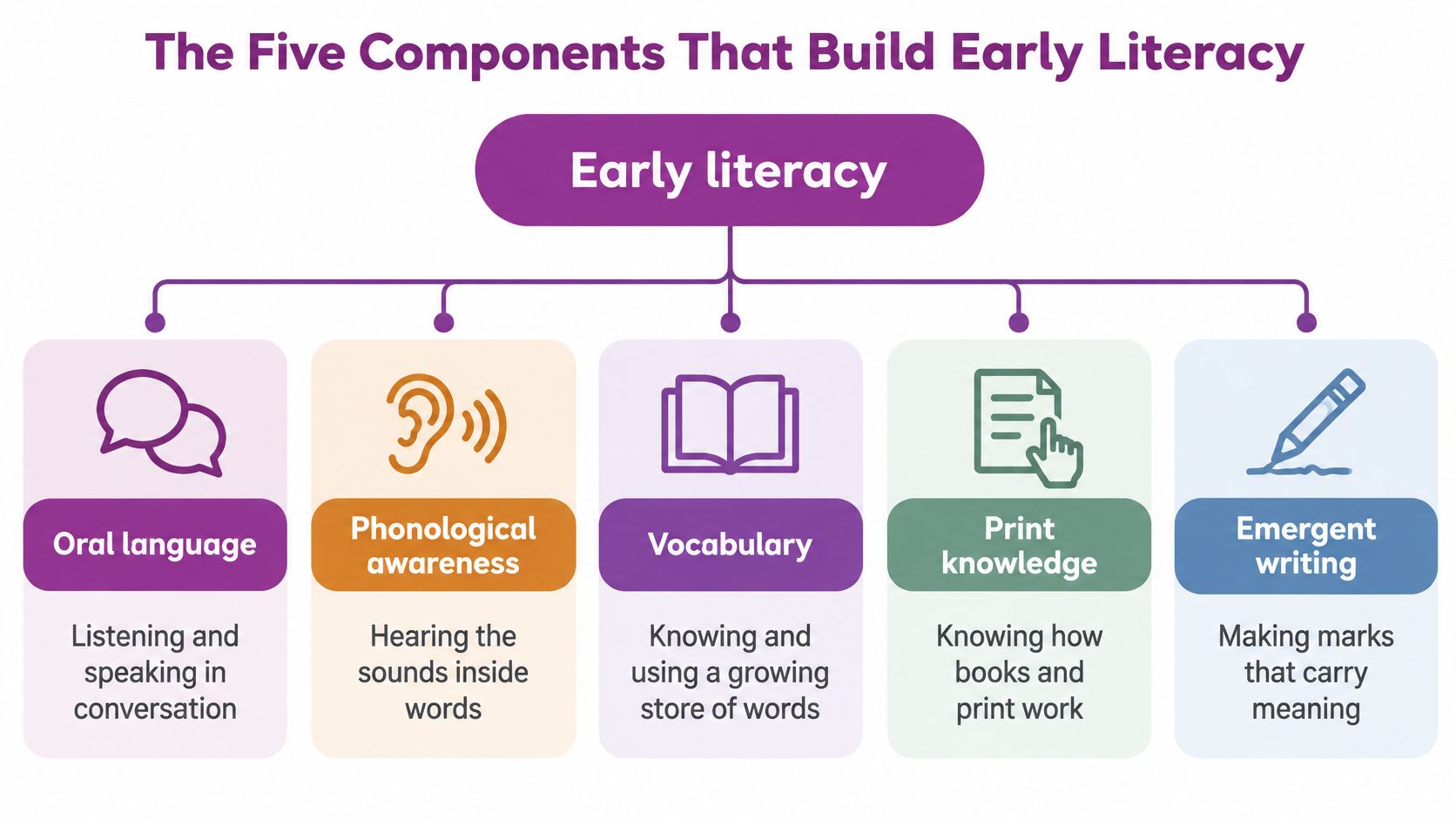
The foundations include oral language, phonological awareness, vocabulary, print knowledge and emergent writing. These aren't separate subjects that need separate lessons. A child might use several while pretending to run a café or helping an adult make a birthday card.
You don't need to turn every interaction into teaching. Notice what interests your child, respond to their attempts to communicate and leave space for their reply. Everyday interaction is somewhere families can start today.
The Five Components That Build Early Literacy
The five components at a glance
| Component | What it looks like at home | Everyday example | Why it matters |
|---|---|---|---|
| Oral language | Talking, listening, asking and answering questions | Narrating a bath-time routine together | Builds the meaning base for everything else |
| Phonological awareness | Hearing and playing with sounds inside words | Clapping the syllables in names | Links spoken sounds to letters later |
| Vocabulary | Knowing and using a wide range of words | Naming tools at the workbench | Supports understanding of stories and text |
| Print knowledge | Understanding how books and print work | Turning pages, following English print left to right, spotting a sign | Shows that print carries meaning |
| Emergent writing | Marks, drawings and early attempts at writing | Scribbling a shopping list during play | Shows the link between speech and symbols |
These components work together rather than developing in a neat sequence.
What each component means
Oral language involves expressing ideas, understanding others and taking conversational turns. During bath time, pause after describing the floating duck so your child can add a sound, gesture or comment. It's an exchange, not a running adult commentary.
Phonological awareness means hearing and playing with sounds within spoken words. Rhyming, clapping the parts of a name and noticing that sun and sock begin alike are examples. No printed text is needed, which distinguishes this from phonics, where children connect sounds with written letters.
Vocabulary includes words children understand as well as words they use. At a workbench, naming a clamp and explaining that it holds something steady gives the word a purpose. Knowing what words mean helps children understand a story rather than merely pronounce its words.
Print knowledge concerns how written language works. Children notice that a label names a container, a book has a beginning and English print follows a particular direction. Other writing systems may work differently.
Emergent writing includes meaningful scribbles, drawings, letter-like shapes and invented spelling. Ask what a child's shopping list says, rather than judging whether the marks look correct.
Seeing the components together
The Australian Government's Preschool Outcomes Measure brings oral language and literacy into learning progressions that help educators identify capabilities and plan next experiences. Parents can also explore how communication fits within the Early Years Learning Framework outcomes.
During a picture-book reading, your child explains a character's problem, learns enormous, notices a rhyme, helps turn the page and draws a message for the character afterwards. That's the components working together: understanding words, hearing sounds, navigating print and making meaning with marks.
Literacy Milestones From Birth to Age Five
Typical literacy behaviours and adult responses by age
The age bands below organise examples of what you might notice. They aren't a diagnostic checklist or deadlines, and a child won't necessarily show every behaviour within a particular band.
| Age | Typical literacy behaviours | What adults can do |
|---|---|---|
| Birth to six months | Responding to familiar voices, watching faces, cooing | Talk and sing during feeds and nappy changes |
| Six to twelve months | Babbling, responding to familiar people and exploring board books | Name pictures and respond to babbling |
| Twelve to twenty-four months | Emerging words, pointing to pictures and experimenting with scribbles | Share short books and name what attracts attention |
| Two to three years | Combining words, asking questions and enjoying repeated language | Expand a child's message and enjoy rhyming songs |
| Three to four years | Using sentences, recounting experiences and noticing familiar names or rhymes | Invite explanations and talk about events |
| Four to five years | Developing story sequences, exploring beginning sounds and attempting letters or a name | Offer sound games and purposeful writing opportunities |
This visual offers a broad picture of the progression, rather than a schedule every child must follow.
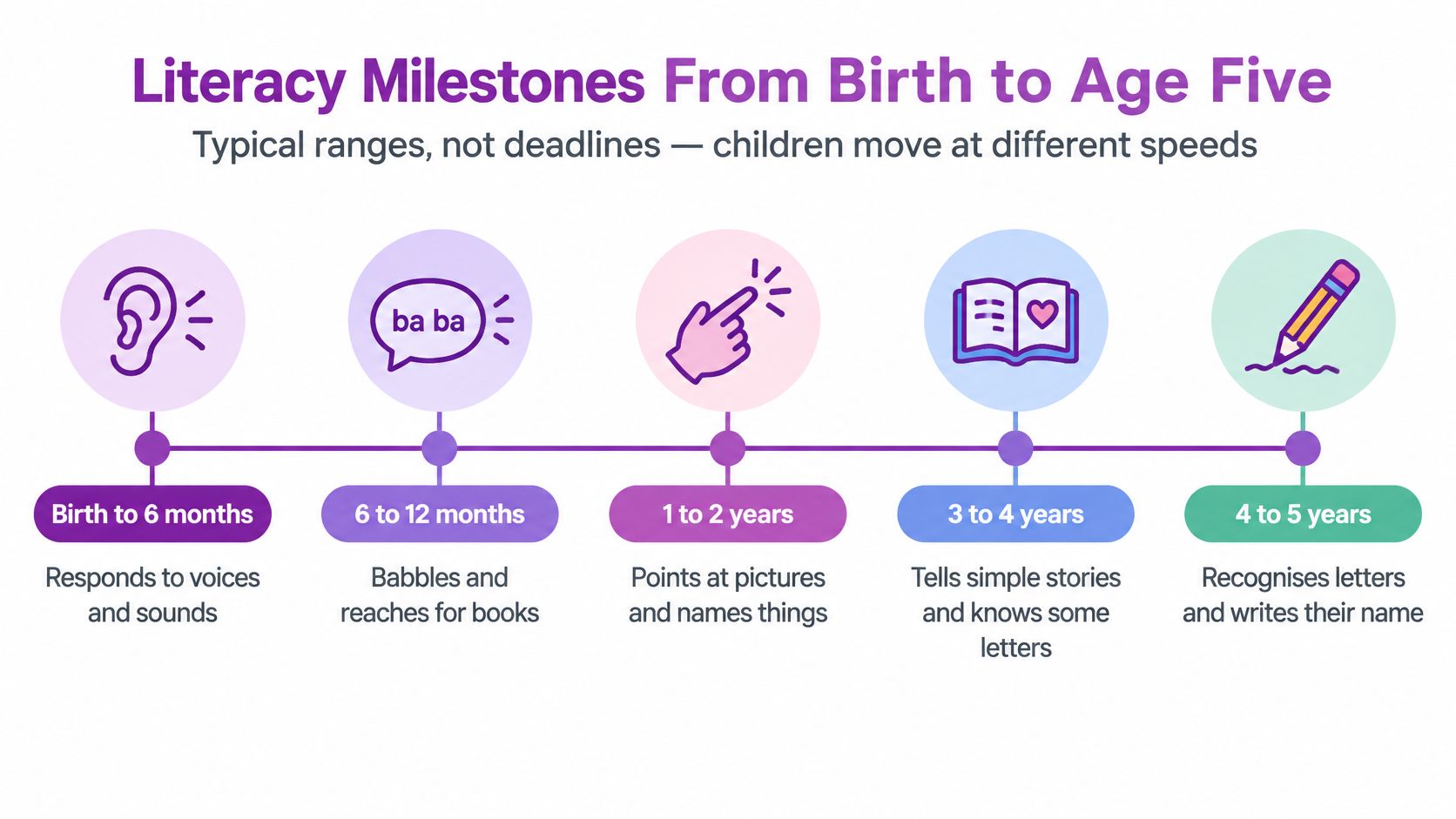
Notice the direction of progress
In infancy, a response might be a movement, an expression or a sound rather than a word. Those small exchanges matter because your baby is participating. Later, pointing at a picture can be a way of requesting a name, sharing interest or asking you to continue.
As children's language grows, look beyond how much they say. Can they make their meaning clearer, connect events or explain something that happened when you weren't there? A familiar story might initially be represented by a gesture, then a phrase, and later a sequence of events.
A child who scribbles a pretend invitation is exploring a different skill from a child who copies a letter. Both activities can be worthwhile, but copying alone doesn't tell you whether the child understands the message.
For another way to explore early literacy, you can watch this video.
Adjust the picture to your child
If your child was born prematurely, ask your Maternal and Child Health nurse how corrected age should inform developmental expectations. Don't apply a chart without considering your child's health and developmental history.
For multilingual children, notice communication across all their languages, including conversations with grandparents and other familiar adults. A child might know food words in a family language and playground words in English.
Use milestones to notice and respond, not to award a pass or fail. Write down new abilities and any concerns, then discuss the whole picture with someone who knows child development.
Why Early Literacy Shapes School Readiness
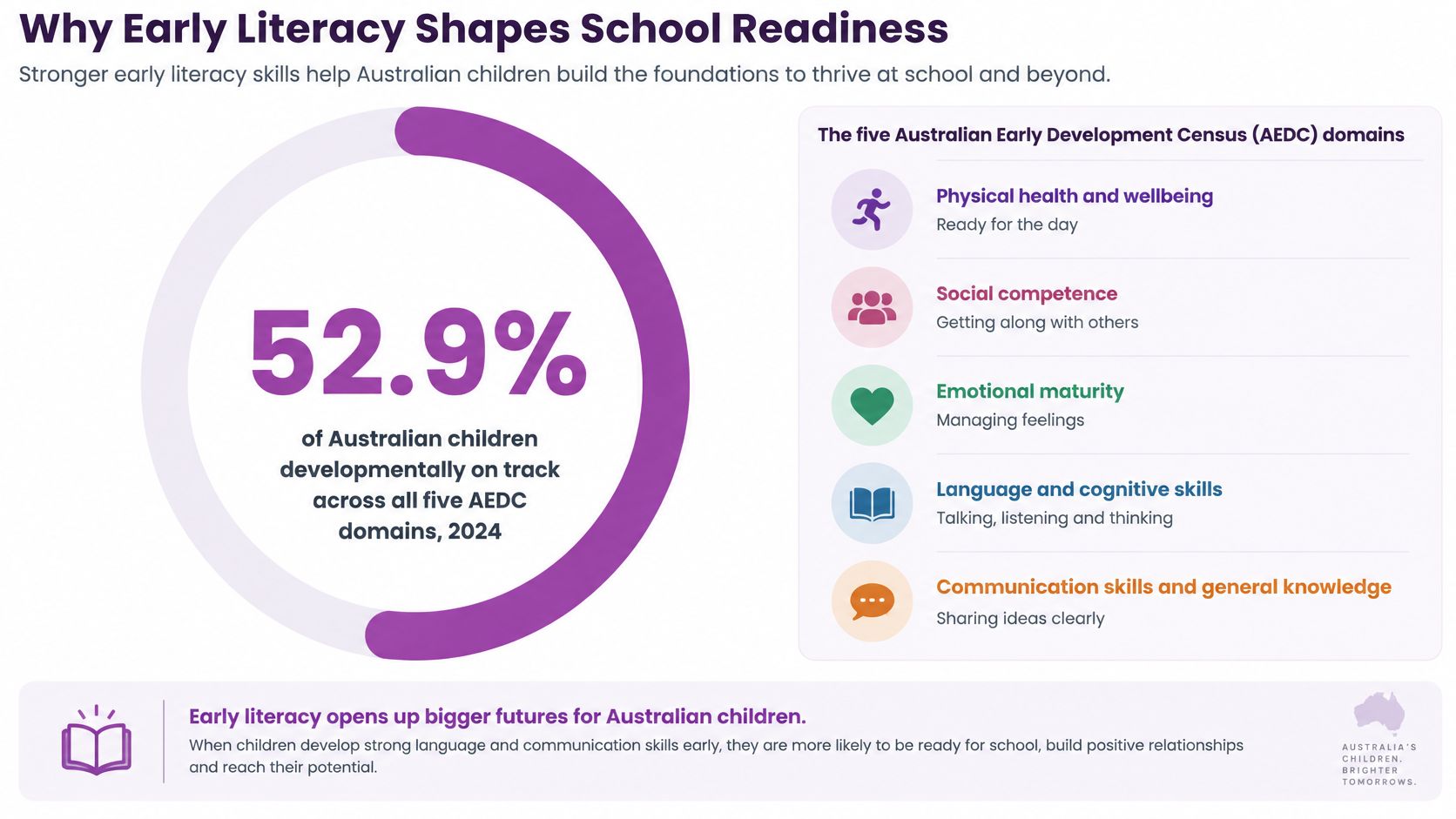
In 2024, 52.9% of Australian children were developmentally on track across all five Australian Early Development Census domains, including language and cognitive skills and communication, according to the Australian Bureau of Statistics.
The census considers children as they start school. It isn't a reading test, and that figure doesn't mean the remaining children couldn't read or weren't ready to learn. It reflects a broader developmental picture.
The infographic places language alongside the other areas involved in starting school.
Readiness involves participation
A child uses literacy foundations when they explain that they need help, follow a story, answer a question or understand that a classroom label identifies where belongings go. Recognising letters is useful, but it doesn't replace these everyday communication skills.
Language-rich experiences can be like a head start on a long road. A child who understands words such as before, because and different has useful ways to interpret classroom explanations. A child still developing those meanings may need more modelling, repetition or individual support.
That doesn't establish a single cause for later achievement. Children's learning also involves their health, access to education, learning needs and the support available to them.
Look beyond early reading
By the time children encounter Year 3 literacy assessment, they're drawing on knowledge and experiences developed over time. NAPLAN isn't a preschool assessment, and preschool shouldn't become preparation for a distant test.
Useful school readiness activities give children opportunities to explain, cooperate, listen and investigate. A group construction project, for example, invites children to describe their plan and negotiate what happens next.
The aim is confident communication and curiosity about print, alongside appropriate teaching of sounds and letters. Reading words early isn't the only meaningful sign that a child is learning.
Everyday Strategies That Build Literacy at Home and in Care
You don't need a separate literacy timetable. Choose an activity that suits your child's interests and stop while they're still comfortable and engaged. The suggested session lengths below are flexible planning ideas, not developmental targets.
This visual offers activities you can adapt to your family's routine.
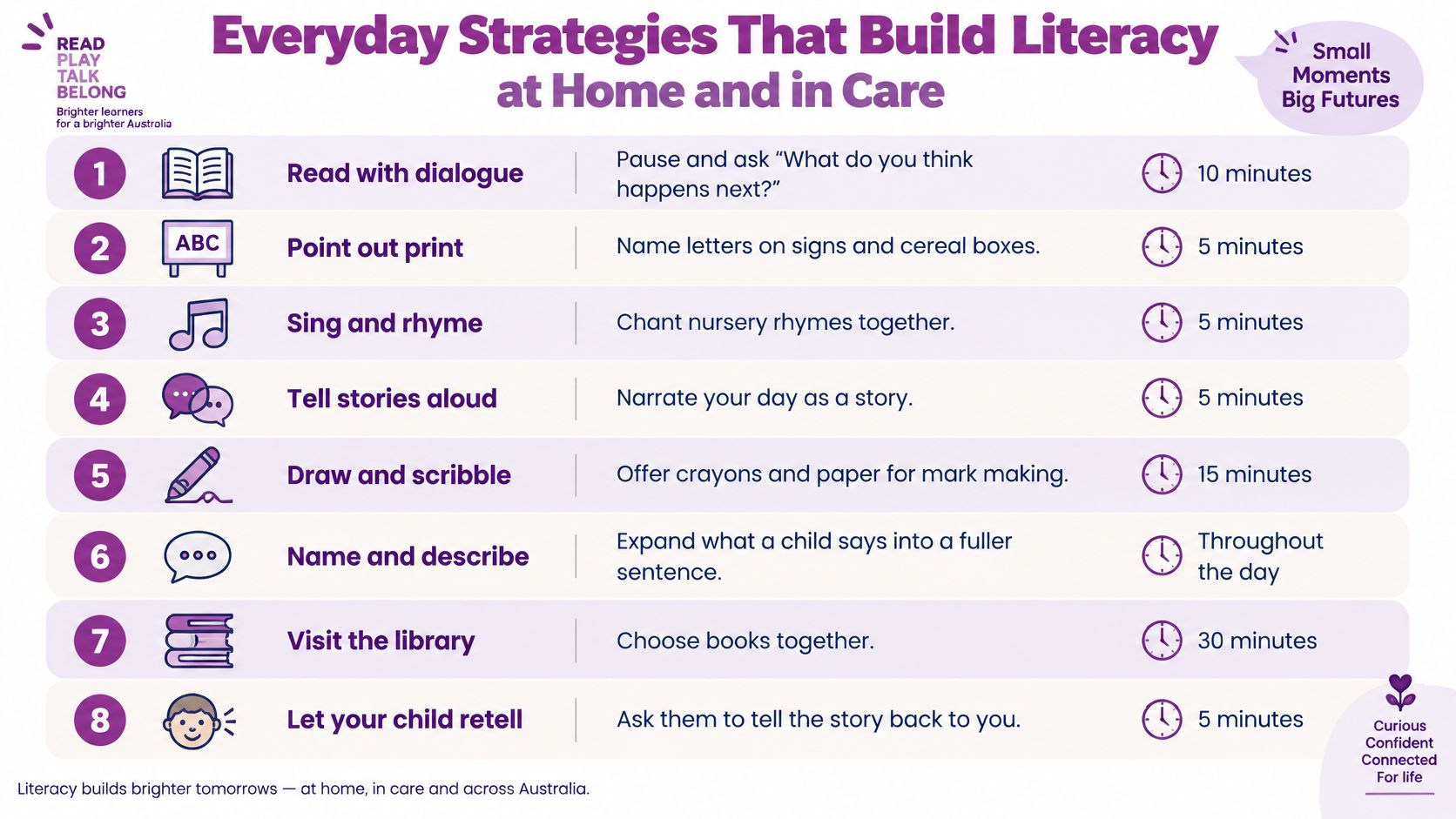
Make the interaction count
Read with dialogue during a short shared session. Pause at a surprising picture and invite a prediction. If your child says the character is hiding, expand the idea by wondering whether they're frightened or playing a game. For younger children, choose from these books for one-year-olds and follow their interest rather than insisting on finishing.
Narrate play in brief bursts. While your child transfers water between containers, describe the jug as full, nearly empty or overflowing. Then pause so they can contribute. Constant talking can leave little room for a child's response.
Play with sounds while you're waiting. Make a silly rhyme about a hat or listen for objects beginning with the same sound. Keep it playful and brief, rather than testing until the child gets an answer right.
Write for a real purpose. During a quick creative activity, let your child dictate a message to attach to a drawing. Read the message back while pointing to the words so they can connect their spoken idea with the writing.
Sing during a familiar routine. A short chant while packing away gives children repeated sound patterns to join. Leave a familiar word unfinished and let your child supply it if they want to.
Add print to an ongoing game. Place menus in a pretend restaurant or a parcel book beside a toy delivery van. There's no need for a separate session, the writing belongs to the play.
Use family languages for an unhurried story or song. The Australian study of multilingual early-childhood educators describes how additional languages can support belonging, inclusion and participation. You don't need to abandon the language in which you communicate most comfortably.
Choose short, repeatable opportunities. A brief conversation after an outing can be more manageable than a long planned lesson. Follow tiredness, frustration and interest, not the clock.
Connect home and care
Educators can document a child's words, questions and marks, then plan a related experience. A question about worms might lead to observing soil, drawing a worm and dictating a label.
Share what your child talks about at home, including home-language interests. That gives educators something specific to build on rather than a general instruction to practise more literacy.
Signs That Mean It Is Time to Seek Support
Literacy warning signs and next steps
These signs prompt a conversation with a professional. They don't establish a diagnosis or explain the cause on their own.
| Sign | What it may point to | Next step |
|---|---|---|
| Little babbling or limited response to familiar voices | Hearing or early communication concern | Speak with the GP or Maternal and Child Health nurse about hearing and communication |
| Very limited spoken language or difficulty combining words | Speech or language concern | Ask the GP about a speech pathology assessment |
| Losing words or skills previously used | Developmental concern needing prompt review | See the GP without delay |
| Persistent difficulty noticing rhymes or beginning sounds despite supported opportunities | A need for closer assessment of sound awareness | Discuss observations with the kindergarten teacher and a speech pathologist |
| Ongoing difficulty following familiar instructions | Possible language comprehension, hearing or attention concern | Ask the GP and educator about appropriate assessment |
Don't rely on reassurance alone
A child who talks later than a sibling doesn't automatically have a language disorder. Equally, describing a child as a late talker doesn't rule out hearing or language difficulties. Several concerns together, persistent difficulties or any loss of skills deserve professional attention.
You don't need to wait for a child to fail at reading before asking questions. The Australian Government's AEDC results announcement highlights the importance of responsive observation, including recognising that English-based assessment may not capture a child's home-language strengths.
For a multilingual child, ask how assessment will consider every language they use, with an interpreter or relevant language expertise where needed. Difficulty using English alone isn't enough to establish a language disorder.
Take a clear next step
In Victoria, start with your GP or Maternal and Child Health nurse. A speech pathologist can assess communication; your GP can arrange hearing assessment or refer to a paediatrician when broader developmental concerns need review.
Bring dated examples of what your child says, understands or finds difficult, plus observations from their kindergarten teacher. Kindergarten educators can contribute useful information about participation and communication, but their observations don't replace clinical assessment.
Victorian families can also explore funded kindergarten options, including three-year-old kindergarten and four-year-old pre-PREP. Book an appointment when you're concerned rather than waiting indefinitely for a gap to close.
At Kids Club Early Learning Centre, we use a Reggio Emilia-inspired approach that encourages inquiry, creativity and collaboration, with conversations, stories and purposeful play supporting early literacy. Visit Kids Club Early Learning Centre to explore our Melbourne centres and talk with our team about your child's communication, interests and next learning steps.