
A child clings to your leg at the gate, hesitates before entering a new room, or goes quiet whenever kindergarten comes up. You may be wondering whether to keep encouraging them, slow down, or ask the early learning team for more support. These moments are common, but they don't need to be treated as a test your child must pass alone.
Successful transitions grow from predictable relationships, repeated exposure and shared routines, not from one large orientation event. The Australian Early Development Census tracks children's development as they enter full-time school, and its 2018 results showed that 22% of children were developmentally vulnerable on at least one domain. The data reinforces why transition planning should include communication, emotional preparation and continuity of learning, not just practice with school tasks. The Australian Institute of Health and Welfare explains the role of transition support, while recognising that population data doesn't diagnose an individual child.
The following early childhood transition activities are organised around real moments, from preparing at home to settling in, moving rooms and entering kindergarten. Families and educators in Springvale South, Dandenong North, Ferntree Gully and surrounding Melbourne communities can adapt them for infants, toddlers and preschoolers, including children who are multilingual, neurodivergent, anxious or still developing self-help skills.
1. Visual Social Stories and Photo Books
A new room can feel less mysterious when a child has already seen its people and places. A personalised social story or photo book turns an unfamiliar transition into a sequence the child can revisit with a trusted adult.
Use genuine photographs of the entrance, the child's locker, the sleep area, the outdoor space and the educators they'll meet. Keep the wording short and concrete. “Mum waves goodbye. Sarah helps me put my bag away. I can choose a book” gives a young child more useful information than “You'll have a great day.”
Build the book around the child
Take photographs during a quiet period, before the room becomes busy. Include a family photograph beside a centre photograph so the book connects home with the early learning environment. For a child moving rooms, show the current educator, the new educator and the route between spaces.
A useful book might include:
- Arrival: A photo sequence showing walking through the gate, greeting an educator and storing a bag.
- Familiar routines: Images of music lessons, meals, rest, bathroom routines and outdoor play.
- Important people: Photographs of the educators and children the child is likely to see.
- Ways to ask for help: A picture of the calm space, a water bottle or an adult offering comfort.
Kids Club families could create versions featuring the layouts and routines of the Springvale South or Dandenong North centres. A book for a toddler might have only a few photographs and repeated phrases. A preschooler preparing for kindergarten might benefit from pages showing a larger group, a shared learning space and ways to find an adult.
Laminate pages if the child likes to handle books, and offer a digital copy for home use. Use the same words at home and in the centre, then update photographs when rooms, educators or seasonal activities change.
Practical rule: The best transition book shows what the child will actually see, not an idealised version of the day.
For families wanting a culturally responsive approach, invite the child and family to contribute photographs, home-language words, familiar songs or a picture of a calming object. This reflects the importance of using children's and families' funds of knowledge during transition, an approach discussed in Australian research on culturally responsive transition practice.
2. Graduated Settling-In Sessions
A child arriving for a first full day may cope well at the gate, then become distressed when the parent leaves or the room grows busy. Graduated settling sessions break that change into manageable experiences. Each visit helps the child learn that the setting is safe, a familiar adult returns, and the next part of the day is understandable.
Start with a short visit while a parent or familiar caregiver stays close. The educator joins the child's play without directing every move. When the child begins to relax, the caregiver can sit nearby while the key educator supports one ordinary routine, such as storing a bag, washing hands or choosing an activity. This gives the educator a chance to notice what helps before separation is introduced.
Adjust the pace, not the promise
Use the child's responses to decide what comes next. One family may move through Familiar visit, with the child exploring alongside a parent and meeting the key educator. Another may remain there for several sessions. Shared routine follows when the child can complete a familiar task while the parent stays close. Brief separation then involves the parent leaving for a clearly explained, short period and returning as promised. Longer participation can include play, meals, rest or group experiences, with the educator providing support.
These stages are options, not a rigid calendar. Clinginess, disrupted sleep or a temporary loss of a familiar skill can appear during change. Record what happens each day, share observations with the family and adjust the plan without treating distress as failure.
Working families may need afternoon sessions or arrangements that fit existing care. A Melbourne centre could offer a quiet weekend visit for a family unable to attend during weekday hours, as long as the experience resembles the usual environment. The trade-off is that unusual weekend staffing or quieter rooms may feel easier, yet they can give the child a less accurate picture of a normal day.
Agree on one short goodbye ritual, such as waving at the window or using a special handshake. Keep the message honest: “I'm going now. Sarah will help you. I'll come back after afternoon tea.” Families can also use this guide to preparing for the first day of kindergarten when the next transition is school entry.
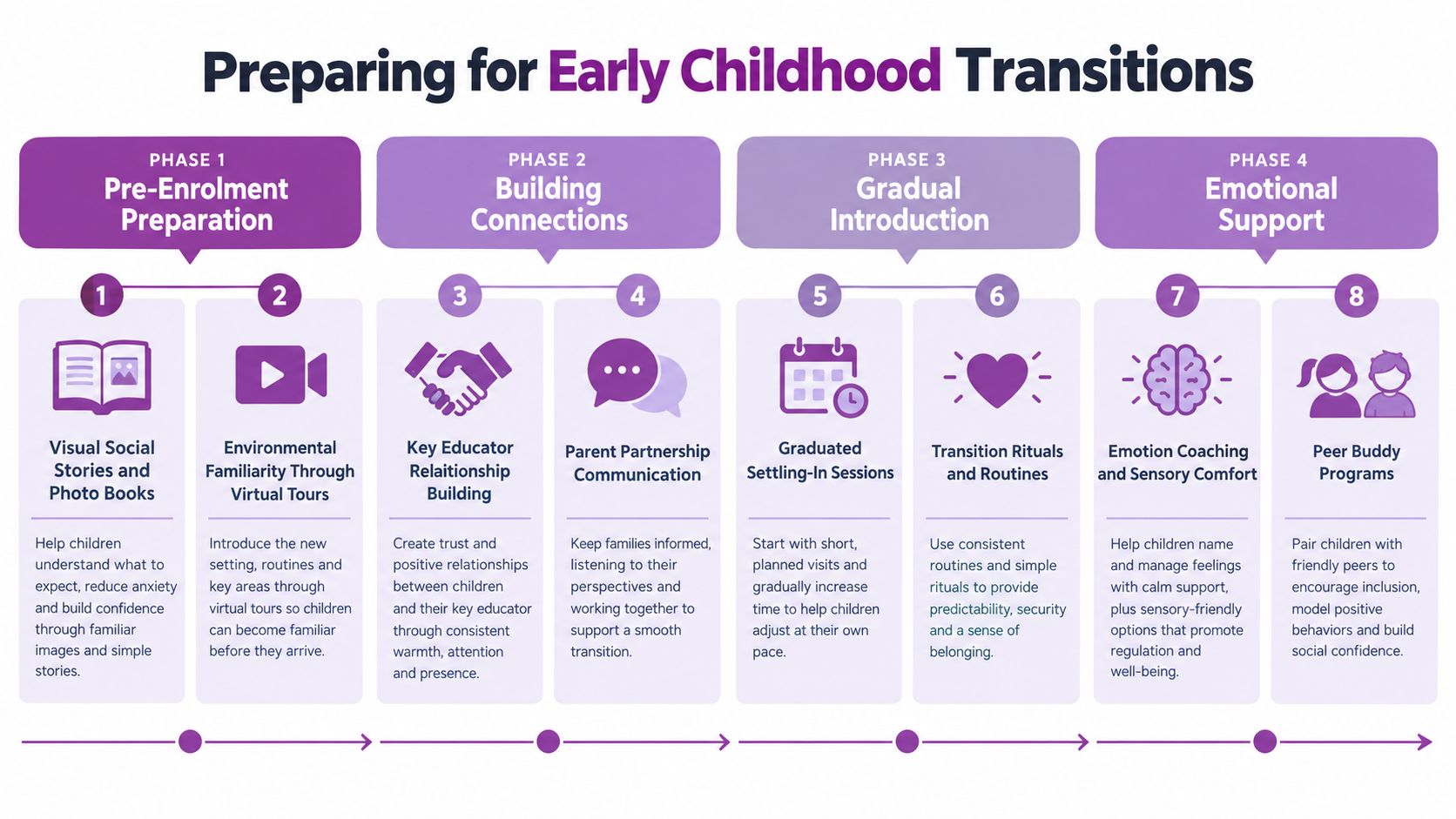
3. Emotion Coaching, Feelings Vocabulary and Sensory Comfort Items
Children often need help expressing what makes a transition difficult before they can participate in it. An educator might hear "I don't want to go" when the underlying problem is noise, uncertainty, tiredness, separation or not knowing how to ask for help.
Use photographs, emotion cards, mirrors and picture books to build a shared vocabulary. During a relaxed morning meeting, children can point to a feeling, choose a colour or show where their body feels tense. The point isn't to make children report emotions perfectly. It's to give them another way to communicate before distress becomes overwhelming.
Practise regulation before the difficult moment
Calming strategies work best when children have used them during ordinary play. Try blowing bubbles, using a pinwheel, pretending to inflate a balloon or following a simple breathing picture. Educators can model the process aloud: “My body feels rushed, so I'm going to take a slow breath and find a quiet space.”
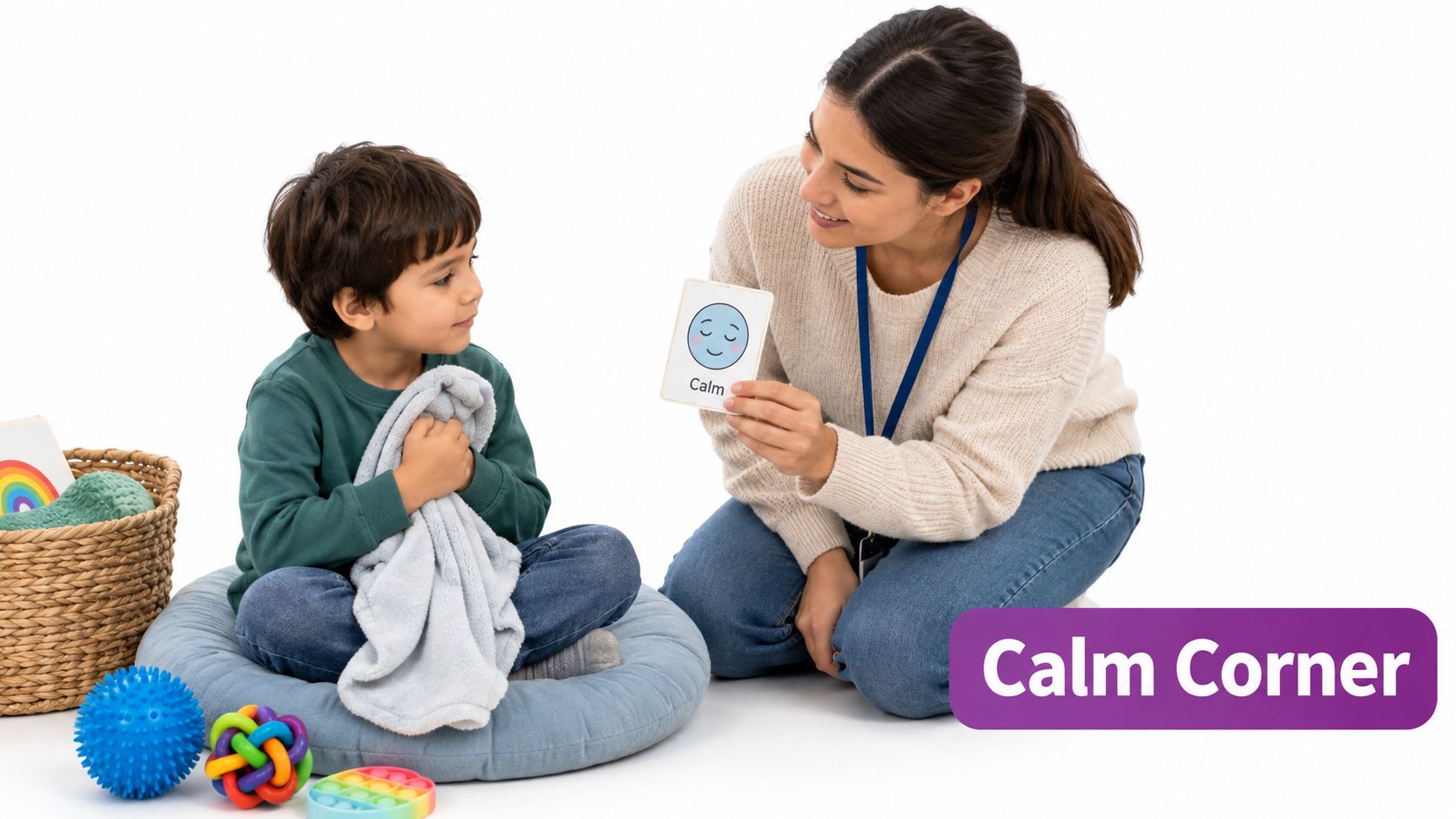
A calm area might include cushions, emotion books, visual breathing prompts and sensory tools. Comfort items can also help bridge home and care. A child may bring a small blanket, soft toy or fabric item that carries a familiar scent. The service should agree with the family on storage, cleaning and what happens if the item is misplaced.
Sensory support needs to be individual. One child may settle while squeezing a stress ball, while another needs a quieter corner and fewer words. A fidget tool should support participation, not become a demand that the child use it. Educators can offer choices and watch which supports reduce stress.
Families and educators can make or explore simple tools together, such as the DIY sensory bottles guide. Use consistent words across home and centre, and validate feelings while keeping boundaries clear: “You're worried about the new room. I won't let you hit. I'll help you move your hands and we can look at the picture.”
4. Key Educator Relationship Building and Consistent Caregiving
A familiar adult can make a new room feel manageable. Assigning a key educator, or “special person”, gives the child a reliable point of connection while they learn the wider environment and relationships.
The relationship should begin before the formal transition. Invite the key educator to enrolment conversations and settling visits. They can learn the child's preferred songs, family names, comfort signals, interests and ways of communicating. At arrival, a consistent greeting might involve looking at a family photograph, checking the visual routine or walking together to a favourite activity.
Keep continuity visible
When a child moves from a toddler space to a preschool room, the familiar educator doesn't always need to stay for the whole day. A planned visit, shared handover or brief check-in can help the child understand that relationships continue even when the environment changes.
For example, an educator might tell the new room, “Maya likes to watch before joining group experiences. She settles when an adult sits beside her and offers the animal puzzle.” This information is more useful than a broad description such as “Maya can be shy.”
Parents also need a relationship with the educator. A short, individual handover at collection can share one genuine learning moment and one practical observation. A communication book or approved digital platform can extend that conversation, especially when a family can't stay at drop-off.
The key educator isn't a replacement for a parent. The relationship gives the child another secure base from which to explore, while the family remains the expert on the child's history, culture and needs. Staff consistency matters too. Every educator should use warm, responsive interactions so the child isn't dependent on only one adult being available.
Educators can connect transition planning with personal and social capability experiences, including recognising feelings, building relationships, seeking help and participating in group routines. These skills support children moving between rooms as well as children preparing for kindergarten.
5. Environmental Familiarity Through Virtual Tours and Pre-Visit Experiences
Some children need to see a place several times before they're ready to participate in it. A virtual tour can introduce the environment at home, while a low-pressure pre-visit lets the child explore it with a familiar adult.
Keep videos short and natural. Film at the child's eye level, include the entrance, bathrooms, quiet areas, learning spaces and outdoor play, and let educators introduce themselves. A child who loves climbing may want to see the outdoor space first. A child who is sensitive to noise may need to see where they can retreat when the room feels busy.
Offer more than one way to look
Not every family has the same access to technology or feels comfortable with a polished promotional video. Offer downloadable photographs, a printed map, a phone conversation or an in-person visit. Ask families what they want their child to see rather than assuming every child needs the same tour.
A practical visit might involve playing in the yard on a quiet morning, finding the lockers, looking at the drinking fountains and meeting an educator. It shouldn't require the child to join a group straight away. The family can leave after a positive experience, even if that experience is brief.
Virtual material should show ordinary routines rather than only tidy, empty rooms. Include educators supporting play, children moving between activities and spaces for rest or sensory regulation. Update the material when room arrangements or seasonal experiences change. For families in Dandenong North, Springvale South or Ferntree Gully, local details such as the entrance route and outdoor areas can make the visit easier to understand before arrival.
Children don't need to memorise a building. They need to recognise a few safe places, faces and routines.
A short video can complement, but not replace, a relationship. Use it to prompt conversation: “That's where the educator waved. What could we do when we get there?” Families can pause, replay or translate the explanation in the language that feels most comfortable at home.
6. Transition Rituals and Meaningful Goodbye and Hello Routines
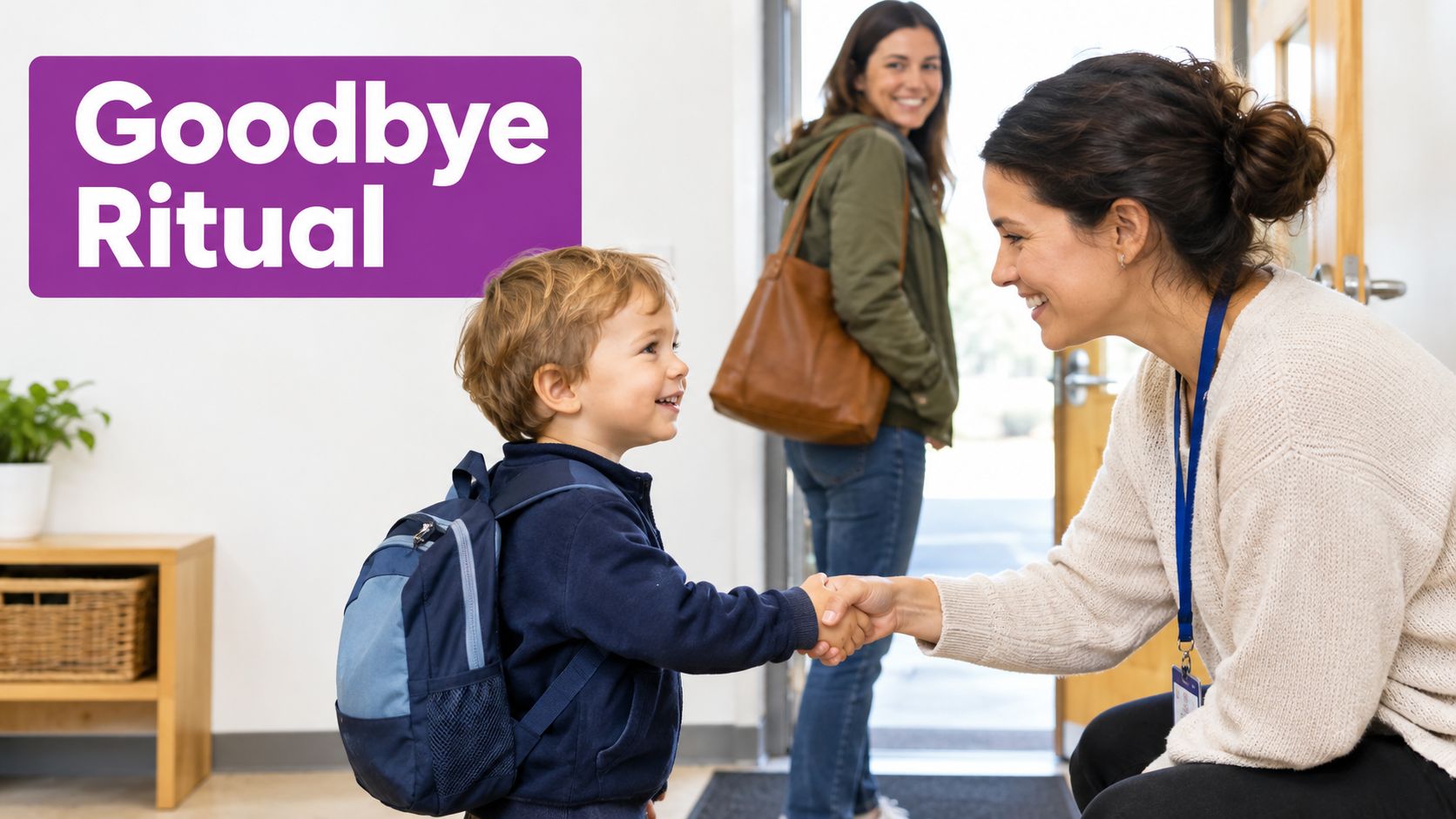
A child may arrive holding tightly to a parent's hand, unsure whether to enter the room. A familiar ritual gives that moment a clear beginning and end. It could be a song, wave, handshake, family photograph or small action completed in the same order each day.
Melbourne educators can shape the routine around the child and the setting. At arrival, the educator might greet the child by name, help place the bag away and sing a short welcome song. The child and parent might touch a “goodbye rock”, wave from the window or use a special handshake before separation. During the day, a familiar song, visual timer or movement pattern can guide children between indoor play, outdoor play and different rooms.
Build the routine around the child
Introduce the ritual during relaxed visits or calm mornings, rather than waiting for a difficult arrival. Keep it warm and brief. A long, uncertain goodbye can give anxiety more time to grow, while leaving without warning can weaken trust. Families can practise the same sequence at home before the first regular session, then adjust it as the child becomes more comfortable.
Invite the child to help choose the details. One child may prefer a high five, another a quiet wave, and another may need the educator to hold a comfort item while they enter. The adult keeps the order consistent without requiring physical contact, eye contact or visible enthusiasm.
A small card near the entrance can prompt the sequence: Say hello to the educator, Put the bag away, Share the goodbye using the agreed phrase or gesture, then Start the next activity with a known choice. The same pattern can support a room change or a move from indoor play to the yard.
The ritual will not prevent every tear. It gives adults a dependable response when tears begin. Acknowledge the feeling, follow the agreed steps and offer one calm next action. Families may want a longer farewell at home, while educators may need to keep the centre routine short, so discuss the plan in advance and review what helps the individual child.
7. Peer Buddy and Peer Mentoring Programs
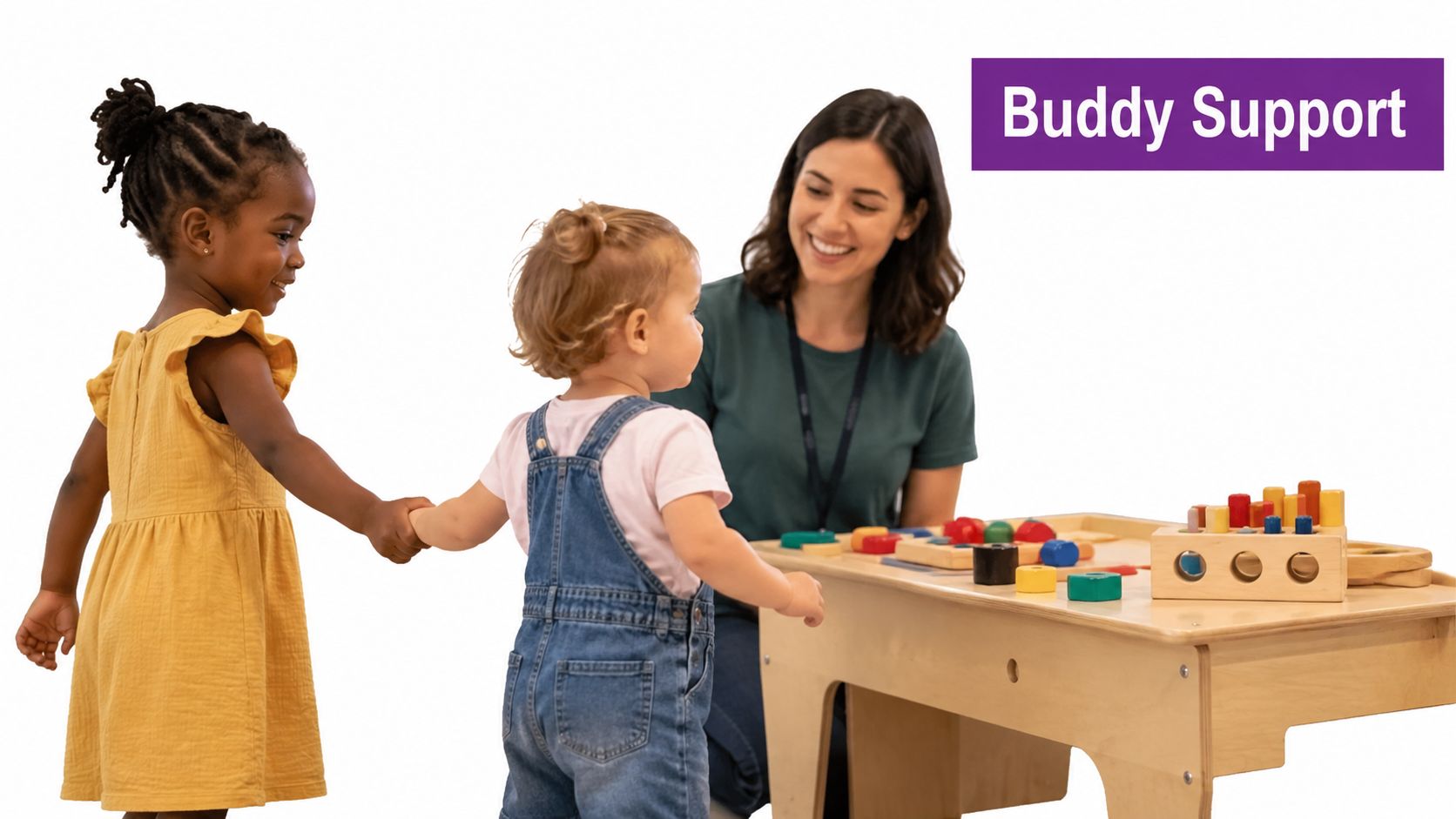
At morning arrival, a new child may stand beside the doorway while another child heads confidently to the block area. A well-chosen peer buddy can make that room feel more familiar by showing practical details, such as where to put a hat, how to join a construction game or where the group sits for music. The buddy offers connection, not responsibility for managing distress.
Introduce the arrangement before the first regular session where possible. An educator might say, “We have a new friend coming. You can show them the lockers and invite them to play. If they're upset, come and get me.” Families can prepare the child by talking about meeting a helpful peer, while educators keep the explanation simple and suited to the child's age.
Choose a buddy who is friendly, observant and comfortable with the room's routines. Shared interests often provide an easier starting point. A child who enjoys dinosaurs might invite the newcomer to the dinosaur shelf, while a keen builder can demonstrate the block area. For a child entering kindergarten, a familiar interest may be more useful than asking them to answer questions or make immediate conversation.
During the first interaction, the educator stays close and watches both children's cues. The buddy can:
- Show a routine: Demonstrate where to store belongings or wash hands.
- Offer an invitation: Ask the new child to join a puzzle, song or outdoor game.
- Find an adult: Tell an educator if the new child is crying, overwhelmed or needs help.
- Share space: Sit nearby without demanding conversation or touch.
A shy child may watch for a while before responding. Explain to the buddy that a new friend might not talk, play or hold hands straight away. If the buddy becomes too energetic, the educator can slow the interaction or offer a different activity.
The arrangement also needs boundaries. Rotate buddies rather than giving one child permanent responsibility. This helps the newcomer form several peer relationships and lets established children practise helping in different ways. A photo board can record shared activities, but it should celebrate participation rather than compare settling progress.
In a Springvale South room, an experienced preschooler might show a younger child the music space, then return to their own play. In a Ferntree Gully room, educators might use a buddy board where children add photographs after a shared activity. Name the contribution specifically: “You showed Leo where the instruments are and gave him time to look. That was thoughtful.”
8. Parent Partnership and Two-Way Communication Strategies
A child arrives after a broken night of sleep, clings at the doorway and refuses the usual morning routine. A parent knows what will help, while the educator can adjust the room, timing and expectations. Transition planning works best when both contribute before the child needs support.
Begin with an individual conversation, not only a group orientation. Ask practical questions: “How does your child show they need a break?” “What helps after a difficult morning?” “Which words does your family use for comfort?” “What would help you feel confident about this transition?” These answers can guide preparation at home, settling into a room, moving between rooms or entering kindergarten.
Record useful information where the educators who need it can act on it. If a parent says their child settles after looking at a family photograph, place one in the calm area. If the child slept poorly, offer a quieter activity and reduce demands. If the family prefers paper communication, provide that option rather than making an app the only route.
A workable partnership usually includes four parts:
- A transition profile: Record strengths, interests, communication preferences, comfort strategies and support needs.
- Authentic daily updates: Share a photograph and a specific observation, such as “She watched the water play for five minutes and then accepted my hand.”
- Shared notes: Invite parents to mention sleep, health, changes at home or new interests that may affect the day.
- Review conversations: Discuss what is helping, what is difficult and which adjustment to try next.
Specific updates build trust without alarming families. “She cried when you left, then sat beside me and watched the water play” gives a more useful picture than “She was fine” or a report focused only on distress. Recognise small steps, including entering the room, accepting help, joining a routine or communicating a need.
The handover to school needs the same care. The Australian Institute of Family Studies identifies continuity, family engagement and information exchange as important parts of positive transitions. With family consent, educators can share a child's strengths, interests, communication style and helpful adjustments with the receiving school, then confirm how that information will be used.
Victoria recorded 96.0% in the year before school in 2024 and 90.1% two years before school. Victoria's annual report provides the participation figures and broader transition context. These figures indicate that many children will need a service-to-school handover, making clear information exchange a practical part of transition planning. Participation figures cannot show whether an individual child feels secure, understood or ready, so the family's knowledge must remain part of the record.
Comparison of 8 Early Childhood Transition Activities
| Strategy | Implementation Complexity 🔄 | Resource & Time ⚡ | Expected Outcomes ⭐ / 📊 | Ideal Use Cases 💡 | Key Advantages ⭐ |
|---|---|---|---|---|---|
| Visual Social Stories and Photo Books | Moderate, personalize photos, sequence narratives | Moderate, photography, layout, laminating, digital copies | Increases predictability and comfort; ⭐⭐⭐⭐ 📊 reduced separation anxiety | Children with anxiety, language delays, home–centre bridging | Concrete visuals, repeatable at home, supports language |
| Graduated Settling-In Sessions | High, phased schedule, staff coordination over weeks | High, extra educator hours, flexible rostering | Strong attachment and trust; ⭐⭐⭐⭐⭐ 📊 fewer traumatic separations | Infants/toddlers, highly anxious children, attachment concerns | Individualised pacing, early identification of needs |
| Emotion Coaching, Feelings Vocabulary & Sensory Items | Moderate–High, training + consistent practice | Moderate, PD, sensory materials, time for check-ins | Builds regulation and resilience over time; ⭐⭐⭐⭐ 📊 reduced behavioural escalation | Children with emotional or sensory needs; whole-class culture building | Teaches durable coping skills, supports non‑verbal regulation |
| Key Educator Relationship Building & Consistent Caregiving | Moderate, staffing plans to ensure continuity | Moderate, stable staffing, handover time, PD | High secure attachment and exploration; ⭐⭐⭐⭐⭐ 📊 strong socio‑emotional gains | All ages, critical for infants and toddlers | Continuity of care, deep personalised understanding |
| Environmental Familiarity (Virtual Tours / Pre‑visits) | Low–Moderate, produce/update media and schedule visits | Low–Moderate, video setup/editing, occasional open sessions | Reduces novelty anxiety; ⭐⭐⭐ 📊 better expectations and confidence | Busy families, pre‑enrolment familiarisation, anxious children | Scalable, repeatable, convenient pre‑exposure |
| Transition Rituals & Meaningful Goodbye/Hello Routines | Low, consistent daily practice required | Low, minimal materials, staff consistency | Immediate predictability and safety; ⭐⭐⭐⭐ 📊 reduced separation distress | Daily arrivals/departures and activity changes | Low‑cost, high‑impact, creates emotional closure |
| Peer Buddy & Peer Mentoring Programs | Moderate, careful matching and brief training | Moderate, selection, supervision, periodic rotation | Accelerates social integration; ⭐⭐⭐ 📊 improved belonging and peer modelling | Preschoolers (3–6), social skill development | Mutual benefit, models routines, reduces isolation |
| Parent Partnership & Two‑Way Communication | Moderate–High, systems, norms, and relationship work | High, ongoing individualized communication and platforms | Greater trust and alignment; ⭐⭐⭐⭐⭐ 📊 smoother transitions and retention | All families, especially anxious/complex cases | Shared expertise, informed personalised transition plans |
Build a Bridge, Not a Deadline
A child doesn't need to complete every transition activity to be ready. A photo book may be ideal for one child, while another gains more from visiting the outdoor area with a familiar educator. Some children need emotional coaching and a comfort object. Others need the same key person to greet them each morning before they can explore.
Readiness is also not limited to letters, numbers or independent dressing. The Australian transition guidance on education and care emphasises that children, families, services, schools and communities all share responsibility for a successful start. That changes the question from “Is my child ready?” to “What can each adult and environment do to make this next step more connected?”
For families, a simple starting plan is enough:
- Choose one preparation tool: Use a photo book, visual schedule or low-pressure visit.
- Choose one relationship strategy: Build a connection with a key educator or peer buddy.
- Choose one predictable routine: Practise the same goodbye, arrival sequence or calming response.
Try the plan consistently, then review the child's response with the educator. Look for observable signs of growing comfort, such as entering with less hesitation, accepting help, communicating a need, exploring a new space or recovering after a difficult moment. Don't expect progress to move in a straight line. Illness, tiredness, family changes and sensory overload can make a previously easy transition difficult again.
The same approach works across different moments. For a baby moving into care, the bridge may be a familiar educator, feeding information and a comfort cloth. For a toddler changing rooms, it may be repeated visits, a photograph of the new space and a short goodbye ritual. For a preschooler entering kindergarten, it may include school visits, role-play, shared information about strengths and support needs, and conversations with the receiving teacher.
Families in Melbourne's diverse communities may also need to adapt materials and routines around home languages, cultural practices, family structure, disability and transport or work commitments. Ask what safety and belonging look like for this child. A multilingual visual schedule, a family-led story, a familiar song or a sensory plan can make a transition more respectful and useful than a standard school-readiness checklist.
The broader reason for this careful work is clear. In the 2018 AEDC results, 78% of children were developmentally on track across all five domains, while 11% were vulnerable on two or more domains. These are population patterns, not labels for individual children, but they show why educators need to notice social-emotional wellbeing, communication, physical confidence and relationships alongside early academic skills. The AIHW outlines these domains and the limits of interpreting the data.
Kids Club Early Learning Centre's family-owned centres in Springvale South, Dandenong North and Ferntree Gully can support families through personalised settling, educator relationships, room visits and school-readiness pathways. Its programs serve children from six weeks to six years, with infant and toddler environments, kindergarten options and a four-year-old pre-PREP program that supports continuity into the next stage.
Start with the transition your child is facing now, not every possible future change. Share what you notice, listen to what your child communicates through words and behaviour, and adjust the bridge together.
Kids Club Early Learning Centre offers personalised settling support, familiar educator relationships and kindergarten pathways for children moving into care, changing rooms or preparing for school. Visit Kids Club Early Learning Centre to explore the centres in Springvale South, Dandenong North and Ferntree Gully and discuss a transition plan for your family.