
You're in the car when your toddler asks why a duck says “quack”. You smile, answer as best you can, and then notice what just happened: your child wasn't only listening to your words. They were noticing a sound, comparing it with an animal, and playing with spoken language.
Those small moments matter. Phonological awareness skills help children recognise and think about the sound structure of language before they read letters or words. Singing, rhyming, clapping names, and stretching out words may look like simple games, but they help children prepare for the more demanding work of reading and spelling.
In Australian early childhood practice, phonological awareness sits within the broader pathway from oral language to early literacy. The Victorian literacy teaching guidance describes awareness of speech sounds, syllables, and rhymes as an important early competency for emergent and proficient reading and spelling.
Why Noticing Sounds Comes Before Reading Letters
Hearing a sound and noticing how language is built from sounds aren't the same thing. A child may hear the word sun clearly, yet still need help recognising that it begins with one sound and ends with another. They may enjoy a song without noticing that two words rhyme.
Phonological awareness is an oral skill. Children use it to recognise, compare, separate, blend, and play with parts of spoken language. They can practise it without seeing a letter, holding a book, or writing anything down.
That distinction often clears up a common confusion. Phonics teaches the relationship between letters and sounds, while phonological awareness happens in the spoken language first. Before a child can use printed letters to decode a word, they need to understand that spoken words contain smaller sound units that can be matched to those letters.
Practical rule: If the activity can be completed with eyes closed, it may be building phonological awareness rather than phonics.
The work starts in ordinary places
Your kitchen, car, bath, and bedtime routine offer useful opportunities. You might stretch the sounds in ssssoup, clap the beats in banana, or pause before the final word in a familiar rhyme. These interactions don't need to feel like lessons. The adult's role is to make the sound feature noticeable, then give the child a chance to listen and respond.
A toddler may begin by turning towards a familiar song or copying a repeated phrase. Later, they may notice that cat and hat sound alike at the end. Eventually, they can listen to /c/ /a/ /t/, blend those sounds, and say cat.
The English study and early literacy guide for parents offers a helpful way to connect these listening experiences with the literacy journey children follow as they move towards formal reading instruction. The key idea is simple: spoken language is not separate from reading preparation. It is where reading preparation begins.
Why the distinction matters
Children who find it difficult to break spoken words into parts may struggle when teachers ask them to connect those parts with letters. A child might know the name of a letter but still be unsure what to do when asked to hear the first sound in map or blend /m/ /a/ /p/.
That's why strong early practice includes more than alphabet songs. Children need rich conversation, songs, rhyme, careful listening, and direct modelling of how words can be pulled apart and put back together. These experiences build the listening foundation that later phonics instruction can use.
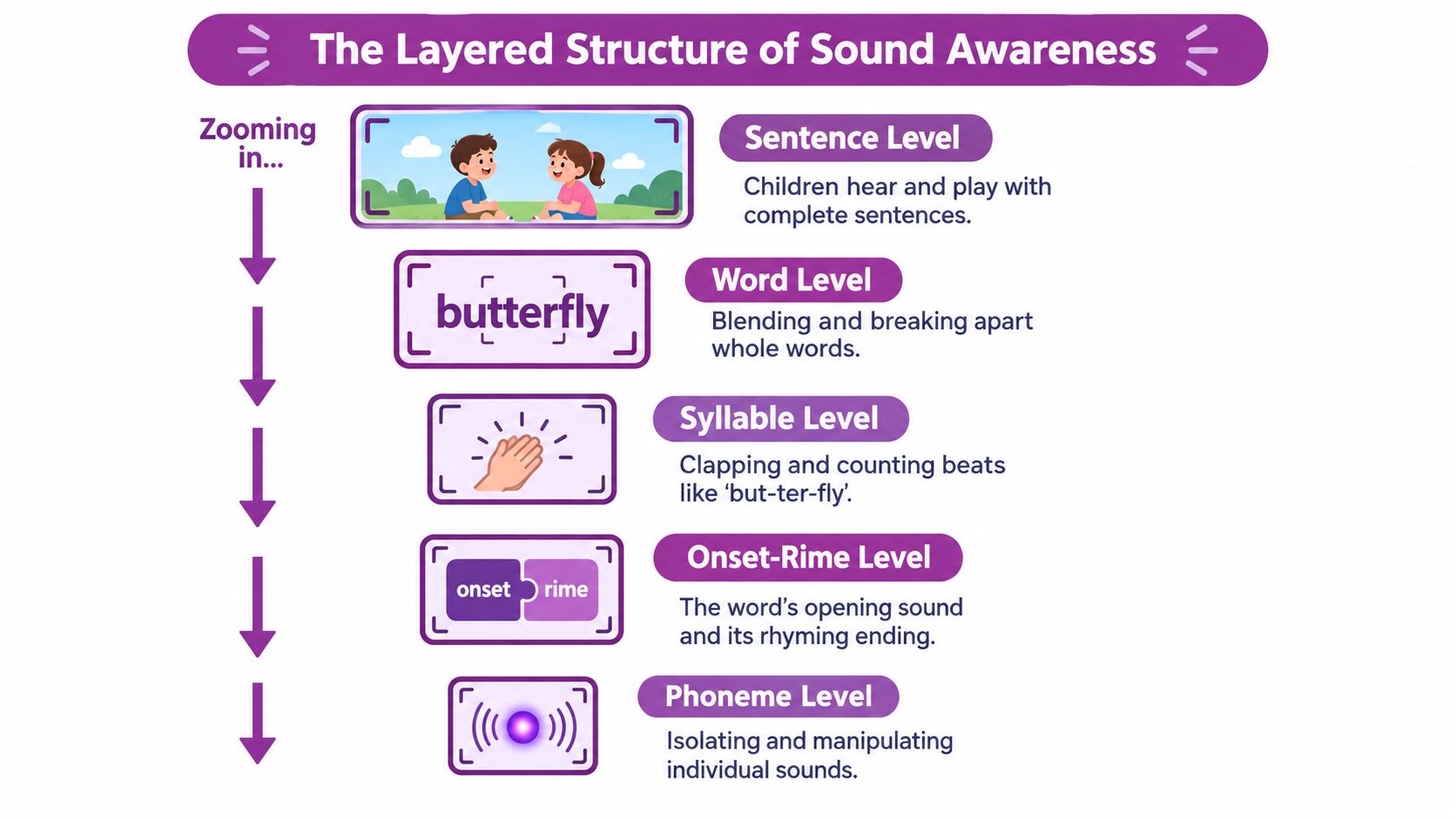
The Layered Structure of Sound Awareness
Think of sound awareness as a camera that gradually zooms in. At first, the camera captures a whole sentence. Then it focuses on individual words, syllables, larger word parts, and finally the smallest individual sounds.
Word awareness
At the widest view, children learn to hear that a sentence contains separate words. Say, “The cat sat.” A child with developing word awareness can begin to recognise the, cat, and sat as distinct spoken units rather than one long stream of sound.
You can make this visible through movement. Say a short sentence and place one counter on the table for each word. Keep the sentence brief, speak naturally, and let your child listen before asking them to count.
Syllable awareness
Zoom closer and children work with the beats inside words. But-ter-fly has three spoken beats, while dog has one. Clapping, tapping, marching, or placing objects can help children feel those parts.
Use familiar names and objects first. Clap Doc-tor, El-e-phant, or straw-ber-ry, then invite your child to try. The purpose isn't perfect performance. It's helping the child hear that a longer word can be divided into manageable spoken chunks.
Onset and rime awareness
The onset is the opening sound or sound group in a word. The rime is the part that follows and creates the word's sound pattern. In cat, /c/ is the onset and at is the rime.
This layer becomes playful when children swap onsets. Cat, bat, and hat share the at pattern while changing the opening sound. Children don't need printed letters for this activity. Say the words aloud, exaggerate the shared ending, and ask what changed.
Phoneme awareness
The tightest zoom focuses on individual phonemes, the smallest sound units in spoken words. In bat, the child listens for /b/, /a/, and /t/, then blends them to make the whole word.
Phoneme work includes isolating a sound, blending separate sounds, segmenting a word into sounds, and later changing, adding, or removing sounds. These tasks are more demanding than clapping syllables, so children benefit when adults move gradually through the sound ladder rather than jumping straight to isolated phonemes.
Age Milestones from Babyhood to Pre-Prep
Children don't all develop in exactly the same order or at exactly the same pace. Milestones are useful for noticing growth, not for turning family life into a test. Listen for what your child can do naturally, then offer the next small challenge.
| Age Band | Typical Skills | Example |
|---|---|---|
| Birth to 2 years | Enjoys babbling, repeated sound patterns, familiar names, and songs | Pauses or smiles when a favourite song begins |
| Two to 3 years | Enjoys silly rhymes, repeated refrains, and simple rhythm | Helps finish “Humpty Dumpty sat on a…” with “wall” |
| Three to 4 years | Begins producing rhymes, hearing parts in compound words, and noticing shared beginnings | Claps rain-bow or hears that cat and car start alike |
| Four to 5 years | Blends larger sound parts and begins separating short spoken words | Combines /d/ and og to say dog |
| Pre-prep and kindergarten | Develops confidence blending and segmenting short words made from several sounds | Listens to /s/ /t/ /a/ /r/ and works towards star |
From babyhood to toddlerhood
Infants communicate through coos, babbling chains, rhythm, and turn-taking. When you copy a baby's sounds and wait for a response, you're helping them experience the pattern of spoken conversation. Familiar songs also teach the rise, fall, and repetition of language.
Toddlers may recognise family names, pause at a familiar refrain, or repeat a sound pattern they find amusing. At this stage, enjoyment and participation matter more than correct answers.
The preschool years
Between two and four, children often become fascinated by nonsense. They may invent a word that rhymes with cat, even if it isn't a real word. That creativity is useful because it shows they're attending to the sound pattern rather than only the meaning.
Compound words provide a gentle next step. Say rainbow, then ask your child to say rain and bow separately. Later, compare the opening sounds in cat and car. Keep the examples familiar and stop while the game still feels enjoyable.
Moving towards formal schooling
Children approaching pre-prep benefit from oral blending and segmenting. You might say /m/ /a/ /p/ and ask, “What word did I make?” Or say sun and invite your child to stretch it slowly, listening for each sound.
Some children will be ready for three- or four-phoneme words sooner than others. The useful question is not whether a child can complete every task immediately, but whether their listening is becoming more precise with patient modelling and repeated opportunities.
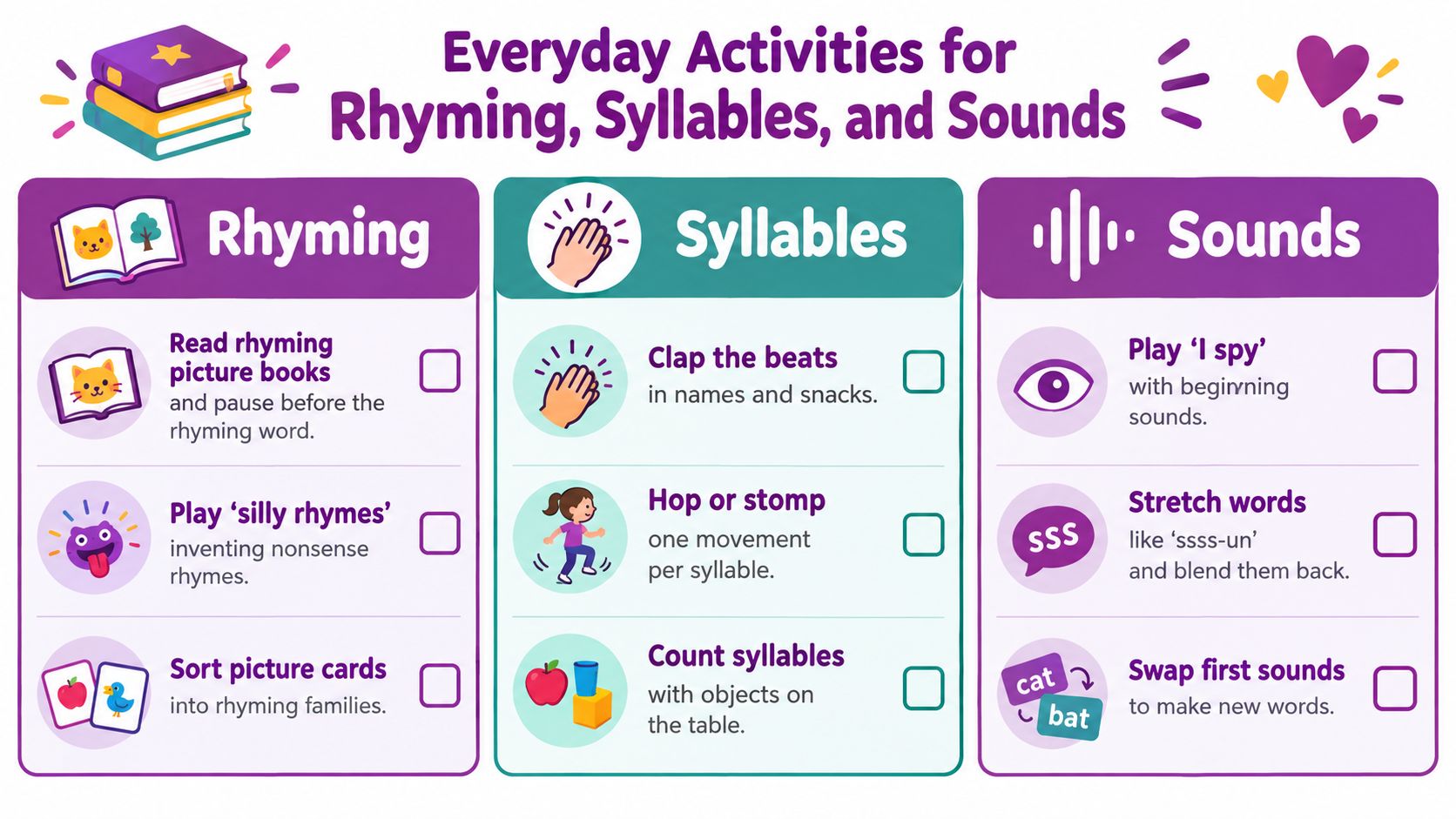
Everyday Activities for Rhyming, Syllables, and Sounds
The most effective activities are short, playful, and matched to the sound layer your child is ready to explore. Start with listening, model the answer, and let your child join in without pressure.
Rhyming games
Nursery rhymes give children a predictable pattern. Pause before the final word in “Hickory Dickory Dock, the mouse ran up the…” and let your child supply clock. Then add a silly version such as sock and laugh together.
You can also make up playful alternatives to familiar songs. If the line ends in cat, try hat, bat, or a nonsense word. Ask, “Does that sound like it belongs with cat?” The child is learning to attend to the ending sound pattern, not to memorise a list.
For a sorting game, place picture cards or household objects into rhyme families. Keep the words oral, say each item clearly, and accept approximate attempts while your child is learning.
Syllable activities
Names are an easy entry point because children care about them. Clap Sa-man-tha, Ben, or A-li-ce, then clap the names of people, toys, or foods around you.
Movement helps make an invisible sound pattern physical:
- Name claps: Clap once for each beat in family names.
- Food steps: March the syllables in ap-ple, yo-ghurt, or ba-na-na.
- Object counting: Place one button, bead, or block on the table for each syllable.
- Syllable building: Thread one bead onto a pipe cleaner for every beat you hear.
If your child claps incorrectly, repeat the word slowly and invite another try. Avoid stretching each syllable unnaturally. The aim is to hear the word's natural rhythm.
Onset, rime, and phoneme play
For onset and rime, build a word family orally: sat, bat, mat, hat. Draw a simple picture for each word or use magnetic letters if your child is beginning to connect speech with print, but keep the listening task central.
For blending, say /c/ /a/ /t/ with a small pause between the sounds, then ask, “What word?” Once your child answers, blend it again smoothly. For segmenting, say cat and ask your child to count the sounds on their fingers.
A bath can become a listening game. During a car trip, swap the first sound in a familiar word. At story time, pause before a rhyming word or stretch a character's name. Music experiences for preschoolers can also support children's attention to rhythm, repetition, and the sound patterns in language.
Why These Skills Predict School Readiness
Phonological awareness matters because it helps children understand the structure of spoken words before they have to represent those words in print. A child who can hear that map contains separate sounds has a useful starting point when a teacher introduces the letters that represent those sounds.
Australian guidance places this work at the foundation of early reading instruction. Victoria's literacy toolkit describes phonological awareness as a key early competency and connects explicit phonemic awareness teaching with evidence supporting early literacy instruction. It also notes that a preschool child's phonemic awareness level is a strong predictor of later reading success. Read the Victorian evidence and guidance on phonological awareness for the policy context.
What the Australian evidence tells us
The need for early support is clear in the Australian context. A Curtin University study reported that in 2016, 40,000 Australian 15-year-olds, about 1 in 7, failed to meet OECD basic reading standards (Curtin University research). That historical benchmark doesn't mean phonological awareness is the only cause of reading difficulty. It does show why educators focus on foundational skills well before secondary school.
The same Australian literature reports differences in non-word spelling, non-word reading, and phoneme segmentation between Aboriginal and non-Aboriginal children in an urban school study, even though all children scored within the normal range on a standardised phonological awareness measure. This is a reminder to look beyond a single broad result and notice the particular sound tasks a child can or cannot manage.
Universal routines and targeted support
Should every child receive sound-based support, or only children who show a delay? In practice, universal, embedded routines give every child access, while observation helps educators provide more focused teaching where it's needed.
A Curtin University classroom study found that children aged 3;8 to 5;4 who received teacher-delivered, explicit phonological awareness and alphabet knowledge instruction improved significantly more than controls in phonological awareness, alphabet knowledge, non-word reading, and spelling (Victorian oral language and phonics resource). The practical lesson is not to replace play with worksheets. It is to make sound instruction intentional, brief, and connected with broader early literacy teaching.
Signs of Difficulty and When to Seek Help
Children don't automatically develop every phonological awareness skill through exposure alone. Some children need adults to slow the task down, model it clearly, and practise it in a more deliberate way.
A single missed rhyme isn't a diagnosis. Look for patterns across ordinary interactions, especially when a child has had regular opportunities to listen and play with language.
Signs worth recording
You might notice that your child:
- Avoids sound play: They show little interest in rhymes, songs, repeated refrains, or silly word games.
- Finds rhythm difficult: They can't clap the beats in a familiar name or simple word.
- Needs meaning to guess: They rely on pictures or context rather than listening carefully to the spoken sounds.
- Struggles to blend: They can't combine two or three spoken sounds into a familiar word after modelling.
- Finds sound comparison hard: They don't notice when words start alike or rhyme, even with clear examples.
For a child around four, persistent difficulty with rhyme and syllable activities is a sensible reason to speak with an educator or speech pathologist. A child approaching pre-prep who can't blend short sequences of sounds or segment familiar words also deserves careful observation and support.
Make help routine, not alarming
Write down specific examples over two to three weeks, such as “couldn't clap the beats in their name” or “blended /s/ /u/ /n/ after two models”. This gives educators a clearer picture than saying a child is just “behind”.
An initial check is usually practical and child-friendly. An educator or speech pathologist may ask the child to identify a rhyme, clap a word, say a word in parts, or blend sounds into a word. They'll consider the child's speech, hearing, language background, attention, and opportunities to learn rather than treating one activity as a final answer.
Seek partnership early: Asking for advice doesn't label a child. It helps the adults around them choose a more useful next step.
Some children are late to join in but progress quickly once the task is made clearer. Others need planned small-group support, repeated practice, or referral to a specialist. Either way, early communication gives families more options.
How Early Learning Centres Build These Skills
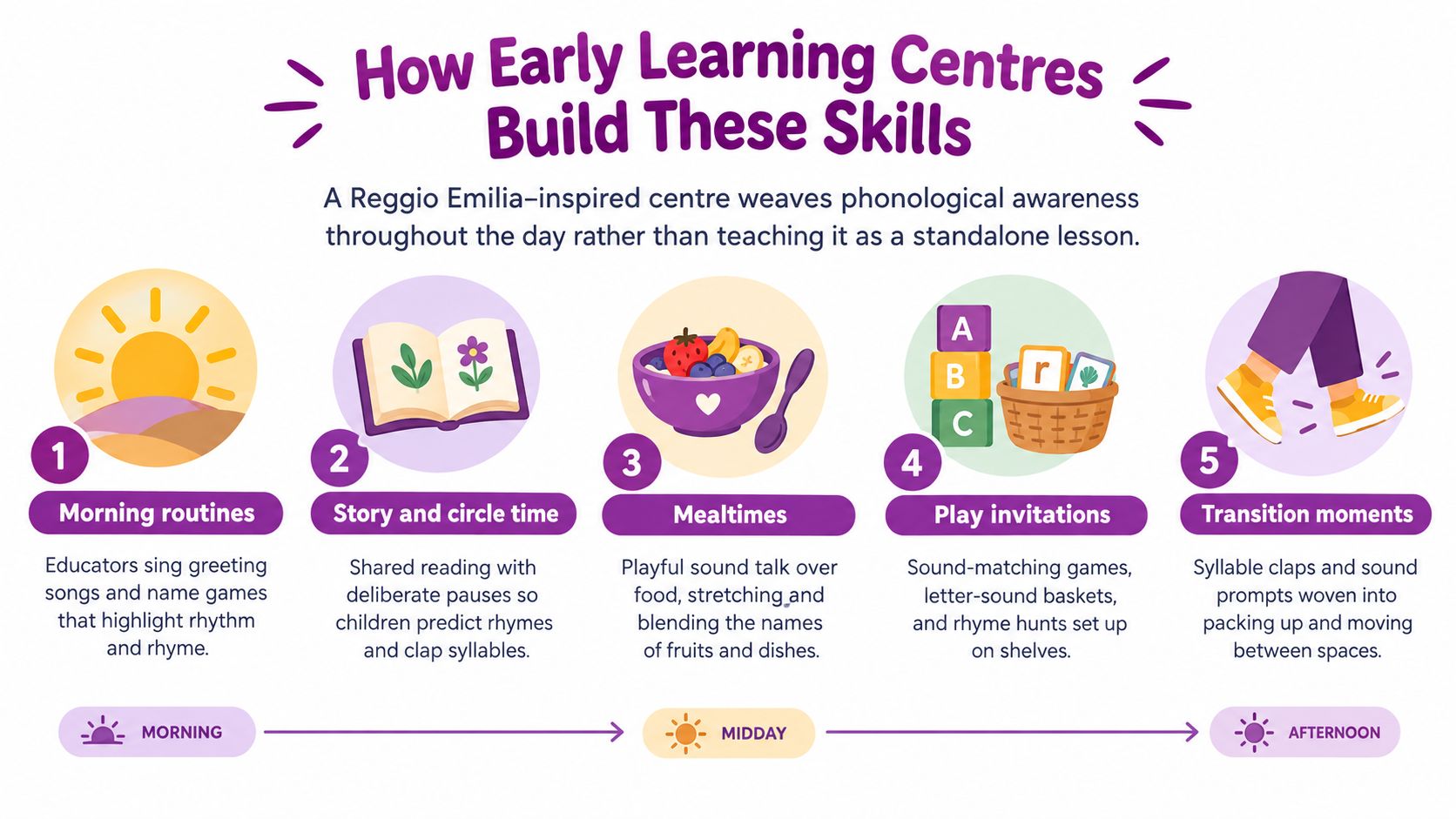
In a Reggio Emilia-inspired early learning centre, sound awareness doesn't need to appear as a separate worksheet session. Educators can weave it through the day, then observe how children respond and plan the next invitation.
At morning group time, a teacher might sing a greeting song and clap each child's name. During story reading, they can pause before a predictable rhyme, invite children to complete the refrain, and repeat interesting words with clear rhythm.
Mealtimes offer natural language. An educator might stretch ssssandwich, compare the beginnings of banana and bread, or clap the beats in straw-ber-ry. In a construction area, children could sort picture cards or objects according to their beginning sounds, then explain their choices to a friend.
What intentional practice looks like
High-quality practice is playful, but it isn't accidental. Educators listen for what children can already do, model the next sound task, and revisit it during transitions, group experiences, shared books, and child-led play.
Australian evidence also cautions against treating phonological awareness as a complete literacy programme by itself. An embedded classroom pilot reported significant gains in alliteration awareness, print knowledge, and story skills, while oral-language gains were limited. That supports a balanced approach combining sound work with rich conversation, vocabulary, storytelling, print knowledge, and educator guidance. The Victorian early learning principles and practices provide a useful framework for considering how these experiences fit within everyday pedagogy.
Before choosing or reviewing a programme, ask:
- Daily practice: Do educators include rhyme, rhythm, syllables, and sound talk throughout the routine?
- Responsive planning: Do they record observations and adjust activities for individual children?
- Broader literacy: Does sound work sit alongside stories, conversation, vocabulary, print, and early writing?
- Family communication: Can educators explain what your child is practising and suggest a simple home activity?
- School transition: Does the programme connect oral language development with kindergarten or pre-prep readiness?
Kids Club Early Learning Centre offers play-based, Reggio Emilia-inspired learning for children from six weeks to six years, with VIT-registered teachers, kindergarten and pre-PREP programs, and learning experiences that support oral language and school readiness.
If you're looking for a Melbourne early learning setting where songs, stories, conversation, and purposeful sound play are part of the daily program, visit Kids Club Early Learning Centre to explore the centres in Springvale South, Dandenong North, and Ferntree Gully and arrange a conversation with the team.