
A parent is at the door at pick-up, half listening while checking the time, and still wants to know whether their child ate well, settled quickly, joined the group experience and made it through the day without that mid-afternoon wobble. Inside the room, educators are holding the bigger picture. They need family insight about sleep, routines, language, health, behaviour shifts and what's happening at home if they're going to support that child well.
That's the tension many centres sit in every day. Families want meaningful connection, not a flood of vague updates. Educators want partnership, not another task that turns into one-way admin. When family engagement strategies work, they don't rely on occasional special events or long newsletters nobody has time to read. They become repeatable centre systems that make communication, participation and decision-making easier for everyone.
That matters because family engagement isn't just nice practice. The Australian Department of Education's parent-engagement review links parent engagement with improved outcomes across early literacy, school readiness, attendance, social skills, self-regulation, retention and graduation, and Evidence for Learning's synthesis of 97 studies estimates parental-engagement approaches produce an average of 4 months' additional progress over one school year.
For centres and families in Springvale South, Dandenong North, Ferntree Gully and nearby Melbourne communities, the strongest approach is usually the most connected one. Start with trust-building communication. Build toward participation that feels realistic. Remove access barriers. Make cultural responsiveness visible. Support transitions properly. Then review what's improving.
1. Parent-Teacher Communication Partnerships
Communication falls apart when it's left to chance. A quick verbal handover can be warm and helpful, but it won't carry the full load for a family with shift work, shared care arrangements or a child who behaves differently at home and in care.
A better model is structured, two-way communication with a clear rhythm. Daily journals or app updates can cover meals, sleep, play and notable moments. Weekly room updates can explain what children are investigating, singing, building or noticing. Scheduled conversations can handle the bigger developmental and wellbeing picture.

What strong communication looks like
At a centre level, this usually means each family knows:
- Who to speak to: A key educator or room leader should be the first point of contact.
- When updates come: Families shouldn't have to guess whether they'll hear daily, weekly or only when there's a problem.
- How to respond: Some parents prefer an app message, others a phone call, translated notes or a quick conversation at the gate.
In Reggio Emilia-inspired settings, documentation can do more than report. It can invite collaboration. A short note such as “He kept returning to ramps today. Have you noticed a similar interest at home?” gives families a clear way in.
Practical rule: Don't save communication for concerns. Families build trust faster when educators share small progress, effort and joy as regularly as they share problems.
What doesn't work is overloading families with generic updates. “We had a lovely day” is friendly, but it rarely helps a parent understand their child. Specific observations do. So do transition meetings between rooms, where educators and families can talk through routines, preferences and what support will make the next move smoother.
2. Home Learning Extension Activities
At 6:10 pm, one family is managing dinner, a tired preschooler and a younger sibling who needs a bath. Any home learning idea that depends on printing, shopping for materials or finding half an hour of quiet will usually be left for another day. The activities that get used fit into routines families already have.

A good extension activity should feel like a continuation of the child's day, not extra homework for the household. If a child has been exploring rhythm at the centre, the home version might be clapping patterns while setting the table. If they have been revisiting a story, a parent can retell it with soft toys at bath time. In Ferntree Gully, a leaf hunt on the walk in from the car can become sorting, comparing and describing at home. In Dandenong North or Springvale South, helping wash rice, count tomatoes or pack fruit into lunchboxes can build the same thinking through familiar family routines.
That connection matters. It shows families what the learning looks like in real life, and it gives educators a more honest picture of what a child can carry across settings.
One useful test is this. Could a busy adult understand the activity in under a minute and start it with what they already have at home? If not, it is probably too much.
Rather than sending one generic task to everyone, centre teams can send a small menu tied to current learning. For example:
- a movement prompt for children who like action
- a talk-and-draw idea for children who want quieter time
- a practical job such as measuring, sorting or matching during meals or pack-up
That approach respects differences in language, confidence and time. It also helps families who want to join in but do not always know how.
The Front Project's national survey of 1,695 parents of children aged 0 to 5 found that 88% said their child had used some form of care or education other than exclusive home care, and 78% were currently using it. Regular contact between centre learning and home life needs to be realistic enough to happen often, not saved for special projects.
For older kindergarten children, educators can link these ideas to school readiness experiences at home without turning family time into formal lessons. A short prompt such as “Can your child explain the steps while helping make toast?” often gives more useful practice than a worksheet.
A short demonstration often helps more than a long explanation.
There is a trade-off here. Personalised home extensions take educator time to plan, especially if teams are trying to keep them culturally responsive and accessible for families with different home languages or different levels of confidence. Still, the return is usually better than sending home elaborate craft packs that need special materials, a large table and a parent with spare energy on a Wednesday night. Practical, low-pressure invitations are more likely to build steady participation, and steady participation is what turns family engagement into a centre habit.
3. Family Events and Community Celebrations
At 5:45 pm, one parent is rushing in after work, another has a pram and a toddler in tow, and a grandparent is waiting by the sign-in area because English is not their first language and they are unsure where to go. A family event either helps those adults feel welcome quickly, or it confirms that centre life is mainly designed for families with more time, more confidence or more familiarity.
That is why community celebrations work best as part of a connected centre practice, not as stand-alone extras on the calendar. Used well, they deepen trust that has already started through everyday communication. They also give educators a better chance to listen, notice relationships and include family members who may not speak much at drop-off.
For Kids Club communities in Springvale South, Dandenong North and Ferntree Gully, the practical question is not “Should we hold an event?” It is “What kind of contact will help families join in without adding pressure?” A shared meal may suit one group. In another room, a short afternoon open session with children showing a song, a block build or a gardening project may get better participation because families can arrive, connect and leave within a clear time frame.

A useful event usually has three signs:
- Families know the purpose before they arrive.
- Children have a meaningful role, not just a performance role.
- Staff can run it without days of extra preparation.
That last point matters. Centres often get better long-term results from modest, repeatable formats than from large celebrations that depend on heavy staff labour or parent volunteering every term. A seasonal picnic, a breakfast catch-up, a room open afternoon or a transition display can all build connection. They are easier to repeat, and repetition is what turns occasional goodwill into a familiar part of centre culture.
Small access decisions shape turnout more than decoration does. Start and finish times need to be specific. Invitations need plain language and, where possible, translation support or verbal follow-up. Families also need permission to participate in flexible ways. “Drop in for 20 minutes if that suits” is often more inclusive than expecting every family to attend the full event.
Some families still will not come, and that does not mean the event failed. Shift workers, separated parents, families with new babies and carers managing transport or cost pressures may want connection but have limited capacity. Good centres plan for that reality by sharing photos, brief summaries or children's comments afterwards, then using those moments in later conversations. Community celebrations should widen belonging, not measure who had the freest evening.
4. Flexible Enrolment and Access Models
A family can be interested in a centre and still not make it through the enrolment process.
That happens more often than teams expect. A parent finishing a late hospital shift may miss the only orientation time. A grandparent helping with enrolment may feel stuck on funding paperwork written in unfamiliar terms. A family new to Melbourne may want care, but hold back because they are not yet sure who to ask, what hours are available, or whether their child will be understood.
Access shapes engagement from the first contact. Families are more likely to enrol and stay connected when the service feels useful, clear and safe, as noted in research on child participation and family engagement in early childhood education, which also found that quality and safety matter strongly in family decisions, and enrolment and engagement are more likely when families feel connected and supported by other professionals.
At centre level, small changes often remove the barrier. One practical example in a Melbourne service is a translated enrolment checklist given to families before the first tour, followed by a phone call to confirm what documents to bring and which funded options may apply. That does not solve affordability on its own, but it reduces confusion, shortens back-and-forth, and gives families a clearer start.
Flexible enrolment usually works best as a set of operational decisions:
- clear explanations of session types, hours and waitlist steps
- orientation times that include early, late or staggered options for shift workers
- support with forms and subsidy questions in plain language
- settling plans that allow some children to start gradually, rather than expecting a full routine on day one
For Kids Club families across Melbourne communities, flexibility can mean different things. In one suburb, the pressure point may be commute timing and pick-up windows. In another, it may be helping a family entering formal care for the first time understand room routines, sleep arrangements or who to speak with about language support.
The trade-off is workload. More flexible access asks more from administration and room leaders, and centres cannot offer every arrangement to every family. Still, teams can be transparent about what is possible, what needs notice, and where the limits are. That honesty builds trust faster than broad promises followed by a confusing start.
5. Parent Education and Skill-Building Workshops
A parent arrives at pick-up after a hard week of rushed mornings, asks why their child is suddenly "pushing back" at home, and wants an answer in two minutes while also keeping dinner on track. That moment is often the starting point for family workshops. Families are not usually asking for more theory. They are asking for practical help they can use tonight.
Short, well-timed workshops give centres a way to turn everyday questions into shared understanding. They also connect family engagement to centre practice, rather than treating support for parents as a one-off extra. In Melbourne services, that might mean a short evening session on toilet learning, a Saturday morning conversation about starting school, or a recorded lunchtime briefing for families who cannot attend in person.
The strongest sessions stay close to real family life. Educators can explain why children need repeated routines, what co-regulation looks like during a rushed transition, or how group experiences at the centre build skills that show up later at home. A discussion about friendship skills, turn-taking and problem-solving can also link naturally to children's personal and social capability without turning the session into curriculum jargon.
Topics usually work best when they solve a specific problem families already recognise, such as:
- preparing for the move to school with realistic expectations about independence
- supporting behaviour with consistent language across home and centre
- building early language through songs, shared reading and everyday conversation
- helping children manage separation, rest routines or big feelings during periods of change
Format matters as much as content.
A 45-minute workshop with examples, visuals and time for questions is often more useful than a long presentation. Some families will come in person. Others need a handout, a recording, or a brief summary in plain language. For Kids Club communities across Melbourne, access can depend on work patterns, travel time, confidence with English, and whether the session feels respectful rather than corrective.
There is a trade-off here. Workshops take preparation time, and not every session will be well attended. Centres still gain value when the material is reused well. A strong slide deck can become a parent handout. A live Q and A can shape future communication. Common family questions can inform room practice, especially if educators notice the same concerns appearing across several households.
The aim is simple. Help families understand what the centre is doing, why it matters, and what a realistic version of support looks like at home. That is how workshops strengthen trust first, then participation.
6. Feedback and Consultation Mechanisms
A parent mentions at pick-up that the late-afternoon routine feels rushed. Another family never says anything in person, but leaves a careful note in a survey about confusing allergy updates. Both are giving the centre useful information. The difference is whether the service has a clear way to collect it, sort it and respond.
Good consultation is part of everyday centre practice, not a once-a-year exercise. It starts with trust. Families are more likely to give honest feedback when communication already feels respectful, when they know who to speak to, and when previous concerns have been acknowledged properly.
For Kids Club families across Melbourne, that usually means using more than one channel. Some parents will talk openly at drop-off. Some will only respond after hours on their phone. Others need paper forms, translated prompts, or a quieter scheduled conversation because the issue is sensitive.
Victorian ECEC research with parents and caregivers found barriers to engagement clustered around communication, consistency and family commitments, and the qualitative synthesis highlighted regular and reliable communication among effective strategies. The same publication also cites ARACY implementation guidance suggesting parent surveys should be 25 to 30 items or 10 to 15 minutes, use multiple formats, and stay open around 4 to 5 weeks.
That guidance is practical. Short surveys get finished. Clear questions produce better answers. A survey that works on a phone, with a paper option at the desk, gives more families a fair chance to respond.
The stronger habit is closing the loop. If families raise the same issue about sign-in congestion, room updates, meal information or transition timing, centre leaders should report back on what changed. If nothing changed, explain why. Families do not expect every suggestion to be adopted. They do expect honesty.
A simple pattern works well in practice:
- collect feedback in a few predictable ways, such as pulse surveys, enrolment check-ins, family meetings and informal conversations
- review themes by room, age group or attendance pattern
- decide which issues need an immediate fix, which need consultation, and which sit outside the centre's scope
- share actions back with families in plain language
There is a real trade-off here. Consultation takes staff time, and every comment cannot become a program change. Anonymous feedback can surface concerns that would otherwise stay hidden, but it can also make follow-up harder. Named feedback allows a better response, especially where a child's routine or care plan is involved. Centres usually need both options.
Used well, feedback systems do more than solve complaints. They show families that participation matters after enrolment too, and they give educators a clearer picture of access barriers, cultural expectations and everyday friction points that affect trust.
7. Individualised Learning Plans and Progress Sharing
At pick-up, a parent asks a familiar question: “How was her day?” A quick “good” keeps the line moving, but it does not build much connection. A short, specific update does. “She spent twenty minutes returning to the same block idea with two peers, then asked for paper to draw it.” That kind of progress sharing helps families see how learning is developing over time, not just how the day felt.
Individualised learning plans work best when they connect three things clearly. What the child is showing at the centre. What the family is noticing at home. What educators will try next. In Kids Club's Melbourne communities, that often means adjusting the format as much as the content. Some families want a brief conversation at the door. Others prefer a digital update they can read after work, or a scheduled meeting with time for questions.
In a Reggio Emilia-inspired setting, documentation can make learning visible through inquiry, relationships, language, movement, creativity and problem-solving. The value is not the display itself. The value is helping families understand why an experience mattered for their child.
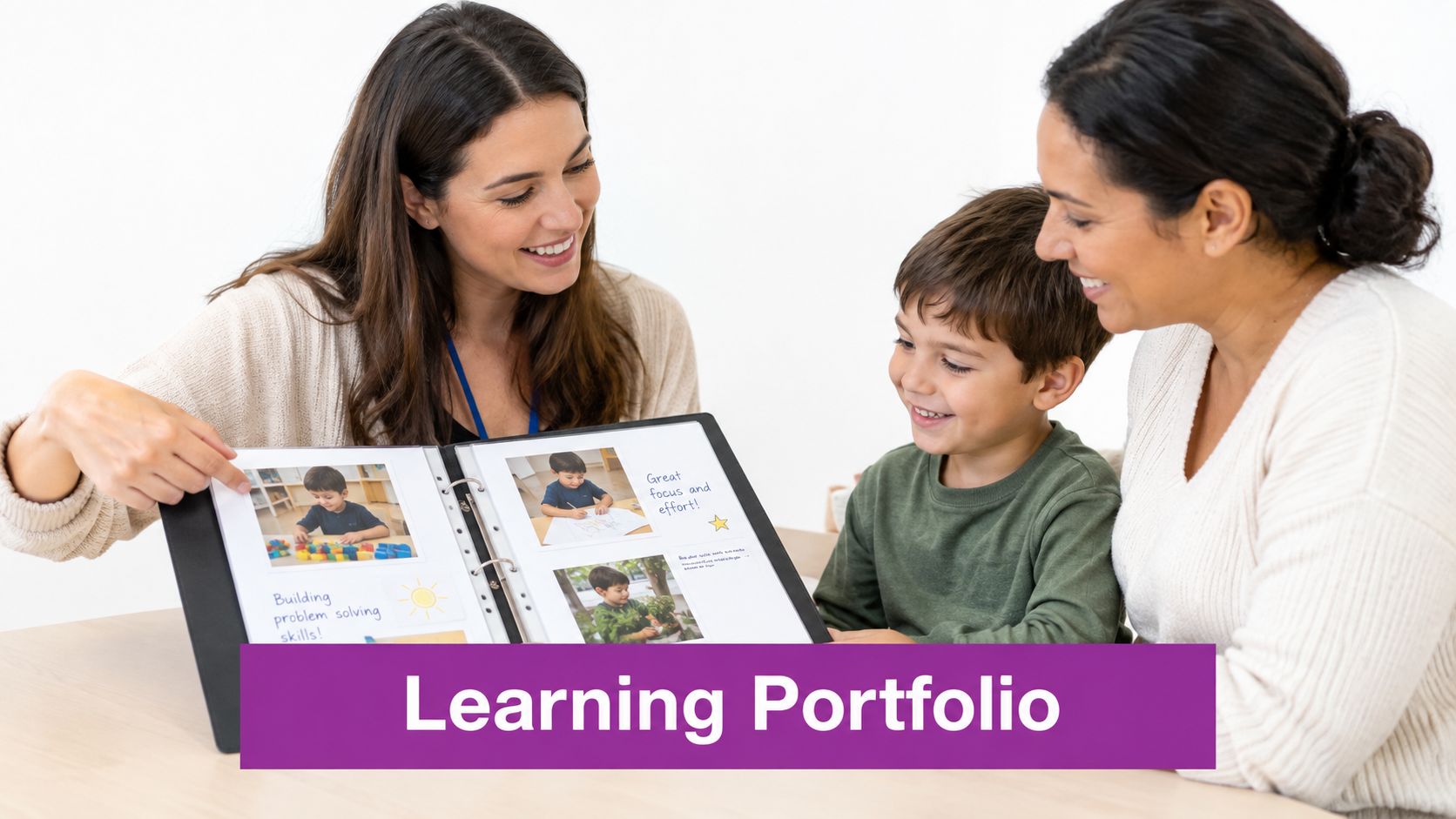
A strong entry usually shows process, not just outcome. That might be a photo sequence with a short observation, a child's own words, and one clear next step. For babies and toddlers, the focus may be attachment, communication, routines, sensory exploration or early peer connection. For preschool children, the same approach can show how a sustained interest is supporting language, early maths, self-regulation or collaboration.
The practical challenge is time. Detailed documentation takes educator attention, and families can feel buried if every post looks polished but says very little. Centres usually get better results by sharing fewer, more meaningful observations in plain language. Weekly touchpoints often work better than a large term summary, especially if families can add a note from home about sleep changes, new interests, family events or language use.
It also helps to be honest about limits. Not every child needs a long written plan every week. Some children need closer tracking during a transition, after a change in routine, or when educators and families are working through a concern together. Others are better served by short, consistent updates that build a fuller picture over the term.
Good progress sharing should answer a parent's real question: “Do you know my child well, and are we working on the same things?” If the answer is yes, trust tends to grow. Families participate more readily, educators get better information from home, and the learning plan becomes a shared working document rather than a folder item.
8. Welcome and Orientation Programs
A parent arrives for the first drop-off already bracing for tears, a new room, new faces and a rush to get to work on time. The centre can lower that stress before the family walks through the door.
One simple tool helps straight away: send a one-page visual daily routine before day one. Include photos of the room, arrival, morning tea, rest time, outdoor play and pick-up. For a toddler, that gives families language they can use at home the night before. For a preschool child, it turns an unknown day into a sequence they can picture. In busy Melbourne households, especially where parents are juggling long commutes, shift work or more than one drop-off, that small piece of preparation often makes the first week calmer.
Good orientation starts before enrolment paperwork is finished. A short phone call with the lead educator can cover the details that matter most early on: who usually drops off, what helps at separation, sleep patterns, comfort items, allergies, home languages and any recent family changes. Centres in communities such as Kensington, Braybrook or Springvale South may also need to ask a practical access question early. Who needs information by email, who prefers a printed copy, and who would find translated key points more useful?
A strong orientation usually has three parts working together:
- One familiar contact person: a key educator who greets the family, learns the child's cues and follows up after the first few sessions
- A paced start: short visits or adjusted early days for children who need a slower build, while recognising that some families need a full start because work leave is limited
- Visible information: room photos, names of educators, where bags go, how meals work, and what families should expect at pick-up
The trade-off is time. Personalised orientation asks more of educators in an already full week, and not every family can attend multiple visits. That is why the process needs to be light enough to use consistently. One clear pre-start call, one visual routine sheet and one key contact usually do more than a polished welcome pack that no one has time to explain.
Families remember the first signals a centre sends. Do educators know my child's name? Did anyone ask what matters at home? Is there a plan for a hard goodbye? Those early moments set up later participation, honest communication and smoother transitions across the year.
9. Culturally Responsive and Inclusive Practices
At drop-off, inclusion is easy to spot. An educator says a child's name the way their family says it, checks whether lunch expectations at home affect mealtime support, and knows which grandparent usually picks up on Thursdays. Families read those signals quickly.
In Melbourne communities such as Springvale South, Braybrook and Kensington, culturally responsive practice is less about displaying diversity and more about how the centre works every day. It shows in enrolment conversations, room setup, food planning, communication choices and who gets asked to contribute knowledge about the child.
A useful starting point is restraint. Educators do not need to know everything about a family's background on day one. They do need to ask respectful questions and leave room for different answers. Some families want home language used in greetings, songs or comfort routines. Some prefer English-only communication at the service while keeping language learning at home. Some are happy to share stories, recipes or celebrations. Others want privacy, especially if they are tired of being treated as representatives of a whole culture.
That means inclusion has to be built into ordinary practice:
- using correct pronunciation of names and checking again if unsure
- offering key information in the formats families can use, including translated summaries where possible
- reviewing books, dolls, music, dramatic play materials and displays so children can see familiar people, homes and family structures
- discussing food routines with care, including religious requirements, sensory needs and family preferences
- avoiding assumptions about who makes decisions at home, who speaks for the family, or what “participation” should look like
Research linked to educator wellbeing and family engagement points to a pattern that fits centre practice well: families engage more strongly when educators use family knowledge, communicate reliably, maintain consistent relationships and link support around the child in a person-centred way, as described in Australian research on educator wellbeing and engagement practice.
The trade-off is practical. Translation, more careful communication and broader curriculum review take time, and centre teams are already balancing ratios, routines and documentation. That is why the strongest approach is usually simple and repeatable. Keep a short list of preferred names and key phrases. Audit one part of the room each month for representation. Ask one culture and inclusion question in regular family check-ins, instead of saving the topic for special events.
Festival days can still be joyful. They just should not carry the whole load.
Children notice whether belonging is occasional or built into the week. Families do too. When cultural responsiveness is treated as a connected centre practice, trust grows faster, participation feels safer, and educators get better information to support each child well.
10. Transition Support and Communication
Transitions test the quality of a centre's family engagement more than almost anything else. Moving from infant to toddler room, from toddler to preschool, or from kindergarten to school can stir excitement, grief, pride, uncertainty and a lot of practical questions all at once.
That's why transitions need more than a noticeboard date. Families usually need time, explanation and continuity. Children need familiar people, repeated exposure and a sense that the adults around them are connected.
Build a bridge, not a handover
Useful transition practices often include room visits, photo books, social stories, family meetings and direct communication between current and next educators. The strongest versions are not rushed. They begin early enough for families to ask the questions they only think of later.
For kindergarten children moving toward school, many centres also share practical resources about routines and what the first days may feel like. For families wanting a simple starting point, guidance around the first day of kindergarten can help turn a big emotional step into a more manageable one.
A child settles faster when adults transfer relationship knowledge, not just paperwork.
What doesn't work is treating transition as an administrative move. If the new educator doesn't know the child's comforts, interests, friendships, stress signals and communication style, families feel that gap immediately. Good transition support protects continuity. It tells the family, “We know your child, and the next room will know them too.”
10-Point Comparison of Family Engagement Strategies
| Strategy | 🔄 Implementation complexity | ⚡ Resource requirements | 📊 Expected outcomes | 💡 Ideal use cases | ⭐ Key advantages |
|---|---|---|---|---|---|
| Parent-Teacher Communication Partnerships | Moderate, daily/weekly routines and meetings | Ongoing educator time; digital app or paper systems; translation support | Improved trust and home-centre consistency; early concern detection | Routine updates, settling periods, ongoing relationships | Strong family-centred partnership and consistent messaging |
| Home Learning Extension Activities | Low–Moderate, content creation each week | Prep time for activity packs; low-cost household materials; multimedia | Extended learning at home; increased parent engagement | Reinforcing weekly themes; low-cost family involvement | Low-cost continuity between centre and home |
| Family Events and Community Celebrations | High, event planning and coordination | Staff planning time; venue/logistics; modest budget; accessibility support | Strong community bonds; cultural recognition; increased parent investment | Building centre-wide community; multicultural celebration | Visible community connection and family belonging |
| Flexible Enrolment and Access Models | High, complex rostering and policy design | Administrative systems; flexible staffing; clear fee structures | Increased access and family retention; improved utilisation | Families with varied work hours; shift workers | Removes logistical barriers and supports diverse needs |
| Parent Education and Skill-Building Workshops | Moderate–High, program design and delivery | Facilitators or guest experts; venue/childcare; materials; recordings | Increased parental confidence; shared approaches at home/centre | Parents seeking child development knowledge; school readiness | Builds competence and positions centre as knowledge partner |
| Feedback and Consultation Mechanisms | Moderate, regular collection and follow-up | Survey tools; meeting facilitation; data analysis time | Improved centre quality; increased ownership and transparency | Policy changes, program evaluation, family voice | Directly informs improvements and builds trust |
| Individualised Learning Plans and Progress Sharing | High, personalised documentation and review | Digital portfolio systems; educator documentation time; training | Clear view of child growth; tailored learning and smoother transitions | Children with identified goals; Reggio documentation practice | Demonstrates responsive, child-centred practice |
| Welcome and Orientation Programs | Moderate, personalised onboarding processes | Staff time for visits/tours; written materials; key-person assignment | Reduced settling anxiety; quicker relationship building | New enrolments, infants/toddlers, centre transitions | Effective first impressions and smoother settling-in |
| Culturally Responsive and Inclusive Practices | Moderate–High, ongoing curriculum integration | Translation, diverse resources, staff training and recruitment | Greater belonging and participation; reduced engagement barriers | Diverse communities; multicultural curricula | Authentic inclusion and stronger family validation |
| Transition Support and Communication | Moderate, planned phased activities and follow-up | Time for meetings, visits, photo documentation; coordination with schools | Reduced anxiety; smoother developmental and school transitions | Room changes, school entry, key developmental stages | Minimises disruption and supports continuity of care |
Make Engagement a Centre Habit
The best family engagement strategies aren't copied whole from another service. They're adapted to the families in front of you, the staffing reality you have, and the barriers that keep showing up in your own centre.
A sensible place to start is communication. Audit what families currently receive, when they receive it, and whether they can easily respond. Many centres discover they're sending plenty of information but not creating enough two-way exchange. A daily app note, a predictable weekly learning update and one scheduled check-in point can do more than a stack of occasional broad messages.
Then remove one participation barrier. Not all at once. Just one. It might be confusing enrolment information, events scheduled at unworkable times, surveys that are too long, or orientation that assumes families already understand how early learning works. When services become more approachable, engagement becomes easier for families who might otherwise stay on the edges.
Family input should be part of that improvement cycle. Ask a focused question, collect responses in a format people can realistically complete, and report back on what changed. Even a short update such as “Families asked for more detail about meals and rest, so we've adjusted daily updates” shows that consultation has weight.
A small set of indicators is usually enough to keep the work grounded. Centres can review response rates to messages or surveys, attendance patterns at events, recurring feedback themes, settling-in concerns raised during orientation, and whether transition follow-ups reveal unresolved issues. Those measures won't capture everything, but they will show whether the centre is building habits that families can feel.
Parents can take a simpler view of engagement. It doesn't have to mean volunteering for every event or writing long updates. Sometimes it's one useful comment at drop-off, one home observation about a new interest, one family photo that helps a child feel connected, or one question that opens a better conversation with the educator.
For Melbourne families looking for a service where partnership is part of everyday practice, it's worth exploring how a centre communicates, welcomes new families, supports transitions and responds to feedback. Kids Club Early Learning Centre serves communities across Springvale South, Dandenong North and Ferntree Gully, and families can learn more about its approach and locations at Kids Club Early Learning Centre.
Kids Club Early Learning Centre offers childcare and kindergarten programs for children from six weeks to six years, with flexible care options, family communication and developmentally aligned learning across its Melbourne locations. If you want to see how these family engagement strategies can work in daily practice, visit Kids Club Early Learning Centre and explore the centres in Springvale South, Dandenong North and Ferntree Gully.