
Some mornings you barely get shoes on, pack the lunch box, and make it to drop-off on time. Then your child hears a song, starts clapping before anyone else does, or hums while stacking blocks, and you realise music is already part of how they move through the day.
That's usually the moment parents start looking into music programs for kids. Not because they want to raise a concert pianist, but because they can see something happening. Their baby settles with a familiar tune. Their toddler joins in with actions before they can say all the words. Their preschooler suddenly remembers a clean-up routine because it was sung, not spoken.
Music often works like a second language in early childhood. Children feel it in their bodies before they can explain it. They repeat it before they can read it. They use it to connect before they have all the social words they need.
In Australia, music learning reaches many children, but access isn't even. A report commissioned by the Tony Foundation found 66% of students in its school sample received music education, while later sector analysis cited in 2026 said 47% of children learn music at school and a further 23% do so through extracurricular providers. The same analysis reported that senior secondary music enrolments fell 16% nationally between 2012 and 2022, which shows participation often narrows as children get older (Australian music education consultation material).
For families, that makes the early years matter. A steady start can help music feel normal, enjoyable, and part of everyday learning rather than something children only try much later.
If you're also interested in how young children learn through exploration, this guide to play-based learning in early childhood pairs naturally with the way music is introduced in quality early learning settings.
Introduction to Music Programs for Kids and Why They Matter
Parents usually aren't searching for a music program because they want more to do. They're searching because they want something that fits real life and helps. They want to know if music will support speech, confidence, coordination, friendships, or help their child enjoy learning.
That question matters because music is already one of the most common organised creative activities for children in Australia. ABS-related reporting cited by Creative Australia noted that in 2021 to 2022, 620,700 children aged 5 to 14 participated in organised singing and music activities, compared with 415,000 in organised dance and 156,200 in organised drama. The same fact sheet also reported that 3.1 million Australians aged 15 and over created music in 2019, equal to 15% of that age group, up from 12% in 2016 (Creative Australia music fact sheet).
Why parents pay attention to music early
When music is part of a child's week, parents often notice small but meaningful things first:
- Easier participation: A child who won't join a group talk may happily join a song with actions.
- Better memory for routines: Tunes help children remember steps like packing away, washing hands, or taking turns.
- More expression: Some children sing feelings before they can describe them clearly.
- A gentler entry into learning: Rhythm, repetition, and movement make new ideas feel less demanding.
Music doesn't have to be formal to be meaningful, but it does need to be regular enough for children to recognise patterns and feel confident joining in.
What families are really trying to solve
For many Melbourne families, the challenge isn't whether music is valuable. It's whether a program is practical. Can it fit around work? Does it involve another trip across town? Is it included in care, or does it become one more extra cost and one more timetable to manage?
That's why the strongest options are often the ones that bring music into a child's usual week, with familiar educators, predictable routines, and no extra scramble for parents.
What Music Programs for Kids Really Include
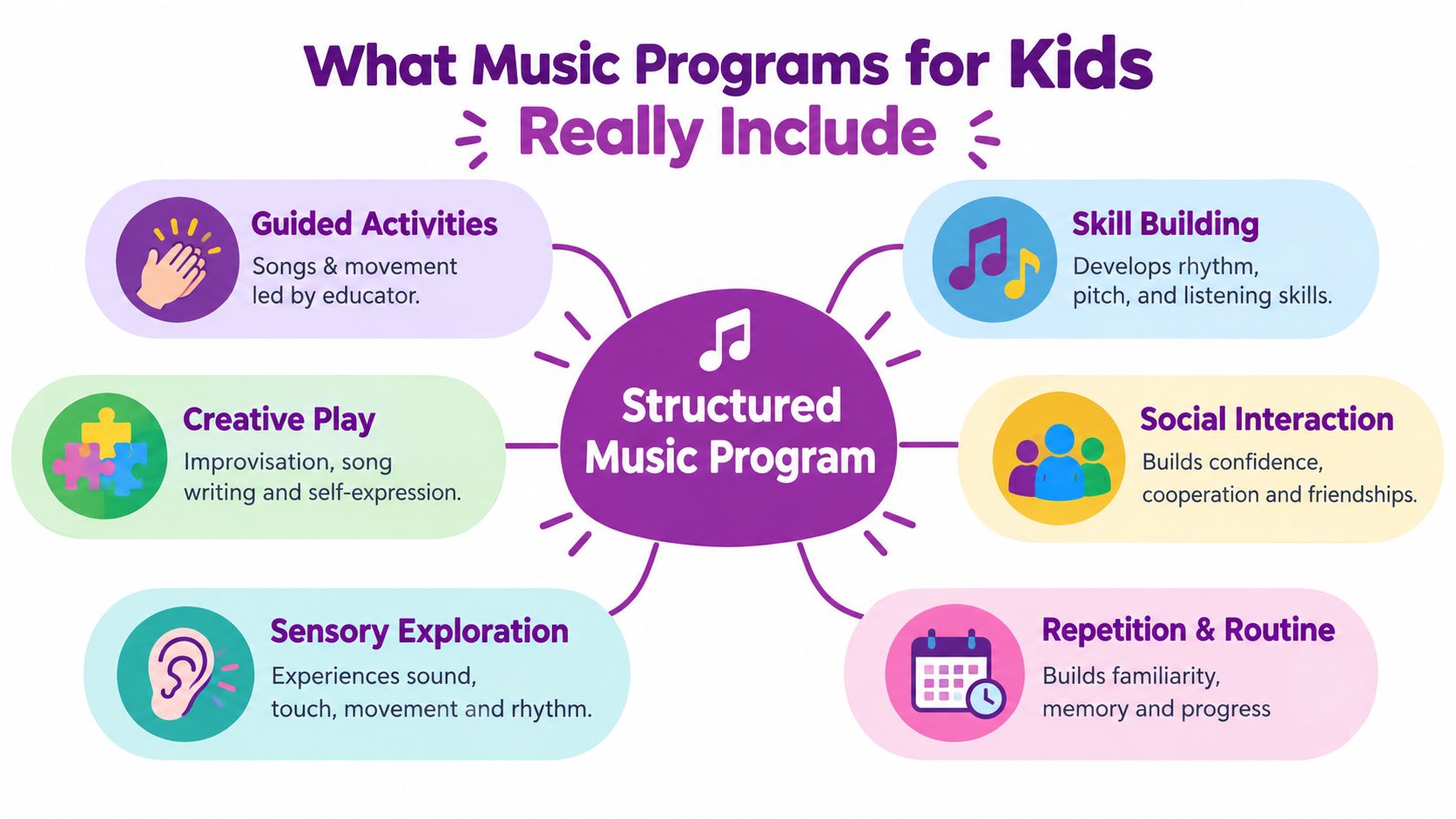
A structured music program is more than putting on a playlist or singing one song before lunch. Those moments are lovely, but a program has intention behind it. It gives children repeated chances to listen, move, respond, remember, and create.
A simple way to picture it is this. Casual singing at home is like chatting with your child during the day. A structured music program is like giving them regular language-rich conversation with purpose, repetition, and room to practise.
The building blocks of a real program
Most quality music programs for kids include a blend of experiences rather than one single activity.
- Singing: Children hear pitch, rhyme, vocabulary, and phrasing.
- Movement: They clap, sway, march, jump, freeze, and follow rhythm with their whole body.
- Instrument exploration: Simple percussion lets children connect sound with action.
- Listening games: They learn to notice starts, stops, loud and soft, fast and slow.
- Repetition: Familiar songs return often enough for confidence to grow.
- Participation with others: Children learn when to lead, copy, wait, and join in.
When these pieces appear together over time, music becomes part of learning rather than a one-off entertainment moment.
What makes it structured
A structured session usually has a recognisable flow. There may be a hello song, action songs, movement play, instrument time, quieter listening, and a goodbye routine. That rhythm matters because young children feel safer when they know what comes next.
A good program also has progression. Children aren't expected to perform. They are expected to participate. Over time they become more willing to sing, more accurate with actions, better at waiting for cues, and more comfortable being part of a group.
Practical rule: If every session feels random, children get novelty but not much growth. If sessions repeat key songs and routines with small changes, children have a better chance to build confidence.
Who usually leads these programs
Music programs can be led by early childhood educators, visiting music specialists, classroom teachers, or a mix of both. What matters most is not flashy performance. It's whether the adult can guide children in ways that are warm, responsive, and developmentally appropriate.
An Australian case study from Monash found music in an early childhood education and care setting was strongest when staff placed high value on it, used both integrated and added music experiences, and received ongoing professional development (Monash early childhood music case study).
That finding helps parents ask a smarter question. Not just “Do they offer music?” but “How well is music embedded, and how prepared are the adults delivering it?”
How Music Supports Development at Every Age
Children don't all use music in the same way. A baby experiences it through closeness, tone, and rhythm. A toddler turns it into movement and imitation. A preschooler starts using it for memory, coordination, cooperation, and pattern recognition.
That's why age-appropriate music programs for kids matter. The same song can work across ages, but the learning inside it changes.
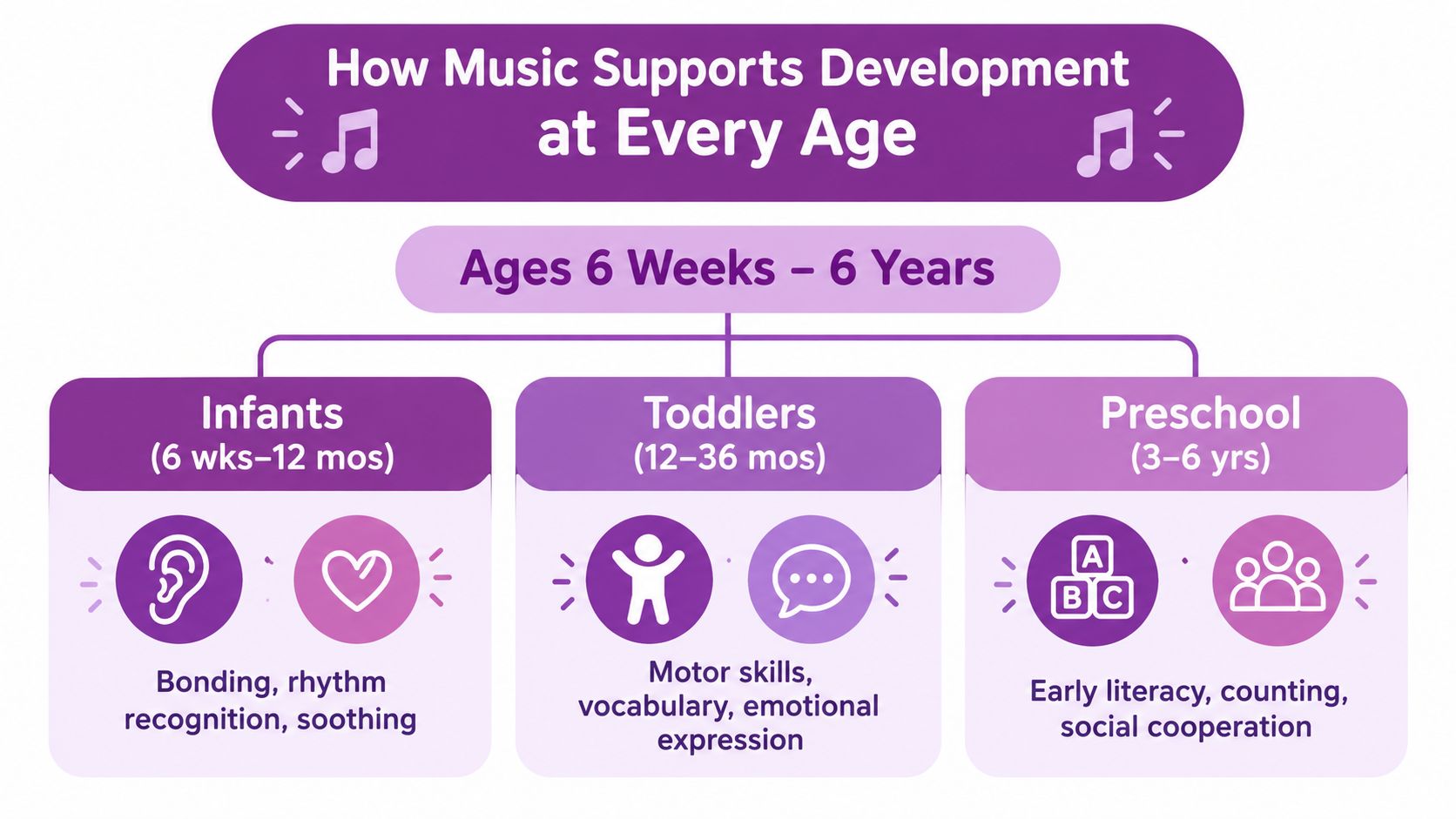
Infants from six weeks to 12 months
For babies, music is first about connection. A calm voice, repeated melody, or gentle bounce helps them anticipate what's coming. That predictability can be soothing because the pattern becomes familiar.
Simple musical play at this age often includes lap songs, rocking, soft singing, and peekaboo-style rhythm. Babies listen before they join in. Then they begin to kick, smile, still their bodies, or vocalise in response.
The learning here is subtle but powerful.
- Bonding and trust: Familiar songs can become part of secure routines.
- Listening: Babies start noticing changes in tone, pace, and volume.
- Early turn-taking: Pauses in songs invite tiny back-and-forth exchanges.
Toddlers from 12 to 36 months
Toddlers often meet music with their whole body first. They stomp, spin, clap late, clap early, and then suddenly clap right on cue. That's not messy learning. That's exactly how early coordination grows.
This is also the age when music supports language beautifully. Repeated song phrases give toddlers a safe way to try words again and again without pressure. Action songs also help them match language with movement, which can make meaning easier to hold onto.
Toddlers often sing a routine before they can explain it. That's one reason songs work so well for transitions, tidy-up time, and emotional regulation.
Helpful music experiences for toddlers include:
- Call-and-response songs: One adult sings a phrase, children answer with a word or action.
- Action songs: Hands, feet, jumping, tapping, and body awareness all come into play.
- Simple percussion: Shakers, bells, or drums connect cause and effect.
Preschool and kindergarten from three to six years
By preschool age, children can handle more complex group music-making. They can wait for their turn, follow multi-step action songs, notice patterns, and contribute ideas.
Music often overlaps with early literacy and numeracy. Beat and rhythm support pattern awareness. Rhyme supports sound play. Counting songs connect number words to sequence. Group singing also teaches children to listen to others while managing their own part.
A 2026 Australian education review reported a reliable association between music lessons and academic achievement regardless of children's age, participation in other activities, family income, or parent education, and recommended one hour of music lessons per student per week in Foundation to Year 8 plus ensemble access (Australian review on access to music).
For younger children, the practical takeaway is simple. Consistent weekly exposure and participatory group music matter more than occasional special events.
If you'd like a closer look at this age group, these benefits of music for preschoolers show how music connects with everyday early learning.
Common Types of Music Programs and How They Work
Once parents start looking, the options can blur together. One program sounds playful. Another says it's educational. Another focuses on instruments. The easiest way to sort them is to look at where the music happens, who leads it, and how easily it fits your week.
Four formats families often see
Some music programs are woven into an early learning curriculum. Others happen in community halls, studios, or private lessons. None is automatically right for every child.
Here's a simple side-by-side view.
| Program Format | Best Age Range | Typical Structure | Family Consideration |
|---|---|---|---|
| In-centre early learning music | Infants to preschool | Group sessions embedded into the weekly program, often linked to routines, movement, and classroom learning | Convenient because it happens during the child's normal day |
| Community music groups | Babies to preschool | Parent-child or small group classes with songs, movement, and simple instruments | Can be lovely for bonding, but travel and timing matter |
| Private instrumental lessons | Usually older preschool onward, depending on readiness | Individual or paired lessons focused on one instrument | Suits children ready for sustained attention and regular practice |
| Choir or ensemble experiences | Preschool to school age | Group singing or shared music-making with clear turn-taking and listening | Works well for children who enjoy group participation |
What each format is really good at
In-centre programs are often the lowest-friction option for busy families. Children learn in a familiar environment, and educators can carry the songs into the rest of the day.
Community classes can be a great fit if you want shared parent-child time. They often help first-time parents learn songs and routines they can repeat at home.
Private lessons work best when a child is ready for focused repetition. If a child still learns mainly through movement, pretend play, and group imitation, formal lessons may feel early.
Choir or ensemble formats suit children who enjoy being part of a team sound. These settings build listening and cooperation because no child is the whole performance.
For a broader look at what children do across the day in care settings, these activities in childcare show how music often sits alongside art, movement, literacy, and play.
How to Choose the Right Music Program for Your Child
The best program isn't the one with the fanciest name. It's the one your child can join regularly, enjoy safely, and grow with over time.
Parents often feel pressure to choose something “good enough” on the spot. It helps to slow down and look for signals that the program is built for children, not just performed at them.
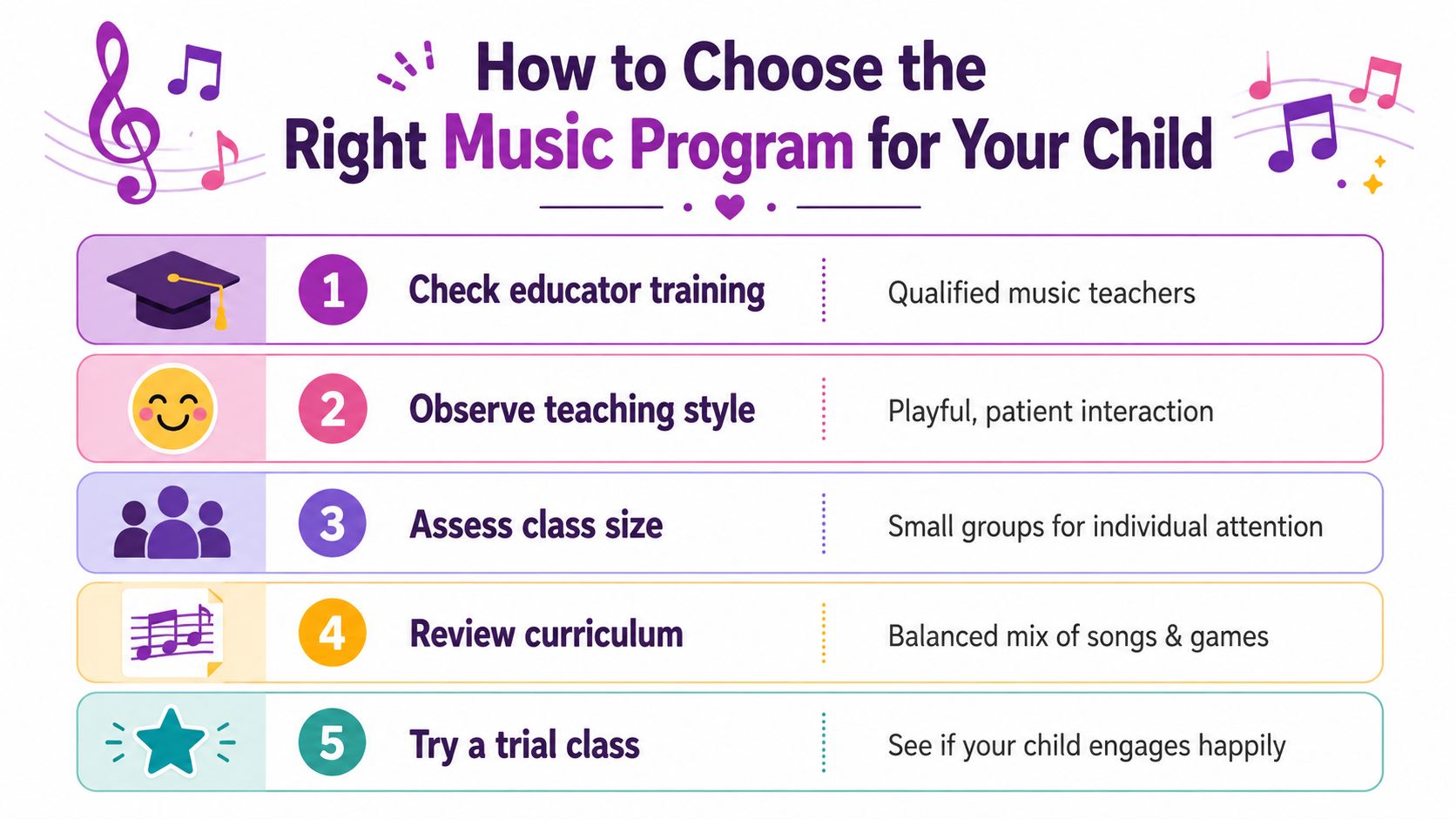
Quality signs worth noticing
Watch one session, if you can. The room will tell you a lot.
- Children are participating, not just watching: You want singing, moving, choosing, copying, and responding.
- The adult is warm and clear: Young children need simple cues, encouraging tone, and gentle pacing.
- There's a routine: Hello songs, repeated favourites, and a calm finish help children settle.
- Different learning styles are included: Some children sing loudly. Some watch first. Both should feel welcome.
- Music connects to the day: In strong programs, songs support transitions, language, movement, and group belonging.
Questions to ask before you commit
You don't need expert musical knowledge to judge a program well. A few practical questions usually reveal the difference between a meaningful offering and a token add-on.
How often does music happen?
Weekly consistency matters more than occasional novelty.Who leads the sessions?
Ask whether music is led by trained staff, a specialist, or both.How is it adapted for age?
Babies, toddlers, and preschoolers shouldn't all receive the same style of session.Do children actively join in?
A performance for children is not the same as music with children.How is inclusion handled?
Some children need quieter entry points, extra visual cues, or time to observe first.
A strong music program doesn't ask every child to respond the same way. It gives each child a way in.
Red flags parents can spot quickly
Sometimes a program sounds impressive but feels thin in practice. Watch for these signs:
- One-off entertainment dressed up as curriculum: If music appears rarely, children don't get enough repetition to build confidence.
- Too much sitting and waiting: Young children learn through doing.
- No clear progression: If songs change constantly, children may enjoy the novelty but struggle to develop familiarity.
- Pressure to perform: Early childhood music should build participation first, not polish.
One practical option for families comparing local settings is to look for centres where weekly music is part of the normal educational program rather than an extra booking. Kids Club Early Learning Centre includes a weekly professional music curriculum within its broader early learning offer for children from six weeks to six years, which is one example of how families can access regular music without adding another stop to the week.
Local Music Opportunities and Inside Kids Club Early Learning Centre
For many families in Melbourne's south-east, the biggest barrier to music isn't interest. It's logistics. Another pick-up. Another fee. Another trip after work with a tired child and a hungry sibling in the back seat.
That practical side matters more than people sometimes admit. ABC reporting on creative participation noted a decline between 2017 and 2022, with the share of children singing or playing an instrument falling from 23% to 19%, and also reported that young Australians identify cost as a major barrier to music participation, with 59% of 16 to 25-year-olds saying cost is a barrier to attending music events (ABC reporting on music participation and cost barriers).
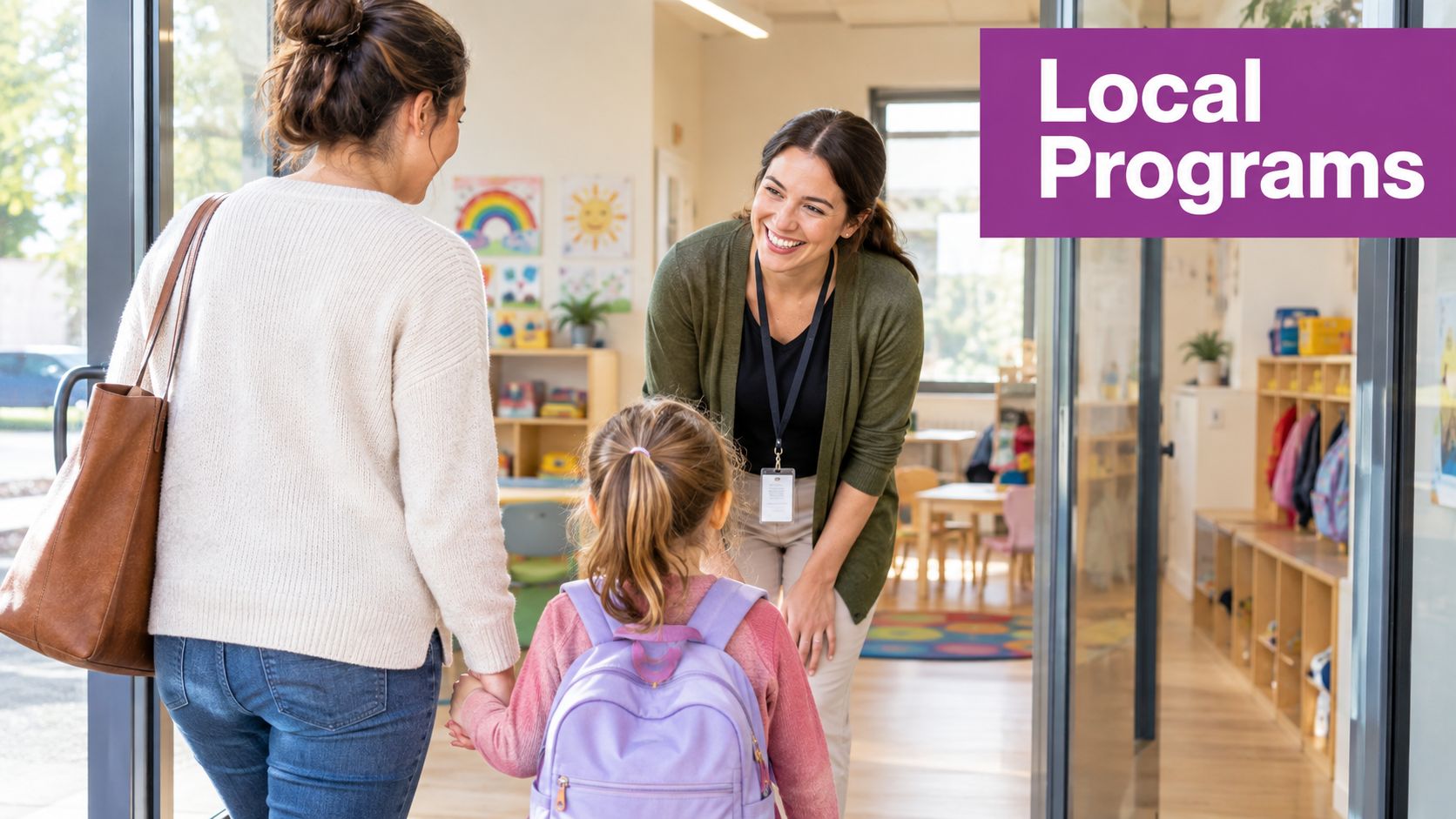
Why local access changes everything
When music is offered where children already are, several friction points shrink at once.
- No extra transport puzzle: Families don't need a separate trip across town.
- No abrupt handover to an unfamiliar space: Young children can learn in a setting they already trust.
- More consistent attendance: If music is part of the ordinary week, children are more likely to experience it regularly.
- Better continuity: Educators can build on songs, rhythms, and routines outside the session itself.
That's especially useful for infants, toddlers, and preschoolers, because repetition across the week is what helps learning stick.
A practical example in everyday childcare
In a local early learning context, this can look quite straightforward. Children attend their usual day. Music happens weekly as part of the curriculum. Educators then carry those songs into transitions, movement, group times, and shared routines.
At Kids Club's centres in Springvale South, Dandenong North, and Ferntree Gully, children from six weeks to six years take part in a weekly professional music curriculum included at no extra cost, alongside a Reggio Emilia-inspired approach and learning led by experienced, VIT-registered teachers. That combination matters because music isn't treated as a disconnected extra. It sits within a broader pattern of inquiry, creativity, social learning, and school readiness.
For families, the value is simple. Children get regular, participatory music without another booking to manage, and parents don't have to choose between enrichment and practicality.
Bringing Music Learning Together for Confident Next Steps
When parents look into music, they often start with one question and end up with three more. Is my child too young? Does it need to be formal? Will it help, or is it just a fun extra?
The clearest answer is this. For young children, music works best when it is regular, participatory, and woven into everyday learning. A child doesn't need a perfect singing voice, an instrument, or long attention span to benefit. They need chances to hear patterns, join actions, repeat songs, and feel safe enough to participate in their own way.
That's also why format matters. The right option is often the one a family can keep going with. Weekly in-centre music can solve problems that stand-alone lessons sometimes create for busy households, especially when cost, transport, and timing are already tight.
A good final check is to ask yourself:
- Will my child experience music regularly enough to become familiar with it?
- Will they be actively involved rather than just entertained?
- Will this fit our family week without becoming stressful?
- Do the adults seem capable, warm, and intentional?
The strongest early music experiences are usually the ones children can count on. Same welcoming rhythm, same chance to join in, and enough repetition for confidence to grow.
If you're comparing options, visit, observe, and trust what you see. Notice whether children look comfortable. Notice whether the session has flow. Notice whether the music invites connection, not pressure.
That kind of music learning doesn't just fill time. It helps children find their voice, their rhythm, and their place in the group.
If you're looking for a practical local option, Kids Club Early Learning Centre offers weekly professional music as part of its everyday early learning program for children from six weeks to six years. Families can visit a centre, see how music is embedded into the week, and decide whether that steady, in-centre approach fits their child and routine.